

What if reviewing a freight invoice could do more than flag a billing discrepancy? For Canadian shippers, freight spend management consulting Canada can connect invoice checks with shipment records, carrier coordination and planning decisions. When those details are difficult to reconcile, it can be hard to tell whether an issue stems from billing or from how freight is being moved.
This guide explains the stages and scope of freight audit and payment services, from invoice validation and payment controls to shipment-level analysis. You’ll learn how to compare consulting approaches using practical operational criteria and turn audit observations into better-informed decisions about shipments, carriers and internal processes. Dubo International Logistics provides logistics consulting and coordinates freight across Canada and North America, bringing an end-to-end perspective to freight management. As a member of the Canadian International Freight Forwarders Association (CIFFA), Dubo understands the practical realities of moving cargo. Learn more about Dubo International Logistics.
Key Takeaways
- Freight spend management consulting Canada can connect invoice observations with shipment activity, helping teams investigate patterns beyond invoice totals.
- A clear audit workflow moves from defining the review scope to matching records, examining exceptions and reporting useful patterns.
- Compare consulting approaches by their data requirements, review cadence, reporting and ability to connect findings to operational decisions.
- Prepare for an engagement by setting objectives, organizing shipment records, assigning owners and documenting how exceptions are handled.
- Explore how Dubo International Logistics connects logistics consulting and freight forwarding with carrier coordination and shipment planning.
Why freight spend management consulting in Canada starts with visibility
Freight spend is more than the amount recorded on invoices. To understand what drives it, Canadian shippers need to connect each charge to the shipment, supporting records and decisions that shaped the movement. A freight spend management consulting Canada engagement can organize this analysis and help teams distinguish billing exceptions from operational patterns.
A freight audit checks whether charges match shipment records and agreed terms. Freight spend management consulting uses those findings alongside operational information to inform broader decisions. An audit can identify discrepancies, but it does not explain their cause or determine the right response on its own. Freight forwarding coordinates cargo movement and carriers, while consulting can relate freight observations to planning and coordination. These activities are connected, but they have distinct roles.
What freight audit and payment services examine
A freight audit compares invoices with shipment records, agreed terms and available supporting documents. The review may flag duplicate invoices, charges that appear inconsistent with agreed terms or missing shipment details that prevent a transaction from being matched confidently. This aligns with the basic purpose of a freight audit: examining freight bills for accuracy.
Exceptions need context before they prompt a change. A charge that looks unusual may relate to shipment characteristics or a service detail recorded elsewhere. Trace the discrepancy to its shipment and documentation, then assess whether it reflects a billing issue, incomplete information or an operational cause before changing a carrier or route.
When Canadian businesses consider outside consulting
Outside consulting may help when discrepancies recur, shipment records are fragmented or internal teams cannot maintain a consistent review process alongside their other responsibilities. A defined method organizes the evidence and assigns follow-up, instead of leaving exceptions unresolved between finance and logistics.
Coordination can become more demanding when shipments move across multiple modes and carriers, including on cross-border routes. Different records and handoffs can make activity harder to compare and obscure how an invoice observation relates to the shipment plan. For a broader view of how planning and coordination fit together, see the end-to-end freight management guide.
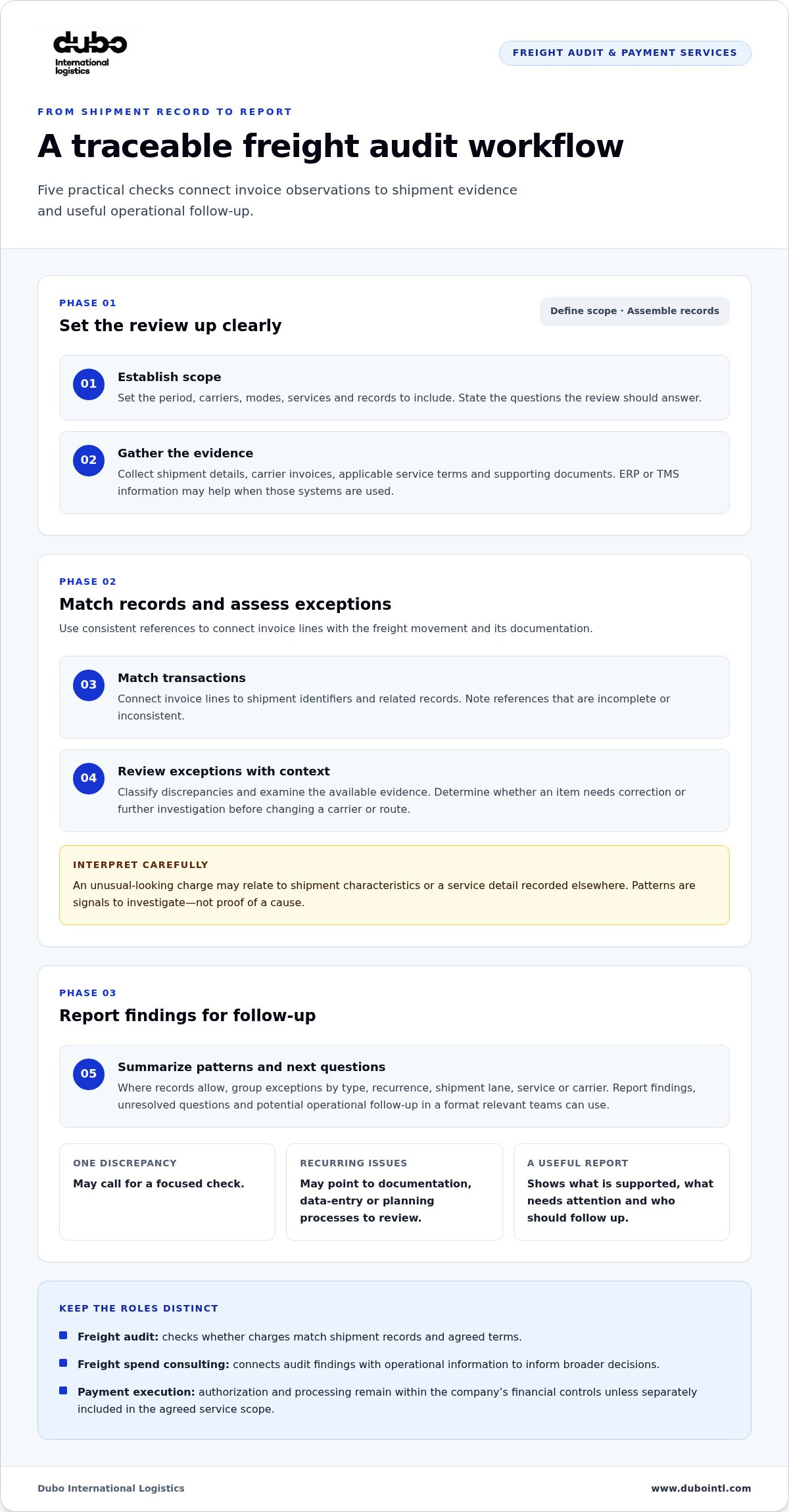
How freight audit and payment services work from shipment record to report
A useful review follows a traceable path from the original shipment record to a clear report. The scope varies by operation, but the process should show which records were compared, how exceptions were assessed and what decisions need follow-up. Freight spend management consulting Canada can connect this review to broader freight planning without treating an audit as a payment platform.
Start by aligning shipment details, carrier invoices, applicable service terms and available supporting documents. Use consistent references to connect each record to the freight movement. Shipment numbers, carrier references and invoice fields need consistent handling. If the same movement appears under different identifiers, matching may require manual review. Missing information can also make a charge difficult to assess confidently.
A practical review workflow
- Establish scope: Set the period, carriers, modes, services and records to include, along with the questions the review should answer.
- Gather records: Collect relevant shipment details, invoices, service terms and supporting documents. ERP or TMS information may help if the business uses those systems.
- Match transactions: Connect invoice lines with shipment identifiers and related records, noting incomplete or inconsistent references.
- Review exceptions: Classify discrepancies and examine the available evidence before deciding whether an item needs correction or further investigation.
- Report patterns: Summarize findings, unresolved questions and potential operational follow-up in a format relevant teams can use.
Audit controls and reporting are distinct from payment execution. A review can document which items appear supported, which need attention and who should follow up. Payment authorization and processing remain part of the company’s financial controls unless separately included in the agreed service scope. Defining these boundaries prevents an audit report from being mistaken for payment approval.
From exceptions to operational findings
Where the records allow, group exceptions by type, recurrence, shipment lane, service or carrier. A single discrepancy may call for a focused check. Repeated issues tied to similar movements may point to a documentation, data-entry or planning process that deserves closer review. Patterns are signals to investigate, not proof of a cause. The freight documentation services guide offers related context on keeping shipment records organized.
For a broader view of how logistics coordination connects with shipment planning, explore Dubo’s expedited logistics services. Learn more about Dubo International Logistics at www.dubointl.com.
How to compare freight spend management consulting approaches
Compare the work behind the report, not just how the report looks. An invoice-only review can flag a charge for investigation. A broader approach connects exceptions with shipment details, carrier activity and planning decisions while distinguishing findings from assumptions. A discrepancy should not automatically be treated as an error or a guaranteed recovery.
Use these criteria to clarify the scope and responsibilities before work begins:
| Comparison point | Invoice-focused review | Operationally connected analysis |
|---|---|---|
| Scope | Checks invoices against available shipment records and terms. | Also considers how exceptions relate to carrier, service or shipment decisions. |
| Data requirements | Centres on invoices and records needed to match charges. | May include shipment references and other operational information relevant to the review. |
| Review cadence | Defines when invoices or a selected group of transactions are examined. | Sets a cadence suited to identifying patterns over time. |
| Reporting | Lists items requiring review or clarification. | Can distinguish recurring patterns from isolated invoice questions where data permits. |
| Operational follow-through | Routes invoice questions for resolution. | Connects findings with internal finance and logistics owners for further assessment. |
Compare audit scope, ownership and reporting
Agree on who organizes records, categorizes exceptions, presents findings and decides what happens next. Documenting these responsibilities helps distinguish a consultant’s review from internal finance approval. Reports should separate a single invoice question from a repeated pattern, show the evidence behind each finding and identify what remains unresolved.
If the engagement includes review or reporting timelines, service level agreements (SLAs) can record those expectations. Define each deliverable and responsibility clearly. An SLA does not establish that a discrepancy is an error or that a particular outcome will follow.
Check operational fit across freight services
Review categories should reflect the operation. LTL freight shipping, other shipment types, cross-border movements and specialized cargo may require different fields or context to interpret records accurately. Using one grouping for every movement can hide meaningful differences between services. For broader coordination context, see the North American freight forwarding guide.
For external context on Canadian transportation modes, Statistics Canada’s Transportation Data and Information Hub provides transportation information. It can help frame industry-level context, but shipment-level evidence is still needed to assess a particular invoice or operation. Learn about Dubo’s logistics consulting and freight planning at www.dubointl.com.
How to prepare for a freight audit and payment consulting engagement
Good preparation gives a review a clear purpose and makes its findings easier to act on. For freight spend management consulting Canada, the scope should reflect the shipment mix, systems, carrier arrangements and internal capacity available for the work. A defined process also helps prevent incomplete records from being mistaken for evidence of a billing error.
Set objectives and organize shipment information
Start by identifying the decisions the review should support. These may include strengthening invoice controls, clarifying exception ownership or informing carrier coordination. Then agree on the review boundaries, assemble relevant records and document the current process before analysis begins.
- Define objectives: State the questions the review should answer and the business decisions it should inform.
- Identify records: Gather available shipment details, carrier invoices, service terms and reporting requirements.
- Agree on boundaries: Specify the shipments, carriers, services or period in scope based on the operation’s needs.
- Assign owners: Name the people responsible for supplying records, reviewing exceptions and approving internal actions.
- Set reporting needs: Decide how findings and unresolved questions should be presented to the business.
Record known data gaps and differences in identifiers. A missing field is a reason to investigate or improve record handling, not proof that a charge is incorrect.
Turn findings into ongoing freight controls
Before the review starts, document who handles exceptions, records decisions and monitors recurring patterns. This clarifies the handoff between logistics and finance. Choose reporting measures that match the objectives and the information available, such as exception categories, resolution status or recurring questions. Avoid measures the records cannot support.
Use the findings to identify processes that may need attention, assign follow-up and check whether the same issue appears again. Analysis should inform decisions, not replace operational judgement. For a broader view of how this work can connect to supply-chain planning, see the guide to logistics consulting in Canada.
Dubo International Logistics provides logistics consulting that connects freight observations with shipment planning and carrier coordination. Learn about Dubo’s logistics consulting.
How Dubo’s logistics consulting connects freight spend with shipment decisions
Freight findings are most useful when considered alongside the movement they relate to. A charge or shipment-record discrepancy may raise a question, but the answer can depend on the service selected, carrier coordination and the shipment’s requirements. Dubo International Logistics brings logistics consulting and freight forwarding together, helping businesses relate freight observations to practical planning and coordination decisions.
This is a logistics partnership, not a standalone audit or payment platform. Dubo’s role is to understand the operating context and connect freight management observations with cargo movement across Canada and North America. The approach is tailored to the business’s requirements, rather than relying on a fixed checklist or assuming that the same finding calls for the same action in every operation.
Connect freight review with end-to-end coordination
Reviewing a shipment in context helps teams consider whether an invoice observation is isolated or relates to a broader coordination question. For example, a business may examine how its chosen service and carrier arrangements fit its shipment needs before adjusting its planning process. The finding informs the discussion; it does not guarantee a financial result or dictate a carrier change.
For time-sensitive freight, shipment planning may include consideration of expedited transport services. The right service depends on the shipment’s requirements. More broadly, freight spend management consulting Canada can connect analysis with logistics decisions while keeping invoice review, payment execution and freight coordination distinct.
Dubo International Logistics is a member of the Canadian International Freight Forwarders Association (CIFFA), a professional association for freight forwarders in Canada. This membership is one trust point alongside a consultative approach focused on understanding the operation and its freight requirements.
Choose a practical next step with Dubo
To start a useful discussion, outline your freight flows, the questions you want a review to answer and the coordination challenges your team is addressing. Sharing how shipment planning and carrier communication currently fit together can help define the consulting scope. Dubo tailors logistics consulting to each business’s operational requirements, connecting freight management priorities with shipment planning and coordination.
Learn about Dubo’s freight management support.
Turn freight findings into clearer decisions
Freight spend is easier to manage when invoice checks connect with shipment records and operational context. A defined review scope, consistent data and clear follow-up responsibilities help teams distinguish isolated questions from patterns that may warrant closer attention. Findings are most useful when they inform carrier coordination and shipment planning, rather than sitting apart from day-to-day freight decisions.
For Canadian shippers considering freight spend management consulting Canada, the right support should fit the operation’s freight flows, records and internal capacity. Dubo International Logistics provides logistics consulting and coordinates freight movement across North America, bringing those operational perspectives together. Dubo is a member of the Canadian International Freight Forwarders Association (CIFFA).
Prepare a clear outline of your freight flows and the questions your team wants to resolve. Learn more about Dubo International Logistics and its logistics consulting services.
Frequently Asked Questions
What are freight audit and payment services?
Freight audit and payment services check freight invoices against shipment records, agreed service terms and available supporting documents, then record exceptions for follow-up. The audit assesses whether charges appear consistent with the evidence; payment controls guide review and authorization within the shipper’s process. A review can produce findings and reports, but a difference alone does not prove an error or guarantee a recovery.
How does freight spend management consulting work in Canada?
Freight spend management consulting Canada typically starts by defining the review’s objectives and scope, then organizing relevant shipment and invoice information. The analysis can identify exceptions and recurring patterns for teams to assess in the context of carrier arrangements and shipment planning. The work should clarify responsibilities, reporting expectations and next steps so findings can inform operational decisions rather than remain in a finance report.
Can freight invoice audits identify duplicate or incorrect charges?
Yes. Comparing invoices with shipment records and supporting documents can flag potential duplicate invoices, charges that do not appear to match agreed terms or missing shipment details. Review each exception before classifying or acting on it. An apparent mismatch may reflect incomplete records rather than an incorrect charge. Trace the item to the shipment and available evidence, then document the outcome and any follow-up.
What information is needed for a freight audit?
Useful records can include shipment details and identifiers, carrier invoices, applicable service terms and supporting carrier documents. Internal reference data can also help link records across teams or systems. The exact information depends on the review scope and the records the business maintains. Consistent shipment references make matching easier. Document known gaps as limitations to investigate, not as evidence that an invoice is wrong.
How should a business compare freight audit and payment consultants?
Compare the engagement scope, data requirements, review cadence, reporting format and operational follow-through. Clarify who organizes records, categorizes exceptions and presents findings, and how those responsibilities relate to your finance team’s approval process. Consider whether the review only flags invoice questions or also helps interpret patterns alongside shipment and carrier context. Clear deliverables and boundaries make it easier to judge whether the approach fits your operation.
What happens if freight invoices do not match shipment records?
Record and investigate a mismatch before taking action. Check whether the shipment identifier, invoice details and available supporting documents refer to the same movement, then identify missing or inconsistent information. The exception may require clarification, correction or an update to record-handling procedures. Assign an owner to document the review and resolution so similar questions can be assessed consistently.
Can freight spend consulting help with cross-border shipments?
Yes. Consulting can help businesses review freight records for cross-border movements and relate invoice observations to carrier coordination, shipment planning and available documentation. The review can account for different services and handoffs without assuming every discrepancy has the same cause. Dubo International Logistics coordinates freight movement across North America and provides logistics consulting. Discuss your freight management requirements with Dubo International Logistics.
