

What if the most expensive item in your 2026 shipping budget isn't the product itself, but the empty space surrounding it? It's a frustrating reality for many Canadian businesses that discover their invoices don't match their scale readings. You've likely felt the sting of hidden volumetric fees that disrupt your financial forecasting and erode your margins. Relying on a precise dimensional weight calculator Canada isn't just a convenience; it's a strategic necessity for maintaining a predictable bottom line in a market where road freight demand continues to climb.
This guide will help you master the complexities of volumetric pricing to ensure precision in your shipping budget and optimize your North American supply chain. We'll examine the specific 2026 DIM factors for major carriers like FedEx and Canada Post, identify strategies to reduce package volume, and explain how a partnership with a forwarder like Dubo International Logistics at www.dubointl.com provides the transparency your operations require. By understanding the methodology behind these calculations, you can transform your logistics from a source of uncertainty into a pillar of operational excellence and fiscal stability.
Key Takeaways
- Understand the distinction between actual mass and volumetric space to ensure your shipping budget remains precise and predictable.
- Master the updated 2026 formulas using a dimensional weight calculator Canada to accurately forecast expenses before dispatching your cargo.
- Identify packaging inefficiencies that contribute to empty miles and learn how strategic "right-sizing" protects your margins from hidden fees.
- Manage the variations in DIM factors across major North American carriers with professional guidance and strategic contract negotiation.
- Secure peace of mind by partnering with a CIFFA-certified expert like Dubo International Logistics at www.dubointl.com for end-to-end freight management.
Understanding the Impact of Dimensional Weight on Canadian Shipping Costs
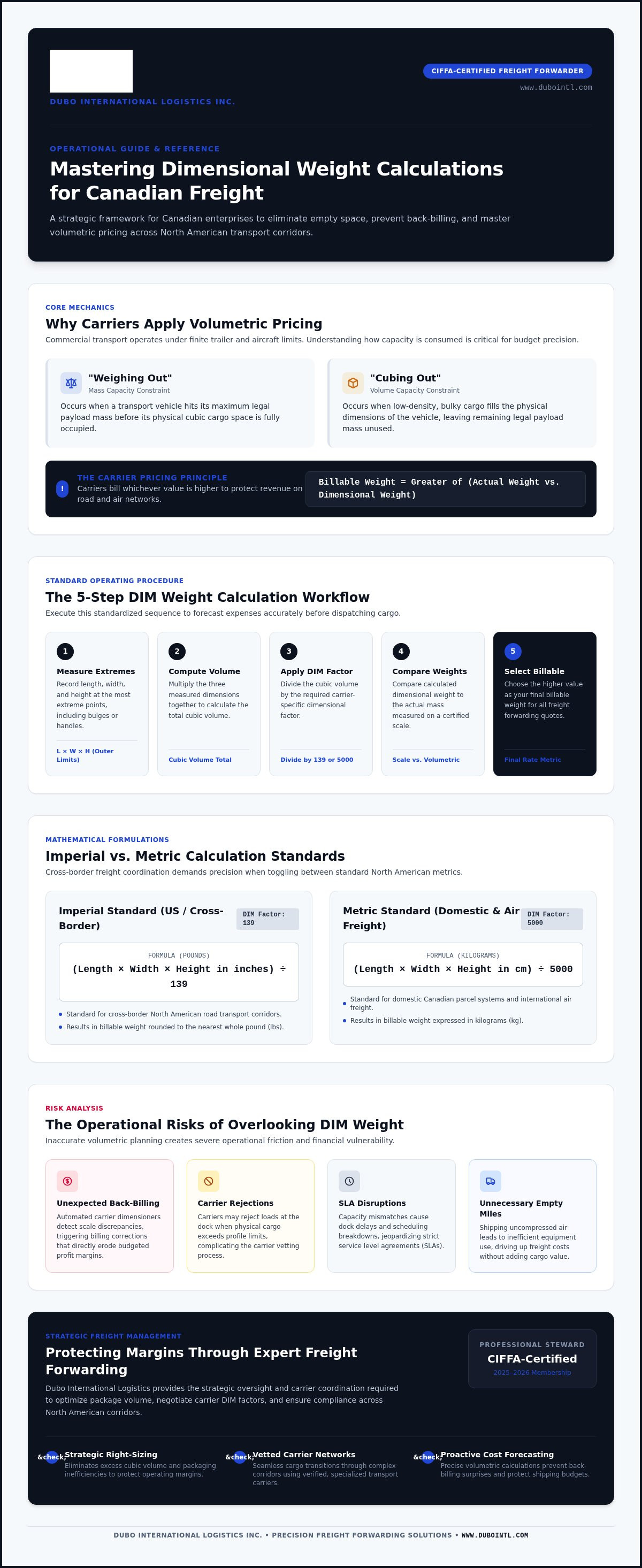
Logistics is a game of geometry as much as it is a game of mass. For many Canadian enterprises, shipping costs aren't merely determined by the reading on a warehouse scale. Carriers apply a technique known as dimensional weight to account for the physical space a package occupies within their network. Understanding the Impact of Dimensional Weight is the first step toward reclaiming control over your logistics budget. By using a precise dimensional weight calculator Canada, shippers can identify the billable weight of their cargo, which is the higher value between the actual weight and the calculated volumetric weight. This distinction is vital for those moving lightweight but bulky items across the vast North American corridors where fuel and space are premium commodities.
Why Carriers Use Volumetric Pricing
Trailers and aircraft have finite capacities. A carrier might weigh out when a load hits its maximum legal mass, or cube out when the physical space is entirely consumed by low-density items. In a market defined by its volatility, carriers use volumetric pricing to ensure they're compensated for the volume that could've otherwise held denser, more profitable freight. Precision in these measurements isn't just about billing; it prevents disruptions to service level agreements (SLAs) by ensuring every cubic centimetre of a vehicle is accounted for during the planning phase. Reliability depends on this level of detail.
The Consequences of Ignoring DIM Weight
Neglecting these calculations often leads to unwelcome financial surprises. Inaccurate data complicates the carrier vetting process, as transport providers may reject loads that don't fit their equipment profiles once they arrive at the loading dock. Operational friction occurs when cargo exceeds the planned capacity of a truck, causing delays and potential safety risks that undermine the continuity of your supply chain. Perhaps most damaging is unexpected back-billing. If your internal data doesn't match the carrier's automated dimensioning systems, you'll face billing corrections that instantly erode profit margins.
A dedicated freight forwarder acts as a logistics architect, bridging the gap between your inventory and these complex pricing models. By integrating strategic coordination and expert oversight, firms like Dubo International Logistics ensure your freight transitions seamlessly through complex corridors. You can explore their specialized services at www.dubointl.com to see how professional management mitigates these risks. Precision is the cornerstone of reliability, and mastering these metrics is the only way to protect your bottom line.
The Mathematical Formula: How to Calculate Dimensional Weight in Canada
Precision in logistics begins with a tape measure and a clear understanding of carrier requirements. While the concept of volumetric pricing might seem abstract, the calculation itself follows a rigid, logical sequence. By using a dimensional weight calculator Canada, you can transform physical dimensions into a billable metric that aligns with carrier expectations. The process follows these five essential steps to ensure your shipping budget remains intact.
- Step 1: Measure the length, width, and height of the package at its most extreme points, including any bulges or handles.
- Step 2: Multiply these three dimensions together to determine the total cubic volume of the shipment.
- Step 3: Divide the resulting volume by the carrier-specific DIM factor, such as 139 for imperial or 5000 for metric.
- Step 4: Compare this calculated dimensional weight to the actual weight recorded on a certified scale.
- Step 5: Select the higher of the two values to serve as your billable weight for all freight forwarding quotes.
Imperial vs. Metric Calculations
Canadian businesses must be adept at toggling between measurement systems, especially when coordinating cross-border movements. For imperial measurements, the formula is (L x W x H in inches) divided by 139 to find the weight in pounds. When working with metric units, which are standard for domestic parcel services and international air freight, you multiply the dimensions in centimetres and divide by 5000 to find the weight in kilograms. Some services, like Canada Post Regular Parcel, may use a divisor of 6000. Choosing the correct formula depends entirely on your carrier's specific tariff and whether your cargo is staying within the country or crossing the border.
Calculating for Irregular and Specialized Cargo
Specialized transportation often involves out-of-gauge machinery or delicate equipment that does not fit neatly into a standard corrugated box. In these instances, you must measure the "envelope" of the item, treating the irregular shape as if it were encased in a rectangular box. It is also vital to account for the thickness of customized crating. A heavy-duty wooden crate can add several centimetres to every dimension, significantly impacting the volumetric calculation. For complex projects involving large-scale stamping presses or fragile assembly tools, the margin for error is slim. You might benefit from consulting with a logistics architect to verify these measurements before booking. Expert oversight ensures that specialized transport projects remain compliant and cost-effective, particularly when managed within an LTL framework. You can find more details on coordinating these complex movements at www.dubointl.com.
Comparing DIM Factors Across Major North American Carriers
While the basic arithmetic of volume remains constant, the divisors applied by carriers are far from uniform. A reliable dimensional weight calculator Canada is only as accurate as the specific DIM factor you input for each provider. Major parcel carriers like FedEx, UPS, and Purolator typically use a standard factor of 139 for imperial units, yet these figures are not static. In the context of carrier contract negotiation services, these factors often serve as a primary mechanism for reducing total landed costs. Sophisticated shippers recognize that service level agreements (SLAs) contain the minute details that dictate whether a shipment is billed at its actual mass or a volumetric premium.
Parcel vs. LTL Dimensional Weight
Parcel shipping and LTL freight shipping operate on different density scales. While parcel carriers use the 139 factor, Canadian LTL providers often implement a density rule of 10 pounds per cubic foot. This shift reflects the operational reality of sharing trailer capacity across multiple shippers. In the trucking industry, density-based freight classes act as the senior counterpart to dimensional weight, categorizing cargo by how much space it consumes relative to its weight and handling requirements. For those moving heavy assembly tools or large-scale stamping presses, understanding these density thresholds is essential for maintaining precision in logistics planning.
Cross-Border Factors for Canada-USA Shipping
Corridors between Canada and the United States often introduce different volumetric rules than those found in domestic transit. As cargo crosses international borders, the smoothness of the transition depends on rigorous compliance and strategic foresight. Factors can shift significantly when moving from a domestic ground network to an international express corridor. Ensuring CUSMA certification is in place helps avoid delays, but managing the volumetric pricing requires a partner who understands the nuances of North American trade. You can learn more about these complexities in our guide to Cross-Border Freight Forwarding: Navigating Canada-USA Logistics in 2026.
Partnering with a CIFFA-certified freight forwarder like Dubo International Logistics provides the expertise needed to navigate these inconsistent factors. Whether you are moving fragile equipment or temperature-sensitive products, specialized cargo expertise ensures that your billable weight is calculated correctly the first time. Visit www.dubointl.com to explore how proactive planning secures your supply chain against unpredictable fees. Reliability is the cornerstone of a successful partnership, and precision in these metrics is where that trust begins.
Strategic Packaging: Reducing Volumetric Weight to Protect Your Bottom Line
Controlling logistics costs requires more than just negotiating carrier rates; it demands a proactive approach to the physical design of your shipments. Shippers often lose significant portions of their budget to the expense of shipping air, an inefficiency that populates transport networks with empty miles and unnecessary costs. Adopting a logistics architect approach to packaging design allows you to evaluate your supply chain with mathematical precision. By utilizing targeted logistics consulting, businesses can systematically identify systemic inefficiencies that standard operations overlook, ensuring that every cubic centimetre of cargo space is maximized.
Right-Sizing and Customized Crating
Purpose-built packaging stands as the most effective defense against the aggressive application of the DIM divisor. When moving out-of-gauge machinery or delicate equipment, standard off-the-shelf boxes inevitably create empty spaces that expand your billable weight when processed through a dimensional weight calculator Canada. Customized crating solves this challenge by engineering containers that match the exact contours of the product, balancing maximum structural protection with minimal total volume. For high-value or temperature-sensitive products, integrating enregistreurs de données into these leaner, customized configurations allows quality assurance teams to monitor environmental conditions continuously without relying on bulky, oversized protective layers.
Consolidation and LTL Strategies
Density is your greatest asset when combating volumetric pricing models. Grouping multiple smaller, low-density shipments into a single, unified consignment significantly improves the overall density profile of the cargo, shifting the balance back toward actual mass. Managing specialized transport projects within an LTL framework allows shippers to share trailer capacity effectively, mitigating the premium costs associated with oversized or irregular freight. This strategic logistics planning aligns your distribution schedules with Just-in-Time systems, ensuring that components arrive precisely when needed while keeping your package volumes lean and your supply chain highly integrated.
Achieving this level of operational efficiency requires an experienced partner who views logistics through a consultative lens rather than a transactional one. The specialists at Dubo International Logistics work closely with your team to audit packaging dimensions and streamline cross-border movement across North America. To transform your supply chain metrics and eliminate hidden volumetric fees, partner with our logistics consulting experts today at www.dubointl.com. Precision in packaging design establishes the foundation for long-term fiscal predictability and operational resilience.
Navigating Complex Logistics with Expert Freight Management
Mastering the mathematical side of shipping is only half the battle. While a dimensional weight calculator Canada provides the necessary data, implementing that information into a resilient supply chain requires a partner who understands the grand scale of global movement. Dubo International Logistics positions itself as a logistics architect, ensuring that your cargo transitions smoothly across North American borders. By choosing an expert partner for end-to-end freight management, you eliminate the stress of hidden volumetric fees and inconsistent carrier policies. Precision remains the cornerstone of reliability, and our team acts as a protective steward of your interests from dispatch to delivery.
The Value of CIFFA Certification
In the complex landscape of 2026 logistics, certification isn't just a badge; it's a commitment to professional excellence. As a CIFFA-certified freight forwarder for 2025-2026, Dubo adheres to the highest standards of the Canadian International Freight Forwarders Association. This membership ensures that your shipments are managed with ethical precision and strategic foresight. It provides a stabilizing force in a market defined by its volatility. For a deeper look at how these standards benefit your operations, read our End-to-End Freight Management: A Strategic Guide for Canadian Businesses. Trusting a certified partner means your compliance and documentation needs are handled with meticulous care.
Seamless Transitions for Specialized Cargo
Specialized transportation requires a level of detail that standard parcel carriers simply cannot provide. Whether you're moving oversized machinery, large-scale stamping presses, or heavy assembly tools, the complexity of the corridor requires expert coordination. We excel at creating seamless freight transitions for out-of-gauge equipment that doesn't fit a standard dimensional weight calculator Canada profile. Our nationwide coverage across Canada and the United States ensures that your specialized cargo reaches its destination safely and on time. We manage the minute details of individual client needs while maintaining a focus on the grand scale of North American trade.
True peace of mind comes from knowing your logistics partner is as dedicated to your bottom line as you are. We invite you to consult with our seasoned experts to develop bespoke solutions for your most challenging freight requirements. Visit www.dubointl.com today to optimize your logistics strategy and secure your North American supply chain. Let us act as your dedicated guide through the complexities of global trade, providing the continuity and security your business deserves.
Securing Volumetric Precision for Your 2026 Supply Chain
Mastering the nuances of volumetric pricing is essential for any Canadian business looking to maintain fiscal stability in a volatile market. By moving beyond simple measurements and adopting a strategic logistics architect mindset, you can eliminate the costs of shipping air and protect your margins from unexpected billable weight corrections. A reliable dimensional weight calculator Canada serves as your primary tool for forecasting, but the real value lies in how you apply those metrics to your packaging and consolidation strategies to improve overall cargo density.
True operational resilience requires a partner who understands the minute details of North American project-cargo logistics. As a CIFFA-certified member for 2025-2026, Dubo International Logistics provides the strategic foresight and specialized expertise needed to navigate complex corridors with quiet confidence. Whether you're moving out-of-gauge machinery or utilizing our verified dangerous-goods carrier network, we ensure every transition is seamless and compliant. You don't have to manage these complexities alone. To ensure your shipping budget remains precise and your supply chain stays optimized, Consult a Dubo Logistics Expert for a Precise Freight Quote today at www.dubointl.com. Let's build a more efficient future for your freight together.
Frequently Asked Questions
What is the standard dimensional weight factor in Canada for 2026?
The standard dimensional weight factor for most Canadian parcel carriers in 2026 is 139 for imperial measurements and 5000 for metric units. This means carriers divide the total cubic volume of a package by these divisors to determine its volumetric mass. While these are the common benchmarks for FedEx and UPS, Canada Post may apply a factor of 166 for domestic regular parcel services. You should always verify these factors within your specific service level agreement to ensure your budget remains precise.
How does dimensional weight differ between LTL and parcel shipping?
Parcel shipping generally relies on a fixed divisor like 139 to calculate volumetric weight, whereas LTL freight shipping often utilizes density-based pricing. In the Canadian market, LTL providers frequently apply a standard density rule of 10 pounds per cubic foot. This rule acts as a threshold for determining if a shipment is billed by its actual mass or its physical volume. Understanding this distinction is critical for businesses using a dimensional weight calculator Canada to manage larger freight consignments across North America.
Can I negotiate the DIM factor with my freight forwarder?
You can certainly negotiate the DIM factor as part of your carrier contract negotiation services to protect your bottom line. A higher divisor results in a lower billable weight, which is particularly beneficial for businesses shipping low-density or bulky items. Experienced partners like Dubo International Logistics leverage industry relationships to secure more favourable factors for their clients. This proactive planning ensures that your logistics strategy remains competitive and tailored to your specific product density and total shipping volume.
What happens if I provide the wrong dimensions on my shipping documents?
Providing incorrect dimensions on your shipping documents leads to automated billing corrections and potential delays in your supply chain. Most modern Canadian hubs use automated dimensioning systems to capture precise measurements during transit. If these readings don't match your paperwork, the carrier will apply back-billing fees that instantly erode your profit margins. Accuracy in documentation is the cornerstone of reliability, preventing operational friction and ensuring your cargo moves through complex corridors without unnecessary administrative interruptions or cost overruns.
Does dimensional weight apply to international air freight from Canada?
Dimensional weight applies to almost all international air freight departing from Canada because carriers must maximize their limited cargo space efficiently. The international standard divisor is typically 5000 when using metric measurements, though some express carriers might apply different factors for premium services. Proactive management of these volumetric costs is essential for maintaining a predictable international shipping budget. You can find specialized support for these global movements by visiting www.dubointl.com to consult with our seasoned logistics team.
How do I calculate DIM weight for a pallet instead of a box?
To calculate the dimensional weight for a pallet, you must measure to the extreme points of the cargo, including any overhang or the pallet height itself. Multiply the length, width, and height in inches, then divide by the LTL density factor or the parcel divisor depending on the service level. If the cargo is irregular, treat it as if it were encased in a rectangular box. Precision here prevents service disruptions and ensures you receive accurate freight forwarding quotes for your shipments.
Are there items that are exempt from dimensional weight calculations?
No specific categories of items are universally exempt, but products with high density often bypass volumetric charges because their actual mass exceeds their calculated dimensional weight. In these cases, the carrier simply bills based on the scale reading rather than the volume. However, specialized transportation for out-of-gauge machinery or heavy assembly tools may follow different pricing structures entirely. It's always best to consult with a logistics architect to determine how your specific cargo type interacts with current carrier tariff rules.
How can customized crating help me save on volumetric shipping costs?
Customized crating helps you save on volumetric costs by eliminating the empty space associated with standard, oversized packaging. By purpose-building a crate to the exact dimensions of your equipment, you minimize the total cubic volume that a dimensional weight calculator Canada would otherwise inflate. This strategy is particularly effective for fragile or specialized equipment, where you need a balance between maximum protection and lean packaging to optimize your North American supply chain efficiency and reduce total landed costs.
