

A delayed shipment isn’t automatically a failed delivery. Handling freight exceptions means spotting when a shipment deviates from plan, assigning someone to resolve the issue and coordinating next steps using confirmed information.
Delays, damage, loss, shortages and refused deliveries each call for a clear response. A consistent process separates confirmed facts from estimates, records who owns the next action and keeps affected parties informed as the situation changes.
This article explains how freight exception management works in Canada and what consistent resolution involves. You’ll learn how teams assess impact, communicate updates, document decisions and respond to different shipment issues, as well as how a freight partner can coordinate solutions across carriers and shipment legs.
Key Takeaways
- Spot deviations from planned shipment milestones early and assess their effect on delivery commitments and operations.
- Assign a clear owner and next action to each issue, with an escalation path for unresolved problems.
- Keep updates grounded in confirmed events, distinguish estimates from actuals, and set a clear time for the next update.
- Record key decisions and changes so teams can resolve disputes and identify recurring causes.
- Use consistent response workflows for delays, damage, loss, shortages and refused deliveries, adapting each response to the shipment and its needs.
What Is Exception Management in Logistics?
Exception management identifies, prioritizes and resolves deviations from planned logistics operations. In Canada, a weather delay, missed pickup or damaged shipment can disrupt milestones beyond the affected carrier leg.
Causes of Freight Exceptions
A freight exception occurs when a shipment departs from its planned schedule, process, condition or delivery requirements. Weather, incomplete shipment information, freight that isn’t ready, access restrictions and unsuccessful handovers can all cause deviations. A carrier may also report a mechanical issue or appointment requirement. Identifying the cause matters: the right response depends on what changed, which milestone is affected and what information is confirmed.
For example, a weather-related delay differs from a missed pickup caused by freight readiness. In the first case, teams assess route and schedule changes; in the second, they confirm readiness and coordinate a new handover. A missing tracking event alone doesn’t establish the cause. Logistics teams distinguish confirmed events from estimates before deciding what to do.
Operational and Business Impacts
Operational impact is the effect an exception has on transport plans and downstream milestones. A delayed pickup can affect a connection, appointment or receiving schedule, while damage may change how cargo can be handled or delivered. A winter-storm example shows the urgency: reactive freight operations can spend the next 48 hours in damage-control mode.
Teams assess business impact by considering customer commitments, inventory availability and revenue risk. A delayed commercial shipment needed for production, for example, may have greater consequences than freight with a flexible schedule. The response could involve revising an estimated arrival time, adjusting inventory plans or considering another route or mode. Each decision depends on confirmed shipment status and the next operational requirement.
Downstream milestones matter because one late event can affect several parties. A changed arrival estimate may alter a consignee’s receiving plan or a broker’s coordination of other shipment steps. Teams should track which milestones remain achievable, which need revision and who needs an update. This helps contain disruption instead of treating every deviation as an isolated carrier issue.
Customer Impact and Priority Sequencing
Priority sequencing ranks exceptions by urgency and business impact instead of treating every delay as equally serious. Teams consider delivery commitments, inventory needs, revenue exposure and the shipment’s current stage. A shipment tied to an imminent customer commitment may need faster attention than freight with a flexible delivery window.
For example, a missed pickup that affects production readiness may require an immediate review of rebooking options. A minor schedule change that threatens no downstream milestone may only need monitoring and a revised estimate. Priorities can change as carrier updates arrive, so teams reassess impact rather than relying on the initial report.
Clear sequencing also guides communication. Before sharing an update, teams identify the affected shipment, last confirmed event, known cause and operational impact. They distinguish an estimated arrival from an actual event and state when they’ll check again. A check-back time sets an update expectation, not a promise of delivery by then. This helps customers plan while ownership stays focused on the next resolution step.
Escalation, ownership and stakeholder communication
Escalation keeps an unresolved shipment issue moving toward a decision. Clear ownership and structured updates help carriers, shippers and brokers coordinate the next action.
Exception Ownership and Escalation Paths
Exception ownership means assigning one accountable coordinator to track an issue through resolution. That person records shipment status, identifies the next action and involves the party who can take it. Without clear ownership, a carrier, shipper and consignee may each assume someone else is following up.
At booking, teams can define who handles origin readiness, carrier coordination, delivery changes and receipt confirmation. If a pickup is missed, the owner can establish whether the freight was ready, obtain the carrier’s status and coordinate a revised plan. The owner remains responsible for tracking progress, even when another party must complete the action.
Escalation paths identify when an issue moves beyond its first point of contact. One practical rule is to escalate to a carrier account manager after 4 hours of carrier non-response. The exception register can then show the movement reference, issue, assigned owner, next action and current status. This record keeps the escalation connected to the shipment rather than an isolated message.
Claims require a separate assessment from operational recovery. Teams can route a damage or loss claim according to its documented value, available evidence and decision authority. Any financial threshold should come from the organization’s established claims process, not an improvised figure. For example, visible damage may need prompt operational attention while claim documentation follows its designated review path.
Escalation Protocols and Service Metrics
Escalation protocols specify the trigger, recipient and information needed to move an exception to the next decision-maker. They matter because a delay affecting a customer commitment calls for a different response than a routine status query. A protocol can specify which details accompany an escalation, including the affected shipment, last confirmed event, current impact and requested decision.
Service metrics help teams assess whether communication and resolution processes are working. They can review on-time delivery, customer satisfaction and the time taken to resolve exceptions. Metrics are more useful when teams compare recurring causes, such as repeated missed pickups, instead of treating every incident as unrelated.
Updates should separate confirmed events from estimates. If a revised arrival time is shared, record when it was checked and identify its source. For example, don’t report an estimated departure as an actual departure. A stated check-back time sets the next update point; it doesn’t promise departure or delivery by then.
For freight with specialized handling needs, specialized transportation coordination can help align shipment requirements with carrier communication and issue ownership. The escalation record should still name the responsible coordinator, next action and decision needed, so each stakeholder understands the current status.
Exception documentation and process improvement
A clear shipment record links each exception to its evidence, decisions and next action. A freight partner can review recurring causes, adjust processes and track exceptions by shipment to assess performance.
Claims Documentation and Filing Deadlines
Claims documentation records what happened, which cargo was affected and what evidence supports the claim. A consistent file helps teams assess damage or loss and maintain an operational record.
For concealed damage, five days after delivery is described as an industry-standard filing deadline, not a legal deadline. For air freight, the Montreal Convention provides notice periods of 14 days for damage and 21 days for delay.
Record the shipment reference, affected quantity, condition, delivery details and when the issue was identified. Photos of damaged cargo and packaging can support the account, alongside delivery records and relevant carrier correspondence. Keep original documents and later updates together so reviewers can follow how the claim developed.
Deadlines and evidence requirements depend on the claim and transport terms. The exception owner should promptly identify the applicable process and record the filing date, responsible party and outstanding documents. This reduces the risk of mistaking an operational response for a formal claim submission.
Preventing Recurring Exceptions
Process improvement uses exception records to identify recurring causes and change the practices behind them. Repeated issues may stem from freight data, readiness, site processes or planning rather than a single isolated event.
A freight partner can group records by cause, route, terminal or milestone, then review patterns with the relevant parties. For example, repeated missed pickups may reveal a mismatch between stated readiness and actual loading availability. Teams can revise intake questions, operating rules, responsibilities or escalation paths to address the cause.
Exception rates add context to that review. The stated target is fewer than 25 exceptions per 1,000 shipments. To track the measure consistently, count exceptions over the same shipment population and reporting period, then compare results over time. Keep the definition of an exception consistent; otherwise, a changing count may reflect different recording practices rather than improved performance.
Documentation should capture both the initial issue and any corrective action. A useful change log records the previous estimate, current estimate, time of change and information source. When a shipper’s decision or document is needed, the request should state what is required, who must provide it and the operational deadline. These details make the request actionable and clarify how an unresolved item may affect the shipment.
Regular reviews turn exception data into practical adjustments. If repeated issues occur at origin, teams can examine readiness information; if they cluster at a terminal, they can review handover processes. These records help measure whether changes reduce repeat problems and keep future shipment planning grounded in observed patterns.
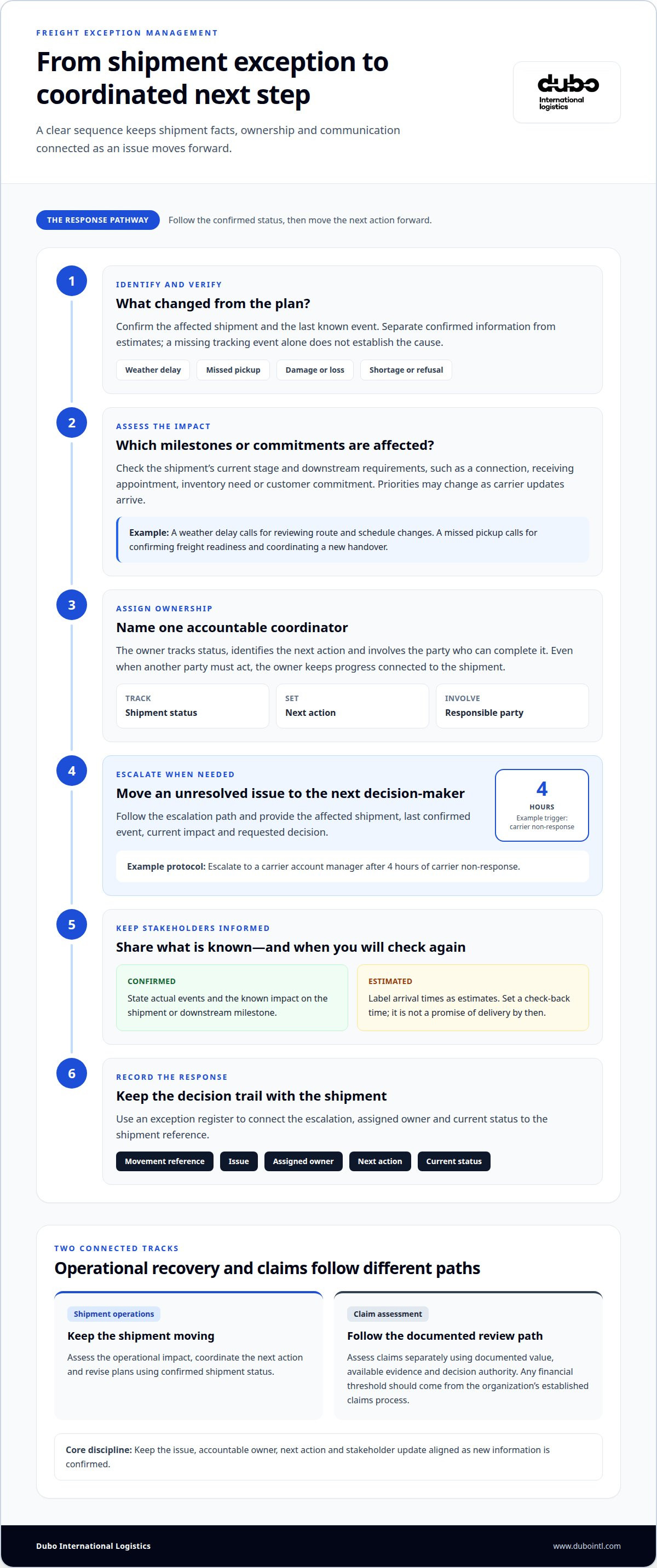
Shipment delay, damage, loss, shortage, and refusal workflows
A freight exception can arise before dispatch, during transit or at final delivery. Handling freight exceptions effectively depends on the shipment’s stage, the confirmed issue and the next operational requirement.
Identifying and Prioritizing Exceptions
Exception identification compares shipment events with planned milestones, such as pickup, transfer and delivery. A missed pickup or a carrier report of damage can trigger a review. Teams prioritize by urgency and business impact, so a shipment affecting a customer commitment receives attention before one with a flexible delivery window.
One exception on a shipment leg doesn’t establish that every unit is delayed, lost or damaged. The owner identifies which pieces and milestones are affected before choosing a response. A missing tracking event alone doesn’t explain why progress stopped, so teams seek a confirmed update before assigning a cause.
Shipment Visibility and Exception Management
Shipment visibility shows location and status information; exception management determines what action to take when a milestone fails. A location update, for example, may show freight at a terminal, while a workflow addresses a missed connection and its effect on the next delivery.
Carrier status feeds and operational milestones can help teams detect changes across transport legs. They then assess the affected shipment, confirm the last completed event and identify what needs attention. A revised estimated arrival time should include when it was checked, keeping an estimate distinct from an actual delivery event.
Shipper Actions When Exceptions Occur
When an exception occurs, the freight partner identifies the affected shipment, confirms the last known event, assigns an owner and coordinates the next action. The shipper can support the response by providing the shipment reference, affected quantity, relevant contacts and any requested decision or document.
The update should explain the confirmed issue, operational impact, current estimate, required shipper input and next update time. For example, if delivery is refused because the receiving site cannot accept the load, the partner needs the reason and revised receiving instructions to coordinate another handover. Consistent handling of freight exceptions also means recording the outcome and any outstanding action.
Before dispatch, incomplete shipment details or freight that isn’t ready can prevent pickup. At booking, teams capture the description, quantity, dimensions, weight, packaging, handling needs, origin, destination, contacts, access conditions and timing requirements. These details help identify readiness gaps before the carrier arrives.
In transit, weather, mechanical issues or an unsuccessful transfer can disrupt a planned movement. Teams verify the carrier’s reported cause, assess rerouting or another mode, and communicate changes to affected parties. A delay on one leg doesn’t automatically mean the entire shipment has failed.
At customs or final mile, a status delay, appointment requirement, access issue, shortage or refusal needs a response suited to the specific event. Teams record what arrived, what remains outstanding and whether delivery can proceed. For reported damage, they document the affected cargo and coordinate the appropriate next action before closing the shipment record.
Accountability and standardized resolution workflows
A consistent workflow assigns responsibility before an exception disrupts a planned shipment. It connects the shipment’s lifecycle stage, issue category, owner and next action, giving each decision a clear operational path.
Accountability starts when the shipment is created, not after a delay. Teams assign responsibility for confirming freight readiness, checking transport details, communicating changes and closing the task after receipt. For a container shipment, for example, the workflow can identify who confirms readiness at origin, tracks the planned handover and records delivery completion. Clear assignments prevent tasks from falling between parties.
Standardized categories help determine the appropriate response. Teams can distinguish incomplete information, freight not ready, access issues, timing changes, damage concerns and unsuccessful handovers. Each category needs a defined response path, but the shipment’s lifecycle phase matters too. A missing document before dispatch calls for a different action than a missed delivery after several transport legs.
For each exception, the operational record should link the issue to an owner, next action, current status and escalation route. A customs milestone, for instance, may require the responsible party to clarify which document or decision remains outstanding. The workflow should identify who supplies it, who coordinates the next movement and how a delay affects later milestones. This supports clear accountability without treating every issue as a carrier failure.
Resolution standards give teams a way to assess whether the process is working. A stated target mean exception resolution time is less than 72 hours. Teams can review resolution time alongside recurring exception types and shipment outcomes, then assess whether a process change addresses the underlying issue. The target is a performance measure, not a promise that every individual shipment issue will close within that period.
Workflows also need room for informed decisions. If a damage report changes handling requirements, the owner records the revised instruction and communicates it to affected parties. If a delivery appointment changes, the record should show who approved the new plan and which downstream milestone needs adjustment. The relevant process should reflect regulatory requirements and shipment-specific documentation rather than assume they are identical across cargo types.
Regular reviews can reveal unclear ownership, repeated handover gaps or missing shipment information. A logistics consulting engagement can help map responsibilities and refine resolution workflows around the operation’s needs. Discuss logistics consulting to develop a clearer accountability framework.
Dubo International Logistics: Freight forwarding
Dubo International Logistics coordinates freight forwarding for businesses managing shipment issues across complex routes and handovers. Its logistics consulting can help clarify ownership, communication and resolution processes, while specialized transportation services address cargo with distinct handling requirements, including oversized machinery, delicate equipment and temperature-sensitive products.
Turn to Dubo when a shipment involves multiple transport stages, specialized cargo or recurring exceptions that need clearer coordination. The right approach depends on the cargo, route, handling needs and operational requirements. Dubo works with businesses to organize these details and support dependable movement across North America.
Contact Dubo International Logistics to discuss your freight coordination needs.
Build exception readiness into your next shipment
Freight exception management works best when the response process is part of shipment planning, not an improvised reaction. Consider how your team would keep decisions moving when a shipment changes course: who coordinates the response, what information they need and how updates reach the people affected. A clear approach can support operational continuity while keeping customer commitments in view.
Handling freight exceptions also means matching the logistics partner’s role to the shipment’s needs. Dubo International Logistics provides freight forwarding, logistics consulting and specialized transportation services for businesses coordinating complex cargo movements. These services support a structured approach to shipment planning and exception response.
Start a conversation about your freight requirements and the coordination your operation needs. Contact Dubo International Logistics to discuss a practical next step for your shipments.
Frequently Asked Questions
What are common freight exceptions and their causes?
Common exceptions include delays, damage, shortages, lost shipments and refused deliveries. They can result from weather, mechanical problems, missed appointments, incomplete shipment details, access restrictions or unsuccessful handovers. For example, a consignee’s changed receiving hours may prevent scheduled delivery, while a quantity mismatch may surface during unloading. Identifying the specific event helps distinguish a transport disruption from a readiness or receiving issue.
How do carriers report and document freight exceptions?
Carriers commonly communicate exceptions through shipment status updates, event records or a cause code when their system provides one. The code may identify an issue such as weather, damage or an appointment requirement. A useful record links the report to the shipment reference and event time. Treat a status as an estimate unless it confirms an actual event, and don’t assume a tracking gap proves why movement stopped.
How can a freight partner help businesses manage freight delays and missed delivery appointments?
A freight partner can coordinate with the carrier and receiving location to establish what changed and identify workable next steps. For a missed appointment, that may mean arranging a revised delivery window and sharing the updated estimate with affected teams. If a delay affects production or customer commitments, the partner can assess alternatives such as rerouting or different transport arrangements based on the cargo and operational requirements.
What are Canadian carrier rules for freight claims and filing deadlines?
Claim timelines depend on the shipment type and applicable terms; the deadlines are not interchangeable. For air freight, the Montreal Convention provides a 14-day notice period for damage and 21 days for delay. Five days after delivery is described as an industry-standard deadline for concealed damage claims, not a legal deadline. Record the issue promptly and follow the relevant claim process for the movement.
How can a freight partner coordinate communication about freight exceptions with customers and carriers?
A freight partner can act as the coordination point, aligning carrier updates with the customer’s operational needs. For example, if a shipment’s estimated arrival changes, the partner can relay the revised timing and when it was checked to the receiving team, then pass any new instructions to the carrier. Clear communication distinguishes confirmed events from estimates and identifies the next decision or update needed.
What documents and evidence are needed to resolve a freight exception?
Useful records depend on the issue. A shortage review may draw on the shipping record, delivery receipt and quantity received; a damage review may include photos of the cargo and packaging, plus notes describing its condition on receipt. Keep relevant carrier updates and delivery timestamps together with the shipment reference. A consistent file helps establish what was expected, what arrived and when the discrepancy was recorded.
