

Could the traditional comfort of seeing a carrier's logo on a physical fleet actually be limiting your supply chain's potential? Many shippers assume that owning trucks automatically equals reliability, yet the debate of asset based vs non-asset based freight forwarder models is rarely that simple. While an asset-based provider offers direct control over their own equipment, they are often bound by the rigidity of their fixed routes and specific fleet capacity. In contrast, a non-asset partner acts as a strategic architect, leveraging a global network to find the precise fit for your unique cargo requirements.
You likely recognize the frustration of being told a lane is unavailable or discovering hidden costs tucked into what seemed like a straightforward direct relationship. We understand that your priority is a seamless, scalable shipping solution that doesn't falter at the border. This comparison will clarify how these two models impact your operational flexibility and long-term costs. We'll examine the nuances of equipment specialization and cross-border compliance to help you decide which partnership best secures your interests. For those seeking bespoke guidance on North American cargo movement, visiting www.dubointl.com provides a deeper look into integrated logistics consulting and strategic coordination.
Key Takeaways
- Understand the fundamental operational differences between an asset based vs non-asset based freight forwarder to determine which model offers the right balance of control and flexibility for your cargo.
- Discover how the non-asset model acts as a logistics architect, providing bespoke solutions that adapt to your specific shipping lanes rather than forcing you into rigid fleet schedules.
- Learn to evaluate your supply chain needs based on cargo complexity and geographic requirements, ensuring your partner can handle specialized equipment and sensitive shipments.
- Gain professional insight into navigating cross-border compliance and optimizing your North American trade strategy by visiting www.dubointl.com for expert consulting.
- Identify how strategic oversight and a diverse carrier network can lead to more scalable shipping solutions and long-term cost reductions for your business.
Defining Asset-Based and Non-Asset-Based Logistics Models
The choice between an asset based vs non-asset based freight forwarder isn't just a matter of who owns the truck. It's a strategic decision that shapes your supply chain's resilience. In the Canadian market, the Canadian International Freight Forwarders Association (CIFFA) plays a vital role in maintaining high standards across both models. CIFFA membership signals a commitment to professional excellence and reliable cargo handling, providing peace of mind for businesses navigating international trade. While one model focuses on physical equipment, the other emphasizes the intellectual and strategic coordination of global movement.
The Asset-Based Foundation
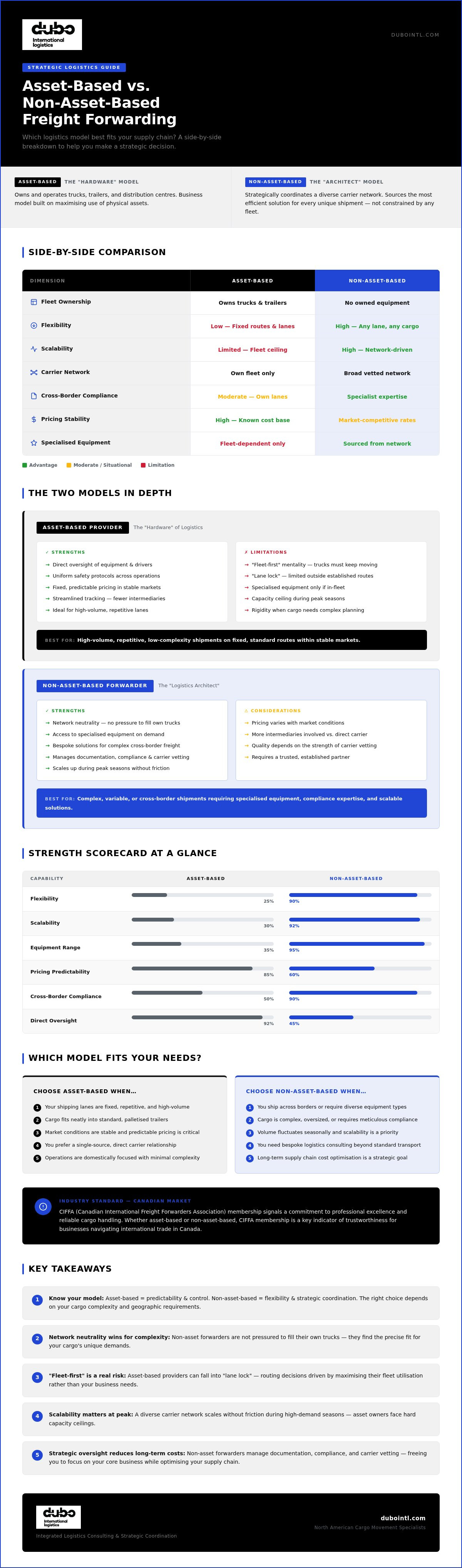
Asset-based providers represent the "hardware" of the industry. These companies own and operate their own fleets, trailers, and distribution centres. Their business model is built on maximizing the use of these physical assets to ensure a high return on investment. This structure is often ideal for shippers with high-volume, repetitive lanes that follow fixed schedules. Because the provider has direct oversight of the equipment and personnel, they can offer a high degree of predictability for standard shipments. However, this model can become rigid when your cargo requires specialized equipment that isn't part of their specific fleet.
The Non-Asset-Based Framework
Non-asset forwarders function as "logistics architects" who focus on the strategic coordination of a diverse carrier network. Instead of being limited by a specific fleet, they use their expertise to source the most efficient and cost-effective transportation for every shipment. This neutrality is a significant advantage. They aren't pressured to fill their own trucks, so they can prioritize finding the exact specialized transportation solution your cargo demands. This model is particularly effective for complex cross-border shipments or oversized loads that require meticulous planning; for example, McVender Logistics provides comprehensive solutions tailored for NVOCC and freight forwarding needs in these scenarios.
The value of a non-asset partner lies in their ability to offer bespoke logistics consulting. They manage the documentation, compliance, and carrier vetting, allowing you to focus on your core business. By leveraging a broad network, they provide a level of scalability that asset owners often struggle to match during peak seasons. You can learn more about how this architectural approach secures your supply chain at www.dubointl.com. For those dealing with urgent or sensitive freight requirements, reviewing the specialized services at learn more can help you identify the right path for your most critical shipments.
The Asset-Based Advantage: Control, Capacity, and Direct Oversight
Direct ownership creates a clear line of sight. When comparing an asset based vs non-asset based freight forwarder, the primary draw of the asset-based model is the perceived simplicity of a single-source solution. By owning the trucks and employing the drivers, these providers maintain total authority over maintenance schedules and safety standards. For a business with consistent, low-complexity shipping needs, this direct oversight provides a reassuring level of predictability.
Predictability in Standard Operations
Asset-based carriers excel when your requirements are static. Because they control the equipment, tracking becomes a streamlined process within their internal systems. Communication is often faster for standard palletized freight because there are fewer intermediaries involved. This model also allows for fixed pricing structures during stable market conditions; the carrier knows their operating costs precisely and can pass that stability on to you. This direct control allows them to implement rigorous safety protocols that are uniform across their entire operation, reducing the likelihood of unexpected incidents. It's a reliable choice for high-volume lanes where the cargo fits neatly into standard trailers and follows an organized, repetitive schedule.
The Trade-off: Rigidity and Limited Scope
However, this control comes with inherent limitations. Asset owners are often victims of a "fleet-first" mentality. Their primary goal is to keep their specific trucks moving to maximize ROI, which can lead to a "lane lock" problem. If your shipment falls outside their established routes, you might face delays or exorbitant fees. During peak seasons, the risk of being deprioritized increases significantly. If a larger client requires the entire fleet, smaller shippers often find themselves searching for alternative capacity at the last minute.
The lack of specialized equipment is another critical hurdle. If your cargo is oversized or requires sensitive handling that their fleet isn't equipped for, an asset-based provider may struggle to pivot. They're bound by the physical constraints of their hardware. While owning the truck offers control, it doesn't always offer the strategic foresight needed to navigate a fluctuating North American market. This is where a more integrated logistics strategy becomes essential. You can explore how professional coordination secures your interests by visiting www.dubointl.com to review our methodology and specialized service standards.
The Strategic Flexibility of Non-Asset-Based Freight Forwarding
The non-asset model represents the intellectual evolution of global shipping. Rather than being confined by the physical limits of a specific fleet, a non-asset partner operates as a logistics architect. This distinction is central to the choice between an asset based vs non-asset based freight forwarder. A non-asset provider prioritizes the strategic alignment of carrier capabilities with your specific cargo requirements, ensuring that the solution fits the freight, rather than forcing the freight to fit the truck. This approach provides a stabilizing force during market volatility, as these providers can pivot to alternative carriers when capacity in one sector tightens.
Unrivalled Network Reach and Scalability
A primary advantage of this model is the sheer scale of the available network. Non-asset forwarders maintain relationships with thousands of vetted carriers across Canada and the USA, providing access to a diverse range of equipment and transit options. This allows your business to scale capacity up or down without the burden of long-term capital commitments. By selecting carriers based on rigorous performance metrics for specific lanes, a non-asset partner ensures that every shipment is handled by a specialist. This neutrality allows for a focus on cost-efficiency and reliability, regardless of seasonal fluctuations or regional disruptions.
Bespoke Solutions for Specialized Cargo
Complex freight requires more than just a trailer; it demands meticulous planning and specialized transportation knowledge. Non-asset experts excel in coordinating movements for oversized, sensitive, or high-value cargo that standard asset-based fleets may not be equipped to handle. They manage the intricate documentation and cross-border compliance necessary for smooth North American trade, reducing the risk of costly delays at the border. For shipments where time is the most critical factor, these experts can quickly deploy expedited freight solutions through their extensive network. This level of coordination is a core component of the logistics consulting offered at www.dubointl.com, where the focus remains on delivering seamless, end-to-end supply chain support.
Choosing the Right Partner: A Strategic Evaluation Framework
Selecting the ideal logistics partner requires a fundamental shift from viewing transportation as a commodity to seeing it as a strategic asset. The decision between an asset based vs non-asset based freight forwarder should be guided by the specific demands of your cargo and the complexity of your North American trade lanes. While a simple truck might suffice for local movement, international trade often requires a more sophisticated architectural approach to ensure long-term stability. You must ask whether your business requires just a vehicle or a comprehensive strategy that protects your bottom line.
Assessing Volume and Lane Consistency
Asset-based models are often the most logical choice for repetitive, high-volume routes where the primary goal is securing consistent space on a fixed fleet. If you're moving standard palletized freight between two static points on a daily basis, the direct oversight of an asset owner provides a clear, predictable advantage. However, non-asset models almost always win for businesses with diverse or unpredictable shipping needs. By integrating strategic logistics consulting into your decision-making process, you can identify where a flexible network provides better protection against market fluctuations than a rigid, fleet-first approach. This flexibility allows you to realize cost savings by selecting the most efficient carrier for each specific shipment rather than being tied to one company's overhead.
Risk Mitigation and Compliance Needs
Cross-border movement between Canada and the USA involves significantly more than just transit. It requires meticulous cargo coordination to minimize delays at customs and ensure all regulatory requirements are met with precision. Evaluating a forwarder's ability to handle specialized freight in North America is critical if your cargo is oversized, sensitive, or high-value. Independent providers typically offer more personalized stewardship of your interests, acting as a dedicated bridge between your local operations and complex international systems. Professional certifications are a non-negotiable part of this evaluation. A CIFFA membership, for instance, ensures the partner adheres to the highest standards of professional conduct and industry expertise. This commitment to excellence is what separates a mere carrier from a true logistics architect who understands the grand scale of global movement. If you're ready to secure your supply chain with a partner that prioritizes your unique needs, explore the bespoke solutions available at www.dubointl.com today.
Navigating Complexity with Dubo International Logistics
Dubo International Logistics operates with the quiet authority of a seasoned expert. We act as a logistics architect; this means we prioritize the strategic alignment of your supply chain over the simple possession of physical equipment. In the strategic comparison of an asset based vs non-asset based freight forwarder, our model prioritizes your specific cargo needs over the necessity of filling a particular truck. Our approach ensures that your cargo is never limited by the constraints of a single fleet or the rigidity of fixed lanes. Instead, we leverage an extensive network of vetted carriers to provide a bespoke solution that adapts to your unique requirements, ensuring that every shipment is handled with precision and care.
End-to-End Management and Strategic Oversight
Success in North American trade requires more than just transit. It demands a sophisticated coordination of carriers, documentation, and regulatory compliance. Dubo manages this complex intersection with steady authority. We ensure that every link in your supply chain is strong and purposeful. By managing the minute details of carrier vetting and route optimization, we significantly lower your operational stress. This professional oversight is why many Canadian businesses trust Dubo for end-to-end freight management. We believe that professional fees represent a clear investment in long-term resilience. Securing your goods against the unpredictability of global trade is our primary objective, and we achieve this through meticulous planning and strategic foresight.
Your Partner in North American Logistics
Trust is the foundation of every partnership we build. We don't rely on high-energy hype or experimental tactics. We rely on consistency and a deep understanding of the industry. As a CIFFA member, Dubo acts as a protective steward of your interests, bridging the gap between your local business operations and the complexities of international movement. Whether you require specialized transportation for sensitive, oversized cargo or comprehensive logistics consulting to refine your long-term operations, we provide a steady hand. We invite you to experience the security that comes with a reliable, established partner. You can explore our full suite of services and discover how we can stabilize your supply chain by visiting www.dubointl.com today.
Securing Your Supply Chain Through Strategic Partnership
Choosing the right logistics model is a fundamental step toward building a resilient business. While the debate between an asset based vs non-asset based freight forwarder often focuses on equipment ownership, the real value lies in strategic foresight and network adaptability. An asset-based provider offers predictability for standard lanes. However, the non-asset model provides the "logistics architect" approach necessary for complex, cross-border movements. By prioritizing flexibility over fixed hardware, you ensure your cargo isn't limited by the constraints of a single fleet or rigid routes.
Dubo International Logistics acts as a CIFFA Certified independent provider, offering specialized project cargo expertise and seamless North American coordination. We focus on the minute details of your supply chain to lower your operational stress and provide a stabilizing force in a fluctuating market. Secure your supply chain today; consult with the experts at Dubo International Logistics to refine your strategy. You'll find that the right guidance makes all the difference in achieving long-term growth. For more information on our bespoke solutions, visit www.dubointl.com.
Frequently Asked Questions
Is a non-asset-based freight forwarder more expensive than an asset-based one?
No, they aren't inherently more expensive. When evaluating an asset based vs non-asset based freight forwarder, the cost difference often comes down to efficiency. While they charge a professional service fee, non-asset partners save money by sourcing the most competitive carrier for each lane. Asset-based providers have high overhead from fleet maintenance, which is passed to the client. Non-asset partners avoid these fixed costs, allowing for a more flexible pricing structure.
Can a non-asset forwarder guarantee capacity during peak shipping seasons?
Yes, they often provide more reliable capacity during peak times by leveraging a vast network of carriers. While an asset-based provider is limited by the number of trucks they own, a non-asset partner can pivot across thousands of vetted carriers. This diverse access acts as a buffer against regional shortages. It ensures your cargo moves even when a single fleet is fully booked, providing the scalability needed for fluctuating demand.
What is the main benefit of working with an independent CIFFA member?
The primary benefit is the assurance of professional standards and ethical conduct. CIFFA membership indicates that the forwarder adheres to a strict code of ethics and possesses deep industry knowledge. As an independent provider, they offer neutral advice that isn't biased toward filling a specific fleet. This results in bespoke solutions that prioritize your supply chain's efficiency and cross-border compliance over the provider's equipment utilization goals.
How do non-asset forwarders handle specialized or oversized cargo?
Non-asset forwarders coordinate specialized transportation by matching your specific cargo with the best-equipped carrier in their network. They act as a logistics architect, managing the permits, specialized trailers, and heavy-haul requirements. Instead of forcing a shipment into standard equipment, they source the exact tools needed for sensitive or oversized loads. You can learn more about these tailored coordination services by visiting www.dubointl.com for expert consulting.
Which model is better for cross-border shipping between Canada and the USA?
The non-asset model is often superior for cross-border shipping because it focuses on regulatory expertise and documentation. Navigating Canada-USA regulations requires meticulous planning rather than just a truck. In the comparison of asset based vs non-asset based freight forwarder models, the non-asset partner provides the strategic oversight needed to prevent border delays. They manage the complex communication between carriers and officials to ensure a seamless transition for your goods.
Do non-asset forwarders provide their own cargo insurance?
Non-asset forwarders typically facilitate cargo insurance through third-party underwriters rather than carrying it directly on their own balance sheet. They ensure that every shipment is properly covered based on its specific value and risk profile. This provides a layer of protection that is tailored to your unique cargo needs. By vetting the insurance coverage of their carrier network, they offer a secure and professional environment for your high-value goods.
Can I use a mix of asset and non-asset-based providers for my business?
Yes, many businesses use a hybrid approach to balance predictability and flexibility. You might use an asset-based carrier for high-volume, repetitive lanes with fixed schedules. Simultaneously, a non-asset partner handles your complex, specialized, or unpredictable cross-border shipments. This diversified strategy allows you to optimize costs while maintaining the strategic agility provided by a dedicated logistics consultant. It's a professional way to realize savings while securing your entire supply chain.

