

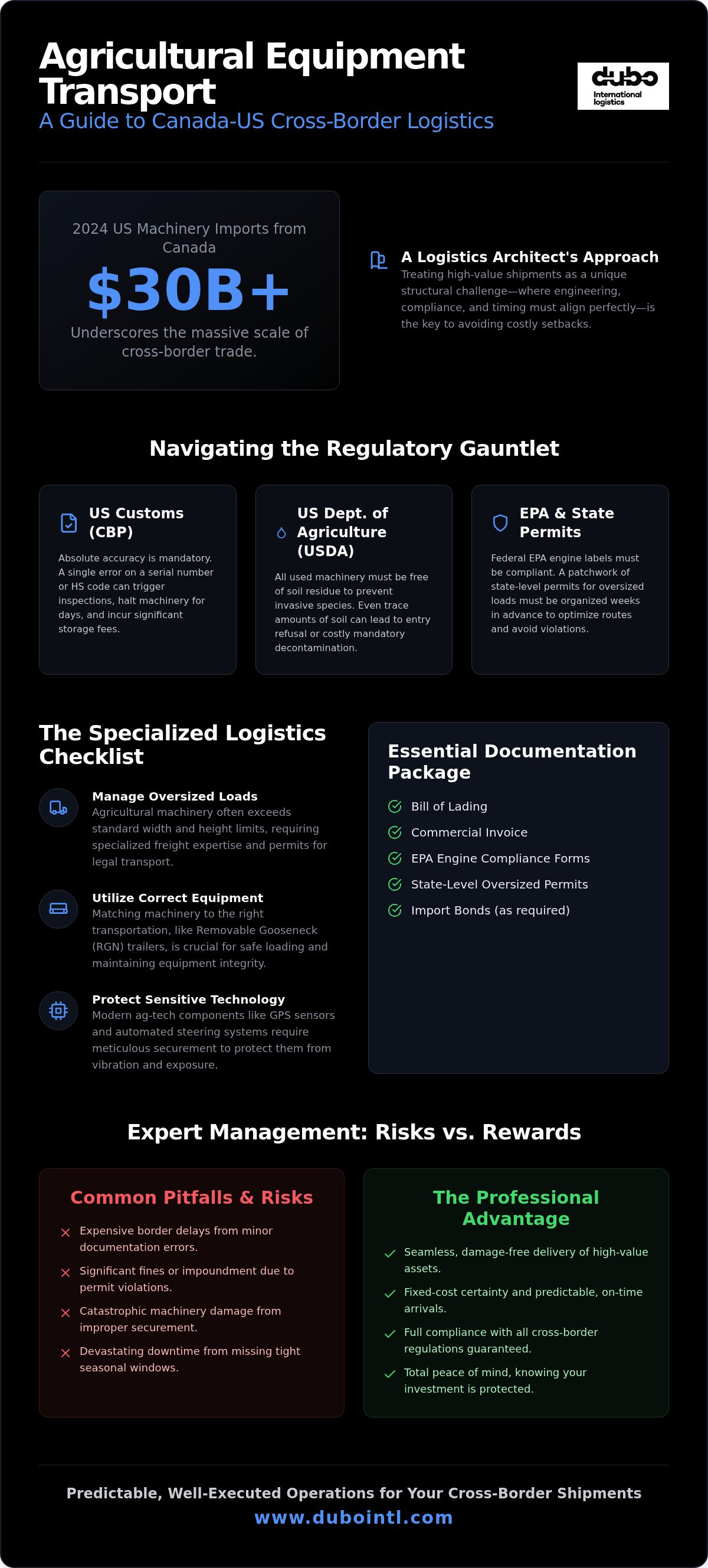
In 2024, the United States imported more than $30 billion worth of machinery from Canada, a figure that underscores the massive scale and vital importance of cross-border trade. For many producers and manufacturers, managing agricultural equipment transport Canada to US is the most demanding link in their supply chain. You likely recognize the quiet anxiety that comes with watching a high-value harvester or tractor depart, knowing that a single documentation error or a missed state permit could lead to expensive border delays. The fear of machinery damage during transit is a legitimate concern, especially when navigating the complex regulatory landscape of multiple jurisdictions.
You can achieve a seamless, damage-free delivery and maintain fixed-cost certainty by treating logistics as an architectural discipline rather than a simple haul. This guide will provide the expert insights you need to master compliance with US Customs and Border Protection, organize specialized equipment, and navigate the permit requirements of individual states. We will explore the strategic planning required for oversized loads and how the professional team at www.dubointl.com helps you realize a predictable, well-executed operation. From USDA cleanliness standards to EPA engine labels, you will gain the foresight needed to protect your investment and ensure your equipment arrives ready for the field.
Key Takeaways
- Understand why viewing machinery movement as a strategic architectural challenge is the first step toward ensuring the safety and success of high-value deliveries.
- Master the documentation required by US Customs and Border Protection to ensure your agricultural equipment transport Canada to US remains compliant and efficient.
- Learn how to match specialized machinery with the correct transportation solutions, such as RGN trailers, to maintain equipment integrity throughout the journey.
- Identify the critical strategic planning steps needed to navigate the patchwork of state-level permits and optimize routes weeks before the equipment departs.
- Discover how the expert freight management services at www.dubointl.com offer the fixed-cost certainty and reliability essential for complex cross-border logistics.
Navigating the Complexity of Cross-Border Agricultural Logistics
Moving multi-million dollar harvesters and tractors between provinces and states is a high-stakes endeavour that requires more than a standard trucking solution. These machines represent significant capital investments and the lifeblood of seasonal operations. When you initiate agricultural equipment transport Canada to US, you aren't just hiring a driver; you're engaging in a complex movement that demands a logistics architect approach. This perspective treats every shipment as a unique structural challenge where engineering, legal compliance, and timing must align perfectly to avoid costly setbacks.
The risks involved in these movements are substantial. Improper securement can lead to catastrophic equipment failure, while minor permit errors often result in significant fines or equipment being impounded at the border. Within the broader context of Canada-U.S. trade relations, the regulatory environment is rigorous. Border congestion and administrative bottlenecks serve as the primary disruptors, making end-to-end coordination a vital stabilizing force for your supply chain and peace of mind.
Why Agricultural Freight is a Specialized Category
Agricultural machinery rarely fits within standard shipping containers or on basic flatbeds. The non-standard dimensions, often exceeding federal width and height limits, require specialized freight North America expertise to manage safely. Beyond the physical size, modern ag-tech components like GPS sensors and automated steering systems are highly sensitive to vibration and environmental exposure. Protecting these delicate systems during a long-haul journey requires meticulous planning and specialized securement techniques that go beyond general freight standards.
The Economic Impact of Seamless Delivery
In the agricultural sector, timing isn't just a preference; it's a non-negotiable requirement. Seasonal windows for planting and harvesting are incredibly tight, and the cost of downtime when equipment is held at the border can be devastating to a farm's bottom line. Professional freight management ensures that your machinery doesn't become a liability. By establishing a meticulous professional process, the team at www.dubointl.com provides the reliability that comes from knowing your equipment will arrive exactly when it's needed, fully compliant with all cross-border regulations and ready for the field.
Compliance and Documentation: Crossing the Canada-US Border Seamlessly
Precision is the hallmark of professional cross-border freight forwarding Canada USA. When you manage agricultural equipment transport Canada to US, the physical movement of the machine is often secondary to the movement of digital data and legal declarations. US Customs and Border Protection (CBP) enforces strict CBP policies and procedures that require absolute accuracy. A single digit error on a serial number or an incorrectly classified HS code can trigger an inspection that halts your machinery for days, incurring storage fees and disrupting your schedule.
Beyond the paperwork, the physical condition of the equipment is a primary regulatory concern. The US Department of Agriculture (USDA) mandates that all used machinery enter the country free of soil residue to prevent the spread of invasive species. This isn't a suggestion; even trace amounts of Canadian soil can lead to a full refusal at the port of entry or a mandatory decontamination process at your expense. It's also vital to distinguish between a permanent import and a temporary entry. Whether the equipment is crossing for a demonstration, a specialized repair, or a final sale, the entry type dictates the specific bonds and documentation required for a legal crossing.
Essential Paperwork for Agricultural Machinery
Success at the border relies on a comprehensive documentation package that anticipates the needs of customs officers. This package includes the Bill of Lading, a detailed Commercial Invoice, and the EPA Form 3520-21, which verifies that the engine meets US emissions standards. You should also provide a USMCA Certificate of Origin to potentially eliminate duties under current trade agreements. For high-value equipment, you'll need to secure a Customs Bond, which acts as a financial guarantee that all legal obligations and potential duties will be fulfilled with the US government.
Navigating Regulatory Hurdles
Achieving compliance requires an industry-literate approach where every detail is scrutinized before the truck reaches the border. Working with a CIFFA-certified forwarder ensures that your logistics strategy aligns with the latest international standards and best practices. For a deeper look at these requirements, see our guide on Cross-Border Freight Forwarding: Navigating Canada-USA Logistics in 2026. If you're feeling overwhelmed by these requirements, the consultants at Dubo International Logistics can help you organize a seamless crossing that protects your investment and your timeline.
Matching Specialized Machinery with the Right Transportation Solutions
Selecting the correct trailer is a matter of engineering precision, where the physical dimensions of the machinery dictate the entire logistics strategy. When you organize agricultural equipment transport Canada to US, weight and height are the two most critical variables that determine the equipment configuration. Removable Gooseneck (RGN) trailers are indispensable for self-propelled machinery like tractors and combines, as they allow the front of the trailer to detach and create a ramp for easy loading. Every bespoke move is subject to specialized transportation project fees, ensuring that the unique technical requirements of your cargo are fully met by a customized solution that prioritizes safety and integrity.
Securement is not a one-size-fits-all process. It requires a deep understanding of the load-bearing points on the machine to ensure it meets both the Ministry of Transportation (MTO) standards in Canada and Department of Transportation (DOT) regulations in the US. Beyond physical stability, engines must comply with EPA emission standards to ensure a legal crossing. The team at www.dubointl.com acts as a logistics architect, coordinating these technical details to provide a seamless transition from the farm to the destination.
Trailer Selection Guide for Ag Equipment
Choosing between a flatbed, step deck, or double drop trailer depends entirely on the implement's height. While flatbeds work for standard attachments, double drop trailers are essential for tall machinery to stay below the typical 13.5 to 14-foot state height limits. Any load exceeding a width of 8.5 feet is designated as oversized, requiring specific lighting and, in many cases, escort vehicles to manage traffic safety. Multi-axle trailers provide the necessary weight distribution for heavy machinery, allowing loads that exceed the standard 80,000-pound federal limit to move safely across diverse road infrastructures.
Protecting High-Value Assets
The journey across North America exposes machinery to road debris and varied weather conditions. We recommend using specialized covers and windshield protection for combines to prevent costly glass breakage or interior damage during transit. It's also vital to ensure you have cargo insurance that covers the full replacement value of the equipment rather than just a standard weight-based liability. To see how we manage these delicate requirements, explore our specialized transportation services for machinery that requires a higher level of professional care and strategic foresight.
The Strategic Planning Process: Timing, Permits, and Route Optimization
Successful agricultural equipment transport Canada to US is won or lost in the planning phase, long before the first strap is tightened. While a standard haul might follow the shortest distance on a map, oversized agricultural loads must follow a path dictated by infrastructure and law. Route planning must commence weeks in advance to account for the physical limitations of the North American highway system. Low bridges, weight-restricted rural roads, and tight urban corners often create "no-go" zones for wide-axle tractors or tall combines that exceed standard clearance heights.
Navigating the patchwork of state-level permits is one of the most significant administrative hurdles for any cross-border move. Every U.S. state the vehicle traverses requires a separate permit, with processing times typically ranging from one to five business days per jurisdiction. For "super-loads" that exceed standard oversized dimensions, coordination with pilot car escorts and local law enforcement becomes mandatory. Pilot car services can add significant operational costs, often ranging between $1.50 and $3.00 per mile. Strategic planners also monitor legislative trends, such as the proposed "BUILD America 250 Act," which could increase interstate weight limits to 91,000 pounds for six-axle trucks, potentially altering future route optimization strategies.
The Role of Logistics Consulting
Strategic consulting serves as the intellectual framework for these complex movements. By applying strategic foresight, a logistics architect identifies cost-saving route alternatives that avoid seasonal road restrictions or high-traffic corridors. This level of planning is essential for maintaining the "smoothness" of the operation and ensuring that all specialized project fees are accounted for upfront. You can learn more about our approach in our Strategic Logistics Consulting in Canada: A 2026 Guide.
Managing the Timeline
In the agricultural sector, delivery windows are tied to the biological clock of the season. "Just-in-time" delivery is critical during planting and harvest periods, where a three-day delay can result in significant financial loss for the producer. End-to-end freight management reduces the anxiety of the unknown by building in contingencies for weather events and border wait times. Remember that the U.S. ACE eManifest must be filed at least one hour prior to arrival at the port of entry. This digital precision ensures that your machinery moves through the border without a second glance from customs officials.
If you're ready to secure a predictable and well-planned route for your next shipment, contact the experts at Dubo International Logistics for a consultation.
Partnering with a Professional Forwarder for Reliable Ag Equipment Transport
Choosing a partner for agricultural equipment transport Canada to US is a decision that impacts your entire operational season. While digital carrier platforms offer a basic connection to owner-operators, they often lack the oversight required to manage the multifaceted risks of cross-border machinery movement. A professional freight forwarder acts as a logistics architect, ensuring that every permit, securement point, and customs declaration is perfectly aligned before the journey begins. This meticulous execution transforms a high-stress event into a predictable, well-managed process. It's about moving beyond a simple truck and trailer transaction to a partnership that values longevity and consistency.
The Dubo Difference in Agricultural Freight
Dubo International Logistics serves as a stabilizing force in the complex environment of North American trade. As a CIFFA member, we prioritize reliability and strategic consulting over mere volume. We understand that your machinery is a vital asset, not just another load on a flatbed. Our focus on precision and bespoke solutions allows us to build a sophisticated bridge between local businesses and global systems. By integrating our freight forwarding capabilities with a deep understanding of the agricultural sector, we provide the completeness that modern producers require. Our commitment to excellence ensures that every project is handled with the strategic foresight necessary to navigate the complexities of international logistics without the high-energy hype of experimental newcomers.
Your Next Steps for a Successful Move
Preparing for a successful move requires a few final steps to ensure a smooth transition from the farm to the destination. First, ensure your equipment is thoroughly cleaned to meet USDA standards; even trace amounts of organic material can cause expensive delays at the border. Check all fluid levels to prevent leaks that could lead to environmental fines during transit and secure any sensitive tech interfaces. It's also wise to document the current condition of the machinery with high-quality photos before loading. Once your machinery is ready, request a specialized transportation project fee quote to establish your fixed-cost certainty and realize a transparent budget. Securing your equipment's journey today with a partner who understands the grand scale of global movement is the best way to protect your investment.
Visit www.dubointl.com to explore how our specialized transportation services can support your next cross-border move with quiet confidence and professional authority.
Securing Your Agricultural Supply Chain for the Seasons Ahead
Successful machinery movement is built on a foundation of meticulous preparation and strategic foresight. You've seen how precise documentation and adherence to cleanliness standards are essential for navigating US Customs without delay. By matching your high-value assets with the correct specialized trailers, you ensure the physical integrity of your cargo throughout its journey. Mastering agricultural equipment transport Canada to US is not merely about moving weight; it's about managing a complex regulatory and geographical landscape with professional authority.
Dubo International Logistics provides the stabilizing force your business needs in a complex global market. Our CIFFA certified expertise and specialized project cargo specialists offer the comprehensive North American coverage required to protect your investments. We prioritize the minute details of your individual needs to deliver peace of mind and fixed-cost certainty. Don't leave your seasonal success to chance. Request a Strategic Consultation for Your Ag Equipment Move at www.dubointl.com and realize a seamless delivery today. We look forward to partnering with you on your next successful move.
Frequently Asked Questions
What documentation is required for agricultural equipment transport from Canada to the US?
Essential documentation includes a detailed Commercial Invoice, the Bill of Lading, and EPA Form 3520-21 to verify emission compliance. You must also ensure the ACE eManifest is filed at least one hour before the vehicle arrives at the U.S. port of entry. A USMCA Certificate of Origin is often required to realize duty-free status. These documents form the legal foundation for successful agricultural equipment transport Canada to US, ensuring a seamless crossing without administrative friction.
Do I need to clean my farm machinery before shipping it across the border?
You must thoroughly clean all used farm machinery to remove every trace of soil and organic debris before it reaches the border. The U.S. Department of Agriculture (USDA) enforces strict cleanliness standards to prevent the introduction of invasive species or pests. Even a small amount of residue can lead to a full refusal at the port of entry. Professional cleaning is a non-negotiable step in the strategic planning process for any cross-border machinery movement.
How much does it cost to transport oversized agricultural equipment?
The total cost for agricultural equipment transport Canada to US depends on the machine's dimensions, weight, and the distance travelled across jurisdictions. State-level permits typically cost between $50 and $300 each, while pilot car escorts can add between $1.50 and $3.00 per mile to your expenses. Specialized project fees are often applied to account for the bespoke nature of moving oversized implements. For a precise calculation, visit www.dubointl.com to request a quote.
How long does it take to get permits for shipping oversized machinery to the US?
Obtaining the necessary oversized permits generally takes between one and five business days per U.S. state on your route. Because you must secure individual permits for every jurisdiction the machinery traverses, it's vital to begin this process several weeks before the scheduled departure. This lead time allows your logistics architect to optimize the route based on current bridge heights and road restrictions, ensuring the wheels start turning exactly when your seasonal schedule requires.
Can a freight forwarder manage the entire cross-border process for me?
A professional freight forwarder acts as a logistics architect to coordinate every aspect of the movement, from initial route consulting to final delivery. They manage the complex communication between carriers, pilot cars, and border authorities so you don't have to navigate these systems alone. By partnering with an expert team, you realize a complete end-to-end solution that prioritizes fixed-cost certainty and total compliance with all North American regulations, including U.S. Customs and Border Protection requirements.
What happens if my equipment is delayed at the border due to soil residue?
If U.S. Customs and Border Protection discovers soil residue, they may refuse entry or order the equipment to a specialized facility for mandatory decontamination. This process often involves significant delays and additional storage fees that can disrupt your entire planting or harvest window. It's much more efficient to invest in meticulous cleaning at the point of origin. Our team at www.dubointl.com emphasizes this detail to protect your machinery from unnecessary holds and administrative complications.
Is insurance included in the freight forwarding service fees?
Standard freight contracts usually include limited carrier liability based on the weight of the cargo, which often doesn't reflect the full value of modern agricultural machinery. You should verify whether your specialized transportation service includes comprehensive cargo insurance or if a supplemental policy is necessary for high-value assets. Ensuring your equipment is covered for its full replacement value provides the peace of mind essential for long-haul movements across the Canada-U.S. border.

