

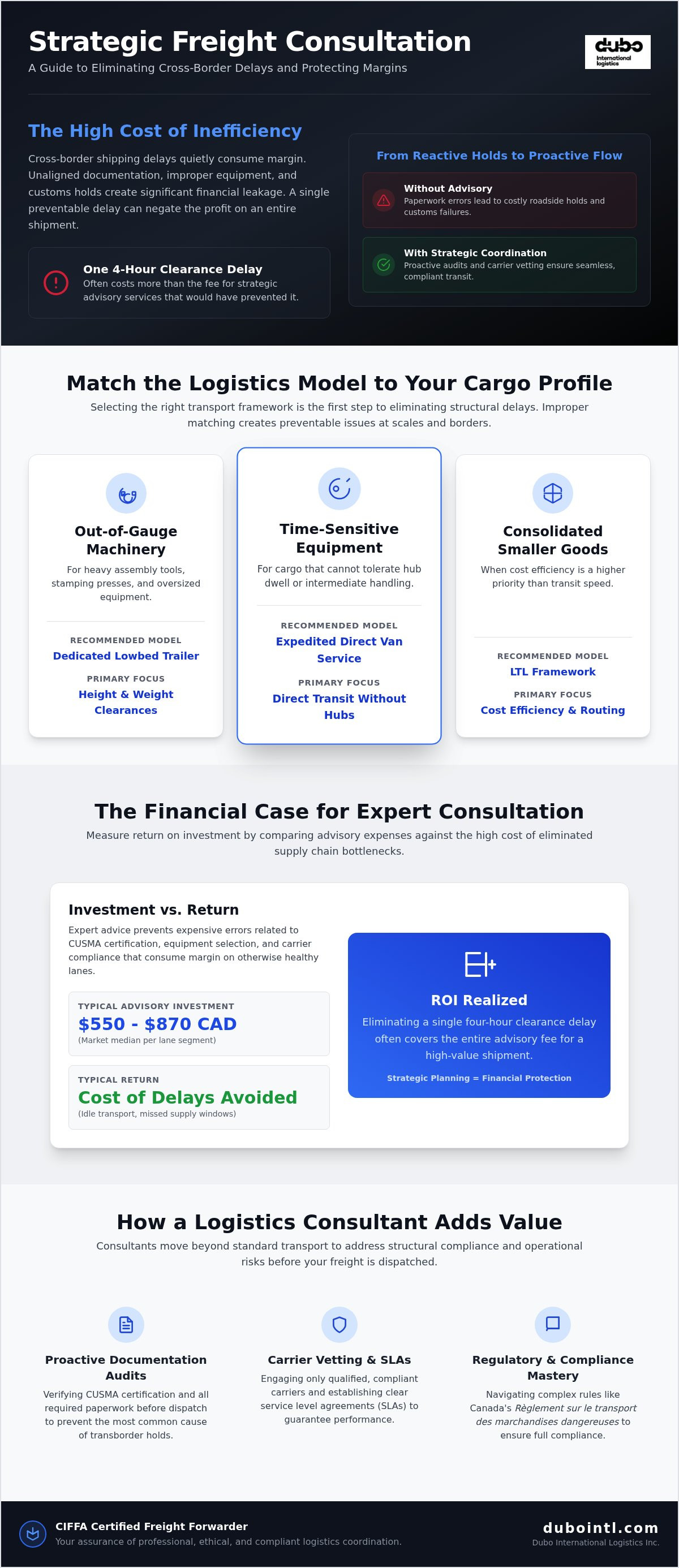
Market data shows freight advisory work typically ranges from $550 to $870 CAD, with a median cost of $644 CAD according to recent market research. Investing in strategic shipping coordination (freight forwarding) ensures full regulatory alignment and eliminates systemic delays across North American supply chains. The decision questions that shape this guide are straightforward: does your cargo profile need structured oversight, will advisory fees offset border delay costs, and when is direct execution the better path? Shippers can review specialized carrier management options directly at www.dubointl.com.
Key Takeaways: Strategic shipping consultation eliminates cross-border delays by auditing documentation and equipment clearances before dispatch to prevent costly roadside holds and customs failures.
- Advisory fees typically range from $550 to $870 CAD per lane segment.
- Consulting yields weak returns for low-volume domestic routes where standard capacity suffices.
- Engage strategic experts for oversized machinery requiring four to eight weeks lead time.
- The article demonstrates how eliminating one four-hour clearance delay covers the advisory fee.
Match the logistics model to your 2026 cargo profile before you book
Selecting an optimal freight model depends on matching your physical cargo profile to specific transportation framework capabilities. Improper trailer matching creates structural delays you only discover at the scale or the border; auditing axle weight limits before dispatch prevents costly roadside holds during cross-border transit.
Three situations come up often:
- Out-of-gauge machinery on a standard trailer: switch to a dedicated lowbed and confirm height and weight clearances before dispatch.
- Time-sensitive equipment that cannot tolerate hub dwell: use fast shipping (expédition accélérée premium) so the load runs direct without intermediate handling.
- Smaller consolidated goods where cost matters more than speed: place the freight in an LTL framework and prioritize routing efficiency.
Strategic shipping coordination requires evaluating cargo weight, volume, and urgency against dedicated transport modes. Based on current market listings, standard freight charges usually run between 550-870 $ (market median 644 $) for a lane segment, shaped by regional equipment availability and fuel surcharges. Shippers executing cross-border movements can review the Quebec to USA guide to align seasonal schedules with regulatory requirements. Choosing equipment without verifying height clearances forces delays the moment the unit hits a restricted overpass or inspection lane.
| Cargo Profile | Recommended Logistics Model | Primary Operational Focus |
|---|---|---|
| Out-of-gauge machinery | Dedicated lowbed trailer | Height and weight clearances |
| Time-sensitive equipment | Expedited direct van service | Direct transit without hubs |
| Consolidated smaller goods | LTL framework | Cost efficiency and routing |
Each routing decision either protects or weakens your supply chain efficiency. Map your cargo strategy at www.dubointl.com when you are ready to compare modes against a live shipment profile.
Consulting ROI: cut cross-border transit delays that erode margin
You measure return on strategic shipping coordination advice by comparing eliminated bottleneck costs with advisory expenses. Industry data indicates that baseline strategy fees generally fall within 550-870 $. Expert advice prevents expensive border paperwork (CUSMA certification) errors that quietly consume margin on otherwise healthy lanes.
Border disruptions cost companies revenue through idle transport hours and missed supply windows. Federal supply-chain programs continue to target friction on national transport corridors; your side of that equation is documentation accuracy and carrier readiness. Resolving administrative holdups quickly stops financial leakage. Eliminating a four-hour clearance delay often covers the advisory fee on a single high-value shipment.
Delays compound across long routes unless you plan for continuous transit. Continuous movement relies on driver teams that keep vehicles moving 24 hours a day, which prevents unnecessary rest-stop gaps on critical runs. Hiring experienced coordinators turns unpredictable transport into a defined operational timeline.
A single clearance failure can halt a factory line. Advisors audit documentation, review trade corridors, and establish clear service level agreements (SLAs) with qualified carriers. Reviewing your freight framework through the Canada to USA cargo guide supports full regulatory alignment before the load is tendered. Check tailored supply-chain options at www.dubointl.com if delay cost is already visible in your lane data.
Tip: Engage continuous team-driver operations to keep cargo moving 24 hours a day on critical cross-border runs.
How a logistics consultant reduces your cross-border shipping delays
A strategic consultant resolves trade delays by auditing supply-chain bottlenecks and optimizing complex Canadian shipping coordination.
Standard carriers move cargo between set points; consultants address structural compliance risks before freight reaches the border paperwork phase. Unaligned documentation causes most transborder holds. Proactive risk reviews remove those errors before a driver joins the customs queue.
Consider a recurring pattern from consulting work: aerospace components fail road inspections over minor paperwork gaps, the trailer sits, and a production window slips. The corrective path is a documentation audit plus carrier checks against the Règlement sur le transport des marchandises dangereuses before departure. Once paperwork and equipment line up, the same class of freight clears without the roadside failure that triggered the hold. That problem-action-outcome loop is the practical case for bringing a consultant in before the next tender.
Consultants negotiate terms through service level agreements (SLAs). Published figures show that typical advisory bands hover around 550-870 $. As a CIFFA-certified freight forwarder and member of the Canadian International Freight Forwarders Association (CIFFA), the team applies association standards to documentation and carrier selection. Read the 3PL cross-border shipping guide when you want to tighten trade-route design around those standards.
Minor carrier scheduling mistakes often trigger costly driver wait times (temps d'attente) at customs checkpoints. Strategic oversight protects your operational deadlines the way coordinated ground control protects a busy corridor: each handoff is timed, and exceptions are caught early. Tailored consultation fits complex supply networks; transactional booking suits simple domestic moves.
Among Google reviews for the firm, Sun (5★) wrote:
"Great Company, Great staff with great lanes and excellent carrier reps. They are fair organization to work with."
Experienced carrier reps and reliable lane coordination are exactly what prevent the unexpected transit delays that erode your schedule.
4 Steps that turn freight consultation into a controlled timeline
A clear consulting process replaces unpredictable freight costs with transparent project timelines. Based on industry quotes, advisory work in this category typically costs 550-870 $. Complex cargo routes need structured oversight if you want to avoid expensive transit delays. Standard shipping coordination fits routine inventory; structured consulting fits highly technical project cargo.
- Initial assessment: The consulting team evaluates your operational risks and reviews previous transport bottlenecks.
- Strategy design: Consultants build tailored plans for specialized transportation services, outlining specific routing requirements.
- Documentation audit: Experts handle complex regulatory details, including mandatory border paperwork.
- Execution oversight: Coordinators manage real-time tracking systems and adjust scheduling during cross-border transit.
Direct execution protects equipment safety when those four stages stay in sequence. You can review the commercial shipping rates guide to align your corporate budget with upcoming cross-border requirements. Most oversized shipments require a lead time of at least four to eight weeks so permitting and planning phases finish before the load is called forward. Coordinate upcoming cargo schedules with experienced planners at www.dubointl.com when your next out-of-gauge move is already on the calendar.
Tip: Factor in a four- to eight-week lead time for oversized shipment planning to secure permits and specialized trailers.
Keep Canadian dangerous-goods moves compliant before the truck rolls
A specialized logistics consultant manages strict regulatory frameworks so complex cargo moving across Canadian borders stays compliant. Aerospace components, as noted above, frequently fail road inspections over minor paperwork errors; the cost sits in detention, rework, and missed receiving windows rather than in the freight rate itself.
Relying on standardized freight options for regulated goods introduces operational risk you cannot recover mid-route. Strategic shipping coordination applies regulatory oversight before trucks leave the loading dock, which is where supply-chain integrity is won or lost.
Technical management of physical cargo flows demands careful organizational coordination across carriers, permits, and handlers. Carriers with proven dangerous-goods handling experience are selected only after equipment and trained personnel are verified. Each transport link is assessed before it becomes a single point of failure on your lane.
Specific rules apply to specialized freight. Miscellaneous dangerous goods assigned to Class 9 under Canadian classification rules require distinct safety protocols. Structured consultations validate border paperwork before release. Dedicated expertise protects the cargo value you already booked.
Reviewing regulatory protocols early prevents supply-chain disruptions that no spot quote can fix after the fact. Structure a compliant transport plan around your commodity list at www.dubointl.com before the next regulated load is staged.
When strategic logistics consulting costs you more than it returns
Advisory services are unsuitable for urgent freight movements that need immediate execution rather than process redesign.
Paying for high-level supply chain planning when your immediate issue is simple capacity access creates overhead without a matching return. Direct operational support serves simple transit needs better than abstract analysis. Consulting yields weak returns for businesses running low-volume, standard domestic routes, where a structured study rarely pays for itself.
Advisors add little when your team only needs basic spot-market quotes. Engaging external strategists without operational readiness ties up capital you could put into capacity.
Advisory costs depend on project scope; according to market listings, general logistics advisory typically runs 550-870 $. Retaining an advisor makes sense for complex supply chain restructuring, while day-to-day shipping coordination fits standard cargo flows.
When immediate execution is essential, direct cargo management provides certainty. Partnering with a specialized provider brings structured control to complex movements without forcing a full advisory engagement. Explore dedicated transport solutions at www.dubointl.com if your next shipment needs execution first and strategy second.
Frequently asked questions
How can I clarify import and export regulations?
You clarify regulatory requirements by establishing a strategic shipping coordination plan that addresses documentation, cargo specifications, and compliance standards. The team evaluates your specific supply chain corridor so border paperwork is fully prepared before transit begins. CIFFA membership and certification underpin the structured guidance used to manage complex international trade rules. Review operational frameworks and request detailed guidance at www.dubointl.com.
How can we manage logistics for aerospace and defence shipments?
Aerospace and defence shipments require specialized transport planning, rigorous risk management, and precise route execution. You must establish strict operational protocols to protect critical, high-value components throughout transit. Transporting oversized machinery or specialized equipment typically requires a lead time of four to eight weeks to complete planning and permitting phases. Partnering with a certified logistics provider keeps high-consequence cargo under continuous supervision.
What logistics services are offered?
Tailored freight management covers fast shipping, project cargo coordination, and specialized transport across North America. That includes oversized machinery, delicate equipment, and temperature-sensitive products within dedicated or LTL frameworks. According to market listings, general consulting services typically range from 550-870 $. A vetted dangerous-goods carrier network is maintained by verifying carrier equipment and confirming that personnel possess proven handling experience.
What support is provided for trade shows and customer demonstrations?
Trade show logistics demand strict adherence to delivery schedules and customized cargo protection. Your demonstration equipment is secured through specialized packaging and direct route planning so unnecessary transit delays never consume the setup window. Continuous movement is maintained through a two-driver strategy that keeps the vehicle in motion 24 hours a day. That uninterrupted driver team operation gets high-priority display units to the floor when your setup window opens.
What does freight advisory typically cost for cross-border lanes?
According to recent market research and current listings, freight advisory and related strategy fees typically range from $550 to $870 CAD, with a median near $644 CAD per engagement band. The right comparison is not fee versus zero cost; it is fee versus the detention, idle time, and missed supply windows that follow a clearance failure. If your lanes already show repeated border paperwork issues or oversized permitting gaps, advisory spend often offsets itself on a single recovered high-value shipment.
Strategic Shipping Consultation for 2026
Long-term operational resilience across Canadian border crossings depends on shipping coordination tailored to your supply chain, not on generic capacity alone. Drawing on CIFFA membership and certification alongside a vetted dangerous-goods carrier network, cross-border operations stay protected against delays you can plan out of the schedule. Request a personalized consultation through www.dubointl.com to review your freight requirements, or open the 3PL cross-border shipping guide when you want to pressure-test trade lanes for 2026 against the same decision questions this article opened with: fit of model to cargo, ROI on delay reduction, and whether advisory or direct execution serves the next move.
