

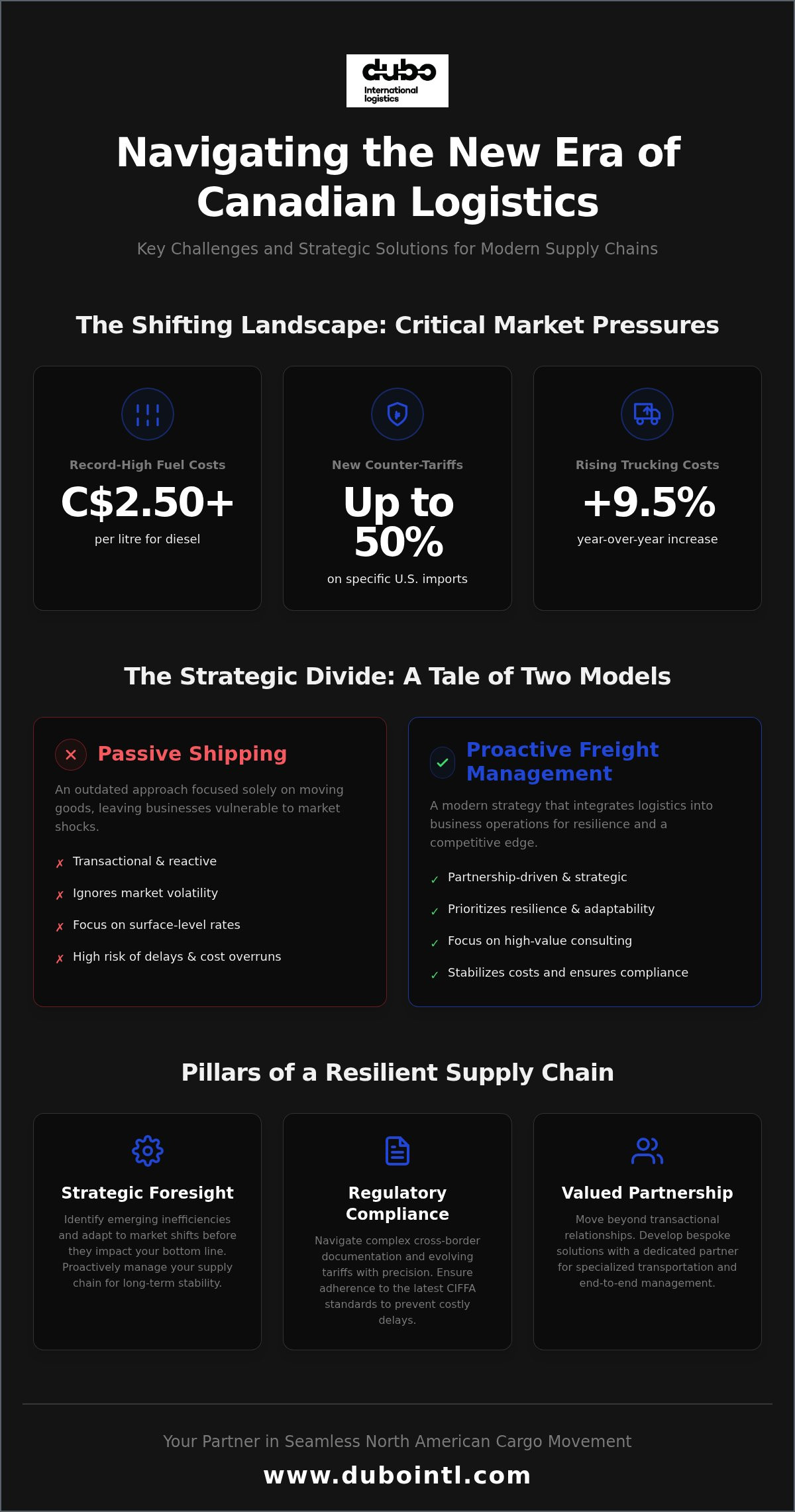
With Canadian diesel prices breaching C$2.50 per litre and new counter-tariffs reaching up to 50% on specific U.S. imports, the margin for error in your supply chain has effectively vanished. It's a challenging reality for any manufacturer or exporter trying to maintain stability while truck transportation costs rise by 9.5% year-over-year. You likely feel the pressure of these fluctuating markets and the weight of increasingly complex cross-border documentation. This Canadian freight forwarding blog serves as a strategic resource to help you transform these obstacles into a structured, competitive advantage.
We promise to provide the strategic logistics insights you need to optimize your North American cargo movement and lower your operational friction. You'll gain a clear understanding of the latest compliance requirements and actionable methods to manage your end-to-end freight more effectively. This article examines how specialized transportation partners and consulting can stabilize your costs even as the USMCA landscape remains uncertain. For deeper insights into our role as a dedicated guide through these global complexities, visit www.dubointl.com.
Key Takeaways
- Adapt to evolving North American trade conditions by using strategic foresight to protect your supply chain from sudden market shifts.
- Navigate complex regulatory requirements with a clear understanding of CIFFA standards and professional accountability.
- By following this Canadian freight forwarding blog, you'll learn to distinguish between surface-level shipping rates and high-value logistics consulting.
- Shift your operations toward a partnership-driven model that prioritizes precision and bespoke solutions for specialized transportation projects.
- Secure a stabilizing force for your cargo movement by exploring the end-to-end management services available at www.dubointl.com.
Why Following a Canadian Freight Forwarding Blog is Critical for 2026 Supply Chains
Strategic foresight is no longer a luxury for Canadian manufacturers; it's a requirement for survival. The North American trade environment in 2026 has become increasingly volatile, marked by the non-renewal of the USMCA in July and record-high diesel prices exceeding C$2.50 per litre. Relying on a consistent Canadian freight forwarding blog helps your business identify emerging supply chain inefficiencies before they impact your bottom line. Statistics Canada reported a 9.5% year-over-year increase in truck transportation prices during the second quarter of 2026, representing the largest jump in four years. Passive shipping models, which focus solely on moving goods from point A to point B, are rapidly being replaced by proactive freight management strategies that prioritize resilience and adaptability.
The Shift Toward Strategic Logistics Consulting
Modern logistics requires a move beyond simple cargo movement toward deeply integrated supply chain support. Businesses are realizing that expert logistics consulting can lead to significant operational cost reductions, particularly when dealing with specialized transportation needs. This transition is essential for manufacturers who handle non-standard or sensitive freight. We focus on bespoke solutions that align with your specific production cycles, ensuring that your logistics strategy acts as a stabilizing force rather than a source of stress. This approach transforms logistics from a transactional expense into a strategic asset. For a detailed look at how these methodologies are applied to optimize your specific routes, you can explore our resources at www.dubointl.com.
Staying Ahead of Regulatory Changes
Compliance standards have shifted dramatically following the introduction of counter-tariffs on U.S. goods in September 2026. These tariffs, ranging from 15% to 50%, have made the role of a professional freight forwarder more critical than ever. Accurate documentation serves as the foundation for seamless cross-border movement, preventing costly delays at the border. By utilizing professional resources, you can maintain compliance across diverse jurisdictions and ensure your documentation meets the latest CIFFA standards. This level of precision is what distinguishes a reliable partner from a basic service provider in a complex global market. Maintaining a clear understanding of these regulatory shifts ensures that your cargo moves without the friction of unexpected administrative hurdles.
Key Regulatory Trends and Compliance Standards in Canadian Logistics
Freight forwarding compliance involves strictly adhering to the national and international laws that govern how cargo moves across borders. In the current environment, this involves more than simple paperwork; it requires a deep understanding of the evolving trade barriers introduced in late 2026. By following a reputable Canadian freight forwarding blog, you can stay informed about these shifts before they disrupt your operations. The transition to digital-first documentation models has accelerated, requiring exporters to adopt integrated systems that ensure data accuracy and speed. This move isn't just about efficiency; it's about the completeness of data required by the Canada Border Services Agency. Specialized cargo, such as steel and aluminum, now faces specific 2026 guidelines that demand meticulous tracking from the point of origin to the final destination.
The Value of CIFFA Certified Forwarders
Reliability in the logistics sector is often anchored by professional affiliations. Membership in the Canadian International Freight Forwarders Association (CIFFA) serves as a mark of accountability and trust. These certified forwarders act as a stabilizing force, providing the expertise needed to manage a tightening market where the truck-to-load ratio dropped to 2.71 in July 2026. This certification ensures that your provider follows standardized codes of conduct, which is vital when navigating the uncertainties of North American trade. Membership also ensures that forwarders stay updated on the latest AI-driven automation trends for customs clearance, helping you avoid the 9.5% price hikes seen in the general trucking market. You can learn more by Understanding the Value of a CIFFA Certified Forwarder and how it protects your business interests in a fluctuating economy.
Navigating Cross-Border Freight Compliance
The cross-border landscape has grown more complex since the United States declined to renew the USMCA in its current form in July 2026. Shipping cargo to the USA now requires heightened regulatory foresight to manage the new counter-tariffs of 15%, 25%, or 50% on certain goods. Precision in documentation is the only way to ensure seamless movement. For instance, the APHIS transponder fee for commercial trucks increased to $870.60 USD as of October 1, 2026, adding another layer of cost and administrative detail to every shipment. End-to-end management prevents these small details from becoming major border delays. We specialize in coordinating these intricate movements to ensure your supply chain remains fluid despite geopolitical shifts. If you're looking for a partner to manage these complexities, consider our specialized transportation services to secure your cargo's journey and maintain your competitive edge.
Distinguishing Strategic Logistics Insights from Surface-Level Shipping Advice
Many businesses mistake a low-cost quote for a sustainable logistics plan. In a market where intra-Canada spot truckload rates rose 10% year-over-year in July 2026, a "cheap" rate often masks poor capacity management or inadequate documentation. A high-quality Canadian freight forwarding blog shouldn't just list prices; it should provide the architectural framework required for long-term supply chain resilience. While a basic freight broker focuses on a single shipment, a logistics consultant acts as an architect, designing a system that balances cost with the "smoothness" and "completeness" of end-to-end cargo movement. This distinction is vital when diesel fuel averages C$2.50 per litre, as inefficient routing can quickly erase the savings of a lower base rate.
Why Logistics Strategy Consulting Matters for Growth
Strategic planning allows businesses to organize for scale rather than reacting to daily crises. This involves implementing Collaborative Planning, Forecasting, and Replenishment (CPFR) to synchronize production with transportation capacity. In 2026, where the truck-to-load ratio has tightened to 2.71, foresight is the difference between a loaded trailer and a stalled production line. Integrated consulting identifies these emerging bottlenecks before they manifest as delays. For a deeper dive into these methodologies, read our Strategic Logistics Consulting in Canada: A 2026 Guide to Supply Chain Excellence.
Evaluating Freight Forwarding Services for Businesses
Reliable freight forwarders in Canada are measured by their ability to handle specialized transportation projects with a tailored approach. When evaluating potential partners, look for indicators of professional accountability, such as CIFFA membership and a proven track record in project-based logistics. Specialized freight in North America requires more than a standard truck; it demands a project-based strategy that accounts for specific dimensional or regulatory needs. Avoid common mistakes by seeking a partner that offers:
- Proactive capacity commitment despite tightening market conditions.
- Sophisticated integration of AI for predicting potential border delays.
- Bespoke routing solutions that mitigate the impact of record-high fuel costs.
Moving from a transactional shipping model to a partnership-driven logistics model ensures your supply chain remains a stabilizing force. You can explore our approach to high-level cargo coordination at www.dubointl.com.
Implementing Strategic Freight Forwarding Principles in Your Business Operations
Transitioning from a transactional shipping model to a partnership-driven logistics framework is the most effective way to protect your business from external shocks. While many companies treat shipping as an isolated cost centre, integrating freight management insights into your quarterly business reviews allows for better fiscal planning and operational alignment. This holistic approach ensures that your logistics strategy supports your broader commercial goals. By outsourcing complex freight management to a dedicated partner, you free up internal resources to focus on core manufacturing and sales activities, significantly improving overall business efficiency. It's about moving from reactive problem-solving to proactive system design.
Specialized transportation solutions are essential for handling unique cargo requirements that standard carriers often struggle to manage. Whether you're moving oversized machinery or sensitive industrial components, a project-based approach ensures that every detail is accounted for before the truck ever arrives. This level of precision is what distinguishes a mature logistics partner from a simple broker. We act as your logistics architect, coordinating every moving part to ensure a smooth and complete delivery process that respects your timelines and your budget.
Reducing Logistics Costs Through Strategic Planning
Reducing logistics costs in Canada requires more than just searching for the lowest rate. Strategic planning involves analyzing lane data to identify opportunities for shipment consolidation or modal shifts, such as moving road freight to rail where timelines allow. A high-quality Canadian freight forwarding blog provides the necessary context to spot these cost-saving trends before they become industry standard. Optimization isn't just about cutting expenses; it's about building a competitive advantage through a more responsive and reliable supply chain. When your logistics architect understands your inventory cycles, they can secure capacity in advance, avoiding the premium prices often found in the spot market during peak seasons.
Optimizing Freight Solutions for Exporters and Importers
Exporters and importers moving cargo across the North American continent require tailored strategies that account for varying infrastructure and regulatory nuances. Meticulous carrier coordination ensures that your goods don't just move, but arrive exactly when needed to meet production schedules. For those with time-sensitive requirements, visiting Dubo Expedited for expedited freight needs provides a pathway to fast, reliable transport without the usual administrative friction. We prioritize precision in every shipment, ensuring that specialized cargo receives the specific care it requires. If you're ready to move toward a more integrated and professional logistics model, explore our logistics consulting services to see how we can stabilize your North American supply chain and ensure the seamless movement of your most critical assets.
Dubo International Logistics: Your Partner in Seamless North American Cargo Movement
Dubo International Logistics Inc. operates as a stabilizing force within a complex global environment, acting as a protective steward of our clients' interests. We don't view ourselves as a mere service provider; rather, we function as a dedicated, hands-on guide for businesses that require longevity and consistency in their logistics operations. Our commitment to precision ensures that every cargo movement is handled with the strategic foresight necessary to avoid the pitfalls of a fluctuating market. By maintaining a high-professional register and focusing on bespoke solutions, we provide a sense of security that allows you to focus on your core business objectives. This Canadian freight forwarding blog is part of our broader mission to provide the transparency and expertise required for modern trade. Discover our full range of services at www.dubointl.com.
Our methodology focuses on the "smoothness" and "completeness" of every project we undertake. We understand that in 2026, a reliable partner must do more than just book a truck. They must anticipate regulatory shifts and capacity constraints before they manifest as delays. As a mature, established partner, we prioritize a professional process that anchors every broad claim with a description of our methodology and support systems. This rhythmic balance of high-level strategy and meticulous execution is what allows our clients to maintain peace of mind despite the uncertainties of North American trade.
Expertise in Specialized Transportation
Managing non-standard or sensitive freight requires the care of a seasoned expert who understands the minute details of individual client needs. We specialize in coordinating complex project cargo logistics across Canada and the USA, ensuring that specialized transportation projects are executed with a level of integration that simple brokers cannot match. Our role as a "logistics architect" means we oversee the grand scale of movement while remaining meticulously focused on the completeness of every individual shipment. For those looking to deepen their understanding of these processes, we recommend our Specialized Freight North America: A Strategic Buyer’s Guide for 2026.
Comprehensive Supply Chain Support
Businesses trust Dubo for strategic logistics planning and execution because we provide a sophisticated bridge between local operations and complex international systems. We understand that a truly efficient supply chain requires more than just moving goods; it requires a partner who understands the broader economic context, from tightening capacity to shifting trade regulations. As a proud CIFFA member, we adhere to the highest standards of professional accountability in the industry. We invite you to contact our team to realize a more efficient and trustworthy supply chain that prioritizes your peace of mind and long-term stability. Let us help you organize a logistics strategy that serves as a foundation for your future growth.
Securing Your Supply Chain for a Resilient Future
The complexities of 2026 demand more than just reactive shipping. By prioritizing regulatory foresight and shifting toward a partnership-driven logistics model, your business can maintain stability despite fluctuating diesel prices and trade uncertainties. This Canadian freight forwarding blog provides the strategic insights necessary to transition from transactional movement to integrated, architectural supply chain design. Precision in documentation and a deep understanding of CIFFA standards are no longer optional; they're the foundation of seamless North American trade.
As a proud CIFFA member with decades of expertise in North American freight, we're dedicated to acting as a stabilizing force for your operations. We specialize in the meticulous management of complex project cargo, ensuring every detail is handled with professional care. We invite you to optimize your supply chain with the experts at Dubo International Logistics and realize the benefits of a truly integrated logistics strategy. For more information on our full range of services, visit www.dubointl.com. Your journey toward logistics excellence begins with a partner who values your peace of mind as much as you do.
Frequently Asked Questions
What is a Canadian freight forwarding blog and why should I read one?
A Canadian freight forwarding blog acts as a strategic guide for businesses navigating the complexities of North American trade. It provides essential updates on shifting regulations, such as the 2026 counter-tariffs, and offers insights into market trends like rising fuel costs. By engaging with this content, you gain the foresight needed to optimize your supply chain, reduce operational friction, and maintain a competitive edge in a volatile global environment.
How can a freight forwarder help my business reduce logistics costs?
Freight forwarders reduce costs by leveraging carrier relationships and optimizing transportation routes to minimize fuel consumption. When diesel prices surpass C$2.50 per litre, precise coordination becomes vital for maintaining profitability. Through strategic consulting, a forwarder identifies shipment consolidation opportunities and lane efficiencies that internal teams might overlook. This professional approach transforms logistics from a variable expense into a controlled, predictable component of your business model and ensures long-term fiscal stability.
What are the benefits of hiring a CIFFA certified freight forwarder?
Hiring a CIFFA certified forwarder provides a guarantee of professional accountability and industry expertise. Members adhere to a strict code of ethics and standardized operational procedures, ensuring your cargo is handled with the highest level of care. This certification is particularly valuable in 2026, as it indicates a partner who stays current with complex regulatory shifts and maintains the technical proficiency required for seamless North American cargo coordination and peace of mind.
What is the difference between freight forwarding and logistics consulting?
Freight forwarding is the operational execution of moving goods, involving carrier coordination and documentation management. In contrast, logistics consulting is a strategic service that analyzes your entire supply chain to improve efficiency and reduce long-term costs. While forwarding handles the immediate coordination of shipping, consulting provides the architectural framework to optimize your overall business movement. Both services are essential for a complete, integrated approach to managing modern trade and ensuring supply chain resilience.
How do I choose a reliable freight forwarder for specialized cargo in Canada?
Reliability for specialized cargo depends on a provider's ability to offer bespoke project management and technical expertise. You should prioritize partners who act as "logistics architects," focusing on the minute details of your unique shipment needs. Verify their experience with non-standard freight and their commitment to end-to-end coordination. A partner who understands the grand scale of global movement while respecting individual client requirements will ensure the smoothest and most complete delivery process.
What documentation is required for cross-border shipping between Canada and the USA?
Cross-border shipping requires a commercial invoice, bill of lading, and detailed packing list as fundamental documents. In the current 2026 trade environment, you must also verify if your goods fall under the new 15% to 50% counter-tariffs on U.S. imports. Meticulous documentation is the only way to ensure compliance and avoid costly border delays. Our team at www.dubointl.com coordinates this paperwork to ensure your cargo moves across the continent without any administrative friction or unexpected costs.
When is the right time to outsource my freight management?
The ideal time to outsource is when logistics management begins to consume excessive internal resources or when regulatory complexities become a barrier to growth. If your team is struggling to keep pace with fluctuating transportation prices or documentation requirements, a professional partner can provide immediate relief. Outsourcing allows you to focus on core manufacturing and sales while ensuring your freight is managed by seasoned experts who prioritize supply chain stability and operational excellence.
How does strategic logistics planning impact business growth?
Strategic planning provides the scalability required for sustainable business expansion. By synchronizing your production cycles with transportation capacity, you prevent the bottlenecks that often occur during peak seasons or market tightening. This proactive approach allows you to organize for growth rather than reacting to daily logistics crises. It builds a resilient supply chain that supports your commercial objectives and enhances your reputation for reliability, allowing you to enter new North American markets with confidence.
