

The carrier isn’t the first decision in a complex shipment. Cargo dimensions, weight, fragility, temperature requirements and delivery milestones can all affect the route, equipment and handoffs before a carrier is selected. For businesses moving specialized freight, a project cargo freight forwarder Canada shippers rely on brings these requirements together at the planning stage.
A missed detail or poorly coordinated transition can disrupt a wider project. Freight forwarding differs from hiring a carrier: instead of arranging transportation alone, a forwarder coordinates shipment planning, carrier selection and the transitions that keep cargo moving across Canada and North America.
This article explains how that coordination works, which shipment details matter early and how cargo-specific needs shape planning. You’ll also see how Dubo International Logistics uses its specialized transportation experience, carrier network and tracking systems to coordinate oversized machinery, delicate equipment and temperature-sensitive products. Learn more at www.dubointl.com.
Key Takeaways
- A project cargo freight forwarder Canada businesses work with coordinates planning, carriers and shipment handoffs; carriers handle the transport legs.
- Cargo dimensions, weight and handling needs help determine equipment and coordination requirements from origin to delivery.
- Standard freight, LTL freight shipping and project cargo differ in planning complexity, cargo handling and visibility needs.
- Gather shipment details and align key milestones early to support a coordinated transport plan.
- Dubo coordinates specialized shipments across Canada and North America, including oversized machinery, delicate equipment and temperature-sensitive products.
What a project cargo freight forwarder does for complex Canadian shipments
A forwarder coordinates shipment planning, carriers, documentation and handoffs so cargo-specific requirements are considered as part of one connected movement. The carrier supplies the vehicle and performs an assigned transport leg; the forwarder organizes how that leg fits into the wider plan. This distinction matters when equipment, timing or handling needs require more coordination than a vehicle booking alone.
In practical terms, a freight forwarder is a logistics intermediary that arranges the movement of goods. Project cargo forwarding applies that coordinating role to shipments that need more planning and careful transitions than standard freight. A project cargo freight forwarder Canada-wide can bring shipment details, transport providers and handoffs into a coordinated plan.
What makes a shipment project cargo?
Project cargo is defined by the planning and coordination its requirements call for, not by cargo value or size alone. Dimensions and weight may affect equipment or route planning. Fragility can influence handling arrangements, while temperature requirements can shape how the shipment is managed in transit.
For example, oversized machinery may need a transport plan suited to its dimensions, while delicate equipment calls for attention to handling during transitions. Temperature-sensitive products add environmental requirements to the plan. The key question is how the cargo’s characteristics affect its movement from origin to destination, rather than whether it meets a single size threshold.
How a forwarder differs from a transport carrier
A carrier executes transportation. A forwarder coordinates the shipment plan around the cargo, its transport requirements and the sequence of assigned legs. Depending on the movement, this may include aligning documentation and shipment details shared with carriers, tracking progress and organizing communication around handoffs.
When several parties or transport legs are involved, details can be missed between stages. A coordinated process keeps shipment information and planned transitions connected, so the parties involved can work from a consistent picture of the movement. It doesn’t replace the carrier’s role on the road; it connects that role to the broader plan.
This distinction is especially useful when a shipment requires specialized transportation across Canada or into the United States. The forwarder considers how the cargo’s handling needs fit the planned movement, then coordinates with carriers to carry out the transport legs. Dubo International Logistics coordinates project cargo for oversized machinery, delicate equipment and temperature-sensitive products using a carrier network and tracking systems. Learn more about its services at www.dubointl.com.
How project cargo forwarding coordinates equipment, carriers, and shipment details
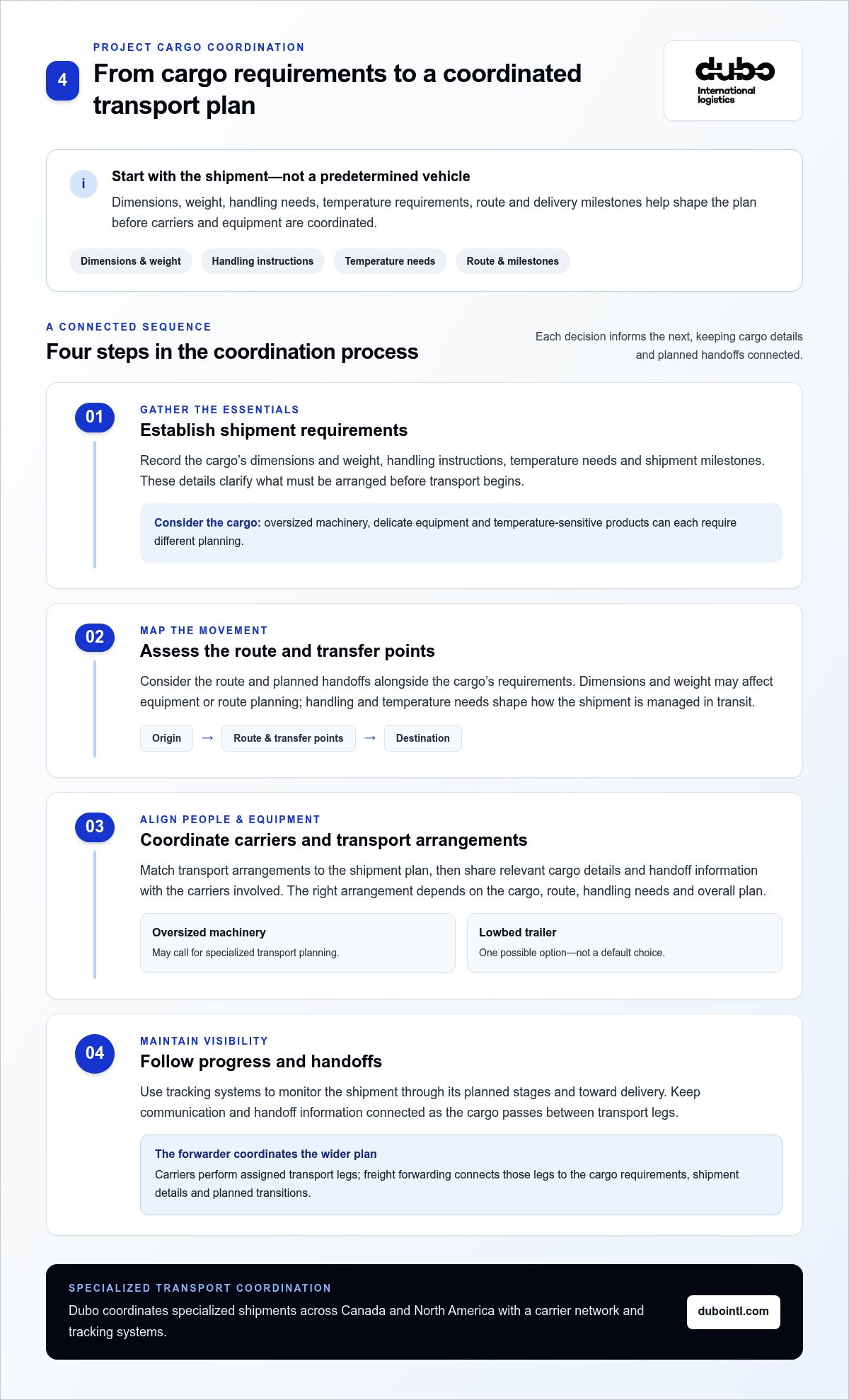
Coordination starts with the shipment requirements, not a predetermined vehicle. The planner brings cargo details, origin and destination, handling needs, route considerations and delivery timing into one working plan. This helps identify what must be arranged before transport begins and what information each carrier needs for its assigned leg.
A project cargo shipment needs a plan tailored to its cargo and route. For businesses looking for a project cargo freight forwarder Canada-wide, the planning process can be understood as a series of connected decisions:
- Establish the requirements: Gather dimensions, weight, handling instructions, temperature needs and shipment milestones.
- Assess the movement: Consider the route and transfer points alongside the cargo’s requirements.
- Coordinate carriers and equipment: Match transport arrangements to the shipment plan and share relevant details with the parties involved.
- Follow progress and handoffs: Use tracking to monitor the shipment through its planned stages and toward delivery.
Matching transport arrangements to cargo requirements
Equipment selection depends on the cargo, route, handling needs and overall plan. Oversized machinery may call for specialized transport planning; a lowbed trailer is one possible option, not a default choice. The appropriate arrangement depends on the shipment’s requirements and the route it must travel.
Other cargo calls for different considerations. Delicate equipment needs a plan that accounts for careful handling, while temperature-sensitive products require appropriate transport arrangements. Assessing these needs separately helps prevent a standard equipment assumption from driving decisions before the cargo has been reviewed.
Managing carrier coordination and shipment visibility
A carrier network gives a forwarder options for coordinating specialized transport around the shipment plan. The forwarder aligns cargo details, planned stages and handoff information with the carriers involved. This helps keep responsibilities clear as the shipment passes between transport legs.
Tracking systems provide visibility into shipment progress. They help teams follow movement across stages and stay oriented to planned handoffs, alongside direct coordination. For background on route and permit considerations in Canadian heavy-haul movements, see Canadian heavy haul and project freight coordination.
Dubo coordinates specialized transport around cargo-specific needs, supported by a carrier network and tracking systems. Its specialized transportation solutions connect tailored transport coordination with shipment requirements. Find more information about Dubo’s logistics support at Dubo International Logistics.
Project cargo forwarding versus standard and LTL freight coordination
Freight options differ in how much planning a shipment needs. Standard freight generally suits routine transport requirements, while LTL freight shipping shares trailer capacity among multiple shippers. Project cargo calls for closer attention to specific handling, coordination and visibility needs. These approaches can overlap, but they aren’t interchangeable by default.
| Coordination factor | Standard freight | LTL freight shipping | Project cargo |
|---|---|---|---|
| Planning complexity | Typically follows routine shipment requirements. | Plans for shared trailer capacity and multiple shipments. | Tailored to cargo requirements and the planned movement. |
| Cargo-specific handling | Based on the shipment’s usual handling needs. | Must account for handling within a shared load. | Arranged around the cargo’s particular requirements. |
| Coordination needs | Focused on the planned transport movement. | Includes coordination around shared capacity and shipment stages. | May require closer alignment of transport arrangements and handoffs. |
| Shipment visibility | Supports awareness of the planned movement. | Helps follow progress through shared transport stages. | Tracking can help teams follow project-specific milestones and transitions. |
When standard freight planning may not address the full requirement
Routine freight planning can suit shipments whose requirements fit established transport arrangements. Unusual dimensions, delicate handling needs or environmental considerations can add decisions that call for project-specific coordination. That doesn’t mean every shipment outside the norm requires the same equipment or process. The right plan depends on the cargo and how it must move.
For instance, oversized machinery may prompt a closer review of transport arrangements, while delicate equipment or temperature-sensitive products may need distinct handling considerations. A project cargo freight forwarder Canada shippers work with can organize the plan around those specific requirements instead of assuming one approach fits every shipment.
When LTL freight shipping can fit a project shipment
LTL freight shipping is a method in which multiple shippers share trailer capacity. It may suit a project shipment when the cargo’s handling and transport requirements can be coordinated within that shared arrangement. The label alone doesn’t determine suitability; cargo characteristics and the planned movement still matter.
Dubo can manage specialized transport projects within an LTL framework when appropriate, matching coordination to the shipment rather than treating LTL as a universal solution. The guide to specialized freight across North America puts these choices in the wider context of planning specialized freight movements. Select the freight framework only after establishing the requirements it must support.
How to prepare a Canadian project cargo shipment for coordinated transport
Good coordination starts with clear shipment information. Accurate cargo and delivery details make it easier to identify planning questions before they affect equipment selection, route decisions or handoffs. A project cargo freight forwarder Canada shippers work with can use this information to shape a shipment-specific plan.
To begin, gather the cargo’s dimensions and weight, handling requirements, origin and destination, and timing needs, including delivery milestones. Add relevant details about fragility or temperature sensitivity, along with known constraints at pickup or delivery points.
Assemble cargo and handling information
Record measurements and weight as accurately as possible, and describe how the cargo should be handled during loading, transport and transfer. For fragile equipment, note known handling concerns or orientation requirements. For temperature-sensitive products, share the applicable shipment requirements so they can inform transport planning. Clear descriptions help the forwarder coordinate around the cargo instead of relying on assumptions.
- Describe the cargo: Gather its dimensions, weight, quantity and any details that affect how it can be moved or handled.
- Explain special needs: Identify fragility, temperature sensitivity and other relevant handling considerations.
- Set out the movement: Provide the origin, destination and timing needs, including significant delivery dates or project milestones.
- Share site considerations: Describe known access or receiving constraints at pickup and delivery points that may affect the transport plan.
- Review the coordinated plan: Align shipment details with proposed transport arrangements, communication points and handoffs.
Align milestones, communications, and handoffs
Milestones give the shipper, forwarder and carriers a shared reference for planned shipment stages. An end-to-end freight management approach connects those stages through a common view of progress and the transitions that need coordination. Agreeing on what each milestone means helps teams communicate clearly and identify when a change needs to be shared.
Proactive planning brings route, equipment and handoff considerations into view early. If cargo details or timing change, sharing the update promptly gives the parties coordinating the movement a chance to reassess the plan.
Preparation is not paperwork for its own sake. It gives the shipment team a reliable basis for coordinating specialized transport and keeping delivery requirements visible as the plan develops. Read more about coordinated project cargo planning with Dubo International Logistics.
How Dubo coordinates project cargo freight forwarding across Canada
Complex cargo needs more than a transport booking. Dubo International Logistics coordinates project cargo and specialized transportation across Canada and the United States, bringing shipment requirements, carrier arrangements and delivery transitions into a plan shaped around the project. As a project cargo freight forwarder Canada businesses can work with, Dubo supports movements that call for careful attention to cargo-specific needs from planning through delivery.
Specialized transport planning grounded in cargo requirements
Each shipment has its own planning considerations. Oversized machinery may call for specialized transport arrangements, while delicate equipment can require particular attention to handling. Temperature-sensitive products bring environmental requirements into the plan. Dubo tailors coordination to the cargo and project rather than applying one transport approach to every movement.
A carrier network helps coordinate specialized transport arrangements, while tracking systems support visibility as shipments progress. These tools contribute to coordination alongside a shipment-specific plan. The plan connects cargo details with the transport stages and handoffs involved, keeping relevant requirements in view as the movement advances.
Some specialized transport projects can also be coordinated within an LTL framework. Whether that approach fits depends on the cargo’s handling and transport requirements; it isn’t a universal answer for project freight. Dubo’s membership in the Canadian International Freight Forwarders Association (CIFFA) is part of its professional grounding in freight forwarding.
Across Canada and North America, coordination means considering the shipment as a connected movement, not treating each transport leg as an isolated booking. This perspective is particularly useful when a project depends on cargo arriving where it is needed, with requirements communicated across the parties involved.
Plan the next step with a logistics partner
A focused planning discussion starts with the essential shipment details. Gather the cargo’s dimensions and weight, origin and destination, handling requirements, timing needs and key project milestones. For fragile or temperature-sensitive products, include the handling or environmental considerations relevant to the shipment. These details provide a practical starting point and help clarify which transport and coordination questions need attention.
It’s also useful to identify the delivery stage the cargo must support and any known constraints at pickup or delivery. With this information, Dubo can discuss how shipment requirements, carrier coordination and handoffs fit together, including whether an LTL framework suits the movement. The aim is a clear plan aligned with the cargo and project, rather than an assumption that every shipment follows the same path.
For specialized cargo movements across Canada or North America, discuss your project cargo shipment with Dubo.
Set the shipment plan in motion
A complex shipment is easier to manage when its transport plan is treated as part of the wider project, not an afterthought. Connect cargo requirements with the operational priorities around them: what the delivery must support, which milestones matter and where teams need clear coordination as plans evolve.
That shared perspective gives the team a practical starting point for decisions about shipment arrangements and communication. A project cargo freight forwarder Canada businesses rely on can help turn those priorities into a coordinated plan shaped around the movement, rather than a generic booking.
You don’t need every detail resolved before beginning the discussion. Bring the information available, identify what remains uncertain and work through the requirements with a logistics partner. Clear planning gives your team a sound basis for moving from project needs to transport decisions.
Start a coordinated shipment discussion with Dubo International Logistics.
Frequently Asked Questions
Is project cargo the same as oversized cargo?
No. “Oversized” describes a physical characteristic; “project cargo” indicates that the shipment needs coordinated planning around its particular requirements. The terms can overlap, but they aren’t interchangeable. A shipment may need project-level coordination because delivery is tied to a wider operational sequence, even if dimensions aren’t the main planning concern. Describe what makes the movement complex, not only how large the cargo is.
Does every project cargo shipment require a lowbed trailer?
No. A lowbed trailer is not automatically required. The choice depends on the movement, so avoid specifying a trailer type based on the project cargo label alone. When sharing cargo information, distinguish the item’s measurements from any packaging or transport configuration that affects how it will be moved. This gives the planner a clearer basis for assessing equipment needs without locking the shipment into an unsuitable assumption.
Can project cargo include fragile or temperature-sensitive equipment?
Yes. For sensitive cargo, provide any handling or environmental guidance available from the equipment or product documentation. Identify which components need particular care and whether requirements apply throughout the movement or at specific stages. These details help the planning team communicate relevant instructions to the parties involved. Avoid relying on a broad label such as “fragile” when more specific handling information is available.
Can LTL freight shipping work for a project cargo shipment?
It can, depending on the shipment’s requirements. Before considering an LTL arrangement, clarify how the cargo is packaged, whether it can be handled alongside other freight and what delivery sequence the project depends on. These details help assess whether a shared-capacity framework fits the movement. A project cargo freight forwarder Canada shippers work with can consider LTL as one planning framework, rather than assuming it suits every shipment.
How does a freight forwarder coordinate multiple carriers?
The forwarder coordinates the information and timing needed to connect carriers’ assigned stages. Keep changes to cargo readiness, receiving plans or delivery priorities clearly documented and share them through the agreed communication channel. This helps reduce conflicting instructions between parties. Carriers remain responsible for their own transport legs, while the forwarder organizes the broader movement.
What shipment details should I gather before planning project cargo?
Alongside basic cargo and route information, note when the shipment will be ready for pickup and who will receive it at destination. Identify project dates that could affect delivery priorities, and flag details that are estimates rather than confirmed. Separating known information from open questions helps focus the planning discussion on decisions that need attention instead of treating provisional details as settled instructions.
Can a project cargo freight forwarder coordinate shipments across Canada and the United States?
Yes. Dubo International Logistics coordinates project cargo movements across Canada and the United States. For an international movement, identify where the shipment begins and ends, how delivery fits the project schedule and which parties are involved at each stage. A clear picture of those dependencies helps frame coordination across the route and keep communication aligned as the shipment progresses.
Contact Dubo International Logistics to discuss your project cargo shipment.

