

Changing freight forwarders is best handled in phases, not abruptly. To understand how to change freight forwarders without disrupting operations, let shipments already in transit finish with the current provider, then test the new arrangement with a small group of future bookings. This lets you assess the service while keeping cargo moving.
Expect clear updates, reliable document coordination, and arrangements suited to your cargo and routes. Repeated, unresolved problems in these areas may justify planning a change, although one poor shipment alone may not be enough.
This guide explains how to assess a new forwarder’s experience, network, communication, and fit with your operations. It also covers managing in-transit shipments, assigning responsibilities, and timing the handover around your business needs.
Key Takeaways
- Compare a new forwarder’s service scope, communication, timing and cargo expertise, not just its quote.
- Let shipments already in transit finish with the current forwarder, while keeping their milestones, documents and status visible.
- Test the new arrangement with a small group of shipments before shifting more volume.
- Plan the handover around your lanes, cargo needs, systems and staff responsibilities to reduce missed tasks.
- Look for recurring, unresolved service problems when deciding whether a change is needed, rather than reacting to one poor shipment.
1. How Can I Know My New Freight Forwarder Is Trustworthy?
Trust starts with clear, testable commitments. Ask the new forwarder to explain its services, shipment milestones, communication process, and responsibility for each task. Request a written outline identifying who coordinates pickup, carrier handoffs, document delivery, and final delivery. Compare that process with your shipment instructions, then note any responsibilities your team must retain. This gives you a practical basis for deciding whether the proposed arrangement fits your operations.
Timing requires the same precision. Ask how transit estimates are set, what can affect them, and when you’ll receive updates if a shipment is delayed. For example, produce may require refrigerated transport, while fragile equipment needs suitable handling arrangements. The forwarder should explain how its proposed logistics plan fits your cargo, route, and delivery window, rather than applying one arrangement to every shipment.
Evaluate communication before transferring significant shipment volume. Ask who will answer routine questions, how shipment milestones are reported, and what happens after a missed pickup. Use a sample scenario, such as a supplier changing a collection date, and listen for a clear sequence of actions. If your team needs repeated calls to get one shipment update, the communication process needs attention.
Assess whether the forwarder can support your business as it develops. Map expected changes in shipment volume, destinations, cargo types, and systems over the coming years. A provider suited to today’s shipments may not fit new routes or specialized handling needs. Ask how its service model can adapt, and document which capabilities matter most to your operation.
Review service performance regularly against the same lanes and requirements. Track delivery performance, document timing, communication, and responses to delays. Keep a record of recurring issues and resolved problems so one unusual shipment does not outweigh the broader pattern. This review shows whether the working relationship continues to meet operational needs.
Finally, assess the practical value of freight forwarding for your business. A forwarder coordinates cargo movement, carriers, shipment information, and logistics planning, helping reduce the coordination burden on internal teams. List the tasks your staff currently manage, such as booking updates or supplier communication, and compare them with the responsibilities proposed under the new arrangement. Clear boundaries make it easier to assess service fit and plan a reliable transition.
2. Managing in-transit shipments during a transition
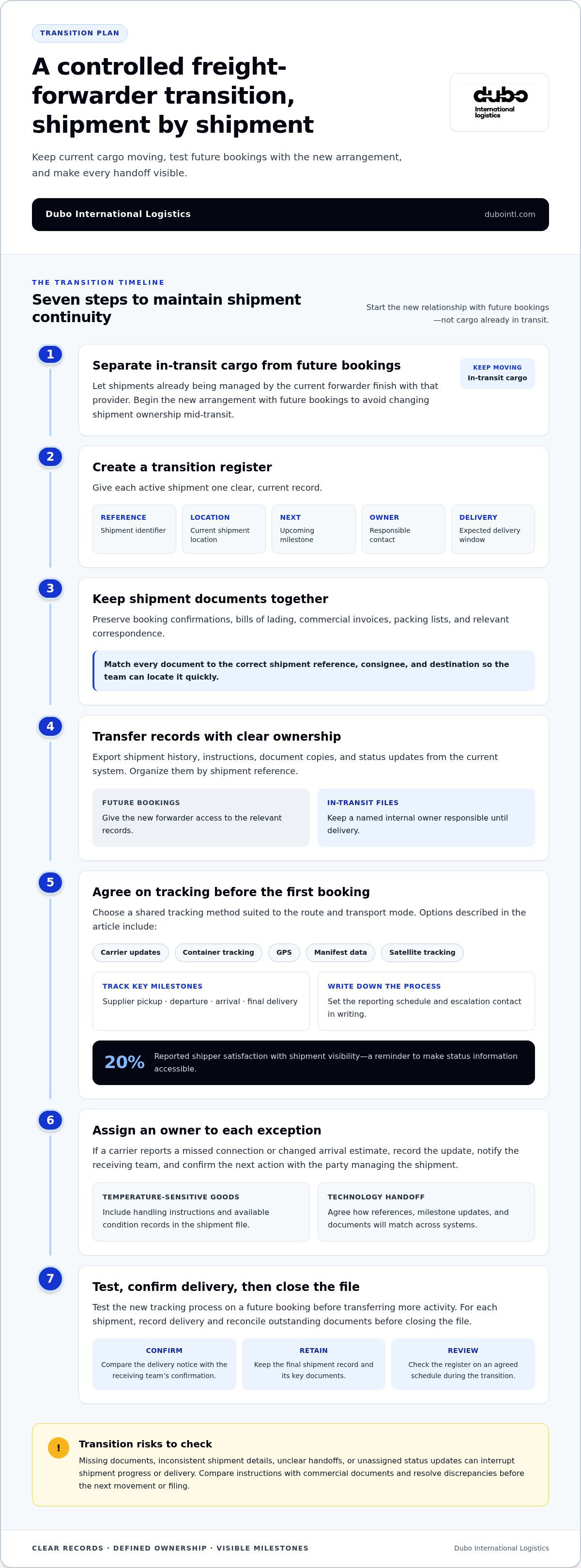
Keep existing shipments with the forwarder already managing them, and start the new arrangement with future bookings. This avoids changing shipment ownership mid-transit, when carriers, importers, and destination contacts may already rely on established instructions. Create a transition register with each shipment’s reference, current location, next milestone, responsible contact, and expected delivery window.
For every in-transit shipment, preserve access to booking confirmations, bills of lading, commercial invoices, packing lists, and relevant correspondence. A bill of lading can be an important document when arranging shipment receipt. Match each document to the correct shipment reference, consignee, and destination so staff can find it quickly.
How do I transfer shipping records, customs documents, and shipment tracking to a new forwarder? Export the shipment history, instructions, document copies, and status updates from the current system, then organize them by shipment reference. Give the new forwarder access to records for future bookings, while keeping a named internal owner responsible for in-transit files until delivery.
Agree on a shared tracking method before the new forwarder handles a booking. Depending on the route and transport mode, this may use carrier updates, container tracking, GPS, manifest data, or satellite tracking. Define the milestones that matter, such as supplier pickup, departure, customs status, arrival, and final delivery. Set the reporting schedule and escalation contact in writing.
What risks can arise when switching freight forwarders, and how can I avoid delays or cargo holds? Missing documents, inconsistent shipment details, unclear handoffs, or unassigned status updates can interrupt clearance or delivery. Compare shipment instructions with the commercial documents, confirm who handles each customs communication, and resolve discrepancies before the next movement or filing.
Assign a clear owner to each exception. If a carrier reports a missed connection or changed arrival estimate, record the update, notify the receiving team, and confirm the next action with the party managing the shipment. For temperature-sensitive goods, include handling instructions and available condition records in the shipment file. This gives teams a reliable basis for responding to delays.
Technology should support the handover, not create another gap. If the new forwarder’s tracking portal differs from your existing system, agree how shipment references, milestone updates, and documents will be matched. Test the process on a new booking before transferring more activity. A reported figure puts shipper satisfaction with shipment visibility at 20%, underscoring why access to useful status information matters.
Close each file only after recording delivery and reconciling outstanding documents. Compare the delivery notice with the receiving team’s confirmation, then retain the final shipment record and its key documents. During the transition, review the register on an agreed schedule so an overlooked shipment, pending customs update, or carrier exception does not fall between teams.
3. Assessing a forwarder’s network and transportation experience
A route map matters less than proven experience on your actual lanes. Ask how many shipments the forwarder handled on each key lane over the last 12 months, and which carriers it booked. Compare the answer with your origin, destination, transport mode, and cargo profile. For an international route, clarify how the forwarder coordinates handoffs between carriers and manages schedule changes across the journey.
Assess capability for your specific cargo, too. A beverage shipment may require temperature-sensitive handling, careful pickup coordination, and clear instructions for each carrier. Ask how the proposed plan addresses product requirements from origin to destination, including what happens if a connection changes. If your shipments use different modes or service levels, assess the network for each rather than assuming strength on one lane applies to all.
What notice period or contract terms apply when ending a freight forwarding agreement in Canada? Start with the signed agreement: it sets the notice period, termination process, renewal terms, and any commitments tied to booked shipments. Put the intended end date in writing and align it with open bookings, record access, and the planned start date for the replacement arrangement.
Build a transition schedule around shipment dates and operational responsibilities. Identify the handover point for each lane, the first booking managed under the new arrangement, and the staff member accountable for each task. A standard operating procedure should define account management, performance measures, and regular review cycles. It should also identify the government agencies that regulate different parts of a shipment, so teams understand where compliance responsibilities sit.
Choose a phased transition when continuity and learning matter. Start with a small set of shipments across different lanes, modes, or service levels, then review the results before moving more volume. A full transition may suit a situation where accounts, systems, and responsibilities are ready to change together, but it concentrates handover work. Either way, assign one internal owner to track open actions and resolve gaps between teams.
Use a written scorecard to compare the new network with your operating needs. Track milestones such as booking acceptance, pickup coordination, document handoffs, and delivery updates. Schedule a review after the test shipments, then record missed steps and corrective actions. This makes the change a managed process, not simply a new carrier relationship, and gives staff a clear reference when international schedules shift.
4. Communication and account management
Set communication rules before the new forwarder handles a shipment. Name the account lead, operational contacts, escalation path, and backup contact in writing. Agree which team owns booking changes, supplier instructions, shipment documents, and customer notices. For example, if a supplier changes pickup readiness, staff should know who updates the booking and informs the receiving team. Clear ownership keeps supply chain tasks from falling between departments.
Agree on update points that match your operations. The new forwarder should report at booking confirmation, departure, customs status, and arrival. Set a preferred channel for each update, such as a transportation management system (TMS), email, or scheduled account review. Define what counts as an exception, who receives the alert, and what information they need to act.
Before connecting a TMS, map the data your team needs to exchange. Match shipment references, supplier details, delivery locations, document fields, and status codes between systems. Test a sample booking from entry through delivery, then confirm that the right staff can access updates. Integrations should be secure and fit existing systems and workflows, rather than forcing teams to manage duplicate records.
Account management also needs a shared operating plan. Document the lanes, shipment volumes, systems, responsibilities, service expectations, and review schedule. Include relevant regulations and identify the government agencies overseeing different parts of each shipment. Assign an owner to maintain the procedure when routes, suppliers, or internal responsibilities change. A current reference gives the forwarder and your team a consistent way to manage recurring work.
Prepare internal teams and external partners for the handover. Share the change date and new contact details with suppliers, customers, and colleagues who arrange or receive shipments. Provide the new forwarder with supplier contacts, shipment history, documentation requirements, and delivery instructions. For an international supply chain, clarify who communicates with overseas suppliers and how language or local business practices affect handoffs.
Review performance using evidence, not impressions. At scheduled account reviews, compare shipment updates, delivery performance, document timing, and unresolved exceptions with the agreed service expectations. Record each issue, its owner, and the corrective action, then revisit it at the next review. If a TMS report shows repeated missing milestones on one lane, investigate that workflow with the forwarder and the responsible internal team.
A well-managed account relationship makes change easier as your supply needs evolve. Keep the operating plan, contact list, system instructions, and escalation process aligned whenever a lane or supplier changes. This gives both teams a practical reference for routine shipments and exceptions while preserving clear accountability across the supply chain.
5. Operational reasons to change freight forwarders
One poor shipment does not automatically justify a change. Repeated, unresolved failures are stronger evidence, especially when they affect delivery schedules, export documentation, or production plans. Track each issue by shipment, lane, date, operational impact, and response. For example, record recurring missed pickups separately from isolated carrier delays, then assess whether the forwarder identifies causes and follows through.
Look for patterns across the service, not just one late arrival. Repeatedly missing documents, late shipment notices, unclear ownership, or inaccurate status updates can disrupt receiving teams. Compare these incidents with agreed service expectations and your own records. If the same handoff fails across shipments, identify where responsibility breaks down and whether corrective actions prevent a repeat.
Capacity and process fit can also change as a business grows. A forwarder managing 100 to 10,000 shipments a month cannot rely on spreadsheets alone. If your volume, destinations, or service mix has expanded, examine whether booking, tracking, exception handling, and reporting still support operations. A system that worked for a small shipment programme may create manual errors at greater scale.
Assess whether the forwarder can adapt when your supply chain changes. A new export market, supplier, or delivery requirement may call for different routes, carriers, or transport modes. If each change leads to confusion or delays, document the operational gap. Then compare the current arrangement with the requirements your team now needs to meet.
Separate provider performance from issues outside its control. A missed delivery may stem from a carrier disruption, incomplete shipment information, or a change at origin. Ask for a clear timeline of events, the decisions made, and the steps taken to limit the impact. A useful review distinguishes a one-off disruption from poor communication or repeated failure to manage exceptions.
Before deciding, give the current forwarder specific concerns and a defined review process. Share shipment examples, operational consequences, and the improvement needed. Record agreed actions, owners, and review dates. If the same problem persists after a reasonable opportunity to correct it, the evidence supports planning a transition rather than reacting to frustration.
Use a decision record to protect continuity. Summarize the recurring issue, affected lanes, customer or production impact, attempted fixes, and remaining risks. For example, if late documentation repeatedly delays export handoffs, include the relevant shipment references and document milestones. This record helps your team explain the change internally and set clearer requirements for the next arrangement.
The practical test is whether the forwarder’s service still fits your operations. Consider changing when documented, unresolved problems, limited capacity, or poor process fit threaten reliable cargo movement. Base the decision on evidence, and plan the transition around open shipments, team responsibilities, and supply chain needs.
Dubo International Logistics: Freight forwarding
Dubo International Logistics provides freight forwarding for businesses coordinating domestic and cross-border cargo movement. Its logistics consulting can help teams assess transition requirements, organize shipment responsibilities, and align freight plans with operational needs. For oversized machinery, fragile equipment, or temperature-sensitive products, specialized transportation services address cargo requirements that standard arrangements may not suit.
Consider this support when a forwarder change involves complex routes, specialized cargo, or multiple handoffs. Reviewing lanes, shipment details, and handling requirements helps shape a transition plan around your business operations. Dubo International Logistics provides freight forwarding, logistics consulting, and specialized transportation services to support these requirements.
To discuss your freight transition, visit www.dubointl.com.
Make the Next Freight Decision with Confidence
Changing forwarders can prompt a wider review of how logistics decisions are made. As you consider how to change freight forwarders, clarify who owns future provider reviews, how operational requirements are documented, and when your team will revisit its freight strategy. This creates a practical foundation for adapting as suppliers, markets, or cargo needs change.
Knowing how to change freight forwarders is a useful starting point, but carrying the plan into daily operations takes informed coordination. Make the process part of a considered logistics decision, with decision-makers aligned on the business requirements that matter most.
Dubo International Logistics offers freight forwarding, logistics consulting, and specialized transportation services. Contact Dubo International Logistics to discuss your freight requirements and explore a suitable path forward.
Frequently Asked Questions
How Can I Know My New Freight Forwarder Is Trustworthy?
Look for verifiable credentials and experience relevant to your trade lanes. In Canada, CIFFA is the Canadian International Freight Forwarders Association. Ask how the forwarder applies its procedures to your cargo and operating needs, then compare its explanations with written service commitments. Consistent, specific answers from the people responsible for your account provide more useful evidence than a polished presentation alone.
How Easy Is It To Switch Freight Forwarders?
The effort involved depends on how many internal systems, approvals, and supplier relationships are tied to the current arrangement. A business using one booking process may have fewer workflow changes than one with separate procedures for each division. Before setting a transition date, identify who approves bookings, which teams use shipment data, and whether system permissions need revision. This clarifies the internal work required.
What information and documents should I provide to a new freight forwarder?
Give the forwarder shipment-level details to plan handling accurately: item descriptions, dimensions, weight, packaging type, pickup constraints, and delivery-site requirements. Record special instructions, such as fragile components or temperature sensitivity, against the relevant items rather than only in general account notes. For recurring shipments, a consistent template can reduce missing information and make differences between products easier to identify.
Can I change freight forwarders while a shipment is in transit?
A shipment may sometimes be reassigned, but the practical options depend on its booking stage and current carrier arrangements. First establish whether the cargo is still at origin, has been collected, or has been handed to another carrier. Those milestones affect which parties can act on instructions. Keep existing arrangements distinct from future bookings, and record any agreed change with the parties responsible for the movement.
How do I compare freight forwarder rates, services, insurance, and transit times in Canada?
For a meaningful operational comparison, review the written service scope, proposed transport mode, transit estimates, and shipment-update process side by side. Read insurance terms for coverage limits, exclusions, and claims procedures, since details can differ even when service descriptions sound similar. Check whether the proposed timing fits your receiving schedule and cargo requirements. Record assumptions so each option is assessed on the same basis.
What fees, cancellation charges, or outstanding balances can apply when changing freight forwarders?
Check the signed agreement for termination and renewal terms, notice requirements, and commitments tied to booked shipments. Compare invoices with quotes, and ask for itemized charges that distinguish base freight, additional charges, service levels, and value-added coverage.
