

A freight invoice should be verified against the shipment and agreed terms before payment. To understand how to audit freight invoices, compare the billed rate and service with shipment records, then examine accessorial charges, weights, dimensions and any adjustments. If a detail doesn’t match, document the discrepancy and resolve it before closing the invoice.
Freight billing can involve several records and charge types, so a careful review takes more than checking the total. Learn how to audit freight invoices by comparing rates, shipment details, and additional charges, then use a clear process to identify and resolve billing discrepancies.
This guide explains invoice-level and shipment-level checks, what to review when charges differ from expectations, and how resolving issues before payment can simplify the process. It also covers how freight forwarding and logistics consulting can support complex shipment requirements.
Key Takeaways
- Freight audits compare carrier invoices with shipment records, agreed rates and the service delivered.
- Review accessorial charges alongside billed weights and dimensions to identify charges that may need correction.
- Keep shipment descriptions and measurements accurate so invoice checks can be matched to reliable records.
- Document discrepancies and resolve them through a clear exception process before closing the invoice.
- For complex shipment requirements, freight forwarding and logistics consulting can help coordinate the wider movement of cargo.
Why Are Freight Invoice Errors Are So Common?
Freight billing errors arise when invoice charges don’t match shipment records, contracted rates, or the service delivered. To calculate audit savings, compare confirmed recoveries and avoided overpayments with the effort required to review invoices; manual checks suit lower volume, while automation can help as volume grows.
The exposure can accumulate across routine shipments. Estimates place losses from freight overcharges and other errors at 3% to 5% of total shipping bills, while freight audits may recover 5-8% of total freight spend.
Sources of Billing Errors
Billing errors happen when shipment information, rates, services, or additional charges are recorded or applied incorrectly. A carrier invoice might show a different service level from the shipment record, apply a rate that differs from the agreement, or include a charge without supporting details.
Small mismatches become harder to spot across multiple logistics systems and carriers. Supply Chain and Demand Executive estimates that nearly one in every four freight invoices is rejected and needs remediation. In October of 2020, shipper respondents reported an average invoice inaccuracy rate of 20.8%. These findings show why consistent records and exception tracking matter.
Audit findings can reveal patterns as well as individual errors. Group discrepancies by carrier, charge type, route, or service. Repeated errors in one category may indicate a process issue that needs clearer billing instructions or more focused invoice review.
Manual Checks and Human Error
Manual review involves comparing invoice lines with shipment records and rate information without automated matching. It can work for a manageable invoice volume, but every additional shipment means more details to compare and more opportunities to miss an exception.
Repeated data entry and review can lead to missed adjustments, inconsistent decisions, or duplicate work when a corrected invoice arrives. For example, an employee might approve the original bill and then fail to link a re-bill to the earlier payment record. A consistent exception log helps prevent the same discrepancy from being reviewed twice.
Automated audit systems can process thousands of shipments at once, but they require staff training and system infrastructure. The right approach depends on invoice volume, data quality, and the time available for review. Compare confirmed recoveries and avoided incorrect payments with the effort required, then reassess as shipment volume changes.
Regular reporting turns invoice checks into a practical control. Record each discrepancy’s type, frequency, and financial impact, then share recurring findings with accounts payable, procurement, and logistics teams. They can use these patterns in business reviews to address billing causes and improve invoice handling.
What is Freight Audit?
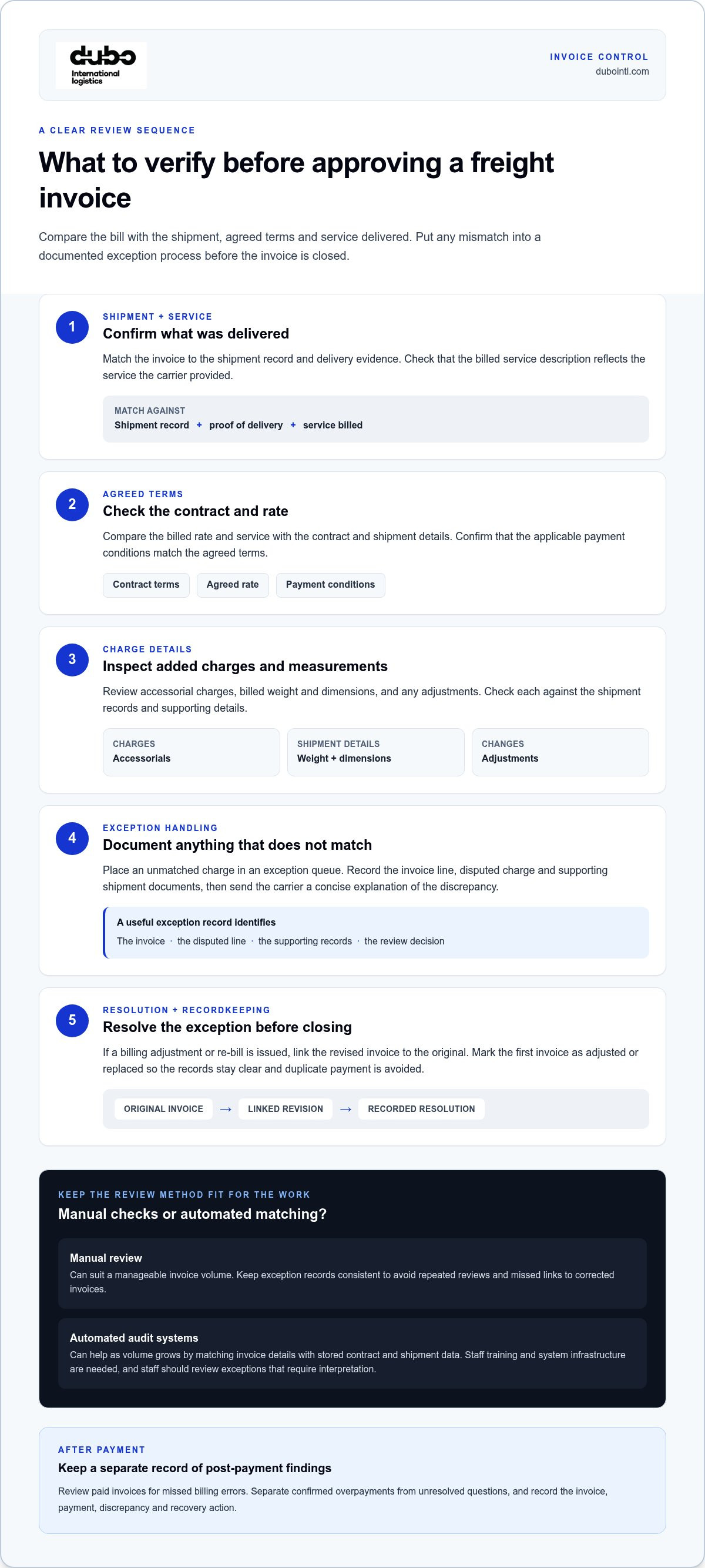
A freight audit checks carrier invoices against the shipment, agreement, and service delivered. Knowing how to audit freight invoices gives payment teams a defined process for reviewing charges, investigating exceptions, and approving supported amounts.
Freight Payment and Billing Discrepancies
Freight payment includes reviewing a carrier’s invoice, confirming the service, and resolving billing differences before payment is finalized. Carriers should invoice upon delivery and include proof of delivery, allowing the organization to confirm the shipment was completed.
When a charge differs from the agreed amount, document the invoice line and supporting shipment record. If the discrepancy is confirmed, the shipper may reduce payment by the incorrectly billed amount. This prevents an unsupported charge from being treated as an approved transportation expense.
A billing adjustment or re-bill creates a second freight invoice. Link the revised invoice to the original record, then mark the first invoice as adjusted or replaced. This helps accounts payable avoid paying both versions and keeps a clear record of the resolution.
Confirming Services and Payment Terms
To confirm contracted services, compare the invoice with the contract, shipment record, and delivery evidence before authorizing payment. This establishes whether the carrier provided the billed service and whether the agreed terms apply to that shipment.
Compare the service description and delivery evidence with the service billed on the invoice. Then check the applicable contract terms, rate, and payment conditions. If the invoice includes a different service or charge, place it in an exception queue rather than treating it as approved.
Digital freight audit systems can check invoices before payment is released, helping teams catch issues early. Automation can match invoice details against stored contract and shipment data, while staff review exceptions that need interpretation. This creates a repeatable process without treating an unmatched charge as automatically valid.
Consistent communication matters during a review. Send carriers a concise discrepancy record identifying the invoice, disputed charge, and supporting documents. A clear explanation helps the carrier respond to the specific issue and gives payment teams a record of the decision.
Post-Payment Audits and Overpayment Recovery
A post-payment audit reviews invoices that have already been approved and paid, looking for overpayments or billing errors missed earlier. For example, an audit of historical ocean freight invoices can identify overpayments.
Separate confirmed overpayments from unresolved questions, then document the invoice, payment, discrepancy, and recovery action. This record helps finance teams track whether a carrier adjustment or repayment has been received and prevents the same item from entering a later review twice.
Pre-payment review is generally more efficient than trying to recover funds after payment. Still, a post-payment audit can reveal patterns that improve future controls. Use the findings to refine invoice matching, clarify contract data, and focus staff attention on recurring billing exceptions. A consistent process also helps teams apply the same review principles across carrier accounts.
Verifying freight invoices against agreed rates and shipment documents
A freight invoice review compares billed charges with the agreed rate, shipment details, and service delivered. In Canada, useful records include the invoice, bill of lading, signed proof of delivery, contract or rate card, and shipment data. Together, they help establish whether the billing matches the completed shipment.
Matching Invoices to Shipment Records
Match each carrier invoice to the shipment and delivery records that support its charges. This can identify bills associated with the wrong shipment or service. Start with the shipment reference, then compare the invoice with the bill of lading and signed proof of delivery.
Check that the carrier, origin, destination, and delivered service align across the records. For example, a delivery record for one shipment cannot support an invoice with a different shipment reference. Keep unmatched invoices in an exception queue until the records explain the difference. This maintains visibility without treating an incomplete match as approval.
Checking Shipment Descriptions and Measurements
Accurate shipment descriptions, weights, and dimensions provide the data needed for a reliable comparison. Incorrect measurements can affect rating, while vague descriptions can make it difficult to assess the billed service.
Compare shipment records and the bill of lading with the carrier’s quote and invoice. Confirm that the package count, description, weight, and dimensions align. Where standard packages have standard weights, invoice-level validation may work. For shipments with varying measurements, compare each shipment’s details with its quote and billed charges.
Freight Invoice Ingestion and Matching
Invoice ingestion brings carrier bills into a review system and matches their details with shipment data. Consistent reference fields help connect each invoice to its supporting records and reduce unresolved entries.
Whether staff enter invoices manually or use digital systems, standardize fields such as shipment reference, carrier, invoice date, and billed service. Match these against shipment data, contract terms, and the rate card. Send missing or conflicting details for review. This creates a consistent workflow for auditing freight invoices across multiple carriers.
Shipment-Level Verification
Shipment-level verification checks charges against the details of an individual shipment, rather than relying only on invoice totals. It can reveal mismatches that a broad account-level review may miss.
Compare measurements and service details with the carrier’s quote and invoice. Assess the billed amount against applicable contract rates, terms, and effective dates. Confirm that the invoice reflects the service delivered and applicable tax treatment. Keep the comparison with the shipment record so reviewers can follow the decision and identify which detail needs correction.
Keep each shipment’s invoice, bill of lading, delivery proof, quote or rate card, and shipment data together. This record set traces a charge from the supply-chain transaction through to payment. It also helps teams audit freight invoices consistently as routes, carriers, and shipping requirements change.
Auditing accessorial fees, weight, and dimensional charges
Accessorial fees and measurement-based charges can increase a freight bill beyond its base rate. Check each item against the carrier’s contract, shipment details, and service records to distinguish supported charges from discrepancies.
Validating Accessorial Fees
Accessorial validation confirms that each additional charge matches the service performed and the applicable carrier terms. Compare the fee description with shipment records and supporting documents, such as delivery evidence. A billed service without a matching record needs review. Also compare repeated line items to identify duplicate charges before approving the freight bill.
Review service-level charges against the service delivered and applicable contractual commitments. If the invoice bills a higher service level than the shipment record supports, flag the difference and document the evidence. A missed delivery window or another service-level failure may also affect the invoice review, depending on the agreed terms.
For mileage-based charges, compare the billed route or distance with the shipment’s recorded origin and destination, then check the carrier’s rating method. Don’t assume a route difference is an error on its own. Record the discrepancy and compare it with the applicable contract terms before deciding whether the charge needs correction.
Check for duplicates across the full invoice, not just adjacent lines. For example, an accessorial fee might appear once under a named service and again as a general surcharge. Compare descriptions, shipment references, and supporting documents. This gives shippers clearer insight into recurring billing issues and helps operations focus on the cause.
Verifying Weight, Dimensions, and Taxes
Measurement checks compare billed weight and dimensions with the shipment’s recorded figures and the carrier’s rating method. Accurate measurements matter because they can affect how a shipment is rated. Compare package-level data with the quote and invoice, then investigate any mismatch before accepting the charge.
Where shipments use standard package weights, invoice-level validation may be suitable. For varying freight, check each shipment’s measurements against its quote and billed charges. Confirm that the description, weight, and dimensions refer to the same shipment. Mixed or incomplete records can lead to an incorrect comparison.
Review the tax structure on the freight bill against the applicable contract and shipment details. Confirm that the invoice reflects the agreed service and rate before assessing tax treatment. If the freight charge itself is disputed, keep that issue separate from the tax review so each discrepancy has a clear record.
A consistent review process can group exceptions by charge type, carrier, and shipment. This helps shippers see whether accessorial fees, mileage, measurements, or taxes create recurring issues. Use the findings to refine invoice controls and clarify billing information across logistics operations. The goal is a documented comparison, not an assumption that every additional charge is incorrect.
Discrepancy identification and exception resolution
An exception is an invoice item that does not match its supporting records or agreed terms. A consistent review process helps teams identify the source, assign responsibility, and decide whether to correct, dispute, or approve the charge.
Identifying Invoice Discrepancies
Identify discrepancies by comparing the invoice with the contract, shipment details, delivery evidence, and applicable carrier terms. Record the invoice reference, disputed line, amount, and source document so another reviewer can trace the finding.
Separate confirmed errors from questions that need more information. For example, a rate mismatch supported by the contract differs from an accessorial charge awaiting service documentation. Clear categories show accounts payable and logistics teams what needs action and why.
Review patterns as well as individual bills. Reporting can group exceptions by carrier, charge type, or shipment lane, helping teams see whether a complex billing issue keeps recurring. This evidence supports targeted follow-up and more accurate invoice approval.
Managing Invoice Exceptions
Managing an exception means routing a disputed or unmatched invoice item for review instead of approving it automatically. Freight audit tolerances of C$5-C$10 per invoice are common, but a tolerance should guide review, not replace contract terms or evidence.
Apply the organization’s documented threshold consistently. A small difference within tolerance may be recorded for trend reporting, while a larger mismatch can be sent for investigation. Keep the original invoice, comparison results, and reviewer decision together to maintain a clear audit trail.
Before approval, assign each exception to a responsible team and record its status. For example, accounts payable can hold an unresolved item while logistics reviews the service details. Approve the correct amount only when the evidence supports the decision, and retain a note explaining any adjustment.
Resolving Disputes and Claims
Dispute resolution communicates a specific billing concern to the carrier and tracks the response through correction or closure. Carriers may provide only 30-60 days to submit a freight invoice dispute, so record the relevant deadline as soon as the discrepancy is found.
Send a concise dispute package with the invoice reference, disputed charge, contract or shipment evidence, and requested correction. Keep a dated copy of the submission and each carrier response. This helps keep a complex case easy to follow across email and payment records.
Close the exception only when the outcome is documented, such as a corrected invoice, accepted adjustment, or supported original charge. Link a re-bill to the earlier invoice so payment staff can distinguish the replacement from a duplicate. The final record should state the decision, evidence, and approval status.
Use recurring exception reports to identify root causes, not just individual errors. If the same issue appears across multiple invoices, review the relevant contract data, billing instructions, or shipment records, then track whether later invoices reflect the correction.
Dubo International Logistics: Freight forwarding
Dubo International Logistics coordinates freight forwarding for shipments with complex routing, documentation, or cargo requirements. When invoice discrepancies point to broader challenges in shipment planning or carrier coordination, its logistics consulting can help clarify the processes and information teams need to manage freight more effectively.
For cargo requiring specialized handling, Dubo International Logistics also provides specialized transportation services. These solutions support businesses coordinating freight movements that need careful planning of shipment details and service requirements. Audit findings can inform that planning by showing where shipment records, agreed services, or billing processes need closer alignment.
For support with freight forwarding, logistics consulting, or specialized transportation, visit Dubo International Logistics at www.dubointl.com.
Make invoice review part of your operating rhythm
Turn audit findings into a repeatable control, not a one-time clean-up. Assign clear ownership for reviewing exceptions, recording decisions, and updating shipment or contract data when recurring issues arise. This gives accounts payable and logistics teams a shared process and helps prevent the same billing concern from resurfacing unnoticed.
Choose a review rhythm that fits your shipment volume and keep records consistent across carriers. A clear process for auditing freight invoices can support better decisions as routes, services, and shipping requirements change. Review the process periodically to keep it practical for the people managing invoices and freight operations.
If your shipment requirements call for broader logistics coordination, Dubo International Logistics can discuss how its freight forwarding, logistics consulting, and specialized transportation services may fit your needs. Contact Dubo International Logistics to discuss your logistics requirements and plan a dependable next step.
Frequently Asked Questions
What is a Rate Tolerance?
A rate tolerance is an internal threshold for deciding which invoice differences require escalation. It helps a team prioritize review, but it doesn’t change the carrier agreement or establish that a charge is correct. Define the tolerance in written procedures, specify who can approve exceptions, and review patterns just below the threshold. Repeated small variances may point to a broader billing or data-entry issue.
What is a freight invoice audit and what charges should be checked?
A freight invoice audit is a financial control for testing whether a carrier’s billing is supported and ready for payment. Alongside freight charges, check the invoice number, billing currency, purchase order reference, payment status, and approval record. These fields can reveal administrative issues, such as an invoice entered twice or assigned to the wrong department, even when the freight charge itself appears consistent.
How to verify freight rates, accessorial charges, fuel surcharges, and taxes?
Review how each line was calculated, not just the invoice total. Confirm the rate basis and units, check that a surcharge follows the method in the agreement, and look for approval records for separately authorized services. For taxes, compare the invoice treatment with the transaction details and the organization’s tax records. Record the calculation and evidence so another reviewer can reproduce the decision.
How to check freight invoice weights, dimensions, class, and shipment details?
Check that measurements use consistent units and represent the full shipment, including all packages. Compare the invoice figures with the shipment’s measurement record or another source document used for rating. If a freight class is shown, confirm that the invoice and supporting quote use the same classification basis. Also match the shipment reference, package count, and description to avoid using data from another consignment.
How to identify duplicate, inaccurate, or unauthorized freight charges?
Search accounts-payable records using the carrier, invoice reference, shipment reference, and billed amount. A duplicate may have a different invoice number but still relate to an already processed shipment. Check approval records for services requiring authorization, and distinguish an authorized charge from one supported by delivery evidence. Record the outcome in the payment system so later reviewers can see whether the item was paid, held, or corrected.
What are common freight invoice errors and overbilling rates?
Common error types include incorrect rate application, duplicate billing, unsupported services, and mismatched shipment data. There isn’t one overbilling rate that applies to every Canadian shipper; results depend on carriers, shipment mix, contract terms, and review scope. Measure your own experience by tracking how often errors occur and their financial impact. Keeping those measures separate helps distinguish frequent minor issues from less common, material discrepancies.
How to dispute a freight invoice and file a carrier billing claim in Canada?
Use the carrier’s stated dispute process and keep a copy of the submission, supporting documents, and all correspondence. Identify the disputed invoice line, explain the basis for the challenge, and state the correction requested. Keep billing disputes separate from cargo loss or damage claims, which may follow different procedures. Track each case by status and outcome, and retain the final resolution with the invoice and payment record.
What are Canadian rules for freight invoices, GST/HST, and provincial taxes?
Tax treatment depends on transaction details, including the service supplied, relevant locations, and the parties’ tax circumstances. Review the tax shown on the invoice against those facts and your organization’s tax records; don’t assume all freight movements receive identical treatment. Keep the invoice and the rationale for the coding used. If a transaction crosses jurisdictions or involves unusual service details, have the tax treatment reviewed before filing.
