

Specialized transportation services in Canada are needed when a shipment’s characteristics call for equipment or handling beyond a standard freight move. Statistics Canada defines specialized freight by factors such as size, weight, shape, or other inherent characteristics. For Canadian shippers, the practical question is how those requirements shape the transport plan from pickup through delivery.
Start with the shipment’s needs, then match them to suitable equipment, experienced drivers, and a carrier network that can support the route. This guide explains how to assess these elements without treating every unusual load the same way. You’ll learn how trailer configurations serve different purposes, why coverage requires coordination across transport legs, and what company-size information can and can’t tell you. Use these considerations to prepare clear shipment details, compare proposed plans, and decide when coordinated freight planning can help.
Key Takeaways
- Identify when a shipment’s size, weight, shape, or handling needs call for specialized equipment.
- Learn what to consider when matching oversized or heavy freight with suitable transport equipment and driver experience.
- Understand how B-trains, curtain-side trailers, and lowboy equipment serve different cargo and loading requirements.
- Assess carrier coverage and shipment coordination across Canadian routes, rather than relying on company size alone.
- See how freight forwarding, logistics consulting, and specialized transportation services can support complex shipments.
What kind of goods require special handling?
Freight needs a tailored transport plan when its dimensions, weight, shape, fragility, or environmental requirements affect how it can move. Statistics Canada describes specialized freight as goods requiring specialized equipment because of their size, weight, shape, or other inherent characteristics. Examples include oversized machinery, delicate instruments, temperature-sensitive products, and bulk materials that need a suitable loading and delivery plan.
Specialized transportation services in Canada coordinate cargo movement around each load’s specific requirements. Before selecting equipment, assess the pickup and delivery sites, cargo dimensions and weight, loading method, and route for accessibility, safety, and vehicle suitability. Requirements vary by shipment and jurisdiction, so the plan must account for applicable provincial or territorial rules rather than assume one vehicle suits every load.
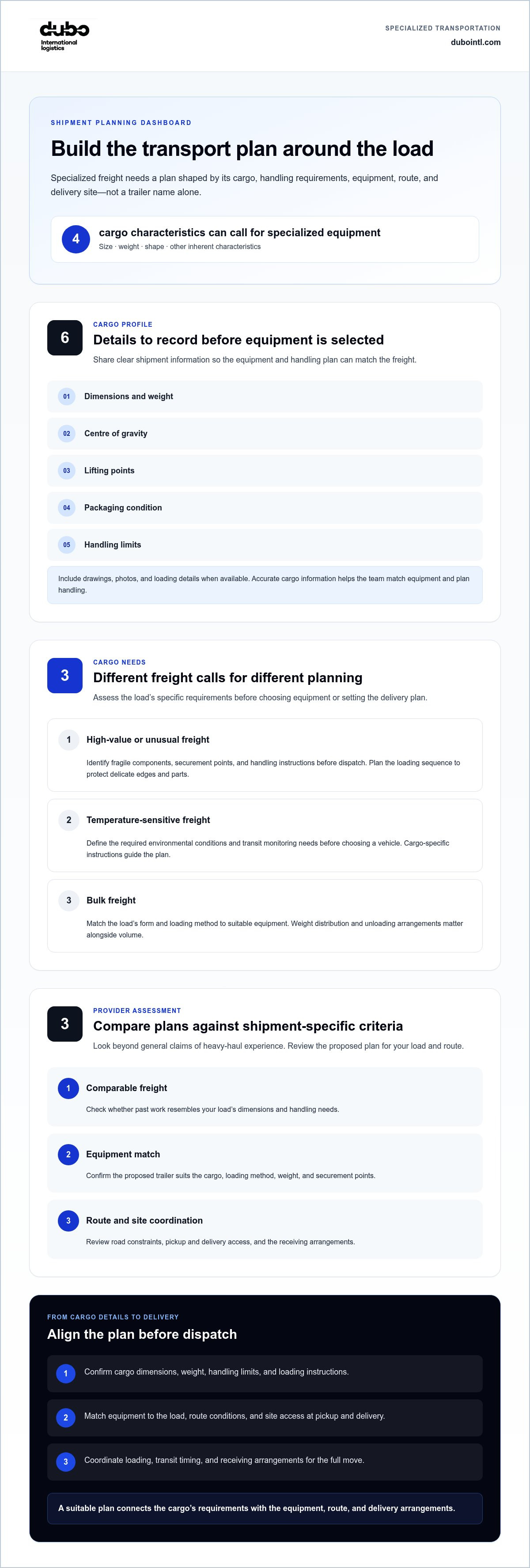
Start with cargo details, not a trailer name. Record the freight’s dimensions, weight, centre of gravity, lifting points, packaging condition, and handling limits. A stamping press, for example, may need loading equipment and a trailer suited to its footprint and weight. A sensitive machine may instead need protection from movement, moisture, or temperature changes in transit.
Uncrated freight needs protection before loading. For a finished panel or machine component, pads and blanket wrap can help prevent scuffs during handling. Identify the faces, edges, and fittings that need coverage, while keeping lifting points accessible. Photograph the cargo before wrapping and record existing marks to keep the condition record clear at delivery.
- High-value or unusual freight: Identify fragile components, securement points, and handling instructions before dispatch. A custom-shaped industrial part, for instance, may need a loading sequence that avoids pressure on delicate edges.
- Temperature-sensitive freight: Define the required environmental conditions and transit monitoring needs before choosing a vehicle. Pharmaceuticals or specialized materials can have different sensitivities, so cargo-specific instructions should guide the plan.
- Bulk freight: Match the load’s form and loading method to suitable equipment, then coordinate pickup, transit, and delivery timing. A bulk shipment’s weight distribution and unloading setup matter as much as its volume.
Time-critical freight adds a scheduling requirement. An urgent replacement component for a production line, for example, may need direct routing and a coordinated receiving window. Expedited transport can address timing, but cargo dimensions, protection, and site access still determine the equipment and handling plan.
Before dispatch, align the cargo description, equipment choice, loading instructions, and delivery arrangements. For machinery going to a Canadian industrial site, confirm that the receiving area can accommodate the vehicle and unloading process. These details help prevent a mismatch between the freight and the transport plan.
Do your drivers have experience with oversized or heavy freight?
Before choosing a specialized transport provider in Canada, assess its experience with comparable loads, equipment selection, securement, and route planning. A wide steel frame, for example, needs different preparation from a dense machine carried on a flatbed.
Oversized Loads
Wide loads need a plan that accounts for cargo dimensions, trailer choice, and conditions at both locations. A fabricated steel frame may fit a flatbed but still need careful placement to balance its weight. Review how the transport team will load it, assess practical route constraints, and coordinate delivery access. This helps surface issues before dispatch.
Overweight Cargo
For overweight freight, consider the load's weight and how it sits across the trailer. A compact industrial machine may take up little deck space while concentrating substantial weight in one area. A sound plan matches the trailer to the load, identifies securement points, and coordinates loading equipment. Route planning should also account for access limits at pickup and delivery.
Flatbed transport can suit cargo that needs loading from the side, above, or by crane. Consider a large agricultural attachment: its shape may rule out enclosed equipment, while its weight and lifting points guide loading and securement. The driver and transport team need clear instructions for lifting, positioning, and restraining the piece. That coordination supports a smooth handoff at each location.
Driver experience is practical, not just a job title. Look for familiarity with loads of similar shape, weight distribution, and handling requirements. A driver moving a long fabricated assembly must understand its securement plan and communicate with the loading crew. Experience also matters at delivery, where restricted access or limited turning room can affect how the trailer reaches the unloading point.
Compare providers using shipment-specific criteria, not general claims of heavy-haul experience:
- Comparable freight: Assess whether past work resembles your load's dimensions and handling needs.
- Equipment match: Confirm that the proposed flatbed or other trailer suits the cargo and loading method.
- Route coordination: Review how the team considers road constraints, site access, and delivery arrangements.
Share accurate dimensions, weight, drawings, photos, and lifting details before planning begins. A long steel assembly, for example, may have projecting parts that change its loaded footprint. Precise cargo information helps the team match equipment and plan handling for the full journey. It also gives the driver and loading crew a shared reference for pickup and delivery.
Dubo International Logistics manages freight and documentation for cross-border specialized transportation services Canada between Canada and the United States. This includes coordinating complex freight movements and required border documentation seamlessly.
B-train, curtain-side, and lowboy equipment
Trailer selection affects how freight is loaded, secured, and delivered. For a truckload travelling between Canadian facilities, match the equipment to cargo dimensions, loading access, and unloading needs at the destination.
B-train configurations
A B-train consists of two connected trailers, making it a distinct option for compatible freight. Before choosing this configuration, consider the load’s size, weight distribution, loading method, and delivery-site access. For example, building materials may suit a B-train if the individual pieces and loading plan fit the trailer arrangement. Confirm how the cargo will be divided and secured across both trailers and whether the destination can accommodate the full combination.
Curtain-side trailers
A curtain-side trailer has flexible side curtains that open to provide loading access. This can help when a facility needs to load freight from the side rather than the rear. For palletized machinery parts or packaged industrial components, for example, a forklift may need access along the trailer’s side. Align loading equipment, cargo placement, and securement with the facility’s workflow. Curtain-side equipment is a poor match when the freight requires a different loading method or protection plan.
Lowboy and lowbed trailers
A lowboy, also called a lowbed trailer, has a lowered deck suited to certain tall or heavy freight. Its lower deck can help manage cargo height, while the load’s weight, dimensions, and loading method still guide equipment selection. A large machine, for example, may need a loading approach suited to its base and lifting points. Before dispatch, compare the cargo’s loaded height and footprint with the route and access at both ends.
These configurations solve different logistics problems and aren’t interchangeable. A curtain-side trailer provides practical side access, while a B-train suits compatible freight planned across two trailers. A lowboy or lowbed addresses a different deck-height requirement. Choose based on the shipment, not just the distance to its destination.
Share clear shipment details before equipment is assigned. Include the cargo description, dimensions, weight, packaging, loading method, and delivery-site constraints. Then assess the proposed setup with three practical questions:
- Loading: Can the site load the selected trailer safely using its available equipment?
- Securement: Can the freight be positioned and restrained as planned?
- Delivery: Can the trailer reach the destination and support the unloading method?
For a truckload going to a Canadian receiving site, an accurate site plan can help match the trailer to location requirements. A logistics review should connect cargo details, equipment, and handoff arrangements before the shipment moves.
Carrier network and terminal coverage
Across Canada, specialized transportation can connect shipments with carriers suited to different routes and handling needs. Options can include transport for oversized or sensitive freight, full truckload moves, less-than-truckload shipments, and cross-border movements. The right option depends on the cargo, route, transfer points, and delivery requirements.
A carrier network connects transport capacity across locations. For freight travelling between distant Canadian facilities, coordination includes pickup, route planning, carrier handoffs, and delivery arrangements. Establish who manages each transfer and how shipment status is recorded. Clear responsibility keeps instructions, cargo details, and timing information consistent as freight moves across North America.
Terminal coverage and service coverage are related but not identical. A terminal may support a transfer or equipment connection, while a shipment may travel directly between sites. A terminal map alone doesn’t show whether a provider can coordinate the full route. Identify the origin, destination, required transfer points, and receiving arrangements before dispatch. This clarifies where carrier coordination matters and which locations need special planning.
Assess the network against practical shipment requirements:
- Route continuity: Identify where one carrier’s responsibility ends and another’s begins.
- Handoff records: Agree how cargo condition, instructions, and transfer status will be communicated.
- Tracking updates: Establish which milestones will be reported, such as pickup, transfer, and delivery.
- Receiving coordination: Align arrival timing with site access, unloading arrangements, and the receiving contact.
These details are especially useful when a route crosses provincial boundaries or includes a United States leg. Before shipping, give each participating carrier consistent instructions and contact details. The receiving site should know who is delivering, what arrival information to expect, and how to communicate a change. This reduces uncertainty at transfer points without assuming that every shipment uses a terminal.
Ask for a route plan that identifies transport legs, carrier responsibilities, planned transfers, and the update process. If a production facility needs a component during a scheduled receiving window, align transit milestones with the site’s intake process. If a shipment changes carriers, pass along the same handling and delivery instructions rather than relying on informal handoffs. This makes the network’s role clear to the shipper.
Across North America, coverage depends on suitable carrier capacity and coordination along the required route, not simply the number of terminals on a map. Compare the proposed network with your shipment’s origin, destination, transfer needs, and receiving arrangements. A clear view of each leg helps you assess whether the plan supports continuity from pickup to final delivery.
Largest Canadian specialized transportation companies
Company size alone doesn’t show whether a carrier can move your freight effectively. For specialized shipments across Canada, compare equipment, relevant expertise, route coverage, and coordination for your specific cargo.
“Largest” can refer to fleet size, employee count, terminal footprint, or geographic coverage. These measures describe different strengths, and a large organization may not suit a shipment requiring unusual handling. A shipper moving a stamping press, for example, should assess experience with comparable project cargo and suitable transport arrangements, not company size alone.
A Canadian specialized transportation company list had a median employee-size category of 11-50 employees as of Sep 18, 2026. The same list averaged 17.7 professional contacts per company on that date. These figures describe the list’s profile, not a ranking of Canada’s largest carriers or proof of any company’s equipment or expertise.
Directory figures can describe the market, but they don’t establish national coverage or suitability for a specific shipment. A company’s listed size may not reflect its carrier network, available equipment, or experience with complex freight. For shipments between distant Canadian locations, assess how the provider coordinates the route, carrier handoffs, and delivery arrangements.
Use a shipment-focused comparison rather than relying on a single measure of size:
- Relevant expertise: Look for experience with cargo similar in dimensions, weight, sensitivity, and loading needs.
- Equipment and carrier reach: Match the required trailer and handling plan to the route and delivery location.
- Coordination: Establish who manages carrier handoffs, shipment updates, and communication with receiving sites.
- Operational fit: Compare the proposed plan with your delivery window, supply requirements, and site access.
Who qualifies for specialized and accessible transportation services in Canada? In freight transport, the need depends on the shipment: goods whose size, weight, shape, sensitivity, or other characteristics require specialized equipment or handling. A large machine, fragile instrument, or temperature-sensitive product may need a different plan from standard freight.
What are the costs and funding options for specialized transportation in Canada? Freight charges depend on the cargo, route, equipment, handling, and timing. Shippers typically arrange payment through business or project budgets and procurement terms. To plan a shipment, share cargo details, pickup and delivery locations, and handling requirements, and allow time for coordination of complex routes and equipment needs.
For a shipment comparison, assess the transport plan against your cargo and route rather than choosing by size alone. Review specialized shipment planning as one way to frame those requirements.
Dubo International Logistics: Freight forwarding
Dubo International Logistics coordinates freight forwarding, logistics consulting, and specialized transportation for shipments with complex requirements. Businesses moving oversized machinery, delicate equipment, or temperature-sensitive products can work with the team to plan cargo movement and coordinate transitions across North America.
Freight forwarding connects shipment requirements with the route, carriers, and handoffs involved. Logistics consulting helps businesses assess operational needs and plan a suitable approach. For example, a shipper moving heavy machinery between Canadian locations may need coordinated transport planning that accounts for cargo handling and delivery arrangements.
When a shipment calls for specialized planning, contact Dubo International Logistics to discuss your freight requirements, or visit dubointl.com.
Plan the next shipment with clarity
Before arranging your next move, bring the cargo details, route, site conditions, and delivery timing into one clear plan. This helps your logistics partner understand the shipment’s needs and where coordination matters most. For Canadian shippers, specialized transportation services in Canada work best when decisions reflect the cargo and its journey, not a standard template.
If your freight has unusual handling needs or requires coordinated movement across multiple locations, Dubo International Logistics can help plan the next steps. Share the shipment’s dimensions, weight, handling instructions, pickup and delivery points, and timing requirements to begin a focused discussion. Clear information gives the planning process a practical starting point.
Ready to discuss an upcoming shipment? Contact Dubo International Logistics to explore a suitable logistics approach. A well-prepared plan can help you move forward with greater clarity and confidence.
Frequently Asked Questions
How do I get contact information for these companies?
Start with the company’s official website and use its published contact page or freight inquiry form. Include your organization’s name, the type of shipment, and your preferred contact method so the request can be directed appropriately. For an inquiry to Dubo International Logistics, visit its website and use the contact information provided there. Keep a copy of your request and any shipment reference details for follow-up.
How many specialized transportation companies are there based in Canada?
There’s no single count that applies across every directory or industry classification. Some lists include only companies based in Canada, while others also include providers serving Canadian routes from elsewhere. Counts can also differ depending on whether a directory includes freight forwarders, equipment operators, or carriers offering specialized services as one part of their business. Compare directories using consistent inclusion criteria and publication dates.
What counts as a “specialized” shipment?
A shipment is specialized when its handling plan needs to be tailored rather than assigned through a routine freight process. Industrial equipment with unusual lifting points, for instance, may require specific loading instructions, while freight needing coordination among several parties may call for project-level planning. The defining factor is the additional transport planning or handling required, not the industry that produced the goods.
What is the widest load you can transport?
There isn’t one maximum width that applies to every carrier and shipment. A workable limit depends on the transport arrangement and movement conditions for the specific load. When requesting a plan, provide the cargo’s measured width as prepared for transport, including any parts that extend beyond its main body. This allows the provider to assess the move rather than rely on a general figure that may not apply.
What regions do you serve?
Dubo International Logistics serves businesses across Canada and the broader North American market. To discuss a shipment, provide its origin and destination and indicate whether the route includes a cross-border leg. Those details help define the geographic scope and coordination needed. You can also outline any required delivery sequence if the freight is going to more than one receiving location.
How do I find specialized transportation providers in my Canadian city or province?
Compare providers by whether their carrier network can support your route and coordinate the shipment from pickup through delivery. Assess coverage alongside your equipment, handling, and site-access needs rather than relying on company size alone.
