

E-commerce Logistics for Canadian Sellers: Buying Guide
The simplest shipment can create a complicated handoff. An online order may pass between several carriers and shipment stages, leaving sellers unsure who owns the next step or how exceptions will be reported. The coordination questions involved in freight forwarding for Canadian manufacturers also matter to e-commerce businesses shipping varied cargo: the right service depends on what’s moving, how it must be handled, and when it needs to arrive.
If you’re comparing parcel, LTL freight shipping, or specialized transportation, look beyond the carrier name. You need clear responsibilities, useful shipment updates, and a service model that can adapt as your orders change. This guide explains what to prepare before a logistics discussion, how to compare coordination options, and when tailored handling may be appropriate.
We’ll cover the shipment details to gather, questions to ask about carrier coordination and visibility, and ways to clarify responsibilities before freight moves. Dubo International Logistics coordinates freight across North America and provides logistics consulting and specialized transportation. Learn more at www.dubointl.com.
Key Takeaways
- Record cargo dimensions, weight, handling needs, shipment frequency, and delivery windows before comparing logistics options.
- Compare providers by coordination scope, carrier review, shipment updates, and exception communication, not transport alone.
- Use a consistent comparison framework for e-commerce logistics and freight forwarding for Canadian manufacturers, while matching services to each shipment’s requirements.
- Before the first movement, document responsibilities, key milestones, and operational contacts so each party understands its role.
- Explore how Dubo’s freight forwarding, logistics consulting, and specialized transportation may fit your needs at www.dubointl.com.
What e-commerce logistics solutions can Canadian sellers expect from freight forwarding?
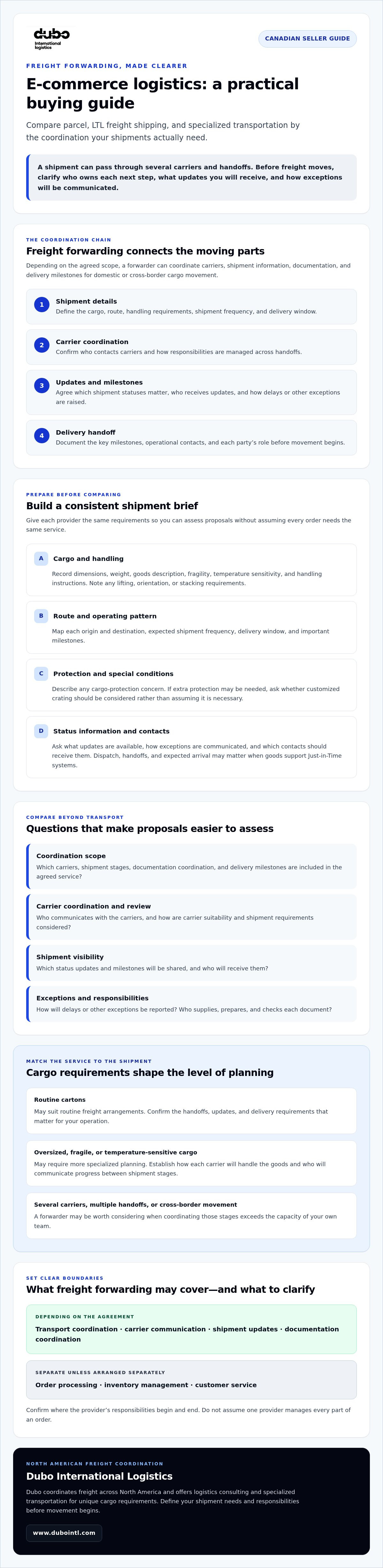
A shipment involves more than a vehicle moving cargo from one address to another. For Canadian e-commerce sellers, freight forwarding can coordinate the parties and information needed for domestic or cross-border movement. Depending on the agreed scope, that may include arranging carriers, coordinating shipment documentation, and tracking agreed milestones.
Freight forwarding coordinates domestic and cross-border cargo movement by aligning carriers, shipment information, documents, and delivery milestones. This is distinct from order processing, inventory management, and customer service, which remain separate business activities unless arranged separately. For a neutral overview of the forwarder’s role in the logistics network, see What is a Freight Forwarder?
When should a Canadian seller consider freight forwarding?
A forwarder may be worth considering when shipments involve several carriers, multiple handoffs, cross-border movement, or unusual handling requirements. For example, a seller shipping delicate equipment may need to establish how each carrier will handle it and who will communicate progress between stages. Not every online seller needs a forwarder. The appropriate level of coordination depends on the shipment and the capacity of the seller’s own team.
What freight forwarding does, and does not, cover
Depending on the agreement, freight forwarding can include transport coordination, carrier communication, shipment updates, and documentation coordination. Before engaging a provider, confirm who prepares, supplies, and checks each document, who contacts the carriers, and how delays or other exceptions will be communicated. Don’t assume the forwarder manages fulfilment, inventory, or customer enquiries; online retailers requiring dedicated pick, pack, and warehousing support often work alongside a specialist 3PL like Pik Pak Logistics. Clarify where its responsibilities begin and end.
This distinction helps sellers choose a service that addresses the actual coordination gap, rather than expecting one provider to manage every part of an order. The same planning principles apply to freight forwarding for Canadian manufacturers: define cargo needs, responsibilities, and handoffs before movement begins.
Dubo International Logistics coordinates freight across North America and offers logistics consulting and specialized transportation for unique cargo requirements. Sellers assessing a coordination partner can review the company’s services at www.dubointl.com and ask how the proposed scope would align with their shipment needs.
Which freight requirements should e-commerce sellers define before comparing solutions?
Useful proposals start with accurate shipment details. Before comparing providers, document what’s moving, where it needs to go, how often shipments occur, and which handling or delivery conditions matter. Giving each provider the same requirements makes it easier to assess proposals without assuming every order follows the same route or needs the same service.
How do cargo characteristics shape the solution?
Standard cartons may suit routine freight arrangements, while oversized, fragile, or temperature-sensitive cargo may require more specialized planning. Record the dimensions and weight of each handling unit, describe the goods clearly, and note any lifting, orientation, stacking, or environmental requirements. If the cargo may need extra protection, describe the concern and ask whether customized crating should be considered rather than assuming it is necessary.
Which operating details should sellers share?
Map each shipment’s origin and destination, expected frequency, delivery window, and important milestones. If your operation uses Just-in-Time systems, updates on dispatch, handoffs, or expected arrival can help teams prepare for incoming goods and maintain continuity. Ask what status information a provider can share, how exceptions are raised, and which contacts should receive updates.
Use this checklist to prepare for a provider discussion:
- Cargo: Dimensions, weight, description, fragility, temperature sensitivity, and handling instructions.
- Movement: Origin, destination, shipment frequency, and expected changes in volume or destinations.
- Timing: Requested delivery windows and milestones that affect sales, replenishment, or production.
- Service fit: Whether LTL freight shipping may suit shipments that can share trailer capacity, or whether the cargo needs a more tailored arrangement.
- Communication: Required status updates, escalation contacts, and the person responsible for receiving exception notices.
Complete information helps a logistics partner distinguish routine freight from shipments that need additional coordination. The planning discipline used in freight forwarding for Canadian manufacturers can also help e-commerce sellers compare options against specific cargo and operating requirements, rather than choosing by service label alone.
For guidance on matching shipment needs with freight coordination, explore Dubo’s logistics consulting services.
How can sellers compare e-commerce logistics solutions beyond basic transport?
A suitable transport option is only part of the decision. Sellers also need to know who coordinates each handoff, how carriers are assessed, what shipment updates are available, and what happens when plans change. Evaluate process clarity alongside the transport option itself. This principle applies whether you’re assessing freight forwarding for Canadian manufacturers or planning e-commerce shipments with different cargo and delivery needs.
Coordination scope: Ask who coordinates carriers, records shipment requirements, and confirms each party’s responsibilities at handoffs.
Carrier vetting: Ask how the carrier review considers safety, insurance, compliance, and capabilities relevant to your cargo and route.
Communication: Confirm who provides updates, how they’re shared, and which contact will notify your team about an exception.
Tracking: Ask what status details are available, how they’re shared, and whether updates cover the milestones your operation needs.
Exception handling: Find out how delays and other exceptions are recorded, escalated, and communicated, including who owns follow-up at each handoff.
Service level agreements (SLAs): Check whether any agreed commitments define relevant milestones, delivery windows, or equipment availability.
What questions reveal the quality of shipment coordination?
Ask for a clear explanation of the coordination process, not just a list of transport services. Who contacts the carrier if a milestone is missed? Who informs your team, and what information will they receive? A useful response identifies responsibilities at each handoff and explains how the provider will document and escalate an exception. No process can guarantee that disruptions will be prevented, so make sure you understand how they will be communicated and managed.
How should sellers assess visibility and system fit?
Visibility should support the decisions your team needs to make. Ask what tracking information is available and how frequently status updates are provided. If shipment details need to enter your ERP, confirm whether the provider can supply information in a format or workflow your team can use. Don’t assume real-time tracking or system integration. Ask specifically what is available for the service being proposed.
Compare providers against the same shipment profile, then note where their processes differ. Clear boundaries, defined updates, and relevant commitments make it easier to judge whether a solution fits your operation as shipment needs change. For more about Dubo’s freight forwarding and logistics coordination, visit www.dubointl.com.
What steps help Canadian sellers prepare for a freight forwarding partnership?
A clear operating plan gives your team and a logistics partner a shared reference before the first shipment moves. Use this sequence to document requirements, assign responsibilities, and establish a review process that can adapt as shipment patterns change.
- Document shipment needs. Prepare a brief with the cargo description, dimensions, weight, handling requirements, origin, destination, frequency, and delivery expectations. List the documents required for the movement and identify who in your business can provide or approve them. Flag oversized, fragile, or temperature-sensitive freight early.
- Clarify responsibilities. Record who supplies shipment information, who coordinates with carriers, and who acts when details change. Assign an owner to each handoff so a delay or missing update doesn’t leave your team uncertain about who should respond.
- Compare providers against the same brief. Ask each provider to explain its coordination scope, communication practices, and approach to your cargo requirements. This makes it easier to compare the proposed process, not just the transport option.
- Agree on communication. Set expectations for status updates, define milestones such as dispatch and delivery, and name operational and escalation contacts on both sides. Confirm how updates will be shared and who should receive exception notices.
- Review performance and refine the process. Periodically review shipment outcomes, recurring exceptions, and missed or unclear handoffs with your provider. Use what you learn to update contact details, shipment instructions, or milestone definitions where needed.
What information belongs in a shipment brief?
Make the brief practical enough for a provider to assess the work. Include cargo details, handling notes, origin and destination, expected frequency, and delivery windows. Add the documents relevant to the shipment and name the internal contacts responsible for decisions. For unusual cargo, such as a fragile item requiring specific protection, describe the need clearly rather than relying on a general label.
How can sellers establish a dependable operating rhythm?
Choose milestones that have a clear meaning to both parties, then agree how status changes and exceptions will be reported. If your team uses ERP records or shared reporting, ask whether shipment information can fit that workflow and confirm the available process before relying on it. Periodic reviews can reveal recurring delays or coordination gaps and help keep responsibilities current.
This preparation is useful for e-commerce operations and for businesses considering freight forwarding for Canadian manufacturers, where cargo requirements and handoffs may vary. To discuss your freight requirements, connect with Dubo International Logistics.
How can Dubo support freight forwarding for Canadian e-commerce sellers?
A logistics partner should fit the shipment rather than force every order into the same process. Dubo International Logistics coordinates freight movement across North America and provides logistics consulting and specialized transportation for unique cargo requirements. For Canadian e-commerce sellers, these services may be relevant when shipments involve multiple handoffs, cross-border movement, or handling needs that call for closer planning. Discuss the appropriate scope against your actual requirements.
Where does Dubo’s coordination model fit?
Shipment details help frame transport planning and carrier coordination. Cargo dimensions, handling instructions, origin and destination, timing, and documentation needs can clarify where coordination is required. Specialized transportation may be relevant for oversized machinery or delicate cargo, but it isn’t a default requirement for every shipment. Confirm the proposed service scope, responsibilities, and communication process before deciding whether it fits your operation.
Dubo International Logistics is a member of the Canadian International Freight Forwarders Association (CIFFA). When assessing any prospective partner, ask how its proposed coordination approach relates to your cargo profile. The phrase freight forwarding for Canadian manufacturers often brings to mind complex industrial shipments, but the same careful approach to requirements and handoffs can help e-commerce sellers assess support for varied freight needs.
What should sellers bring to an initial discussion?
A focused conversation starts with information that helps the provider understand the movement and its operational context. Prepare:
- Cargo specifications: Description, dimensions, weight, fragility, temperature sensitivity, and handling requirements.
- Shipment pattern: Origins, destinations, frequency, and expected changes in volume or lanes.
- Delivery expectations: Required windows and milestones that matter to sales, replenishment, or production continuity.
- Communication needs: Preferred status updates, exception contacts, and internal stakeholders who make shipment decisions.
Sharing these details helps a provider explain what it can coordinate and where responsibilities remain with your team. For a wider view of how shipment coordination fits into business operations, read this guide to end-to-end freight management.
If you’re assessing freight forwarding for Canadian manufacturers or planning logistics support for e-commerce shipments, a clear requirements discussion is a practical next step. Discuss your Canadian freight requirements with Dubo to explore whether its freight forwarding, logistics consulting, or specialized transportation services suit your needs.
Build a freight process that fits your operation
Reliable e-commerce freight starts with clear requirements. Define what you’re shipping, how it needs to be handled, and which milestones your team depends on. Then compare providers by how they coordinate carriers, communicate updates, and manage exceptions, not by transport options alone.
Before a shipment moves, agree on responsibilities, contacts, and how performance will be reviewed. These steps help your logistics approach adapt as cargo, shipment frequency, or delivery expectations change. The same disciplined planning is valuable when assessing freight forwarding for Canadian manufacturers.
Dubo coordinates freight across North America and provides logistics consulting and specialized transportation for unique cargo requirements. The company is a member of the Canadian International Freight Forwarders Association (CIFFA).
Ready to discuss a coordination approach for your shipments? Discuss your freight forwarding requirements with Dubo at www.dubointl.com.
Frequently Asked Questions
What are e-commerce logistics solutions for Canadian sellers?
E-commerce logistics solutions are the processes and services that help a seller plan and coordinate the movement of goods. Depending on the provider and agreed scope, freight forwarding can coordinate carriers, shipment milestones, and relevant documentation. It doesn’t automatically cover every part of an online order’s journey. Before engaging a provider, confirm which activities it manages, which your team handles, and how responsibilities transfer at each shipment handoff.
When should an e-commerce seller use a freight forwarder?
A seller may consider freight forwarding when shipments involve multiple carriers, cross-border movement, unusual cargo requirements, or coordination that’s becoming difficult to manage internally. The right point depends on the shipment profile and your team’s capacity. Before speaking with a provider, note cargo details, origins and destinations, shipment frequency, delivery expectations, and the support you need if a delay or other exception occurs.
Can a freight forwarder support cross-border shipments from Canada?
Yes, freight forwarders can coordinate domestic and cross-border cargo movement, but responsibilities depend on the provider and agreement. Confirm the route, carrier coordination, documentation responsibilities, status updates, and each party’s role before shipping. Dubo International Logistics coordinates freight across North America and provides logistics consulting and specialized transportation. The company is a member of the Canadian International Freight Forwarders Association (CIFFA). Learn more at www.dubointl.com.
How do Canadian sellers choose between logistics solutions?
Start with your shipments, not the service labels. Compare providers on coordination scope, carrier review, communication, tracking information, exception handling, cargo-specific expertise, and assigned responsibilities. Ask how the proposed process fits your shipment profile and what updates your team can expect. The planning principles involved in freight forwarding for Canadian manufacturers can also help e-commerce sellers assess complex handoffs, but the service scope should reflect each seller’s actual needs.
What information should I provide when requesting freight forwarding support?
Prepare cargo dimensions and weight, handling requirements, origin and destination, shipment frequency, delivery windows, and relevant documentation. Describe whether the freight is fragile, oversized, or temperature-sensitive, and note any instructions carriers need to follow. Include internal contacts responsible for shipment decisions, the status updates your team needs, and milestones that matter to your operation. A clear brief helps a provider assess requirements and explain its proposed coordination process.
Does freight forwarding include order fulfilment?
Not necessarily. Freight forwarding focuses on coordinating cargo movement, while order fulfilment is a separate operational activity. Don’t assume fulfilment is included just because a provider describes its services as logistics. Ask for a clear explanation of what the proposed arrangement covers, which parties perform each task, and where responsibilities transfer during the shipment journey. Confirm who handles order processing and customer communications if those activities are part of your requirements. For brands seeking dedicated warehousing and pick-and-pack services alongside cargo transit, learn more about EZ3PL Ltd to see how specialised third-party fulfilment providers manage order execution.
Can freight forwarding work for LTL shipments?
Yes, LTL freight shipping may suit shipments that don’t require an entire trailer and can share capacity with other shippers. Whether it fits depends on the cargo’s dimensions, weight, handling requirements, route, and delivery expectations. Provide accurate shipment details and ask how carrier coordination, milestones, and exceptions will be managed. A logistics partner can help assess the requirements, but confirm the appropriate arrangement for each shipment profile.
