

An enclosed trailer isn’t automatically the right fit for every load. With dry van shipping Canada to US, the decision depends on the cargo, the route and how the shipment will be coordinated across the border.
If you’re unsure whether your goods suit dry van equipment, or whether to book full-truckload or shared-trailer space, resolve those questions before arranging the shipment. Clear details about the cargo, pickup and delivery points, timing and handling needs help a logistics partner assess the service structure and coordinate carrier arrangements.
This guide explains when a dry van may suit your shipment, what information to prepare and what to confirm before booking, including how cross-border responsibilities will be coordinated. Dubo International Logistics provides freight forwarding and logistics support across North America, helping businesses plan cargo movement around shipment-specific requirements. Learn more about Dubo International Logistics and its approach to freight coordination.
Key Takeaways
- Assess whether enclosed dry van equipment suits your cargo, handling needs and shipment constraints before requesting a carrier arrangement.
- For dry van shipping Canada to US, accurate cargo and route details help guide equipment selection and cross-border coordination.
- Compare full-truckload and shared-trailer options against your shipment volume, scheduling needs and handling preferences.
- Before booking, confirm timing, responsibilities and who will prepare and verify the required shipment information.
- A freight-forwarding partner can coordinate shipment requirements and carrier arrangements. Learn about Dubo at www.dubointl.com.
Is Canada-US dry van shipping right for your cargo?
A dry van is an enclosed trailer used to move freight. Its enclosed design can shield cargo from direct exposure to weather during transit, making it a practical option for some general freight. But an enclosure alone doesn’t confirm that the equipment is suitable. Before arranging dry van shipping Canada to US, assess the shipment and verify the available equipment details with the carrier.
Start with the cargo’s dimensions, packaging and handling requirements. Then consider any conditions the goods must maintain during transit. The broader trucking industry includes different vehicle types and transport arrangements, so match the equipment to the shipment rather than assuming one option will suit every load.
What cargo may suit an enclosed dry van?
General freight that is packaged for transport and needs protection from outdoor weather may be suitable for enclosed transport. Boxed or palletized goods, for example, could be considered if their dimensions, packaging and handling requirements align with the carrier’s equipment and the planned loading and unloading process.
Protection from weather is not the same as temperature control. Don’t assume an enclosed trailer will maintain a specific temperature. Share the cargo’s requirements and ask the carrier to confirm whether the proposed equipment can meet them. Suitability depends on the shipment details, not just the type of goods.
When should you consider another transport arrangement?
Ask for a more specific assessment if the load is oversized, fragile or sensitive to temperature. Out-of-gauge machinery, for instance, may not fit standard equipment and can require specialized transport planning. Provide accurate dimensions and describe any handling constraints so the appropriate arrangement can be evaluated.
Temperature-sensitive goods need particular attention. Confirm the required conditions and ask whether the proposed equipment can maintain them throughout the move. Don’t treat an enclosed trailer as proof of temperature control or proceed based on assumptions about equipment capability.
Fragile freight also calls for a close review of packaging, loading and handling needs. If the cargo requires protection beyond what the proposed arrangement can provide, discuss alternatives before booking. For more guidance on cargo-specific planning, see specialized freight options.
Choose based on the complete shipment profile: dimensions, packaging, handling and required conditions. A freight-forwarding partner can help coordinate requirements and carrier arrangements, while the carrier confirms the equipment details for the requested lane.
How dry van shipping works across the Canada-US border
A cross-border dry van move involves a sequence of coordinated decisions, not just pickup and delivery. First, assess the shipment. Its description, dimensions, weight, packaging and handling needs help determine what equipment and carrier arrangement to request. Confirm the carrier’s available capacity and service details for the requested lane before finalizing plans.
Once the arrangement is established, the shipment enters transit and proceeds to delivery. Confirm who is responsible for preparing and checking shipment information and which details each party needs. Requirements can vary by shipment, so don’t assume the same document list or responsibilities apply to every move. For general information, consult U.S. customs requirements and confirm shipment-specific responsibilities with the appropriate parties. For further planning context, see this guide to cross-border freight forwarding guidance.
What shipment details should you prepare?
Give the logistics partner a clear shipment profile before requesting arrangements. Gather:
- A precise cargo description, dimensions and weight
- Packaging details and any handling instructions
- Pickup and delivery addresses, access details and relevant contact information
- Preferred timing, delivery constraints or other scheduling requirements
Accuracy matters. If a dimension, weight or other detail hasn’t been confirmed, flag it for follow-up rather than estimating. Incomplete or changing information can affect equipment selection and carrier coordination, so share updates as soon as they’re known.
How do coordination and shipment visibility fit together?
A freight forwarder coordinates cargo movement by aligning shipment requirements with carrier arrangements and the information needed across the move. Freight forwarding is the coordination of cargo movement between the shipper, carriers and other relevant parties. For dry van shipping Canada to US, that coordination helps connect the shipment details to the planned route and delivery requirements.
Tracking can provide visibility into shipment progress, but confirm the available system and frequency of updates for the specific arrangement. Ask what information will be shared, how updates are communicated and whom to contact if shipment details change. Clear expectations make visibility useful without assuming a particular platform or real-time reporting.
To align shipment requirements with carrier arrangements, consider speaking with a logistics partner such as Dubo International Logistics. You can also review its freight coordination services for more information about its logistics support.
Dry van FTL or LTL: which option fits your shipment?
Choosing between full-truckload (FTL) and less-than-truckload (LTL) depends on shipment fit. Neither option is always faster or more economical. For dry van shipping Canada to US, compare the capacity your cargo needs with its handling preferences, schedule and delivery constraints. Then confirm carrier availability and service details for the specific lane.
| Consideration | FTL | LTL |
|---|---|---|
| Trailer capacity | A dedicated trailer is arranged for the shipment. | Multiple shippers share trailer capacity. |
| Cargo volume | May suit a larger load or one that needs dedicated capacity. | May suit a shipment that doesn’t require the full trailer. |
| Handling preferences | Consider if limiting intermediate transfers is a priority, and confirm the planned handling. | Ask how shared capacity may affect handling and whether it suits the cargo. |
| Scheduling and constraints | Confirm pickup and delivery timing, equipment and lane availability. | Confirm how the shared arrangement fits the timing and shipment requirements. |
When might FTL be the better fit?
FTL may be worth considering when the shipment needs dedicated trailer capacity or when cargo handling preferences make a shared arrangement unsuitable. Ask whether the planned move involves intermediate transfers and discuss cargo-specific limits with the logistics partner and carrier. Dedicated capacity doesn’t guarantee a particular transit time, handling outcome or equipment availability, so confirm the arrangement for the shipment and lane.
When might LTL freight shipping be suitable?
LTL freight shipping means multiple shippers share trailer capacity. It may suit a shipment that doesn’t need a dedicated trailer, provided its dimensions, packaging, handling needs and timing fit the proposed arrangement. Consider whether shared capacity and any planned handling steps are appropriate for the cargo before proceeding. For broader planning considerations, read this guide to end-to-end freight management guidance.
Whichever structure you choose, FTL or LTL, you still need to confirm who will prepare and verify shipment information. Consult U.S. Customs and Border Protection requirements, then confirm shipment-specific responsibilities with the appropriate parties.
A freight-forwarding partner can help assess the cargo and coordinate carrier arrangements. To discuss shipment-specific needs, visit Dubo International Logistics or review its freight coordination services.
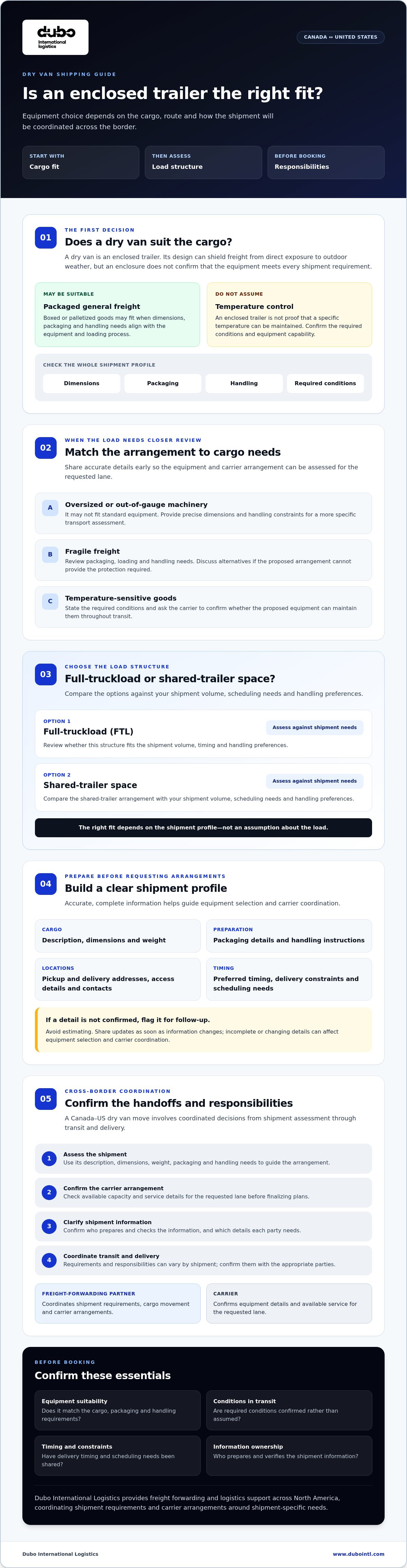
What to confirm before booking dry van shipping Canada to US
A clear booking starts with a shared record of what’s confirmed, what still needs checking and who owns each follow-up. Use this sequence to align cargo details, route, timing, handling and cross-border responsibilities before finalizing a carrier arrangement.
- Confirm the cargo profile. Record the description, dimensions, weight, packaging and handling instructions. Flag unverified measurements or special constraints rather than estimating.
- Confirm the route and equipment. Specify pickup and delivery locations, then ask whether dry van capacity and the proposed equipment are available for that lane.
- Confirm timing and access. Review requested pickup and delivery windows, site access, appointment needs, and loading and unloading arrangements.
- Confirm responsibilities. Identify who will prepare and verify shipment information and required documentation with the appropriate parties.
- Confirm communication and service terms. Agree how status updates and exceptions will be shared. Review any applicable service level agreements (SLAs) and ask about the carrier vetting process.
Which operational details should both parties confirm?
Small gaps can affect coordination. Confirm access instructions and appointments at both ends, who will be available to coordinate loading and unloading, and which contacts should receive updates. Put cargo dimensions, packaging, handling instructions and shipment-specific constraints in writing so everyone is working from the same information. Also agree how changes or exceptions will be reported and whom to contact if plans need to be revisited.
How should you prepare for cross-border coordination?
Confirm documentation roles instead of assuming one party is responsible for every step. Check what shipment information is needed, who will prepare it and who will verify it with the relevant parties. Requirements can depend on the shipment, so have uncertain details reviewed by an appropriate professional. For broader context, read the Canada-US freight coordination guide.
Keep two lists: confirmed details, such as verified dimensions and agreed site access, and items to verify, such as carrier capacity, equipment specifics or documentation responsibilities. Resolve open questions before proceeding with the arrangement. This preparation supports more dependable dry van shipping Canada to US without treating assumptions as commitments.
For help coordinating shipment requirements and carrier arrangements, discuss your cross-border freight needs with Dubo.
Coordinate your dry van shipment with a freight-forwarding partner
Dry van shipping Canada to US involves more than finding a trailer. Cargo details, carrier arrangements and cross-border responsibilities need to align. A freight-forwarding partner helps coordinate those moving parts while keeping the shipper’s requirements central to the plan.
Dubo International Logistics coordinates freight movement and carrier arrangements across North America. As a logistics partner, Dubo coordinates with carriers rather than operating the vehicle. Confirm the carrier’s available capacity and service details for the requested lane, and clarify shipment-specific documentation responsibilities with the appropriate parties.
What does a freight forwarder coordinate?
Freight forwarding brings shipment planning and carrier coordination together to organize cargo movement from origin through delivery. A forwarder can help align cargo requirements with a suitable transport arrangement, coordinate information among relevant parties and identify details to confirm before proceeding. The right arrangement depends on the shipment, including its dimensions, handling needs, timing and route. For time-sensitive freight, review Dubo transport information to determine whether the service described may fit your requirements.
What should you include in an initial shipment discussion?
Provide a clear shipment profile so the logistics partner can assess requirements and discuss potential arrangements. Include:
- Cargo type, dimensions, weight and packaging
- Origin, destination and requested timing
- Handling instructions, delivery constraints and any special conditions
- Known border-documentation responsibilities, plus any roles that still need confirmation
If a measurement or responsibility is uncertain, identify it as unconfirmed rather than estimating. That gives the parties a clear list of open questions and helps them verify shipment-specific details before plans are finalized. Ask who will prepare and check the relevant shipment information, and confirm dry van capacity and service details for the lane.
These details make for a more focused service-fit discussion. Share the cargo profile, route, schedule and handling requirements, then confirm which arrangements are available and who is responsible for each next step.
Discuss a Canada-US freight shipment with Dubo International Logistics to review your cargo-specific needs and coordinate next steps.
Plan your next Canada-US shipment with confidence
The right dry van arrangement depends on the cargo, route, handling needs and timing. Before booking, confirm whether enclosed equipment suits the shipment, compare dedicated FTL capacity with shared LTL space, and clarify responsibilities for shipment details and documentation.
With dry van shipping Canada to US, preparation and coordination go hand in hand. Dubo International Logistics coordinates freight and carrier arrangements across North America, helping shippers assess cargo-specific requirements and discuss service fit. When evaluating a logistics partner, ask how its carrier coordination process relates to your requested shipment.
Have your cargo description, dimensions, weight, packaging, origin, destination, timing and handling needs ready for an informed discussion. Discuss your Canada-US freight requirements with Dubo and take the next step with a clear shipment plan.
Frequently Asked Questions
What is dry van shipping from Canada to the US?
Dry van shipping uses an enclosed trailer to transport freight between Canada and the United States. The enclosure can shield goods from direct exposure to weather, but it doesn’t confirm that the trailer suits every load. Assess the cargo’s dimensions, weight, packaging and handling needs, then confirm equipment details and carrier availability for the requested lane before arranging the move.
Is a dry van suitable for fragile or temperature-sensitive freight?
It depends on the shipment’s protection and environmental requirements. An enclosed trailer may shield cargo from direct exposure to weather, but that isn’t the same as confirmed temperature control or specialized protection. For fragile goods, review packaging and handling needs. For temperature-sensitive freight, confirm the required conditions and ask whether the proposed equipment can meet them throughout transit before proceeding.
Can dry van shipments move from Canada to the US as LTL freight?
Yes, a shipment may be arranged as LTL freight if shared trailer capacity suits its cargo and handling requirements. LTL freight shipping means multiple shippers share space in a trailer. Assess the shipment’s dimensions, packaging, timing and handling preferences, then confirm whether a suitable arrangement and carrier capacity are available for the specific Canada-US lane. Availability isn’t automatic.
What information do I need to arrange dry van shipping to the US?
Prepare a clear cargo description, dimensions, weight and packaging details, along with the shipment’s origin, destination and requested timing. Include handling instructions, pickup and delivery access information, appointments or other known constraints. Accurate details help a logistics partner assess equipment and carrier arrangements. If a measurement or requirement is unknown, flag it for confirmation rather than estimating.
Who coordinates cross-border documentation for a dry van shipment?
Confirm documentation responsibilities with the parties handling your shipment before booking. Ask who will prepare the shipment information, who will verify it and what details each party needs from you. Responsibilities can depend on the shipment and its arrangements, so don’t assume one party handles every step. A freight forwarder can help coordinate shipment information and carrier arrangements while you confirm roles with the relevant parties.
How do I choose between FTL and LTL dry van shipping?
FTL assigns dedicated trailer capacity to a shipment, while LTL freight shipping shares trailer capacity among multiple shippers. Compare your cargo volume with the space needed, then consider handling preferences, scheduling needs and shipment constraints. If limiting intermediate transfers matters, discuss the planned handling. Neither option is always the better fit, so confirm lane details and carrier availability.
Can a freight forwarder arrange dry van shipping from Canada to the US?
A freight forwarder can coordinate shipment planning, carrier arrangements and cargo movement across the border. Dubo International Logistics provides freight forwarding and logistics coordination across North America. Specific dry van equipment, service details and carrier capacity must be confirmed for the shipment and requested lane. Discuss your shipment requirements with Dubo International Logistics.
