
A single regulatory oversight in the transport of volatile cargo can transform a routine shipment into a million-dollar liability overnight. With the SOR/2026-127 amendments now refining petroleum classifications and the suspension of U.S. de minimis thresholds, the margin for error has effectively vanished. Selecting a specialized Canadian freight forwarder for hazardous materials is no longer just a logistical choice; it's a critical strategy for risk mitigation. You likely feel the pressure of maintaining total compliance while the ongoing CUSMA review process creates a backdrop of trade uncertainty. At Dubo International Logistics (www.dubointl.com), we understand that your peace of mind depends on a partner who acts as a logistics architect, meticulously planning every movement to prevent safety incidents and costly border delays.
We agree that the complexity of cross-border documentation between Canada and the USA has never been more taxing for modern businesses. This 2026 guide provides the expert framework you need to navigate these shifting requirements with absolute confidence and safety. We will examine the latest TDG updates, explore the nuances of harmonizing Canadian regulations with U.S. 49 CFR, and outline how professional oversight ensures the seamless movement of your most sensitive goods.
Key Takeaways
- Analyze how the 2026 TDG amendments, specifically regarding petroleum classifications and "HOT" designations, will reshape your corporate compliance and safety protocols.
- Master the nuances of the Canada-U.S. border by harmonizing Canadian TDG regulations with U.S. 49 CFR requirements to facilitate seamless cross-border movement.
- Identify the strategic advantage of partnering with a Canadian freight forwarder for hazardous materials that acts as a logistics architect, ensuring precise cargo coordination through every stage of transport.
- Understand why CIFFA membership serves as a critical hallmark of professional excellence, providing a stabilizing force for your global trade interests.
- Leverage our comprehensive 2026 framework for safety and efficiency by visiting www.dubointl.com to ensure your dangerous goods shipments remain fully compliant and on schedule.
The Landscape of Hazardous Materials Transport in Canada
Transporting dangerous goods across Canada is a high-stakes endeavour that demands more than simple logistics coordination. It requires a meticulous understanding of what constitutes a "hazardous material" under federal law, ranging from industrial chemicals to everyday consumer products like lithium batteries. The inherent risks are profound, encompassing immediate threats to public safety and long-term environmental consequences that can cripple a business's viability. While standard freight providers focus on speed and volume, a specialized Canadian freight forwarder for hazardous materials prioritizes the stabilizing force of precision. Professional oversight acts as a protective steward, ensuring that volatile cargo doesn't become a liability in a landscape where regulations are constantly shifting. Our role as a logistics architect is to provide the strategic foresight needed to manage these complexities without compromising the smoothness of your operations.
The Nine Classes of Dangerous Goods
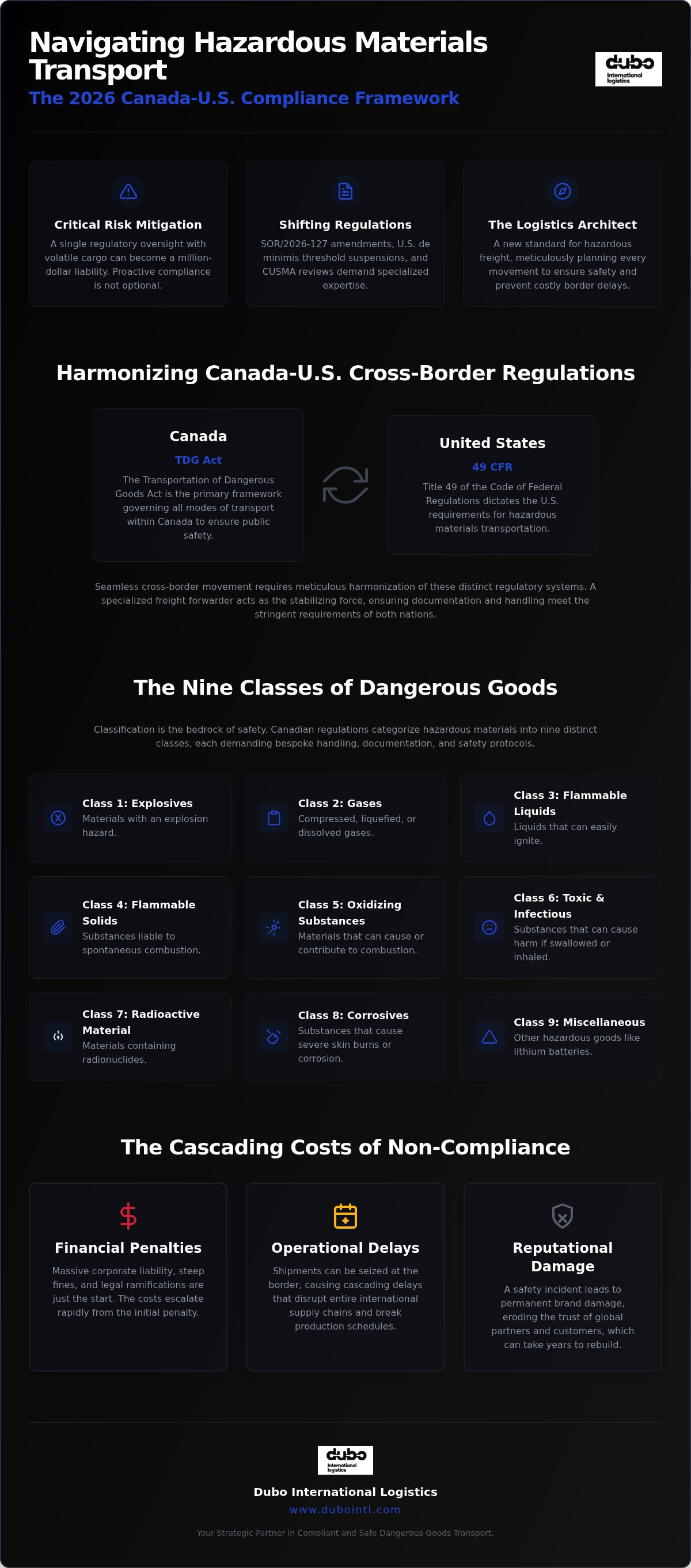
Classification serves as the bedrock of safety. Canadian regulations divide these materials into nine distinct classes, each requiring bespoke handling and documentation. High-visibility risks like explosives (Class 1) and flammable liquids (Class 3) often receive the most attention due to their volatile nature. However, the experts at Dubo International Logistics (www.dubointl.com) recognize that frequently overlooked hazards, such as corrosive substances (Class 8) or miscellaneous dangerous goods (Class 9), require equal vigilance. Precise classification ensures that every safety mark is accurate and every handling procedure is optimized for the specific chemical profile of the cargo. This prevents your supply chain from being compromised by technical errors or improper packaging choices.
The Real Cost of Non-Compliance
The financial penalties for regulatory failures are merely the beginning of the fallout. Shipments can be seized at the border, leading to cascading delays that disrupt international supply chains and erode the trust of global partners. The Transportation of Dangerous Goods (TDG) Act serves as the primary legislative framework that governs the movement of these materials to ensure public safety across all modes of transport in Canada. Beyond the legal ramifications, a safety incident can lead to massive corporate liability and permanent brand damage. Working with a dedicated Canadian freight forwarder for hazardous materials and an expert consultant at https://www.duboexpedited.com helps businesses transform these risks into a managed, predictable process. This strategic foresight protects your bottom line and maintains the integrity of your cross-border relationships, providing the peace of mind that comes from professional stewardship.
The Logistics Architect: A New Standard for Hazardous Freight
The role of a modern logistics partner has shifted. It's no longer sufficient to simply move cargo from one terminal to another. We act as a logistics architect. This means we design a comprehensive framework that anticipates every variable of the journey. For a Canadian freight forwarder for hazardous materials, this architectural approach is the only way to maintain absolute safety and compliance. It involves end-to-end cargo coordination that begins long before the goods are loaded. By adhering strictly to Transport Canada regulations, we build a foundation of compliance that supports the entire supply chain. Our seasoned experts focus on meticulous process design to lower your stress, providing a stabilizing force in a global trade environment that often feels volatile. This approach places the safety of your cargo at the centre of every decision we make.
Bespoke Solutions for Unique Cargo Needs
Standard shipping models often fail when applied to sensitive or non-standard cargo. Every hazardous shipment possesses its own chemical personality and specific regulatory requirements. We provide bespoke solutions tailored to these unique needs. This might involve temperature-controlled environments or specialized routing to avoid densely populated areas. Our specialized transportation project fees reflect the high level of precision and individual attention required for these complex hauls. Custom pricing ensures that you aren't paying for a generic service. Instead, you're investing in a meticulously executed plan that guarantees the integrity of your product through strategic foresight.
Logistics Consulting: Optimizing the Supply Chain
Strategic planning is the most effective tool for reducing operational costs. Through our logistics consulting services, we help manufacturers identify hidden inefficiencies in their hazardous material movement. Many businesses don't realize that minor adjustments in documentation or packaging can lead to significant time savings at the border. A seasoned expert at learn more can analyze your current processes to prevent bottlenecks before they occur, acting as a reliable Canadian freight forwarder for hazardous materials throughout the lifecycle of your shipment. We invite you to visit www.dubointl.com to learn more about our consulting methodology and how it can bring quiet confidence to your global trade operations. This professional foresight lowers your stress by positioning our team as a protective steward of your interests.
Navigating Compliance: The TDG Act and International Standards
The Transportation of Dangerous Goods (TDG) Act serves as the definitive regulatory backbone for every shipment moving through Canadian territory. It establishes a rigorous framework that ensures public safety and environmental protection by mandating strict adherence to classification, packaging, and handling protocols. For a Canadian freight forwarder for hazardous materials, this legislation is the primary filter through which every logistical plan must pass. Compliance isn't merely a legal requirement; it's a commitment to the safety of the communities our shipments traverse. When logistics involve high-risk materials, the implementation of Emergency Response Assistance Plans (ERAPs) becomes essential. These specialized plans outline the technical expertise and equipment required to respond to an incident, providing an extra layer of security for the most sensitive cargo classes.
Global trade demands that domestic rules align with international standards to maintain the smoothness of movement across borders. Whether your cargo travels by sea under IMDG standards, by air following IATA regulations, or by road using ADR protocols, professional oversight ensures that every transition is seamless. Cross-border hazardous shipments require a nuanced understanding of how Canadian TDG intersects with international and U.S. requirements. We act as a sophisticated bridge, integrating these varied standards into a single, cohesive movement strategy. This strategic foresight prevents regulatory friction and ensures that your goods move across territories without unnecessary interruptions.
Essential Documentation and Labelling
Precision in documentation is the only way to avoid costly delays and audits. Every "hazardous" label must meet exact Transport Canada specifications regarding size, colour, and durability. Beyond the physical marks, the necessity of accurate manifests and Safety Data Sheets (SDS) cannot be overstated. Professional oversight from a partner like Dubo International Logistics (www.dubointl.com) ensures that your documentation is error-free and ready for regulatory scrutiny at any moment. This meticulous attention to detail transforms a complex paperwork trail into an organized, transparent record of compliance, allowing you to focus on your core business with quiet confidence.
Carrier Coordination and Vetting
The physical movement of dangerous goods requires more than just a truck or a vessel; it requires a vetted network of certified professionals. We select only carriers with proven experience in handling dangerous goods, ensuring they possess the specialized equipment and trained personnel necessary for the task. Rigorous carrier management is a cornerstone of our role as a logistics architect. By coordinating with experts at https://www.duboexpedited.com, you ensure that every driver and handler understands the specific risks associated with your cargo. This level of vetting guarantees the smoothness of the journey and reinforces the safety of your supply chain, providing a reliable foundation for your most sensitive shipments.
Strategic Planning for Cross-Border Hazardous Shipments
Moving sensitive freight across the 49th parallel involves more than just crossing a geographical boundary. It requires a sophisticated understanding of how two distinct regulatory systems intersect. In April 2026, trade freight between the United States and Canada reached $64.8 billion, representing a 14.4% increase from the previous year. For a Canadian freight forwarder for hazardous materials, this volume underscores the need for a logistics architect who can manage the friction of high-traffic corridors. The June 2026 amendments under SOR/2026-127 have introduced refined petroleum classifications and new "HOT" designations that must be mirrored in U.S. documentation. We ensure your cargo coordination remains seamless by harmonizing the Canadian TDG regulations with U.S. DOT 49 CFR requirements before the wheels ever turn.
The current trade environment demands heightened vigilance. The July 2026 suspension of the U.S. de minimis threshold and the ongoing CUSMA annual review have led to increased scrutiny at every inspection plaza. Accurate documentation is the only way to prevent your cargo from becoming a statistic in a border backlog. While customs brokerage is a separate professional function, our role is to ensure every piece of the logistical puzzle is audit-ready and perfectly aligned with border authority expectations. This proactive compliance strategy lowers your stress by positioning our team as a protective steward of your cross-border interests, ensuring your goods move with quiet confidence across North America.
A Step-by-Step Framework for Cross-Border Success
- 1. Pre-shipment classification and documentation review: We realize that errors often occur at the source. Our team conducts a rigorous audit of safety data sheets and manifests to ensure they reflect the latest 2026 regulatory updates.
- 2. Strategic carrier selection and route planning for expedited delivery: We select carriers with specific experience in cross-border hazardous movements, optimizing routes to avoid known bottlenecks and high-risk zones.
- 3. Real-time monitoring and proactive communication with border authorities: Maintaining a steady flow of information ensures that any potential issues are addressed before they result in a seizure or delay.
Expedited Solutions for Time-Sensitive Hazards
When dealing with volatile substances, time is often the greatest risk factor. Delays can lead to product degradation or increased safety concerns. Balancing speed with safety requires a specialized transportation approach that prioritizes precision over simple velocity. We provide bespoke solutions that ensure your most critical shipments reach their destination without compromise. You can explore duboexpedited.com for time-critical hazardous solutions that meet the highest standards of safety and efficiency. To secure your supply chain against the uncertainties of 2026, partner with a strategic logistics expert who understands the intricacies of cross-border compliance.
Why Dubo International Logistics is Your Strategic DG Partner
Dubo International Logistics acts as a stabilizing force in an increasingly complex global environment. We provide the quiet confidence that comes from knowing your cargo is managed by a protective steward who understands the gravity of every shipment. As a premier Canadian freight forwarder for hazardous materials, we recognize that the stakes of global trade require more than just movement; they require a deep commitment to dependability and professional oversight. Our CIFFA membership serves as a hallmark of professional excellence, signaling to our partners that we adhere to the highest standards of international logistics coordination. We act as a sophisticated bridge, connecting local Canadian businesses with the intricate demands of international regulatory systems and ensuring that every movement is both compliant and efficient.
Decades of Expertise in Specialized Freight
Precision is the hallmark of a seasoned expert. We have spent decades refining our approach to non-standard cargo, ensuring that every shipment is handled with the meticulous care it deserves. Our focus remains on North American logistics excellence, providing seamless delivery across the continent through a series of well-planned, strategic movements. This architectural approach to logistics allows us to handle the most sensitive cargo with a level of detail that generic providers simply cannot match. For a deeper understanding of how we manage these complexities, you can read our strategic buyer's guide for 2026. This level of expertise allows us to anticipate challenges before they arise, maintaining the smoothness of your supply chain regardless of the cargo's sensitivity.
The Partnership Approach to Logistics
We believe in moving beyond transactional shipping. Our goal is to establish long-term strategic partnerships that prioritize your business's growth and security over simple volume. By integrating our logistics consulting services into your operations, you gain access to strategic planning that identifies hidden efficiencies and reduces long-term risk. Our logistics consulting fees are designed to provide a high return on investment, often uncovering cost-saving opportunities that standard freight services overlook. We invite you to realize your supply chain's full potential by visiting www.dubointl.com. Whether you require specialized transportation or expert guidance from learn more, we are dedicated to being the reliable partner you need as a Canadian freight forwarder for hazardous materials. Your peace of mind is the ultimate measure of our success, and we remain committed to protecting your interests at every turn.
Securing Your Supply Chain for the Future of Global Trade
Navigating the 2026 regulatory landscape requires more than just adherence to rules; it demands strategic foresight and a meticulous approach to cargo coordination. Success at the Canada-U.S. border hinges on the precise harmonization of TDG and 49 CFR standards. As a dedicated Canadian freight forwarder for hazardous materials, Dubo International Logistics provides the stabilizing force your business needs to manage these volatile variables with quiet confidence. Our independent CIFFA membership and deep expertise in specialized North American transportation ensure that every shipment is treated with the care of a protective steward.
By integrating our strategic logistics consulting into your operations, you transform complex supply chain challenges into a managed, predictable process. We invite you to partner with a logistics architect who prioritizes your peace of mind and long-term security. Partner with a logistics architect for your hazardous cargo. Discover our specialized solutions at www.dubointl.com. We look forward to helping you realize a more seamless and compliant future for your global trade operations.
Frequently Asked Questions
What qualifies as hazardous materials for Canadian freight forwarding?
Hazardous materials, or dangerous goods, are substances that pose a risk to health, safety, property, or the environment during transport. Under Canadian law, these are categorized into nine classes, including explosives, flammable liquids, and toxic substances. The 2026 updates under SOR/2026-127 have further refined classifications for certain petroleum products and elevated temperature goods. Identifying these items correctly is the first step in ensuring your shipment moves safely through the supply chain.
Does my business need an Emergency Response Assistance Plan (ERAP)?
An ERAP is mandatory only for certain high-risk dangerous goods that require specialized expertise and equipment to respond to an incident. These plans must be approved by Transport Canada before the goods are imported or offered for transport. Whether you need one depends on the specific UN number, class, and quantity of the material you are shipping. Our team at www.dubointl.com can help you realize if your cargo coordination requires this level of formal emergency planning.
How do Canadian TDG regulations differ from US DOT requirements for cross-border shipping?
While Canada and the USA maintain a high degree of regulatory reciprocity, specific differences in placarding and documentation language persist. For instance, Canadian regulations now require a "HOT" designation for elevated temperature products and allow "Residue – Last Contained" terminology for returning tanks. A specialized Canadian freight forwarder for hazardous materials ensures that your documentation satisfies both Transport Canada and U.S. 49 CFR requirements to prevent border delays or compliance penalties.
What documentation is mandatory for shipping dangerous goods by road in Canada?
Every shipment must be accompanied by a shipping document that includes the UN number, the proper shipping name, the class, and the packing group. It must also contain a consignor's certification, which is a signed statement confirming the goods are properly classified and packaged. Accurate manifests and accessible Safety Data Sheets (SDS) are equally vital for maintaining the smoothness of the journey and ensuring that emergency responders have the information they need.
Can a standard freight forwarder handle hazardous materials?
A standard forwarder may possess the legal ability to book a shipment, but they often lack the technical foresight required for volatile cargo. Handling dangerous goods requires a vetted network of certified carriers and an architect’s approach to process design. Partnering with a specialized Canadian freight forwarder for hazardous materials reduces your corporate liability by ensuring that every safety mark and handling procedure is meticulously executed according to the latest 2026 standards.
How are specialized transportation fees calculated for dangerous goods?
Fees for hazardous shipments are calculated based on the risk profile of the cargo and the specific equipment required for its safe movement. Unlike generic freight, these shipments often involve specialized transportation project fees that account for the precision of the coordination and the training of the personnel involved. We provide bespoke solutions that reflect the unique complexity of your cargo rather than using a one-size-fits-all pricing model that might compromise safety.
What is the role of a CIFFA certified forwarder in hazardous logistics?
CIFFA membership acts as a hallmark of professional excellence and a signal of deep industry literacy. It guarantees that the forwarder adheres to a strict code of ethics and possesses the sophisticated knowledge required to manage global trade complexities. For businesses shipping sensitive cargo, this certification provides peace of mind, knowing that their logistics partner is a seasoned expert committed to the protective stewardship of their interests across North America.
How can logistics consulting reduce the risks of shipping hazardous materials?
Logistics consulting identifies potential supply chain bottlenecks and documentation errors before they result in a safety incident or a border seizure. By analyzing your current processes, a consultant provides the strategic foresight needed to lower operational costs and ensure total regulatory compliance. This partnership approach transforms your logistics from a source of stress into a stabilizing force, allowing you to focus on your core business while we manage the technical details.

