

What if better freight management depends less on adding another platform and more on having the right people act on the information it provides? The benefits of outsourced freight management become clearest when shipment details are scattered across systems, carriers and teams, and staff must coordinate exceptions alongside their other responsibilities.
Software can bring shipment information into view, support reporting and make patterns easier to identify. But visibility alone doesn’t coordinate a carrier, resolve a disruption or account for specialized cargo handling. Those tasks require operational judgement and follow-through. The right balance depends on shipment complexity, internal capacity and the coordination each movement requires.
This article explains what freight management software can improve, where outsourced expertise adds value and how software-only, outsourced and combined approaches compare. It also considers how a logistics partner can work alongside your existing systems to support freight coordination across Canada and North America. Dubo International Logistics provides freight forwarding, logistics consulting and specialized transportation for complex freight needs. Learn more at www.dubointl.com.
Key Takeaways
- Use freight management software to organize shipment information, improve visibility and support clearer reporting.
- Turn shipment data into coordinated action with timely communication, defined handoffs and proactive planning.
- Compare software-only, outsourced and combined approaches against your team’s capacity and shipment complexity.
- Identify where freight coordination creates friction, then clarify who owns information, approvals and follow-up.
- The benefits of outsourced freight management can include experienced coordination alongside your existing systems, especially for complex freight movements.
What are the benefits of freight management software for day-to-day shipping?
Freight management software is a set of digital tools for organizing shipment information and freight workflows. Depending on the platform and the information connected to it, teams can use it to review shipment status, keep records together, manage tasks and prepare reports. Its value is in helping people work from consistent information, not in making every operational decision for them.
That distinction matters. Freight management software supports the organization and review of data; freight forwarding is the strategic coordination of domestic and cross-border cargo movement. Software can support that work, but it doesn’t replace carrier communication, shipment-specific planning or human judgement. The Supply Chain Management Software overview provides broader context on how digital tools can support supply-chain processes.
Which freight management tasks can software support?
A shared view of shipment details can help teams check what has been booked, identify missing updates and see which movements need attention. Reporting can help staff examine recurring patterns, such as where handoffs slow down or which shipment details are often incomplete. Teams can use those observations to improve a process, but the picture is only as reliable as the data entered and updated.
- Shipment records: Keep key details organized so staff can review freight activity without piecing together every update from separate sources.
- Reporting: Sort or compare available shipment information to identify patterns and support operational decisions.
- Tracking and workflows: Some systems support status tracking, task assignment or alerts. Available tools depend on the platform, integrations and data entered.
For example, when a pickup is delayed, staff can check the recorded status, planned pickup details and recent updates to establish what is known and who should follow up. The system can help identify the next internal step, but it doesn’t confirm why the pickup was missed or determine the right response. Those questions can require direct follow-up with the relevant parties.
What software cannot decide on its own
A platform records and organizes the information it receives. It can’t automatically resolve every exception, verify that a carrier can meet a shipment’s handling requirements or make a judgement call about a revised plan. Systems also differ in their features and connections to carrier and business systems. Teams need to know what their tools capture and where manual updates or direct communication remain necessary.
That’s where the benefits of outsourced freight management can complement software: a logistics partner can coordinate carriers, documentation and shipment handling while working alongside a business’s systems. For Canadian shippers managing domestic or North American routes, distinguishing system visibility from operational responsibility clarifies what technology can support and where experienced coordination matters. Dubo International Logistics provides freight forwarding and logistics consulting at www.duboexpedited.com.
How software benefits connect to stronger freight coordination
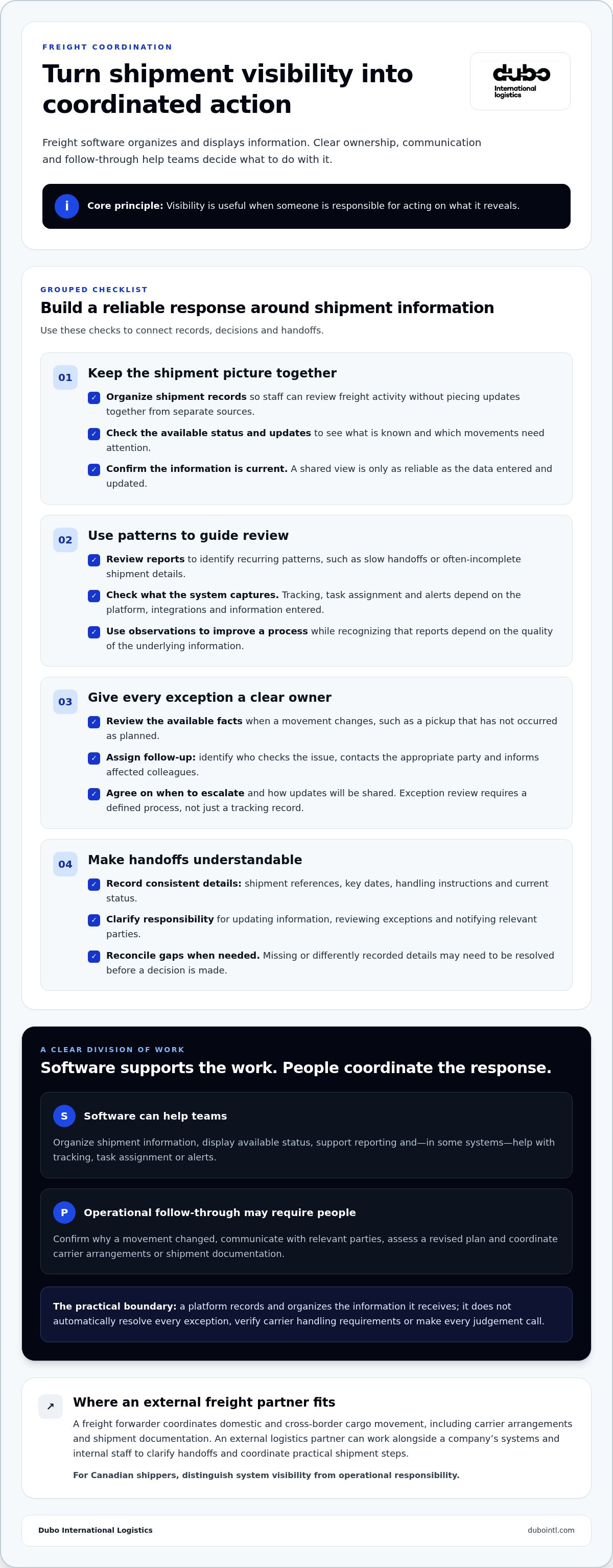
Shipment information becomes useful when teams know what it means and who is responsible for the next step. A status update can prompt a planning review, carrier follow-up or internal handoff, but only when the information is current and the process for acting on it is clear.
Visibility is useful when someone is responsible for acting on what it reveals. A tracking record alone doesn’t confirm why a movement has changed or determine the right response. People need to assess the circumstances, communicate with the relevant parties and record what happens next.
From shipment visibility to operational decisions
A shared shipment status can help a team prepare for an upcoming handoff and decide when to follow up. If an update shows that a pickup has not occurred as planned, for example, the responsible person can review the available information, contact the appropriate party and inform colleagues who depend on that shipment. This turns a record into a defined response.
Exception review is a process, not an automatic result of having software. Teams need agreed steps for checking updates, deciding when to escalate an issue and keeping affected colleagues informed. Tracking methods vary by system, carrier and shipment requirements, so teams should know what information is available and how it is shared.
Clear handoffs depend on consistent details. Shipment references, key dates, handling instructions and current status need to be recorded so the next person can understand them. If information is missing or entered differently across systems, teams may have to reconcile records before making a decision. Defined responsibilities help close that gap: someone owns the update, someone reviews exceptions, and relevant parties know when to expect an update.
Where an external freight partner adds coordination
A freight forwarder coordinates domestic and cross-border cargo movement, including carrier arrangements and shipment documentation. This work connects information in a company’s systems with the practical steps needed to manage a freight movement. An external logistics partner can coordinate with internal staff, clarify handoffs and follow up on shipment details while the business maintains visibility through its own processes.
The value depends on sound information and clear roles on both sides. Teams should establish which records they maintain, who approves changes and how shipment issues are communicated. These working arrangements help keep software records and operational decisions aligned, particularly when a shipment involves several parties or specific handling requirements.
Coordinating a movement from planning through follow-up requires clear ownership at each stage, as explained in this end-to-end freight management guide. The benefits of outsourced freight management are most relevant when experienced coordination complements, rather than replaces, a company’s own systems and knowledge. Dubo International Logistics supports freight coordination through freight forwarding and logistics consulting. Learn more about Dubo’s logistics services.
Software-only, outsourced, or combined freight management?
There isn’t one right model for every Canadian shipper. The choice depends on how much freight coordination your team can manage, how much control you need over daily decisions and whether shipments involve complex routes or specialized handling. Software can support internal processes, while outsourced coordination can add capacity and freight expertise. A combined approach brings the two together.
| Approach | Internal workload | Process control | Coordination needs and fit |
|---|---|---|---|
| Software-only | Internal staff handle monitoring, follow-up and exceptions. | The business directs its own processes and decisions. | May suit established teams with consistent workflows and capacity to manage carrier communication. |
| Outsourced coordination | A logistics partner takes on agreed freight coordination tasks. | The business sets priorities and retains decision-making according to the working arrangement. | May suit operations with limited internal capacity or demanding shipment requirements. |
| Combined model | Work is shared between internal staff, systems and an external partner. | The business maintains visibility and oversight while delegating defined activities. | May fit complex freight that needs specialist coordination alongside internal control. |
Outsourcing doesn’t have to mean giving up visibility or handing over every decision. Before selecting an approach, define which activities stay internal, which are delegated and how updates and approvals move between the parties. Clear boundaries reduce duplicate work and uncertainty about who follows up when a shipment changes.
When a software-led approach may fit
A software-led model can work well when a business has established freight processes and staff with capacity to manage them. Consistent shipment records and defined workflows can help the team review activity, assign follow-up and maintain its own operating controls. The key is assigning responsibility for data quality and for acting on information that needs attention.
When outsourced or combined support may fit
Complex coordination, specialized cargo or limited internal capacity may point towards outsourced or combined support. Internal staff can retain oversight while a logistics partner coordinates agreed freight activities. For oversized machinery, delicate equipment or temperature-sensitive products, planning needs to account for the cargo’s particular requirements. This specialized freight guide for North America explores considerations for those movements.
The benefits of outsourced freight management are most relevant when external expertise addresses a real coordination need, rather than adding another layer without clear responsibilities. Consider the routes, handoffs, cargo requirements and follow-up your team must manage, then choose the arrangement that supports those demands. Dubo coordinates specialized transportation across North America. Learn more at Dubo’s specialized transportation service or visit www.dubointl.com.
How to assess whether outsourced freight management suits your operation
Base the decision on the work your freight actually requires. A clear assessment helps separate technology needs from coordination needs, so you can identify where internal processes are sufficient and where additional expertise could help. It also gives your team a practical basis for assigning responsibilities before changing how freight is managed.
Map the work before choosing a management model
Start with a representative view of shipments moving through your operation. Include domestic and cross-border movements, cargo characteristics, recurring coordination tasks and the internal teams involved. Look beyond shipment volume: even a small number of complex movements can require substantial planning and follow-up.
Then trace where information or responsibility becomes unclear. Look for repeated requests for the same details, handoffs without a clear owner, or exceptions that sit unresolved because no one knows who should act. Separate gaps that better systems might address, such as inconsistent records, from those that call for freight expertise, carrier coordination or shipment-specific planning.
- Map shipment patterns. Record the routes, movement types, cargo needs and recurring coordination activities your team handles.
- Identify friction points. Note where updates, approvals or handoffs are delayed, unclear or repeated.
- Review internal capacity. Establish who has time and expertise to manage routine follow-up and more complex exceptions.
- Set priorities. Decide which operational needs matter most, such as clearer shipment oversight, defined ownership or specialized planning.
Set expectations for oversight and performance
Before implementation, document which decisions remain with your organization and which coordination tasks a partner will manage. Assign clear ownership for shipment information, approvals, escalation and performance review. This reduces uncertainty when plans change and helps internal staff understand when they need to act.
Choose measures that reflect your priorities. Depending on the operation, these might include the completeness of shipment records, timeliness of status updates, adherence to agreed delivery windows or how exceptions are documented and resolved. Review the information regularly with the people responsible for the work. A measure is useful only when it informs a decision.
Service level agreements (SLAs) can set out agreed service performance, delivery windows or equipment availability. Define what will be measured, how updates will be shared and how responsibilities are divided. Clear expectations make it easier to assess whether the arrangement supports your operating needs, without assuming that outsourcing alone will resolve every process issue.
When freight findings point to wider process gaps, place them in the context of a supply chain optimization framework so operational priorities can be considered alongside broader resilience goals. If your assessment points to a need for experienced freight coordination, discuss your operation’s requirements with Dubo International Logistics. The benefits of outsourced freight management are most relevant when the agreed support addresses specific shipment complexity and internal capacity needs.
How Dubo supports freight management beyond the software
Freight software can organize shipment information, while experienced people coordinate the movement itself. Dubo International Logistics is a freight forwarding and logistics partner, not a freight management software vendor. Its team coordinates carriers, shipment documentation and handling requirements, working alongside a business’s internal systems and staff.
This distinction matters when freight involves several parties, complex routes or cargo that needs specific handling. A system can hold shipment records, while a logistics partner connects those records to carrier arrangements and the practical steps required to move cargo. The right division of responsibilities depends on each shipment and the company’s operating priorities.
A freight partner for complex North American movements
Dubo coordinates freight across Canada and North America, aligning shipment handling and carrier coordination with the requirements of each movement. Its work includes specialized transportation for oversized machinery, delicate equipment and temperature-sensitive products. These shipments require attention to the cargo’s particular needs as plans and handoffs are coordinated.
For specialized transportation, Dubo uses tracking systems and a carrier network to support shipment coordination. These tools and relationships form part of the operational picture, alongside documentation and communication among the parties involved. They complement a shipper’s own systems and help clarify responsibilities as freight moves through its planned stages.
Dubo serves businesses nationally across Canada and provides logistics support across North America. As an independent provider and member of the Canadian International Freight Forwarders Association (CIFFA), Dubo brings freight forwarding experience to complex cargo coordination. CIFFA membership is a professional association credential, not a guarantee of a particular shipment outcome. Dependable planning still relies on clear requirements and appropriate coordination for the movement.
The benefits of outsourced freight management are most relevant when a partner’s expertise complements internal oversight. A business can retain responsibility for its priorities and approvals while relying on a logistics partner to coordinate agreed shipment activities and documentation. This connects internal decision-making, operational follow-through and the systems the company already uses.
A practical next step for evaluating support
Begin with a focused discussion about your freight coordination needs. Consider the shipment types involved, recurring handoffs, documentation responsibilities, internal capacity and cargo-specific handling requirements. These details help define which activities your team wants to manage directly and where external coordination fits. A clear conversation can also establish how information will be shared and who owns key decisions, rather than assuming one arrangement suits every operation.
Dubo’s freight forwarding, logistics consulting and specialized transportation services support businesses managing shipments across Canada and North America. To discuss your operational priorities and freight coordination needs, visit the Dubo International Logistics website.
Make your next freight decision with confidence
The right approach gives your team dependable oversight without leaving important coordination tasks unowned. Before making a change, identify one recurring point of friction and decide what better support would look like: clearer shipment information, defined follow-up or added expertise for complex movements. That focus helps you assess the benefits of outsourced freight management against your operating needs, rather than adopting technology or external support without a clear purpose.
For Canadian businesses coordinating freight across North America, Dubo brings freight forwarding and specialized transportation experience, alongside its membership in the Canadian International Freight Forwarders Association (CIFFA). Discussing your shipment requirements and internal priorities is a practical way to determine where logistics support fits.
Discuss your freight management needs with Dubo and take a considered next step towards freight coordination that supports your operation.
Frequently Asked Questions
Does freight management software replace an outsourced freight management partner?
No. Software can organize records and display updates, but it doesn’t take responsibility for decisions, carrier communication or shipment-specific follow-through. Outsourced support assigns agreed coordination work to a logistics partner, while the business retains oversight through its own processes. The benefits of outsourced freight management are most relevant when a real expertise or capacity gap exists, not simply because a company already uses a platform.
Can a business outsource freight management and keep visibility over shipments?
Yes. A business can agree on how shipment information will be shared, which updates it will receive and who can view relevant records. For example, an internal team might retain responsibility for delivery approvals while a partner coordinates agreed freight activities and reports material changes. Set these arrangements out before work begins, including how both sides will handle updates that need prompt attention.
Is freight management software useful for a small business?
It can be, if it addresses a practical need. A small business coordinating several shipments may benefit from a consistent way to record shipment references, planned dates and status updates, especially when more than one employee handles follow-up. Start by identifying where information gets lost or duplicated. Then assess whether a digital workflow would address that specific issue without adding unnecessary steps.
What should a business compare when evaluating freight management software benefits?
Compare how well a system fits your workflow, not just the number of features it lists. Consider what shipment details your team can record, how staff will keep information current, which reports support decisions and whether the tool fits existing processes. Also account for training and ongoing data ownership. A platform is useful when its information is relevant, accurate and practical for the people managing freight.
Can outsourced freight management support cross-border shipments?
Yes. A freight forwarder can coordinate cross-border cargo movements by arranging carriers and managing shipment documentation as part of the movement. Businesses should define who supplies shipment details, who reviews documentation and how status changes are communicated between the parties involved. Dubo International Logistics coordinates freight across North America. Visit www.dubointl.com to learn about its freight forwarding support.
When should a company consider combining freight software with outsourced management?
Consider a combined model when internal teams need to retain shipment oversight but lack capacity or specialist experience for certain movements. For example, a business could use its own records and reporting while assigning selected carrier coordination or specialized shipment planning to a logistics partner. Define the division of work first, including approval authority and how updates return to the internal team, so the arrangement supports rather than fragments the process.

