

The initial quote you receive is rarely the final price you pay. In the current 2026 market, unforeseen surcharges often inflate logistics costs by as much as 25 per cent, turning a straightforward shipment into a budgetary challenge. For many Canadian businesses, the frustration of an unpredictable shipping budget is a recurring reality that erodes profit margins and complicates long-term financial planning. You likely recognize the feeling of opening a final invoice only to find a list of unfamiliar accessorials and administrative fees that weren't part of the original agreement. Mastering the art of avoiding hidden fees in freight shipping requires more than just a keen eye; it demands a strategic approach to contract architecture and a deep understanding of the North American logistics landscape.
This guide provides a professional roadmap to help you identify and neutralize these unexpected costs before they impact your bottom line. We'll explore the most common surcharges, such as terminal handling fees and volumetric pricing adjustments, while offering practical steps to streamline your documentation. By the end of this article, you'll have the tools to ensure your logistics spending remains predictable and your supply chain remains resilient.
Key Takeaways
- Distinguish between base freight rates and the total landed cost of goods to establish a more accurate and predictable logistics budget.
- Master the art of avoiding hidden fees in freight shipping by identifying the specific triggers for demurrage and detention at Canadian ports and rail yards.
- Uncover the "invisible" expenses of specialized transportation, such as provincial permit requirements and escort fees for oversized or overweight cargo.
- Learn how to audit carrier contracts for vague accessorial definitions and pricing traps that often lead to unexpected surcharges.
- Implement packaging and palletization strategies designed to eliminate dimensional weight penalties and improve overall shipment efficiency.
The Anatomy of Freight Surcharges: Why Quotes and Invoices Differ
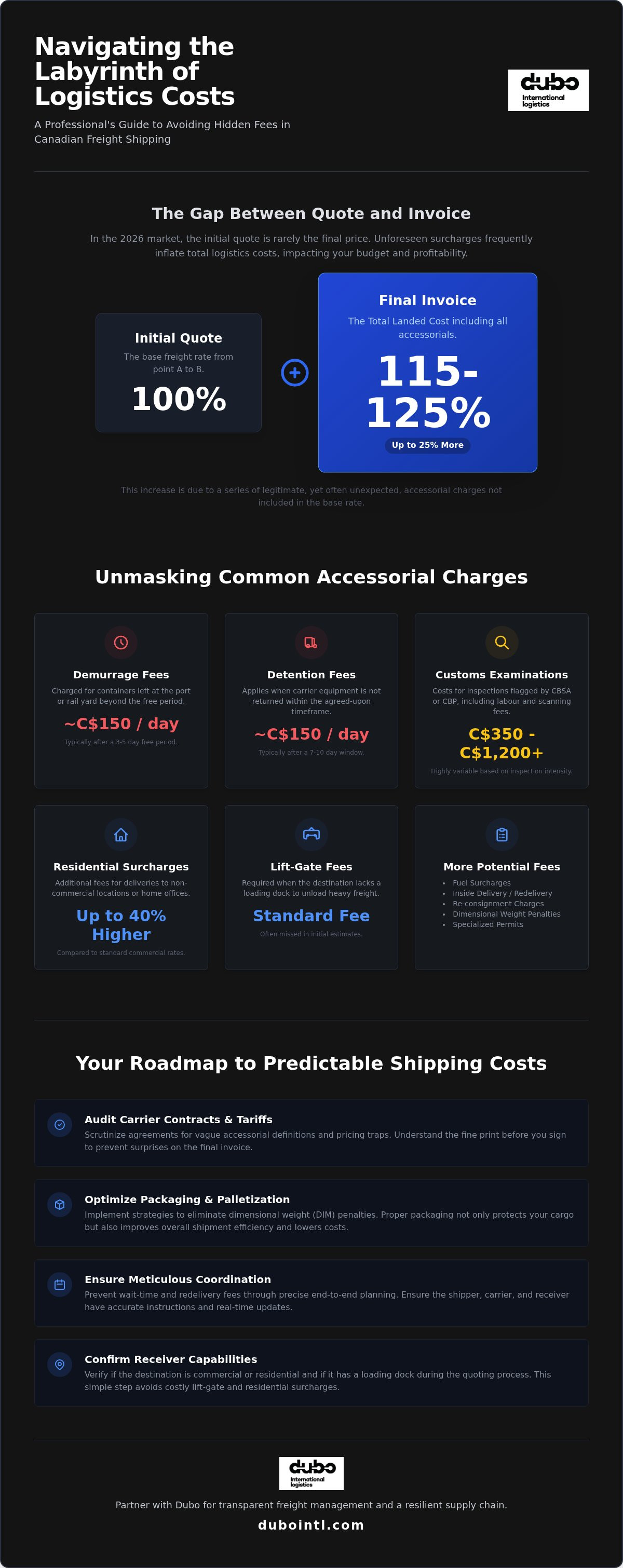
The quote is a promise; the invoice is the reality. For many Canadian shippers, the gap between these two documents is where profitability disappears. The base freight rate usually covers the simple movement of goods from point A to point B, but it often excludes the total landed cost, which encompasses duties, taxes, and the complex web of surcharges. Industry data suggests that importers frequently pay 15 to 25 per cent more than their initial quote due to these overlooked line items. Achieving true transparency in avoiding hidden fees in freight shipping starts with recognizing that most "hidden" costs are actually legitimate accessorials defined within the carrier's tariff or the Bill of Lading (BOL). If the BOL contains inaccuracies regarding weight, class, or delivery requirements, the carrier will automatically apply corrections that lead to significant billing discrepancies.
The Impact of Market Volatility on 2026 Shipping Rates
Market conditions in 2026 remain fluid. Fuel surcharges fluctuate weekly based on North American indices, making fixed-cost budgeting difficult without professional oversight. When capacity crunches occur, particularly during the peak season from August to October, carriers often implement equipment repositioning fees to move empty containers to high-demand areas. Capacity-based surcharges represent dynamic pricing adjustments triggered when the demand for specific equipment or lanes exceeds available carrier supply. These fees ensure that equipment remains available for those willing to pay the premium, yet they often catch unguided shippers by surprise. Strategic consulting from a partner like Dubo International Logistics can help forecast these shifts and secure more stable pricing structures.
The Human Element: Miscommunication in Logistics Coordination
Operational friction often stems from a lack of synchronicity between the shipper, the carrier, and the receiver. If a driver arrives at a facility that isn't ready to receive, wait-time fees begin to accrue almost immediately. Similarly, re-consignment charges apply if a delivery address is modified while the cargo is already in transit. These costs are preventable through meticulous end-to-end coordination. By ensuring that every stakeholder has precise instructions and real-time updates, businesses can eliminate the administrative errors that lead to penalties. Precision in documentation is the most effective tool for avoiding hidden fees in freight shipping and maintaining a stable logistics budget. It turns a reactive process into a controlled, professional methodology.
Common Accessorial Charges and Regulatory Fees in North America
The clock begins ticking the moment your container touches the quay. In Canadian rail yards and ports, demurrage fees often accumulate after a brief three to five day free period, costing approximately C$150 per day for each container left on-site. Detention fees mirror this cost once the container leaves the port but isn't returned within the seven to ten day window. These charges are a significant hurdle in avoiding hidden fees in freight shipping, as they frequently stem from congestion or administrative delays beyond the shipper's immediate control. Precise scheduling and proactive communication with drayage partners are essential to minimize these daily penalties.
Beyond the port, the "last mile" presents its own set of financial traps. Shipping to a home office or a non-commercial site in 2026 can attract residential surcharges that are up to 40 per cent higher than standard commercial rates. If the destination lacks a loading dock, a lift-gate fee is almost certain. Shippers also encounter inside delivery or redelivery charges when a driver is required to move freight beyond the curb or when a first delivery attempt fails. These accessorials are often missing from initial estimates but appear prominently on final invoices, making it vital to confirm receiver capabilities during the quoting process.
Customs examinations represent another unpredictable expense. If the CBSA or CBP flags a shipment for inspection, you're responsible for the costs of the exam, X-ray scanning, and even the labour required to reload the cargo. These fees can range from C$350 to over C$1,200 depending on the intensity of the search and the time required for the physical inspection.
Cross-Border Regulatory Fees and Compliance Costs
Documentation errors are the primary cause of cross-border delays between Canada and the USA. Incomplete paperwork results in bond fees and administrative charges that quickly erode margins. A forwarder with CIFFA certification understands the nuances of these regulations, ensuring that your documentation is precise and compliant before the wheels ever turn. Engaging in strategic logistics consulting allows you to identify these potential pricing traps early in the planning phase, providing the peace of mind that comes from a well-architected supply chain.
Fuel Surcharges and Environmental Levies
Carriers in 2026 use complex formulas to calculate the Fuel Surcharge (FSC), often based on weekly national fuel price indices. Additionally, new "carbon offset" or green energy levies are emerging within the Canadian market as the industry moves toward sustainability targets. To achieve more predictable pricing, shippers should look for contracts that offer transparency in how these environmental fees are applied rather than accepting a flat percentage that lacks clarity. Locking in more predictable fuel-related pricing requires a deep understanding of carrier tariff structures and the ability to negotiate terms that reflect actual market movements.
Specialized Transportation: Avoiding Costs for Unique Cargo
Moving heavy machinery or oversized components across the Canadian landscape requires a level of precision that standard freight models simply don't support. When cargo exceeds legal width, height, or weight limits, carriers apply significant surcharges to account for the increased risk and operational complexity. These expenses often extend beyond the base rate to include permit fees, which vary significantly by province, and escort vehicle charges for particularly wide loads. Avoiding hidden fees in freight shipping for specialized cargo depends on identifying these requirements during the initial planning phase rather than at the provincial border. A reactive approach to oversized permits can result in thousands of dollars in fines or forced rerouting.
For flatbed or open-deck shipments, tarping and lashing charges are frequently omitted from initial estimates. Tarping provides essential protection against the harsh Canadian climate, while lashing ensures the load remains secure during transit. Temperature-controlled logistics also command a premium, reflecting the additional fuel consumed by refrigeration units and the specialized monitoring equipment required to maintain cargo integrity. These costs are a necessary investment in the safety of your goods, yet they must be itemized early to maintain budget accuracy.
Managing Complex Project Cargo Logistics
Standard quotes often fail in the context of project cargo because they lack the foresight to account for site-specific challenges. A professional site survey can identify physical obstacles, such as low-hanging power lines or narrow access roads, that would otherwise trigger unforeseen delay fees or equipment swaps. Strategic planning allows for a "logistics architect" approach, where every potential friction point is neutralized before the cargo leaves the facility. This proactive methodology transforms a high-risk movement into a seamless, predictable operation, reducing the likelihood of emergency surcharges.
The Cost of Specialized Equipment Handling
The financial impact of specialized freight doesn't end when the truck arrives at the destination. Crane rentals and specialized rigging fees are often required for offloading heavy machinery; these services must be coordinated with the carrier's arrival to avoid costly standby time. Shippers should also be aware of deadhead fees, which carriers charge to move specialized trailers into low-density lanes where backhaul opportunities are scarce. By partnering with an expert in specialized transportation solutions, you gain access to a network that prioritizes efficiency and cost-containment. This high-level oversight is the most reliable way of avoiding hidden fees in freight shipping for your most valuable assets.
Proactive Strategies to Eliminate Hidden Shipping Expenses
Strategic foresight is the most effective tool for maintaining a stable logistics budget. While many shippers view accessorials as an inevitable cost of doing business, most can be neutralized through a proactive approach to contract management and operational planning. Avoiding hidden fees in freight shipping starts with a rigorous audit of your existing carrier agreements. You must identify "pricing traps" where accessorial definitions are left vague, allowing carriers to apply discretionary charges for services that should be inclusive. Implementing a structured freight audit and payment (FAP) process ensures that every invoice is verified against the original quote, preventing overpayment on administrative errors or unauthorized surcharges.
Packaging optimization has become a critical pillar of cost containment in 2026. As many LTL carriers move toward 100 per cent volumetric pricing, the physical dimensions of your cargo are just as important as its weight. Pallets that are poorly stacked or contain excessive empty space trigger "dim-weight" (dimensional weight) penalties that can inflate costs by 20 to 40 per cent. By redesigning your palletization strategy to maximize density, you eliminate the risk of paying for "shipped air" and protect your margins from unnecessary volumetric adjustments.
Precision Documentation: The Best Defence Against Fees
Accuracy on the Bill of Lading (BOL) is the foundation of a frictionless supply chain. Shippers must ensure that weights and measurements are precise and that National Motor Freight Classification (NMFC) codes are applied correctly. Misclassification is a frequent trigger for significant re-class fees and audit penalties that appear long after the shipment has been delivered. When documentation lacks precision, terminal handling charges often escalate because of the additional administrative labour required to verify and correct cargo details at the port. Professional diligence in the documentation phase removes the justification for these corrections.
Leveraging Logistics Consulting for Long-Term Savings
Strategic consulting goes beyond simple carrier selection; it involves "freight architecting" to redesign supply chain routes for maximum efficiency. By analyzing systemic inefficiencies, a consultant can identify opportunities to consolidate shipments or shift lanes to avoid high-congestion areas where demurrage is most likely to occur. Engaging in strategic logistics consulting in Canada provides the specialized insight needed to navigate complex provincial regulations and market volatility. This high-level oversight transforms your logistics from a source of stress into a competitive advantage. To secure your supply chain against unforeseen costs, consider partnering with an expert through Dubo's logistics consulting services to build a more transparent and predictable shipping model.
Partnering with Dubo International Logistics for Transparent Freight Management
Logistics is a complex discipline that requires a steady hand and a meticulous eye for detail. When you partner with Dubo International Logistics, you aren't just hiring a freight forwarder; you're engaging a dedicated partner who acts as a protective steward of your logistics budget. Our commitment to price transparency ensures that the complexities of North American cargo movement don't translate into unexpected expenses for your business. By leveraging our CIFFA-certified expertise, you gain a partner who prioritizes high professional standards and precision in every transaction. Achieving excellence in avoiding hidden fees in freight shipping requires this level of dedicated oversight to ensure that your supply chain remains both efficient and cost-effective.
Our approach is rooted in the belief that predictable spending is the result of strategic foresight rather than luck. We provide a stabilizing force in a volatile global environment, positioning ourselves as a bridge between your local needs and the intricate systems of international trade. This partnership allows you to focus on your core business while we manage the minute details of your cargo movement, ensuring that every C$ spent is an investment in reliability.
The Dubo Difference: Precision and Peace of Mind
Our methodology focuses on the seamless integration of carrier coordination and documentation management. We understand that the smallest error in a Bill of Lading can trigger a cascade of surcharges, which is why we meticulously architect every shipment from origin to destination. This focus on precision is particularly vital for specialized cargo and complex cross-border movements between Canada and the United States, where regulatory nuances often hide potential costs. As a seasoned expert in the field, we provide the stabilizing force needed to navigate these international systems. For reliable support that prioritizes your peace of mind, www.dubointl.com serves as your central hub for sophisticated logistics solutions.
Next Steps: Securing Your Supply Chain for 2026
The first step toward a more predictable budget is a strategic audit of your current shipping processes. This audit identifies systemic vulnerabilities and provides a clear roadmap for optimization. A successful logistics partnership relies on longevity and consistency, allowing for the development of bespoke solutions that grow with your business needs. Transitioning to a model of end-to-end freight management is a strategic investment in the future of your supply chain. We invite you to request a comprehensive logistics consultation to realize the full potential of your operations and eliminate the friction of unpredictable costs. Let us help you build a supply chain that is as resilient as it is transparent.
Building a Resilient and Predictable Supply Chain for 2026
Precision in documentation and a sophisticated understanding of North American accessorials are your strongest tools for budget stability. We've explored how identifying "pricing traps" and optimizing packaging to avoid volumetric penalties can move your business from a reactive stance to one of strategic control. Success in avoiding hidden fees in freight shipping isn't found in chasing the lowest base rate; it's found in architecting a transparent, end-to-end movement plan that accounts for every variable. It's about replacing uncertainty with the quiet confidence of a well-managed supply chain.
As a proud member of the Canadian International Freight Forwarders Association (CIFFA), Dubo International Logistics brings the high professional standards and specialized expertise required for complex cross-border movements. We act as a protective steward of your interests, providing total cost visibility and meticulous coordination. Ready to bring transparency to your logistics budget? Consult with the experts at Dubo International Logistics today. Your supply chain deserves the security that comes from dependable partnership and meticulous execution.
Frequently Asked Questions
What are the most common hidden fees in North American freight shipping?
The most prevalent surcharges include fuel adjustments, terminal handling charges, and administrative documentation fees. Terminal handling fees alone can range from C$200 to over C$500 per container at major hubs; these are rarely included in initial ocean freight quotes. Shippers also encounter administrative fees for digital documentation processing, which typically range from C$25 to C$50 per shipment. Recognizing these line items early is the first step in maintaining budget integrity.
How can I avoid demurrage and detention charges at Canadian rail yards?
Minimizing these daily penalties requires meticulous coordination with your drayage partners and a clear understanding of port-specific free time. Most Canadian ports offer a three to five day window before demurrage fees, currently averaging C$150 per day, begin to accrue. By ensuring that your carrier is ready to pull the container as soon as it's discharged, you avoid the ticking clock of port storage. Real-time tracking and proactive communication are essential for these time-sensitive movements.
Why is my freight invoice higher than the original quote I received?
Discrepancies often occur because the initial quote only covers the base rate, while the final invoice includes actual operational costs and corrections. Achieving success in avoiding hidden fees in freight shipping requires ensuring that your Bill of Lading matches the physical cargo exactly. If a carrier discovers that the weight or freight class is incorrect, they'll apply re-class fees and audit penalties. Market volatility also triggers dynamic pricing adjustments that aren't reflected in static quotes.
Can a freight forwarder help me negotiate better accessorial rates?
A professional forwarder uses volume leverage and industry expertise to standardize accessorial definitions within your carrier contracts. They identify vague language that allows for discretionary charges and negotiate more favourable terms for common services like lift-gate or residential delivery. This protective oversight ensures that you aren't paying a premium for standard operational requirements. By auditing contracts for pricing traps, a forwarder acts as a stabilizing force for your overall logistics expenditure.
What is dimensional weight (dim-weight), and how does it affect my shipping costs?
Dimensional weight is a calculation that determines the shipping rate based on the volume of the package rather than its physical mass. In 2026, many LTL carriers have moved toward 100 per cent volumetric pricing to maximize trailer capacity. If your cargo is light but bulky, you'll be charged for the space it occupies. Optimizing your packaging to reduce empty space is the most effective way to eliminate these unexpected penalties and protect your margins.
How do I ensure my cross-border documentation is compliant to avoid penalties?
Precision in your NMFC codes and a thorough understanding of CBSA regulations are the best defences against cross-border penalties. Incomplete paperwork often leads to customs examinations, which can cost between C$350 and C$1,200 depending on the intensity of the inspection. Partnering with a CIFFA-certified expert ensures that every document is compliant before the shipment reaches the border. This proactive methodology prevents the administrative delays and bond fees that often plague cross-border trade.
What role does logistics consulting play in reducing hidden shipping fees?
Logistics consulting provides a high-level view of your supply chain to identify systemic inefficiencies that trigger surcharges. Instead of merely selecting carriers, a logistics architect redesigns your routes and consolidation strategies to minimize exposure to high-cost lanes and congested ports. This strategic foresight transforms your logistics from a reactive expense into a controlled, professional process. Consulting offers the long-term savings that come from a meticulously planned and transparently managed supply chain.
Is it possible to dispute an unexpected accessorial charge from a carrier?
You can successfully dispute unexpected charges if you maintain a rigorous freight audit and payment process supported by accurate documentation. If a carrier applies an incorrect accessorial, your primary defence is a precise Bill of Lading that contradicts their claim. Success in these disputes requires acting quickly and providing clear evidence of the cargo's actual dimensions or delivery requirements. Consistent auditing prevents overpayment and holds carriers accountable to the terms of your original agreement.

