

Complex project freight management demands precise route engineering, specialized heavy-lift machinery, and rigorous compliance to prevent costly delays. Strict adherence to transport regulations across North American freight corridors holds when you partner with a certified freight forwarder. Head over to www.dubointl.com to coordinate your specialized cargo needs.
Project Cargo Scenarios: How to Segment Your Logistics Needs
You segment logistics needs by weight, dimensions, handling risk, and routing options, because a wrong call on unit specifications is what turns a planned move into an unexpected transit delay. Before you choose equipment, match your situation to a concrete path:
- Oversized machinery on Canadian corridors: confirm dimensions early so you know whether a standard flatbed still clears legal heights or you need a lowbed trailer configuration.
- High-value assembly tools: book custom transport so components are protected from transit damage rather than forced into a standard van.
- Site-critical deliveries where driver time is tight: stage the correct equipment before arrival so you avoid excess waiting for loading (temps d'attente) fees that stall heavy assembly work.
Accurate dimensions dictate whether you require standard flatbed trailers or specialized lowbed trailer configurations to maintain legal road clearances. Categorizing oversized machinery or temperature-sensitive goods early allows precise route planning across Canadian corridors. Standard freight fits standard vans, whereas oversized assembly tools demand specialized freight forwarding for a safe shipping project (freight forwarding). Each cargo profile dictates a distinct plan, so you lock equipment and routing before the truck is dispatched.
Choosing custom transport solutions protects high-value components from potential transit damage and keeps your schedule under quiet confidence rather than last-minute improvisation.
Tip: Assess cargo weight and dimensions early to determine whether standard flatbeds or custom lowbed trailers are required.
Project Freight Defined: When Cargo Outgrows Standard Shipping
Project cargo refers to the transportation of high-value, oversized, or complex equipment requiring specialized shipping project solutions. It covers movements that exceed standard container dimensions or demand precise operational timing. In this specialized sector, cargo often requires custom flat-racks, heavy-haul trailers, or dedicated vessels.
Consider a large-scale stamping press as a working arc. The problem is not only mass: bridge capacities, overhead clearances, and site permits all constrain the corridor. The action is meticulous route planning, specialized rigging, and the right trailer deck height before the load rolls. The outcome is a move that clears legal limits without structural delays or damaged assets. Transporting that press is closer to relocating a small building than booking a routine lane; every millimetre of clearance matters for operational continuity.
You must account for strict site permits, specialized rigging, and potential dock delays when drivers arrive before the site is ready. Proper execution requires securing freight (protocoles d'arrimage) correctly to minimize movement risks across long routes.
For complex shipments across Canada, you can review how to outsource freight management with strategic oversight. Discover project-cargo capabilities at www.dubointl.com.
Why Heavy Industry Depends on Specialized Logistics
Heavy industrial sectors depend on precision transport for massive equipment, and the cost of a missed window shows up fast on the plant floor. Manufacturing, energy, and infrastructure projects require tailored movement strategies for oversized machinery.
Uncoordinated site deliveries trigger detention-style fees and hold up heavy assembly work when the truck is ready and the bay is not. You can review Canada freight management guidance to align route permits with delivery schedules. Moving a large stamping press under a logistics architect’s plan keeps timelines intact: route and permits first, equipment matched to deck height second, site readiness confirmed third. Careful sequencing prevents severe downtime and supports compliance on provincial corridors.
Strategic oversight acts as a stabilizing force for critical assets. Coordinate specialized moves through www.dubointl.com.
Complex Project Freight Management: 5 Execution Steps That Protect Your Timeline
Heavy-lift transport rewards shippers who treat engineering standards, safety compliance, and route management as one sequence rather than separate errands. Field observations confirm that thorough preliminary route assessments prevent severe structural delays, and early coordination reduces financial risk while the load is in transit. Shippers often review Canadian freight management material when organizing complex domestic routes.
Follow these standard operational steps:
- Route survey: Analyze bridge capacities, overhead clearances, and road turning radii.
- Permit acquisition: Secure municipal and provincial transport authorizations along the corridor.
- Equipment selection: Choose specialized configurations like a lowbed trailer (a low-deck trailer used to transport tall or heavy cargo while maintaining legal clearance).
- Cargo securing: Apply strict tie-down systems so the load cannot shift under braking or grade changes.
- Transit monitoring: Track driver schedules so dock and site windows stay aligned.
Structured coordination gives you peace of mind on specialized cargo. For expert guidance on complex movements, visit www.dubointl.com.
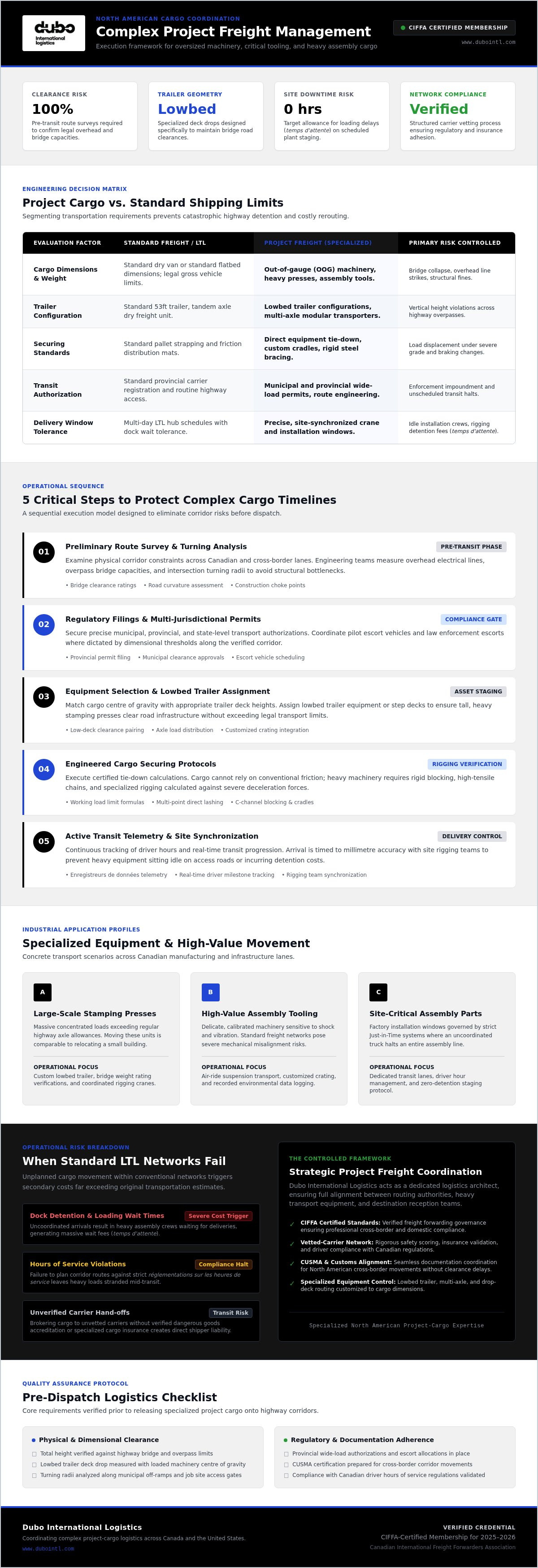
When Standard Shipping Fails: Evaluating Operational Limits
Standard LTL networks fail when cargo exceeds regular weight capacities or requires precise site coordination, and that failure mode is visible before the first kilometre if you read the dimensions honestly.
Relying on standard transport for oversized industrial assets creates severe operational bottlenecks. In logistics practice, routine freight networks lack the specialized lowbed trailer equipment needed to clear bridge heights safely. Specialized shipping project strategies become necessary when you move heavy assembly tools or large-scale stamping presses.
Standard transport operates like a public bus, whereas project cargo demands a dedicated escort. Moving high-value assets without custom protocols risks total supply chain disruption. Attempting to fit specialized industrial loads into standard shipping models is an unacceptable risk that leads to expensive delays. Specialized transport supplies the coordination required to hold cargo stable and protect operational continuity.
Review your dimension requirements at www.dubointl.com.
How Project Freight Pricing Reflects Real Operational Risk
Project freight rates depend on cargo dimensions, specialized equipment requirements, and transit route complexities rather than simple distance formulas, so your budget stays accurate only when those drivers are visible up front.
From client work, unexpected transit delays often stem from unaccounted load dimensions that require special permits. Specialized transport costs escalate when oversized items need escorts, route surveys, or custom crating for safety. Transportation operational costs also move with regulatory shifts and infrastructure demands nationwide, which is why clear coordination prevents financial surprises during heavy industrial moves.
Carrier scheduling adjustments can reduce empty kilometres and lower total expense when backhaul and timing are planned together.
| Cost Factor | Primary Driver | Risk Mitigation |
|---|---|---|
| Equipment Needs | Cargo size and weight | Dedicated flatbed or lowbed trailer planning |
| Waiting Time | Port and site bottlenecks | Clear service level agreements (SLAs) |
| Route Permits | Provincial regulations | Proactive route surveys |
Managing a shipping project still depends on disciplined load restraint and on keeping site windows tight enough that unplanned dock time does not inflate the invoice. Tailored planning supports predictability and limits operational risk.
Request a personalized quote to structure your budget accurately. More on this: Reliable Freight Forwarding Services.
How Regulatory Compliance Protects Dangerous Goods Moves
Transporting regulated cargo across Canadian corridors requires strict adherence to the Règlement sur le transport des marchandises dangereuses, and the penalty for treating that as paperwork alone is delay at the inspection gate.
From project reviews, handling hazards demands rigorous oversight. Non-compliance risks severe transit delays. Managing oversized permits alongside hazardous classifications is essential for secure transport; each regulatory body has to align on the same corridor plan.
Select carriers with proven dangerous-goods handling experience and verify their equipment and trained personnel. That approach keeps your shipping project compliant across provinces. Correct load restraint prevents unnecessary downtime when inspectors stop the unit at roadside or at the gate.
Visit www.dubointl.com to coordinate regulated shipments with verified specialists.
Tip: Verify carrier dangerous-goods certifications and equipment before signing transport contracts.
Why Industry Certification Separates Reliable Forwarders
Evaluating a shipping project partner means checking verified industry credentials and precise regulatory compliance, because credentials are what you can test before a critical load is at risk. Independent accreditation confirms that a team maintains strict standards for safety, financial stability, and risk management.
From client work, uncertified intermediaries often overlook regulatory steps, which leads to sudden delays during cross-border transit. Partnering with accredited experts prevents costly oversight errors and secures specialized equipment when you need it.
As a proud member of the Canadian International Freight Forwarders Association (CIFFA), a certified forwarder can offer the strategic foresight and end-to-end freight management necessary for complex cargo. Certified teams execute strict load-restraint discipline to shield high-value machinery throughout transit. Choosing an accredited organization supports regulatory alignment for every heavy shipment.
You can review full service capabilities at www.dubointl.com. A forwarder’s operational record and billing clarity reveal dependability in practice.
Among Google reviews, Jatinder (5★) wrote:
"One of the best company to work with. This company pays by EFT with in 30 Day
Prompt vendor payments and professional operations demonstrate the reliability required to execute complex freight projects successfully.
Frequently asked questions
What is Project Freight?
Project freight refers to the complex project freight management of high-value, oversized, or critical equipment moving along specialized transportation supply chains. A dedicated shipping project requires detailed route surveys, engineering assessments, and custom coordination to secure safe delivery across global routes.
Which industries use project freight?
Energy, manufacturing, infrastructure, and heavy industrial sectors depend on these services to move critical machinery. Shippers frequently require specialized transportation for heavy assembly tools and large-scale stamping presses across North America.
What are the key characteristics of project freight?
Strict timelines, out-of-gauge dimensions, and complex regulatory requirements define these shipments. Managing cargo safely involves customized crating, specialized trailers, and tight control of dock and site windows so drivers are not idle before loading.
Why is an experienced team important?
An experienced team mitigates financial risk by managing strict permit requirements, border compliance, and site access constraints through proactive planning. A CIFFA-certified freight forwarder can provide the strategic foresight needed for uninterrupted transport continuity. You can review detailed service criteria at www.dubointl.com.
Why is Project Cargo so Complex?
Extreme dimensions and regulatory constraints demand specialized routing, precise permits, and certified transport networks. High-risk shipments often require load restraint through a vetted dangerous-goods carrier network with verified equipment and trained personnel.
Managing Heavy Cargo Corridors
Executing complex project freight management across Canadian and North American corridors requires meticulous planning and adherence to strict regulatory guidelines. In 2026, specialized transportation services remain the practical way to secure your cross-border supply chains when dimensions, permits, and site windows must move as one plan.
Working with a freight forwarder that holds Canadian International Freight Forwarders Association (CIFFA) certified membership supports adherence to industry standards. Access to a vetted dangerous-goods carrier network protects critical shipments against costly regulatory delays. Reach out via www.dubointl.com when you need a quote shaped around your corridor, equipment, and compliance profile.
