
A late delivery is often a symptom, not the whole problem. Logistics performance consulting examines how routes, hand-offs, carrier schedules, and internal processes work together, helping Canadian businesses identify where disruptions begin and which changes may improve performance.
When shipments travel long distances or serve different regions and industries, a single fix rarely addresses every operational pressure. A careful assessment connects day-to-day logistics decisions with delivery reliability, shipment visibility, and the flow of goods.
This article explains how consultants assess logistics operations, identify weaknesses in delivery and route planning, and turn recommendations into practical steps. It also considers how priorities differ across Canadian industries, so you can see what to review, what information supports sound decisions, and how a measured improvement plan can fit your business.
Key Takeaways
- Use operational measures such as on-time delivery, shipment accuracy and transit time to locate performance gaps.
- Turn assessment findings into a phased plan, then track progress as changes are put into practice.
- Review route design, carrier schedules and hand-offs together to identify practical ways to improve delivery reliability.
- Adapt logistics improvements to the needs of each industry, cargo type and distribution process.
- Consider consulting support when operational challenges involve complex freight movement or specialized transportation requirements.
Assessing operations and identifying weak spots
Logistics performance consulting starts with evidence from daily operations, not assumptions. Consultants trace delays, review how goods move, and identify where processes disrupt service or resilience.
Logistics Strategy and Resilience
A strategy assessment maps how goods move from suppliers through transportation to their destinations. Consultants examine dependencies, hand-offs, and recurring disruptions to see where one delay can affect later shipments. For example, a late supplier delivery may leave a production schedule without the materials it needs. The analysis considers practical alternatives, such as adjusting schedules or planning backup routes, to support continuity when conditions change.
For global operations, the review also accounts for differences between corridors, partners, and cargo requirements. Mapping these connections helps show whether a disruption is isolated or could affect several stages of the supply chain.
Efficiency and Results Monitoring
Performance monitoring turns operational activity into measures managers can use. Consultants can assess on-time performance, pick accuracy, and throughput per hour, then compare results across routes, teams, or periods. A dashboard can bring delivery accuracy and transit time into view. Regularly reviewing these measures helps distinguish a recurring process issue from a one-time delay.
Inbound analysis can also track supplier delivery accuracy and timeliness. When missed arrivals cluster around certain suppliers or receiving periods, the pattern points to a more focused operational review.
Operational Improvement and Scaling
Operational improvement starts with finding process waste without compromising service. Consultants examine repeated handling, underused transport capacity, avoidable delays, and inefficient shipment flows. They assess possible changes against service measures to maintain delivery reliability. For global expansion, the analysis tests whether current processes can support new routes, partners, and shipment volumes.
Scaling also means identifying which procedures should remain consistent and which must adapt to local operating conditions. Documented processes give teams a clearer basis for managing new supply lanes.
Transport and Inventory Performance
Consultants improve transport performance by reviewing shipping processes, route planning, carrier schedules, and delivery outcomes. They can identify route weaknesses and recommend technology for real-time shipment tracking. Inventory analysis can examine replenishment timing, stock accuracy, and how supplier deliveries align with demand. These checks help reveal where information or planning gaps contribute to shortages, excess inventory, or urgent shipments.
These areas are connected. Inaccurate inventory records, for instance, can prompt urgent transportation, while a late supplier delivery can disrupt planned replenishment. Reviewing hand-offs helps locate the underlying cause.
A useful assessment links each finding to an operational measure and a next step. Teams can prioritize recurring delays, assign responsibility for process changes, and monitor whether delivery accuracy or throughput improves. This creates a continuous improvement cycle grounded in observed performance.
Consulting engagement stages and implementation
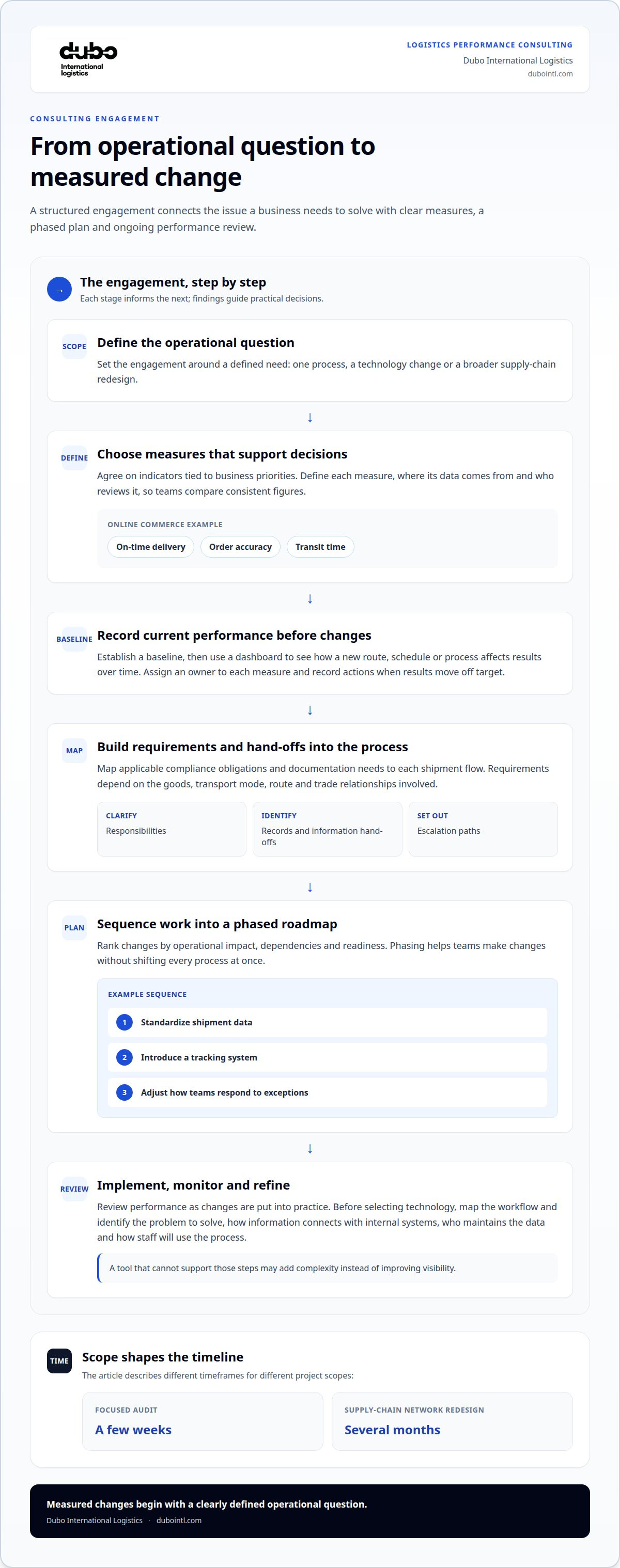
A useful engagement moves from a defined operational question to measured implementation. Its scope may cover one process, a technology change, or a broader supply-chain redesign.
Performance Indicator Implementation
Start by agreeing on indicators that connect operational changes with business priorities. For example, an online commerce business might track on-time delivery, order accuracy, and transit time across shared carrier routes. Consultants define each measure, its data source, and who reviews it internally. This helps prevent teams from comparing inconsistent figures or adopting indicators that do not inform decisions.
Next, establish a baseline before making changes. A dashboard can then show whether a new route, schedule, or process shifts performance over time. Reviews should assign an owner to each measure and record actions when results move off target.
Regulatory and Trade Requirements
Canadian logistics requirements depend on the goods, transport mode, route, and trade relationships involved. An engagement should map applicable compliance obligations and documentation needs against each shipment flow, then identify where responsibilities or information hand-offs could cause delays. Cross-border movements also require attention to the requirements that apply to the goods and destinations involved.
Because requirements vary by shipment, consultants should build compliance considerations into process design rather than leave them until the final check. The business remains responsible for operational decisions and execution; recommendations should clarify responsibilities, records, and escalation paths.
Project design turns findings into a sequence of work. A focused audit may take a few weeks, while a supply-chain network redesign can take several months. The roadmap should rank changes by operational impact, dependencies, and readiness. Phasing the work helps teams implement changes without shifting every process at once.
For example, a company could first standardize shipment data, then introduce a tracking system, and finally adjust how teams respond to exceptions. Before selecting technology, consultants map the current workflow and identify the problem the tool needs to solve. They also examine how information will connect with internal systems, who will maintain the data, and how staff will use the new process. A tool that cannot support those steps may add complexity instead of improving visibility.
Hiring a consultant also has limits. Recommendations rely on accurate operational information and timely input from the people who manage shipments. The consultant can provide expertise and design a plan, but the business retains control of execution, resourcing, and internal adoption. A phased roadmap makes those responsibilities visible and allows teams to address implementation barriers as they arise.
For a complex shipment flow, a logistics planning review can help connect operational priorities with practical implementation decisions.
Delivery performance and route planning
Route decisions shape delivery reliability across a supply chain. A focused review connects route design, distribution schedules, shipment hand-offs, and customer commitments. Consultants compare planned movement with actual delivery patterns, then identify where an adjustment could reduce delays. For example, repeated late arrivals on one corridor may point to a scheduling or route issue, rather than a problem affecting every shipment.
Route optimization involves more than distance. The analysis can compare stop sequences, delivery windows, shipment volumes, and carrier schedules against service requirements. A shorter route may still perform poorly if its timing leads to missed receiving windows or difficult hand-offs. Digital shipment information can reveal recurring patterns, while operational teams provide context about constraints that system data may not show.
Last-mile delivery deserves separate attention because it links distribution plans with the final receiving point. Consultants can examine failed delivery attempts, appointment timing, access limitations, and the accuracy of delivery instructions. For instance, if a commercial location accepts freight only during set receiving periods, dispatch planning must reflect that constraint. Clear exception procedures also help teams respond when an arrival changes or a delivery cannot proceed as planned.
Delivery performance should be judged against the service promise, not speed alone. Consultants can compare on-time results with transit time, delivery accuracy, and shipment-level performance. An illustrative e-commerce case study reported delivery times dropping by 30% within six months after logistics changes. That example shows why focused changes and follow-up measurement matter, rather than suggesting the same result for every operation.
Consulting delivery models describe how the work is organized. A focused engagement may assess a specific route or distribution process, while an ongoing advisory model may support staged improvements across several operations. The revenue model is a separate commercial matter: an agreement may define a fixed scope, time-based work, or continuing advice. Clear deliverables, responsibilities, and review points help the business understand what the engagement covers.
Before implementation, consultants can set a baseline for selected routes and define how results will be reviewed. A digital dashboard might track delivery accuracy and transit time by corridor, while dispatch teams record reasons for exceptions. The team can then test one change, such as revising a departure schedule, and compare later results with the baseline. This stepwise method helps distinguish a useful adjustment from one that simply shifts delays elsewhere in the distribution network.
Transport and logistics consulting firms in Canada
Canadian businesses can assess consulting firms by matching their expertise to a defined transportation or procurement challenge. A suitable partner should explain the scope of work, the information it needs, and how its recommendations will support business decisions. This makes it easier to distinguish strategic guidance from day-to-day execution, which remains under the business’s control.
Transportation Planning and Carrier Coordination
Transportation planning examines how shipment requirements align with carrier capabilities, service commitments, and operating schedules. A consultant can review whether current arrangements fit the goods, destinations, and delivery expectations involved. For example, a retailer coordinating replenishment across several regions may need distinct plans for frequent smaller shipments and scheduled transfers. The review should clarify responsibilities at each hand-off and identify which service measures matter to the business.
Procurement can support this work by organizing shipment requirements before carrier arrangements are reviewed. Clear cargo descriptions, delivery needs, and equipment details help teams evaluate whether proposed services fit the operation. This also gives internal stakeholders a shared basis for discussing carrier performance and future changes.
Consultant Selection Criteria
Choose a consultant whose experience aligns with the operational issue, rather than relying on broad claims of expertise. Ask how the firm will examine transportation flows, communicate findings, and distinguish recommendations from implementation responsibilities. A useful proposal describes the work products, required internal participation, and how progress will be assessed. These details help determine whether the approach fits the business’s decision-making process.
Industry familiarity can also shape the quality of guidance. A consultant working with retail distribution may understand replenishment cycles, while another may focus on complex freight movements. Consider whether the proposed method accounts for your cargo, delivery patterns, and operating constraints. Clear communication matters, especially when several teams share responsibility for transportation decisions.
Transformation plans should connect recommendations to operational outcomes, not just produce a report. For example, a business could set an objective for more consistent delivery scheduling, assign internal owners, and establish a review process for implementation. The consultant can provide analysis and guidance, while management decides which changes to adopt and how to sequence them. This keeps accountability clear.
Canadian businesses can also examine how a consulting firm handles changing requirements. A new product line, supplier relationship, or destination may affect shipment processes and team responsibilities. The consultant’s approach should make those dependencies visible and show how recommendations can adapt as operations change. This is especially relevant when a company coordinates several transportation partners or serves different customer groups.
Before starting, align on the operational question, the teams involved, and the decisions the engagement should inform. A focused mandate helps the consultant concentrate on a specific service gap, while a broader review can address connected procurement and transportation processes. Clear expectations make it easier to judge whether the work is relevant and actionable.
Logistics consulting across industries
Logistics priorities shift with the goods, customers, and operating model involved. A useful assessment therefore starts with industry constraints, then traces how supply chains respond to disruptions, demand changes, and delivery requirements.
For a Canadian manufacturer, a late component can interrupt production even when outbound transportation performs as planned. Consultants can map supplier schedules against production needs, identify where a missed hand-off creates a bottleneck, and examine options for improving flow. For example, a plant receiving parts from several suppliers may benefit from clearer delivery windows and shared visibility into shipment status. The focus is continuity, not simply moving each shipment faster.
Retail operations face a different mix of pressures. Seasonal demand, varied product ranges, and customer fulfilment expectations can expose gaps between inventory records and actual availability. A consultant might follow a product from supplier dispatch through distribution to the customer, then identify where inaccurate data or unclear ownership causes delays. This end-to-end view can reveal opportunities to better coordinate replenishment and delivery plans.
Food and other temperature-sensitive goods require attention to cargo handling and conditions during transit. An assessment can examine shipment hand-offs, route timing, and how teams respond when a delay threatens product requirements. For example, a business moving temperature-sensitive products between Canadian regions may need its transport plan to account for handling needs at each transition. The relevant measures depend on the product and operating process.
Project cargo brings its own planning demands. A company moving oversized machinery or delicate equipment must coordinate transport requirements with site readiness, loading arrangements, and delivery sequencing. If a receiving site cannot accept a shipment as scheduled, the disruption can affect several connected activities. Consultants can map those dependencies and develop a sequence that aligns transport planning with the project’s operational milestones.
These examples show why a single improvement template rarely suits every industry. A consultant can compare the actual flow of goods with the business’s service commitments, identify process-specific bottlenecks, and prioritize changes by their effect on continuity and customer fulfilment. One operation may need better supplier coordination; another may need clearer transport hand-offs or more reliable inventory information.
For a business spanning several sectors or regions, the assessment should distinguish shared processes from local requirements. A consistent method for tracking shipment status can support several supply chains, while product handling and delivery plans may need to vary. That distinction helps businesses scale useful practices without forcing unlike operations into the same process.
To discuss logistics consulting for complex supply chains, contact Dubo International Logistics.
Dubo International Logistics: Logistics consulting
Dubo International Logistics helps businesses assess logistics operations and shape practical improvements through logistics consulting. This support can be useful when recurring delays, complex freight movements, or specialized cargo requirements make existing processes difficult to manage. Recommendations can align operational priorities with freight forwarding and specialized transportation services when those fit the shipment’s needs.
For example, a business moving oversized machinery or delicate equipment may need a transport plan that accounts for cargo requirements, route coordination, and hand-offs. A focused review can clarify the issue, identify the process decisions involved, and set a practical direction for implementation. The approach is tailored to the movement and operational context, rather than applying one solution to every supply chain.
To discuss logistics consulting for your operations, contact Dubo International Logistics.
Set your next logistics priority
Turn your findings into a decision brief before committing to a larger change. Identify the operational issue that matters most, name the internal owner, and define what evidence will guide the next decision. A focused starting point gives your team a clear basis for planning and keeps improvement work connected to business priorities.
Logistics performance consulting can shape the next step around your operation. Dubo International Logistics offers logistics consulting, freight forwarding, and specialized transportation services, connecting operational planning with the movement requirements of your cargo. This can suit businesses reviewing complex shipments or seeking a clearer plan to improve logistics processes.
Contact Dubo International Logistics to discuss your logistics priorities and the practical support that could fit your operations.
A considered next step gives your team firmer ground for the decisions ahead.
Frequently Asked Questions
What does logistics performance consulting include?
It includes a review of how goods, information, and decisions move through a business’s supply chain. The work may examine supplier coordination, transportation planning, fulfilment processes, inventory flow, and hand-offs between teams. For example, consultants can trace a delayed order from its initial request through dispatch and receiving to locate where responsibilities or information break down. The scope depends on the operational issue being addressed.
What logistics KPIs do consultants measure and benchmark?
Consultants select indicators that match the operation’s priorities and available data. Common measures include on-time delivery, order accuracy, transit time, supplier delivery reliability, and shipment-level performance. For a manufacturer, measuring supplier arrivals against production schedules can help distinguish supply interruptions from internal planning issues. Benchmarks are most useful when definitions stay consistent across routes, periods, and teams, so comparisons reflect performance rather than differences in measurement methods.
How can a business prepare for a logistics consulting engagement?
Preparation starts with defining the operational question and identifying the teams closest to the work. Gather relevant shipment records, process documents, and examples of recurring exceptions, such as orders that require manual intervention. Assign a contact who can coordinate input from transportation, procurement, and customer-facing staff. Access to these perspectives helps consultants understand how procedures work in practice, not just how they appear in written plans.
What is the typical logistics consulting process and timeline?
A consulting engagement typically defines the problem, reviews operational information, develops recommendations, and supports a practical implementation plan. A focused audit may take a few weeks, while a broader supply-chain network redesign can take several months. Timing depends on the scope of the review, data readiness, and how many operational teams need to contribute. Agreeing on scope and decision-makers early helps keep the work organized.
How can teams keep logistics improvements in place?
Teams can sustain improvements by assigning ownership for each changed procedure and documenting how exceptions should be handled. For example, after revising an order hand-off, managers can include the new steps in staff onboarding and review unusual cases during regular operations meetings. Clear responsibilities help prevent teams from reverting to informal workarounds. Feedback from the people using the process can also reveal when procedures need refinement.
How do Canadian logistics consultants use data analytics and supply chain technology?
Consultants use operational data to identify patterns and support decisions, rather than treating software as a solution by itself. Shipment records, supplier updates, and internal planning data can reveal recurring delays or mismatches between demand and inventory. They may assess whether tracking tools or ERP integrations could improve information flow. The right technology depends on existing systems, data quality, and the decisions teams need to make.
What ROI and cost savings can logistics performance consulting deliver?
Logistics consulting can reduce supply chain operating costs by 5-10% annually, with targeted strategies reducing them by up to 17%. An illustrative e-commerce case study also reported delivery times falling by 30% within six months.

