

A production schedule can be precise and still be disrupted by freight decisions made too far from the factory floor. When materials arrive out of sequence or finished goods face uncertain handoffs, the resulting friction can affect the movement of cargo. Logistics consulting for manufacturers connects transportation planning to production requirements, so freight decisions reflect what the operation needs and when it needs it.
Dependable freight movement takes more than booking a shipment. It requires clear coordination, practical contingency planning, and visibility across each freight movement, especially when cargo is oversized, delicate, or temperature-sensitive. The goal is to identify weak points before they create uncertainty.
This article explains how to assess operational risks, align freight plans with production schedules, and develop recommendations that support continuity for materials and finished goods. It also explores how Dubo International Logistics connects consulting with freight forwarding and specialized transportation coordination across Canada and North America. Learn more at www.dubointl.com.
Key Takeaways
- Logistics consulting for manufacturers works best when freight plans reflect production schedules, cargo needs, and operational constraints.
- Map inbound materials and outbound shipments to spot coordination gaps that could disrupt the flow of goods.
- Assess recommendations for practical detail, including carrier coordination, compliance needs, cargo requirements, and shipment visibility.
- Turn findings into a clear action plan: define requirements, map freight flows, identify gaps, prioritize actions, and review progress.
- Connect planning with freight forwarding and specialized transportation coordination for cargo such as oversized machinery, delicate equipment, and temperature-sensitive products.
Why logistics consulting for manufacturers starts with production requirements
Freight decisions affect more than the movement of a shipment. They influence whether materials are available for planned production, whether components reach the right stage when needed, and whether finished goods can be dispatched in line with customer commitments. Logistics consulting for manufacturers is expert planning that aligns freight flows with operational requirements, helping teams identify friction and make cargo movement more dependable.
This work differs from production planning. Production teams determine what to make and when; logistics planning organizes how required materials and finished goods move to support those plans. The two functions need a shared view of timing, shipment status, cargo characteristics, and handoffs. These connections sit within the wider discipline of supply chain management, where coordinated decisions shape the flow of goods and information.
Where freight decisions meet manufacturing schedules
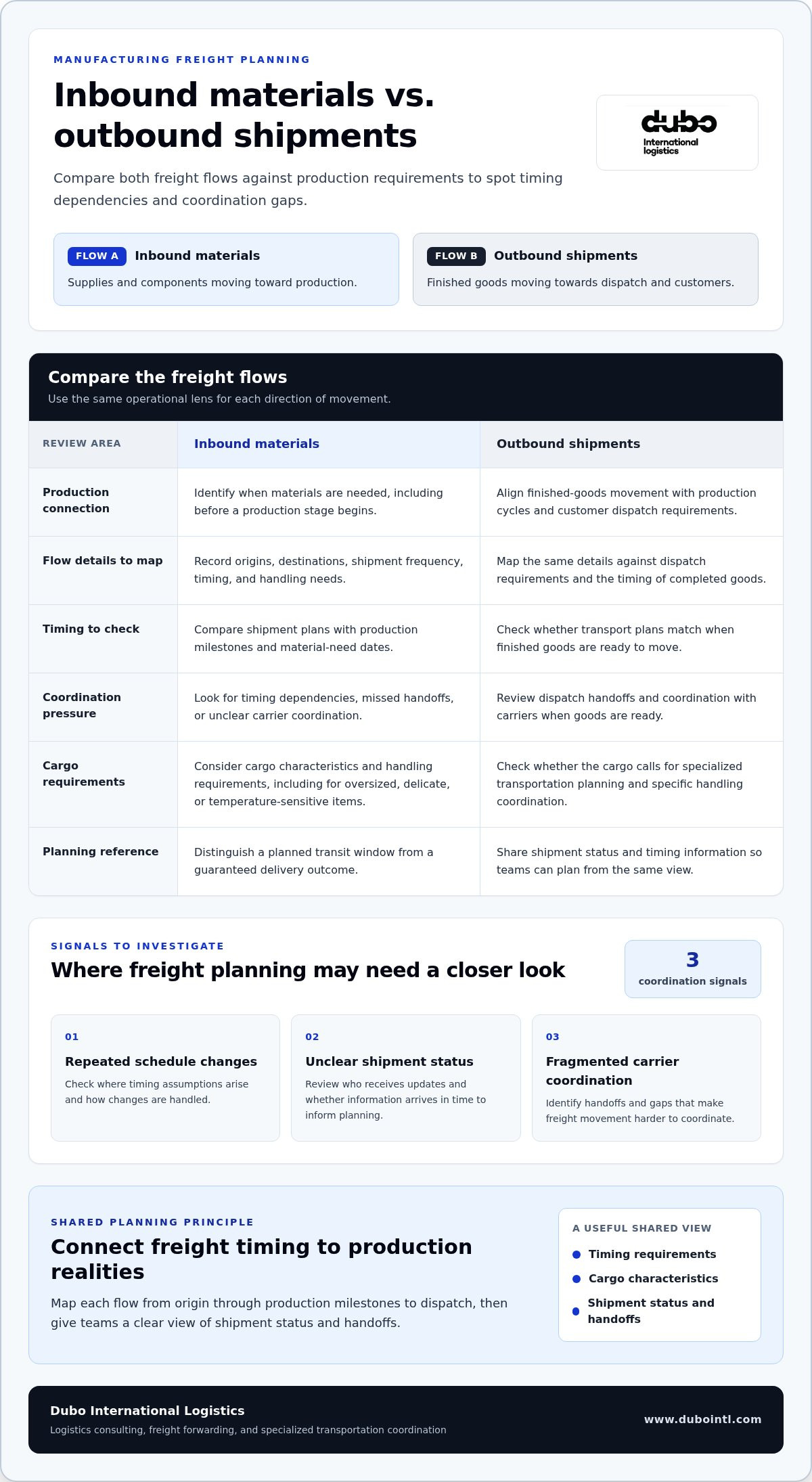
Trace each flow from inbound materials through production milestones to finished-goods dispatch. While internal facility transfers often rely on infrastructure supported by material handling specialists like Jealco International, Inc., coordinating external freight handoffs requires equal attention. An input may be needed before a production stage begins, while completed goods may require coordinated transport once they are ready to move. Compare these timing requirements with shipment plans, and distinguish a planned transit window from a guaranteed delivery outcome. Clear handoffs help production and logistics teams act on the same information.
Signals that logistics planning may need a closer look
Repeated schedule changes, unclear shipment status, or fragmented carrier coordination can make it harder to determine whether freight supports the production plan. Review these signals by identifying where timing assumptions arise, who receives shipment updates, and how teams respond when plans change. The review is particularly relevant when cargo is oversized, delicate, or temperature-sensitive, since cargo characteristics can affect handling and coordination requirements.
Also examine whether expectations are clear between the manufacturer and its logistics partners. Service level agreements (SLAs) can define agreed service expectations, such as delivery windows or equipment availability, where those commitments apply.
The goal is to connect freight decisions to production realities, so teams can see where coordination is working and where clearer planning may support continuity. Dubo International Logistics provides logistics consulting alongside freight forwarding and specialized transportation coordination across Canada and North America. Learn more at www.dubointl.com.
What manufacturer-focused logistics consulting should examine
A useful assessment looks beyond individual shipments. It considers how freight moves through the operation, what each service needs to support, what the cargo requires, and which production or transport constraints affect the plan. For manufacturers, the assessment should connect freight flows, service expectations, cargo characteristics, and operational limits to reveal where coordination needs attention.
Patterns often tell the story. Inbound shipments may arrive from several origins at different frequencies, while outbound loads follow production cycles or customer dispatch requirements. Reviewing both directions can expose missed handoffs, unclear timing dependencies, or carrier coordination gaps. For cross-border operations, the U.S. National Institute of Standards and Technology provides U.S. manufacturing supply chain data that can offer context for the U.S. side of broader supply-chain activity. Use it as context, alongside the manufacturer’s own shipment records.
Reviewing inbound materials and outbound shipments
Map each freight flow by origin, destination, frequency, timing, and handling needs. Compare these details with production milestones and dispatch requirements to see where shipment patterns create coordination pressure. LTL freight shipping may suit loads that don’t require a full trailer, while oversized machinery or delicate equipment may call for specialized transportation planning based on the cargo and movement requirements.
Connecting shipment requirements with operational information
Relevant ERP data can help teams relate production requirements to shipment details, such as planned material needs or dispatch timing. Focus on information that supports a decision, rather than collecting data without a clear purpose. Service level agreements (SLAs) can define measurable expectations, including delivery windows or equipment availability, where applicable. They also give teams a shared reference for reviewing service performance.
Shipment visibility is another assessment area. Review what status information is available, who can access it, and whether it arrives in time to inform planning. Visibility can support coordination, but it doesn’t guarantee a particular delivery outcome. Identify where information gaps make it harder for teams to respond to changes.
Logistics consulting for manufacturers should produce a practical view of the current operation, not a generic list of best practices. Dubo International Logistics connects logistics consulting with freight forwarding and specialized transportation coordination across Canada and North America. For manufacturers reviewing freight requirements, explore Dubo’s logistics support.
How to evaluate logistics consulting for manufacturers
A useful consulting assessment reflects how your operation moves materials and finished goods. Generic advice may sound reasonable but miss production priorities, cargo handling needs, or points where carrier coordination breaks down. Evaluate recommendations by how clearly they connect findings to specific freight requirements and practical next steps.
Strong logistics consulting for manufacturers separates evidence from assumptions. Findings should draw on shipment records, operating requirements, and discussions with the people involved in freight decisions. Recommendations should address carrier coordination, cargo characteristics, applicable compliance needs, and shipment visibility without promising results that depend on factors outside the plan. For broader context, the Association for Supply Chain Management outlines manufacturing supply chain best practices across processes from procurement to distribution.
Questions that reveal whether recommendations are practical
Ask how the assessment will account for production priorities, shipment timing, and cargo requirements. A useful plan identifies who owns each action, where decisions are made, and when progress will be reviewed. It should also distinguish routine freight from specialized movements, since machinery or delicate equipment may call for different coordination and handling considerations.
Look for recommendations your team can put into practice, not just observations about what could improve. Each proposed action should connect to a defined issue, identify the people responsible for moving it forward, and include a way to review whether it addresses the issue.
Comparing strategic advice with shipment execution
Consulting helps set priorities and shape the freight plan; freight forwarding coordinates cargo movement in line with those requirements. These are distinct functions, but recommendations are more useful when they connect to execution. The article Strategic Logistics Consulting in Canada: A 2026 Guide to Supply Chain Excellence explores the strategic side of this relationship.
| Area | Consulting focus | Freight forwarding focus |
|---|---|---|
| Planning | Identify requirements, gaps, and priorities. | Coordinate shipment arrangements around the plan. |
| Carrier coordination | Clarify needs and coordination expectations. | Coordinate carriers for planned cargo movements. |
| Shipment oversight | Recommend what information teams need to guide decisions. | Use available tracking information to support shipment coordination. |
This distinction helps keep consulting practical rather than theoretical. Link each finding to an action, an owner, and a review point. Dubo International Logistics connects logistics consulting with freight forwarding and specialized transportation coordination. Explore Dubo’s logistics consulting for planning support shaped around freight requirements.
A practical process for turning logistics findings into action
An assessment creates value when it leads to decisions that teams can carry out and review. A clear sequence keeps the work grounded in production requirements: define what freight must support, map current flows, identify gaps, plan actions, then review what changes in practice. Move from logistics assessment to ongoing review by assigning each finding an action, an owner, and a point for follow-up.
Prioritize according to operational importance, not an assumed savings figure. A shipment issue that could interrupt a critical production stage may deserve attention before a process change with less effect on continuity. Use shipment records and carrier feedback to understand where timing, handoffs, or requirements are unclear, then choose actions that address those findings.
Building a logistics action plan around production needs
Translate each priority into a practical action plan. Record the issue, the next step, the person responsible, any dependencies, and when the team will review progress. For example, if a shipment requirement depends on a production milestone, identify how that milestone will be communicated and who coordinates the related freight decision. Tailor the plan to the operation rather than assuming every production cycle or shipment follows the same pattern.
Where performance expectations need formal definition, service level agreements (SLAs) can set out measurable commitments, such as delivery windows or equipment availability. Keep these expectations aligned with operational requirements and the responsibilities of the parties involved.
Keeping freight plans responsive as requirements change
Review freight plans when production schedules, routes, carrier performance, or shipment requirements change. A revised cargo dimension or handling need, for instance, may affect the coordination required for a movement. Use shipment information and carrier feedback to identify where the plan still fits and where adjustments are needed. Regular review supports preparation, but cannot prevent every disruption.
For a wider view of how planning and execution connect, see End-to-End Freight Management: A Strategic Guide for Canadian Businesses. In practice, logistics consulting can set priorities, while freight forwarding coordinates cargo movement against those priorities. Together, they provide a framework for keeping decisions connected to operational needs.
Dubo International Logistics provides logistics consulting, freight forwarding, and specialized transportation coordination for businesses across Canada and North America. To develop a practical freight plan around your production requirements, explore Dubo’s logistics consulting at www.dubointl.com.
How Dubo supports manufacturer logistics planning and freight coordination
Manufacturing freight needs a plan shaped around the operation and the cargo, not a standard set of assumptions. Dubo International Logistics brings logistics consulting together with freight forwarding and carrier coordination, helping manufacturers connect operational requirements to practical shipment planning. Its logistics support extends across Canada and North America, with specialized transportation coordination for cargo that calls for closer attention.
This planning accounts for the relationship between production requirements, shipment details, and the movement itself. Recommendations can then inform freight coordination, helping teams work from a clearer understanding of responsibilities and requirements. Each project has its own cargo and operating conditions, so planning should reflect the shipment details rather than assume a single approach fits every movement.
Planning for specialized manufacturing cargo
Dimensions, fragility, and temperature requirements can affect how cargo is handled and coordinated in transit. An oversized machine, delicate equipment, and a temperature-sensitive product each present distinct planning considerations. Dubo coordinates specialized transportation for these cargo types through a carrier network, with tracking systems supporting specialized transport deliveries. For further context, see Specialized Freight North America: A Strategic Buyer’s Guide for 2026.
Carrier coordination and shipment visibility help teams follow the movement and keep relevant information in view. These tools support planning, but they don’t remove the need to account for cargo-specific requirements or changing operational conditions. A careful review considers the movement as a whole, including how freight arrangements relate to the manufacturer’s production needs.
Starting a focused logistics consulting conversation
A focused discussion starts with operational detail. Manufacturers can prepare a picture of shipment patterns, production dependencies, cargo requirements, and recurring coordination challenges. This information helps define the questions to examine and the freight decisions that need attention. Dubo provides logistics consulting and connects its recommendations with freight forwarding and specialized transportation coordination.
Start with a practical discussion about your requirements, priorities, and current freight processes. Not every movement needs the same solution. A clear starting point keeps the conversation specific to your operation and the cargo involved.
Discuss your manufacturing logistics requirements
Make freight planning part of production readiness
Dependable manufacturing logistics starts with production requirements. Map inbound and outbound freight, identify where timing or handoffs create uncertainty, and turn findings into clear actions with owners and review points. This gives teams a practical way to keep freight decisions connected to changing operational needs.
Logistics consulting for manufacturers can bridge planning and execution. Dubo International Logistics is a CIFFA member and provides logistics support across Canada and North America, including specialized transportation coordination for oversized machinery, delicate equipment, and temperature-sensitive products.
Bring shipment patterns, production dependencies, cargo requirements, and current coordination challenges into the discussion. Discuss your manufacturing logistics requirements with Dubo and take a considered next step towards freight planning that supports your operation with greater clarity and continuity.
Frequently Asked Questions
What does logistics consulting for manufacturers include?
Logistics consulting for manufacturers reviews how freight supports production and business operations. An assessment can examine inbound materials, movement between production stages, outbound shipments, cargo characteristics, service requirements, carrier coordination, shipment visibility, and operational constraints. The aim is to identify friction and turn relevant findings into practical recommendations. Depending on the operation, this may also include clarifying responsibilities, defining service expectations, and setting review points for freight plans.
How can logistics consulting help manufacturers?
It can help manufacturers understand where freight decisions and production needs are misaligned. By reviewing shipment patterns, handoffs, and information flow, teams can identify issues that contribute to schedule uncertainty and decide what to address first. Recommendations can connect production requirements with carrier coordination and shipment oversight. Results depend on the operation and how actions are put into practice, so consulting should focus on clear, relevant steps rather than promise a particular outcome.
When should a manufacturer consider logistics consulting?
Consider reviewing logistics when schedule changes recur, shipment status is unclear, or coordinating carriers takes repeated effort. A closer assessment may also be useful when production requirements change or shipments involve cargo with specialized handling needs. These signs can help identify whether freight flows, responsibilities, and information sharing are clear enough to support current operations.
Can logistics consulting support both inbound and outbound freight?
Yes. A manufacturer-focused assessment can examine inbound materials and outbound finished goods as connected freight flows. It can map origins, destinations, shipment frequency, timing dependencies, and handling requirements, then compare those details with production and dispatch needs. Reviewing both directions may help reveal handoff or coordination gaps that are less visible when teams look at one shipment at a time. Recommendations should reflect the manufacturer’s actual cargo and operating requirements.
How do manufacturers evaluate a logistics consulting engagement?
Evaluate whether the work is based on your operation rather than generic recommendations. Look for findings supported by relevant shipment information and clear links between each issue and proposed action. Advice should address carrier coordination, cargo requirements, applicable compliance needs, and shipment visibility. Practical recommendations also identify responsibilities, decision points, and how progress will be reviewed. Service level agreements (SLAs) may help define measurable service expectations where formal commitments are needed.
What information should manufacturers prepare before a logistics consultation?
Prepare a useful picture of shipment patterns, including origins, destinations, frequency, and timing dependencies. Note how freight relates to production milestones, along with relevant cargo dimensions, handling needs, and any temperature requirements. It can also help to summarize recurring coordination challenges, how shipment status is shared, and who makes freight decisions. This context supports a focused discussion about the issues to assess and recommendations that may suit your operation.
Can logistics consultants help coordinate specialized manufacturing cargo?
Yes. Dubo International Logistics coordinates specialized transportation for oversized machinery, delicate equipment, and temperature-sensitive products. Cargo dimensions, fragility, and handling requirements can shape transport planning and carrier coordination, while tracking systems support specialized transport deliveries. Dubo provides logistics support across Canada and North America and is a member of the Canadian International Freight Forwarders Association (CIFFA). To discuss your freight requirements, visit www.dubointl.com.
