

A shipment can be ready to move and still face a customs hold if its paperwork doesn’t clearly describe what’s inside. For Canadian businesses, the legal requirements for shipping to the USA depend on the goods, their origin and the shipping method. A commercial invoice should describe the items accurately, and a CUSMA origin statement may be included on it for shipments under US$2,500.
It’s reasonable to expect one set of forms to cover every shipment, but required documents vary. LTL and FTL freight shipments require a bill of lading. Eligible Canadian-origin goods may receive preferential duty treatment under CUSMA when the required origin documentation is provided.
This guide explains which customs forms and shipping documents may apply, how CUSMA can affect duties, and what to consider for restricted goods and U.S. import compliance. You’ll learn what information a freight forwarder needs to coordinate a compliant cross-border shipment and keep its documentation consistent with the cargo.
Key Takeaways
- Understand which customs forms and shipment details help support a clear U.S. customs entry.
- Learn how CUSMA origin paperwork can affect duty treatment and why e-commerce shipments may follow separate rules.
- Recognize why restricted goods, dangerous materials and commodity-specific requirements need attention before shipping.
- See how importers and exporters share responsibility for meeting applicable U.S. compliance requirements.
- Find out which shipping documents may apply to postal and freight shipments, including bills of lading and Declaration IDs.
What Canadian customs forms are required?
For Canadian shipments entering the United States, required documents depend on the goods, shipping method and customs entry category. Accurate descriptions, declared values and origin details help customs officials assess each import.
Cross-Border Customs Documents
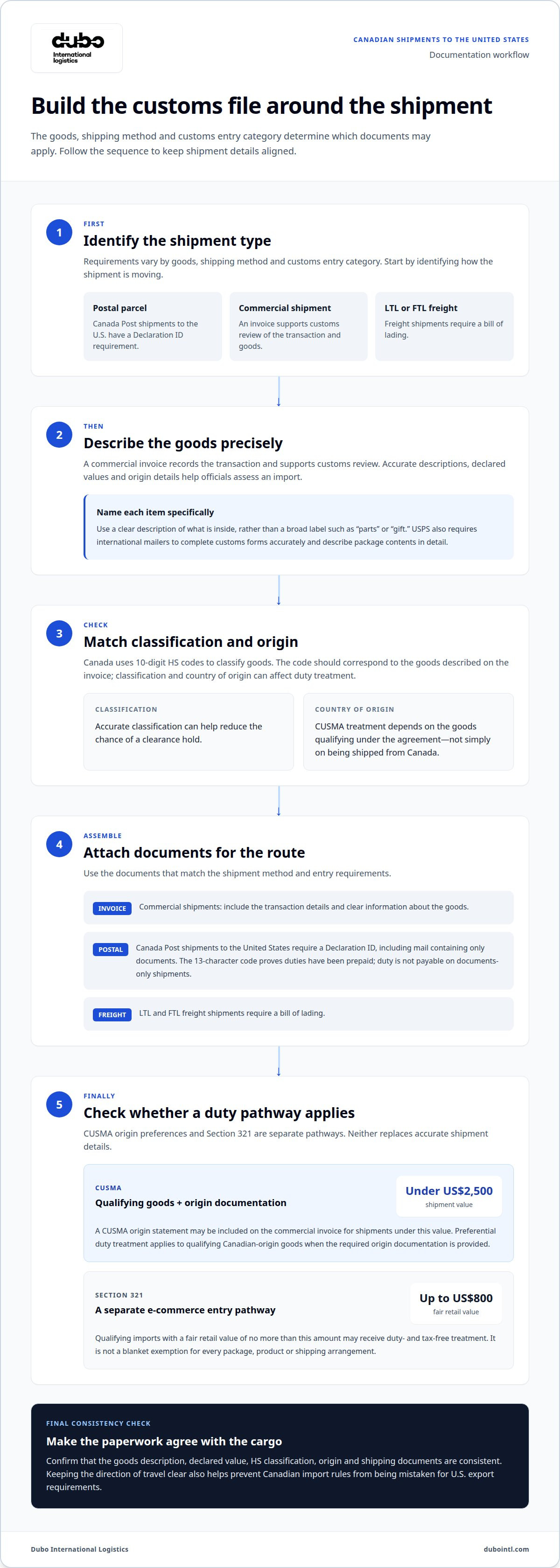
Cross-border customs documents identify a shipment and provide information for assessing its entry into the United States. Requirements vary for postal parcels, commercial shipments and freight, so the shipping method matters. A commercial invoice records the transaction and supports customs review. Canada Post shipments to the United States also require a Declaration ID, including mail containing only documents, although duty isn’t payable on documents-only shipments.
Forms, Contents Descriptions and Invoices
Customs forms and commercial invoices describe the goods, their value and their origin for border processing. Each item should have a specific description rather than a broad label such as “parts” or “gift.” USPS says international mailers must complete customs forms accurately and provide more detailed descriptions of package contents. A CUSMA origin statement may appear on a commercial invoice for shipments under US$2,500. Canada uses 10-digit HS codes to classify goods, and accurate classification can help reduce the chance of a clearance hold.
Shipment Type and Product-Origin Variations
Personal gifts, online orders and commercial shipments can face different customs treatment because their purpose, value and product origin differ. A gift valued at US$100 or more is charged duty based on the item. E-commerce shipments may be considered under Section 321, which allows qualifying U.S. imports with a fair retail value of no more than US$800 to receive duty- and tax-free treatment. Product classification and country of origin also affect whether duties apply; CUSMA treatment depends on the goods qualifying under the agreement and the required origin paperwork.
U.S. customs entry categories reflect how a shipment is presented and which rules apply, rather than a single form for every parcel. For example, an eligible low-value import may fall under Section 321, while a commercial shipment may need an invoice with enough detail to support its declared value, classification and origin. Postal shipments have their own documentation, including the Canada Post Declaration ID for shipments to the United States. These distinctions matter for businesses, online sellers and individuals preparing different types of shipments.
Canadian thresholds apply to imports entering Canada, not to Canadian goods exported to the United States. For example, commercial shipments entering Canada valued above C$2,500 require a Canada Customs Invoice (CI1). That Canadian requirement may become relevant if goods return across the border, but it isn’t a U.S. export form. Keeping the direction of travel clear helps prevent Canadian import rules from being mistaken for U.S. entry requirements.
Can CUSMA eliminate duties on my shipments?
CUSMA can eliminate duties on qualifying Canadian-origin goods when the required origin documentation is provided. Qualified imports with a fair retail value of no more than US$800 may receive duty- and tax-free treatment under Section 321, according to CBP.
Section 321 Treatment for E-Commerce
Section 321 allows qualifying imports with a fair retail value of no more than US$800 to receive duty- and tax-free treatment. For Canadian businesses selling online, this threshold may affect how eligible packages enter the United States. U.S. Customs and Border Protection has implemented two test programs to monitor Section 321 shipments in the e-commerce environment. The treatment is separate from CUSMA origin-based duty preferences.
Shipment Value Thresholds
The Section 321 threshold is US$800 in fair retail value for a qualifying import. It is not a blanket exemption for every package, product or shipping arrangement. Shipment value may be one factor in assessing whether this customs pathway applies, alongside other shipment details. U.S. Customs and Border Protection says Section 321 authorizes duty- and tax-free treatment for qualified imports with a fair retail value of no more than US$800.
Shipment Value and Duty Estimates
Shipment value is one factor in estimating duties, but product classification and country of origin matter too. A commercial shipment’s declared value gives customs a basis for assessment, but doesn’t determine the final duty on its own. Two packages with equal values, for example, can receive different duty treatment if they contain different products or have different origins. Accurate invoice details help ensure estimates reflect the actual goods.
HS Codes for Commercial Shipments
HS codes classify commercial goods for customs purposes and help identify the tariff treatment applicable to a product. Canada uses 10-digit HS codes, and accurate classification can reduce the chance of a clearance hold. The code must correspond to the goods described on the invoice. A perishable product and a manufactured item, for example, should not be treated as interchangeable simply because their declared values match.
CUSMA preferences apply to goods that qualify under the agreement, not simply to shipments sent from Canada. CUSMA replaced NAFTA in 2020, and Canadian-origin goods may still qualify for duty exemptions when required paperwork, such as a Certificate of Origin, is provided. Origin evidence supports the claim; it doesn’t replace accurate product classification or declared value.
Canada Post requires a Declaration ID for shipments to the United States, and the 13-character code proves duties have been prepaid. Canada Post states that documents-only shipments still need this ID, although duty isn’t payable when the parcel contains only documents. For cross-border shipments with different products, a logistics review of shipment details can help align origin records, classification and value information.
Prohibited and restricted goods
Restrictions on shipments from Canada to the United States depend on the product, shipping method and destination. Explosives, fireworks, ammunition, flammable materials, toxic substances, illegal narcotics and certain infectious agents are listed as prohibited goods. Other items, including alcohol, firearms, medications, batteries and hazardous materials, may be restricted or require specific handling.
There isn’t one rule for every shipment. USPS requirements apply to international mail sent through USPS, while destination states may impose additional conditions. An item accepted on one route may face different restrictions on another, so the shipping plan should account for both the product and destination before dispatch.
USPS says international mailers should consult Publication 52 and the International Mail Manual to determine whether an item is mailable. Its rules identify several specific restrictions:
- Safety matches cannot be mailed internationally through USPS.
- USPS says only licensed manufacturers and dealers may mail or receive handguns.
- USPS says prescription medications may be mailed only by distributors registered with the Drug Enforcement Administration (DEA).
- USPS bars international shipment of flammable or combustible paint and related items. Nonflammable, noncombustible latex or similar water-based paint isn’t restricted as hazardous material.
Hazardous materials require particular attention. USPS says international mail containing hazardous materials must be separated from other packages and presented in a container marked “HAZMAT.” Regulated hazardous-material shipments also require a shipper’s declaration for dangerous goods, signed by trained staff. Lithium batteries require careful attention to packaging and labelling, as well as whether they are damaged or installed.
Alcohol and firearms show how destination-specific conditions can affect clearance. Businesses shipping alcohol to U.S. customers need a licence, and the destination state must permit the shipment. Firearm shipping is typically limited to Federal Firearm License holders; state rules may also restrict firearm types or magazine capacities. Compliance planning must account for the destination, not just the U.S. border.
Plant shipments can also face state restrictions. Arizona, for example, may restrict citrus plant imports from Florida to prevent pest spread. Although this example concerns a route between U.S. states, it illustrates why plant rules can depend on destination and pest-control conditions. Consider regulated goods alongside the requirements for their route.
For Canadian exporters, the practical distinction is between goods that can’t travel through a selected service and goods that may move only under specific conditions. A carrier’s acceptance doesn’t replace applicable regulations. Before dispatch, review the contents, destination state, shipping method, packaging, labels and required declarations. This helps align handling with the product’s restrictions and supports a more orderly customs clearance process.
U.S. import and export compliance responsibilities
Cross-border compliance involves both U.S. authorities and the businesses moving goods. Requirements can also depend on the commodity, so shipment records need to accurately reflect what is being exported and imported.
Compliance Risks and Ongoing Checks
Compliance checks compare shipment details with the rules that apply to the goods and route. They matter because an inaccurate description or overlooked commodity requirement can complicate customs processing. U.S. Customs and Border Protection (CBP) says importers, exporters and CBP share responsibility for maximizing compliance with applicable laws and regulations. CBP encourages businesses to learn the rules that apply to their shipments.
That responsibility goes beyond preparing a postal label or freight document. For each shipment, the parties involved need consistent information about the goods, their origin, value and destination. Restricted products may require more than general entry paperwork. Review the details whenever the product, destination or shipping method changes, since an earlier shipment file may not cover a new commodity or route.
Permits, Licences and Certifications
U.S. permits, licences or certifications may apply to particular imported commodities. Their relevance depends on the goods, so consider product-specific requirements alongside general customs information. CBP notes that U.S. imports may have commodity-specific requirements, including those set by Partner Government Agencies. One standard set of documents may not address every product.
For example, a shipment of regulated goods may require documentation for a government agency in addition to its commercial paperwork. The applicable agency and documents depend on the commodity. Accurate product identification helps determine which requirements apply; a broad description can make that assessment harder. The same principle applies to environmental compliance: commodity-specific rules may involve the relevant government agency rather than one requirement for every shipment.
Customs Clearance and Import Charges
Customs clearance is the process of presenting import information for review and entry. CBP and the importing and exporting community share responsibility for maximizing compliance, so both sender and importer have a role in providing accurate information. The parties should also agree in their shipping or sales arrangements who will coordinate clearance and pay import charges.
Under the parties’ arrangement, the recipient may be billed for import charges, but clarify the payment terms before dispatch. Charges depend on the product and the rules that apply to its import. A carrier may transmit shipment information, but that doesn’t remove the importer’s and exporter’s shared compliance responsibilities identified by CBP.
Country-of-Origin Marking
Country-of-origin marking identifies where imported goods originate, while origin information in customs paperwork supports import assessment. The distinction matters because a document entry and a physical product mark serve different purposes. Requirements may depend on the imported commodity, and CBP notes that U.S. imports may face commodity-specific requirements set by Partner Government Agencies.
Keep origin details consistent across product information and shipment documents. For example, an origin statement used to support a CUSMA claim should accurately describe where the goods originate. Marking requirements may involve additional commodity-specific rules, so the goods and destination determine what applies. Accurate records help importers and exporters address these requirements as part of shipment compliance planning.
Requirements for shipping documents
Cross-border documentation works best as a coordinated shipment file, not a collection of unrelated forms. Each document records a different part of the movement, from the goods and transaction to the carrier’s receipt. For Canadian shipments entering the United States, consistency is key: the subject, value, origin and description should align across the invoice and transport records.
A commercial invoice describes the transaction and the goods being shipped. Its details help distinguish products for customs review and tariff classification. “Consumer goods” alone may be too broad to explain a shipment’s contents; a specific product description gives customs a clearer basis for assessing the import. The stated value and country of origin should also accurately reflect the shipment.
The invoice and bill of lading serve different purposes. The invoice records transaction and product information, while a bill of lading acts as a legal contract and receipt for LTL and FTL freight shipments. This distinction matters when commercial goods move by truck: invoice details explain what is crossing the border, while the bill of lading records the freight movement. Treating one document as a substitute for the other can leave important information out.
Postal shipments have a separate documentation detail. Canada Post states that documents sent to the United States still require a Declaration ID. The ID demonstrates that duties have been prepaid; duty isn’t payable when the shipment contains only documents. This is distinct from freight paperwork, so the shipping method determines which transport document is relevant.
Before dispatch, assemble a shipment file with records that match the cargo and its movement:
- Invoice: describe the goods specifically, with transaction and value details that correspond to the shipment.
- Bill of lading: include this for LTL or FTL freight, where it serves as the carrier’s receipt and legal contract.
- Postal Declaration ID: include the required code for Canada Post shipments to the United States.
- Commodity details: align product descriptions, origin information and tariff classification across applicable records.
Restricted items also need accurate descriptions; a generic label can obscure the product and its handling requirements. For example, documents for a commercial order should identify the product being shipped, rather than only stating that it is for a consumer. Clear records also help distinguish ordinary merchandise from goods that need additional compliance attention.
For Canadian businesses coordinating LTL or FTL movements, a document review can align the invoice and transport records before dispatch. Get support coordinating cross-border freight documentation for a shipment with multiple records to reconcile.
Dubo International Logistics
Dubo International Logistics helps Canadian businesses coordinate cross-border shipments where documentation, product requirements and transport planning intersect. Its freight forwarding and logistics consulting services bring shipment details and route planning together, while specialized transportation addresses cargo with particular handling needs.
This support is especially relevant for commercial freight, unusual cargo or shipments involving multiple transport requirements. Clear product information and shipment records remain central to compliance, and coordinated planning helps keep those details connected to the movement of the goods.
Contact Dubo International Logistics to discuss your shipment and logistics requirements for the United States.
Build a More Predictable Cross-Border Process
Planning for the legal requirements for shipping to the USA is easier when documentation and shipment decisions are considered together, rather than handled separately. For future shipments, establish a consistent planning process around the product, destination, shipping method and responsible parties. This gives your team a clear starting point when an order, route or cargo requirement changes. It also connects operational decisions, from the initial shipment brief through delivery planning.
Where shipments involve specialized cargo or several connected logistics considerations, a coordinated review can help shape a suitable freight plan. Dubo International Logistics can support that work through freight forwarding, logistics consulting and specialized transportation services. Discuss your next U.S.-bound shipment with Dubo International Logistics and take a considered next step for your cross-border plans.
Frequently Asked Questions
What is a Declaration ID and why is it required?
A Declaration ID is a Canada Post reference associated with mail sent to the United States. For a dispatch with multiple parcels, pair each parcel’s reference with its own shipment record. This makes it easier to identify which postal record belongs to each package if shipment details need review. Treat the identifier as part of the individual parcel’s documentation, not as a general reference for the entire dispatch.
Will Canadians still be able to send Delivered Duty Unpaid (DDU) shipments to the U.S. after August 29, 2025?
The date alone doesn’t establish a universal yes or no for DDU shipments. DDU describes how the sender and recipient allocate import duties, while shipping terms determine how those amounts are billed and collected. For each sale, state the agreed responsibilities in the commercial terms and shipping instructions. This helps the sender, recipient and carrier follow the same billing arrangement.
What customs duties will my customer pay when receiving a shipment from the U.S.?
A Canadian customer’s import assessment depends on the goods’ tariff classification, origin, declared value and applicable tax treatment. Different products in one order may therefore receive different treatment. The seller’s shipping terms also determine whether the customer is expected to handle import charges at delivery or the seller has arranged another billing method. The country of dispatch alone doesn’t determine the customer’s final import assessment.
What customs forms are required to ship goods from Canada to the USA?
There isn’t one paperwork set for every shipment from Canada to the United States. The shipping method, commercial transaction and nature of the goods determine which documents are involved. Check for consistency between the records: commercial information should match the goods being sent, and freight records should describe the load presented for transport. This helps identify mismatches before dispatch, rather than assuming completed forms prove the details align.
What are the U.S. de minimis threshold and duty rules for shipments from Canada?
The Section 321 de minimis threshold is a value ceiling for qualifying U.S. imports; a low declared value alone doesn’t establish eligibility. U.S. Customs and Border Protection has implemented two test programs to monitor Section 321 shipments in e-commerce. For online sellers, the threshold is one part of the entry assessment, not a blanket exemption for every order shipped from Canada.
What information should I provide so a freight forwarder can prepare the commercial invoice and customs declaration?
Organize shipment information by product line instead of grouping unlike items under a broad label. Include an identifying description and origin for each item, and distinguish products with different classifications or handling needs. For a mixed order, list a household item and a machine component separately rather than describing both as “goods.” This gives the shipment file a clearer link between the transaction and its individual contents.
What extra requirements apply to food, alcohol, cosmetics, plants, or animal products?
These product groups don’t share one universal documentation rule. Requirements can depend on the product’s specific characteristics and its destination; U.S. imports may also have commodity-specific requirements set by Partner Government Agencies. For planning, identify the exact product and destination rather than relying only on a broad category such as “food” or “plant.” Alcohol shipments also depend on the destination state’s rules and applicable business licensing.

