

Documenting cargo for international shipment starts with a core set of records, not one universal checklist. A commercial invoice, packing list and transport document support the movement and clearance of goods. Depending on the cargo and destination, certificates or dangerous goods declarations may also be required.
It is reasonable to expect one standard package of paperwork, but requirements vary with the route, transport mode, goods and importing country. Missing or inconsistent details can hold up a shipment while the documents are corrected.
This guide explains what the main documents do, when additional certificates or declarations may apply, and how to keep shipment information consistent across the paperwork. Use it to understand the documentation involved and plan for fewer avoidable surprises.
Key Takeaways
- Build the document set around the cargo, transport mode and destination rather than relying on one standard checklist.
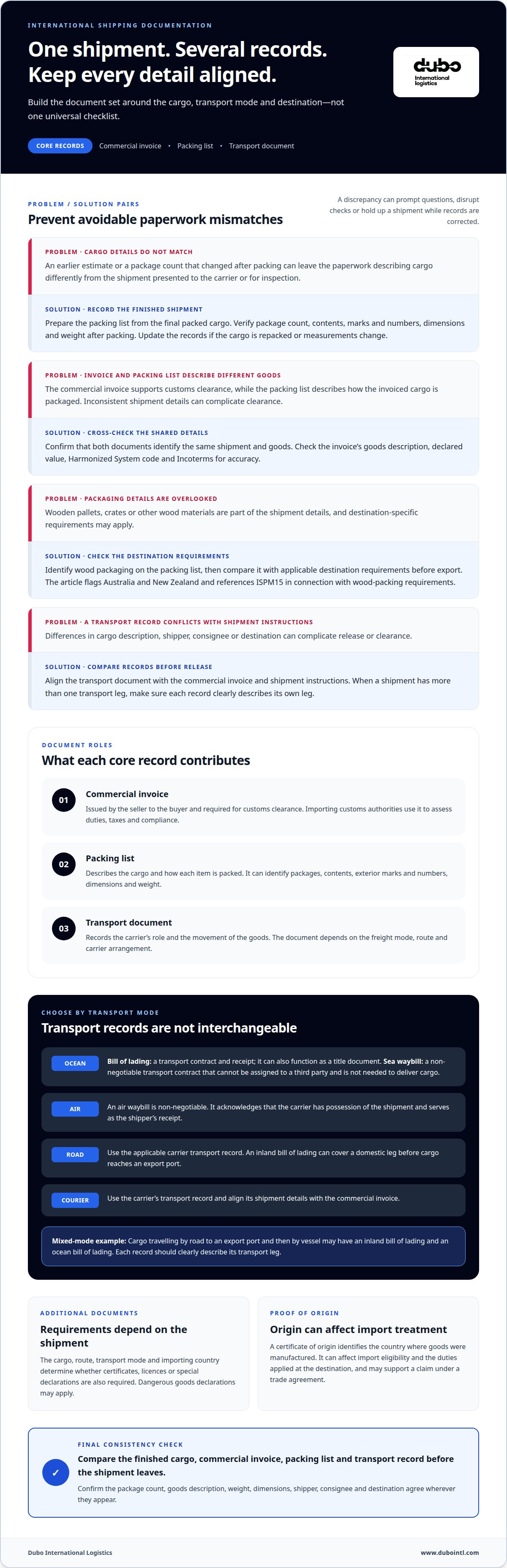
- Keep the commercial invoice, packing list and transport document aligned on shipment details to reduce the risk of delays or corrections.
- Understand how a bill of lading differs from an air waybill before choosing the transport documents for your shipment.
- Check whether the goods need proof of origin, permits or certificates, and prepare dangerous goods declarations when applicable.
- Freight forwarding and logistics consulting can help coordinate document details across shippers, carriers and customs processes.
Documents needed for international shipping
International shipments commonly need a commercial invoice, a packing list and a transport document. The cargo, route and destination determine whether certificates, licences or special declarations are also required.
Packing list contents and packaging details
A packing list describes the cargo and how each item is packed for transport. It can identify packages and their contents, along with the marks and numbers displayed on the outside of boxes. This detail connects the physical shipment to its paperwork. Prepare the list from the final packed cargo, not an earlier estimate, so the package descriptions match what the carrier handles.
Cargo dimensions and weight
A packing list records shipment measurements and weight alongside package details. These figures describe the cargo accurately and inform transport planning. Verify dimensions and weight after packing, when the shipment is in its final form. If the measurements, weights or listed items differ from the cargo presented for inspection, checks may be disrupted. Changes to dimensions or package count can also affect shipment arrangements.
Commercial invoices alongside packing lists
The seller issues a commercial invoice to the buyer, and the document is required for customs clearance. The packing list describes how the invoiced cargo is packaged, so both documents should identify the same shipment and goods. Importing customs authorities use the invoice to assess duties, taxes and compliance. Check that the goods description, declared value, Harmonized System code and Incoterms are accurate. Incorrect pricing, vague descriptions or inaccurate codes can complicate clearance.
Wood-packing restrictions and ISPM15
Wood packaging requires destination-specific attention. Shipments to Australia and New Zealand are restricted to wood packing, and ISPM15 is referenced in connection with these requirements. Since packaging forms part of the shipment, identify wooden pallets, crates or other wood materials when preparing the packing list. Then compare the destination’s applicable requirements with the packaging details before export. This helps keep the declared packaging and the cargo presented for inspection consistent.
Use the packing list as a working description of the freight, not just a record of box contents. For example, a shipment with several crates should show which goods are in each crate and match the marks and numbers printed outside. Before the shipment leaves, compare the finished packages with the list and invoice. Check the package count, descriptions, weight and dimensions together. If the cargo is repacked or its measurements change, update the documents so the carrier and inspection records reflect the shipment as prepared.
Bills of lading and air waybills
The transport document depends on the freight mode and the carrier’s role. Ocean freight may use a bill of lading or sea waybill; air freight uses an air waybill, while road and courier shipments use the applicable carrier transport record.
Bills of lading as contracts and receipts
A bill of lading is a transport contract and a receipt confirming that the carrier received the goods. For ocean freight, it can also confirm that the cargo was loaded onto a vessel. This receipt matters if shipment records later need to show what the carrier accepted. Compare its cargo description with the commercial invoice and packing list before the documents are issued.
Title documents and bill of lading details
A bill of lading can function as a title document, with possession giving the holder control of the cargo. Its details connect the shipment, carrier and destination, so mismatches can complicate release or clearance. Check that the shipment description and destination agree with the accompanying records. For example, if the invoice identifies machinery but the transport document describes a different commodity, the inconsistency may prompt questions.
Bills of lading and sea waybills
A sea waybill is a non-negotiable transport contract, unlike a bill of lading, which can control access to cargo through possession. A sea waybill cannot be assigned to a third party and is not needed to deliver cargo. This distinction matters if the buyer, consignee or delivery arrangements change. The chosen document should reflect who is entitled to receive the shipment at its destination.
Documents across freight modes
Ocean freight uses a bill of lading or sea waybill, while air freight uses a non-negotiable air waybill. The air waybill acknowledges that the carrier has possession of the shipment and serves as the shipper’s receipt. For road transport before cargo reaches an export port, an inland bill of lading can cover the domestic leg. Courier shipments use the carrier’s transport record; align its shipment details with the commercial invoice.
A change in transport mode can create multiple transport records for one shipment. For example, cargo travelling by road to an export port and then by vessel may have an inland bill of lading and an ocean bill of lading. Each record should clearly describe its leg. Transport-document requirements can also vary by destination, so confirm which details the route and receiving party need.
Before release, compare the transport document with the commercial invoice and shipment instructions. Confirm that the cargo description, shipper, consignee and destination are consistent across the records. A freight forwarder can coordinate documentation among shippers and carriers, helping keep the paperwork for each transport leg aligned.
Certificates of origin
A certificate of origin identifies the country where goods were manufactured. It can affect import eligibility and the duties applied at the destination.
Certificates of origin and trade agreements
A certificate of origin supports a claim that goods meet an agreement’s origin rules. Under CUSMA, certification establishes whether goods qualify for preferential treatment. This matters because inaccurate origin information can lead to denied tariff benefits or heightened customs scrutiny. Before making a claim, compare the stated origin with the product’s manufacturing records and the agreement’s conditions.
Origin means where a good was manufactured, not necessarily where it was packed or shipped. For example, goods made in one country and exported from Canada still need an accurate origin declaration. The importer may use that information to assess eligibility and applicable duties. Keep the certificate aligned with the commercial invoice and other shipment records, including the product description.
When origin certificates are required
For Canadian exports, the destination’s customs process may require an origin certificate, or it may be needed to support a trade-agreement claim. Ask the foreign buyer at the start of the transaction which documents are needed for import clearance. This helps identify destination requirements before finalizing export paperwork and logistics arrangements.
Do not assume every shipment needs the same certificate. The destination, goods and agreement claim determine whether proof of origin is relevant. If the buyer expects preferential treatment, the origin details must support that claim. An incorrect certificate can undermine the requested tariff benefit, while mismatched documents can invite additional scrutiny.
Other certificates address different questions. A phytosanitary certificate confirms that plants or plant products meet the importing country’s specified plant-health requirements and are free from regulated pests. A certificate of free sale states that goods are legally sold and safe for use in their home market. These documents serve different purposes, so an origin certificate does not replace them.
A production certificate describes the materials, product types, resources or approved methods used to make goods. It may be required when shipping into or out of regions with applicable production regulations. A vessel certificate records vessel ownership and details such as age and maintenance; it may appear among letter-of-credit requirements. Each document links a specific shipment fact to a clearance or contract condition.
Regulated commodities may need permits or certificates from authorities such as the Canadian Food Inspection Agency, the U.S. Food and Drug Administration or the U.S. Department of Agriculture. For specialized shipments such as live animals, international pet air travel coordinators like FurExpress must align veterinary health certificates and import permits with cross-border regulations. The relevant authority depends on the goods and destination, so exporters should identify the applicable document with the buyer early. Clear, accurate certificates give everyone handling the shipment consistent information about origin, production or compliance requirements.
Dangerous goods declarations
A dangerous goods declaration describes hazardous cargo and confirms its classification, packaging and labels. Customs declarations serve a separate purpose: they provide information for export or import clearance and the assessment of applicable duties or taxes.
For Canadian exports, HS classification starts with an accurate description of the goods and the correct code. Export declaration requirements depend on shipment value, destination and national regulations, so these details determine the required filings.
Common errors include inaccurate codes, incomplete descriptions and inconsistent shipment details. These can lead to customs review, cargo holds, delays, fines or seizure. Late or missing export declarations can result in fines or export holds.
Classifying goods and export requirements
HS classification assigns goods a code used to identify them in customs documentation. A precise product description helps determine the applicable code; a generic or incorrect code can lead to incorrect duty assessments, reclassification requests and delays. For a Canadian export, assess requirements based on the shipment’s value, destination and applicable national regulations. Confirm that the goods description and code match across the export declaration and supporting documents.
Keep customs declarations distinct from dangerous goods declarations. Customs declarations support clearance and duty or tax assessment; dangerous goods declarations communicate hazards and confirm the cargo is prepared for transport. If a shipment contains hazardous materials, the declaration must describe the cargo accurately and match the goods presented to the carrier.
Documentation errors, delays, and penalties
Errors include inconsistent cargo descriptions, values or weights across shipment records, as well as incorrect or generic HS codes. Missing essential paperwork can also hold up a shipment. These problems may prompt questions, inspections, corrections or delays while parties reconcile the records. Late or missing export declarations can result in fines or export holds.
For dangerous goods, the declaration must describe the hazardous cargo and attest to correct classification, packaging and labelling. Air shipments require an IATA Shipper’s Declaration; ocean shipments require an IMO Dangerous Goods Declaration aligned with the IMDG Code. The required form therefore depends on the freight mode, and its information must correspond to the actual goods.
Export declarations and advance cargo filings are related but distinct submissions. Many jurisdictions require cargo information before arrival, while export declaration requirements depend on value, destination and national regulations. Identify who prepares and submits each filing, and ensure the consignee and shipment details match across the records. A mismatch can prompt questions during processing.
Prepare declarations early and compare the goods description, classification and consignee details across the shipment paperwork. For hazardous cargo, align the declaration with the transport mode and the shipment presented to the carrier. These checks help keep filing information clear and consistent as cargo moves through export and import processes.
Freight-forwarder documentation support
International paperwork passes between the seller, freight forwarder, carrier and customs authorities. A freight forwarder coordinates shipment documents among these parties, helping connect cargo details with each transport leg and the destination’s information requirements.
That coordination matters when a shipment crosses several borders or changes transport modes. For example, road freight to an export port followed by ocean freight creates separate transport records. The forwarder can coordinate information for each leg and flag differences before documents are submitted. The seller remains responsible for providing accurate information about the goods.
Document control starts with a clear record of the shipment’s key details. Compare the goods description, package count, weight, dimensions, origin, shipper, consignee and destination across the relevant paperwork. If the commercial invoice describes one product while a transport record describes another, customs or a carrier may request corrections before moving the freight.
A useful review follows the shipment’s handoffs. First, the seller provides cargo and transaction details. Next, the forwarder coordinates documents required by the selected carrier and route. Before submission, compare the final information across the invoice, packing list, transport document and any required certificates or declarations. This process can reveal inconsistent values or missing details while there is still time to correct them.
Destination requirements can change the information transport documents must carry. Export declaration requirements also depend on shipment value, destination and national regulations. A forwarder can coordinate document details between the shipper and carrier, while the parties responsible for each filing provide the required information. Clear responsibility matters: a missing declaration can hold up an export, while inconsistent cargo details can prompt questions or compliance review. For businesses seeking dedicated trade compliance support, including Importer and Exporter of Record services, global-4pl.com provides guidance to help keep cross-border documentation and regulatory filings aligned.
Some freight needs records beyond standard transport paperwork. Temperature-controlled cargo may require temperature logs to demonstrate integrity. A forwarder can coordinate how those records travel with the shipment information, so the relevant parties can access the documents when needed. For a shipment involving several carriers, identify who submits each document and who receives the completed record at each handoff.
Payment terms can also shape document timing. Under a letter of credit, the seller must submit required documents by a predetermined deadline. The forwarder can help coordinate transport paperwork around that deadline, while the seller remains responsible for meeting the payment conditions. Missing a required document or submitting inconsistent records can disrupt payment processing as well as shipment movement.
For multi-leg freight or cargo with special documentation needs, freight forwarding can bring document coordination into the transport plan. Discuss freight-forwarding coordination when your shipment involves several carriers or complex handoffs.
Dubo International Logistics: Freight forwarding
Dubo International Logistics coordinates freight forwarding for businesses managing international cargo movements. Its logistics consulting can help structure shipment plans when routes, transport modes and documentation requirements intersect.
Consider a freight-forwarding partner when a shipment involves several carrier handoffs, a complex corridor or cargo that needs specialized transportation. Dubo International Logistics coordinates specialized transport for oversized machinery, delicate equipment and temperature-sensitive products. Planning these requirements alongside cargo movement helps align transport arrangements with the shipment’s handling needs.
For unusual cargo requirements or multiple transport legs, discuss the movement and documentation needs with Dubo International Logistics. Visit dubointl.com to start the conversation.
Build documentation into your next shipment plan
Make document ownership part of shipment planning, not a last-minute task. Assign responsibility for gathering product details, preparing records and submitting required paperwork. Then set a review point before cargo is handed to its first carrier. This gives everyone time to resolve inconsistencies while shipment details are still accessible.
A shared document file can also help teams manage changes. If the consignee, route or packaging changes, record the update and share the revised information with the parties handling the freight. For recurring exports, use the previous shipment file as a reference, then confirm that the current goods and destination match. A consistent process makes documenting cargo for international shipment easier to manage across teams and transport legs.
When the route or cargo calls for coordinated freight planning, Dubo International Logistics offers freight forwarding, logistics consulting and specialized transportation services. Contact Dubo International Logistics to discuss your shipment planning. A clear plan gives your next export a more organized start.
Frequently Asked Questions
What is Shipping Documentation?
Shipping documentation is the collection of records used to identify a shipment, support its movement and document its handling. Depending on the transaction, it can include commercial records, carrier paperwork, permits and delivery records. For example, an arrival notice tells the consignee cargo is arriving, while a delivery order authorizes its release after required charges and paperwork are cleared. Documenting cargo for international shipment means managing these records as one connected file.
What documents are required for an international cargo shipment from Canada?
Required documents depend on what is shipped, the route and the importing country. In addition to export records, destination-stage paperwork may include an arrival notice or delivery order. A rail shipment may also involve a rail waybill prepared by the shipping agent or railway after receiving the shipper’s instructions. Map each document to the party using it, so the consignee knows what to expect when the cargo arrives.
How do you complete a commercial invoice for an international shipment?
Prepare the invoice from the sale transaction, then compare its details with the agreed payment terms before issuing it. This is especially useful when payment uses a letter of credit, because the seller must submit required documents by a predetermined deadline. Keep the invoice version used for the shipment with the transaction records. If the sale terms change before dispatch, align the paperwork with the updated transaction.
What information must a packing list include for cargo shipments?
Make the list useful to someone identifying packages without opening them. Give each package a clear reference that matches its external marks, then link that reference to the listed contents. For a consignment split between crates, package-level detail helps distinguish the goods in each unit. Keep a copy that reflects the packed shipment, so the teams preparing and receiving the cargo can reconcile the same package references.
How do you prepare a bill of lading or air waybill for international freight?
Provide the shipper’s instructions to the relevant agent or carrier, then review the transport record before it is finalized. For rail freight, the shipping agent or railway prepares the rail waybill after receiving those instructions. Keep the issued document with the shipment file and note which transport leg it covers. This is especially useful when a shipment changes mode, since each leg may have its own record.
How do customs declarations and export reporting work for shipments leaving Canada?
Identify who is responsible for each export filing and keep a record of what was submitted. Requirements can depend on shipment value, destination and national regulations, while some jurisdictions request cargo information before arrival. If details change after submission, such as the consignee or package information, coordinate the correction with the party handling that filing. This creates a clear record of the information associated with the export.
What documents are required to claim preferential tariff treatment under a trade agreement?
The importer needs origin information that supports the agreement claim, prepared in a form accepted for that agreement and destination. Before dispatch, align the claim details with product records and the buyer’s import documentation process. Retain supporting production or manufacturing records with the shipment file. This makes it easier to respond if the importer needs to substantiate the claim during customs review.

