

A delivery receipt doesn’t close the door on a freight claim. In Canada, written notice of loss, damage, or delay must be given to the carrier within 60 days after delivery, and the final statement of a claim must be filed within nine months of shipment. The freight damage claims process in Canada starts with documenting the issue, notifying the carrier, and submitting a formal claim with supporting records.
The steps and deadlines in the freight damage claims process in Canada can be difficult to keep straight, especially when damage is discovered after delivery or an inspection is needed. An initial damage report may not count as a formal claim, so distinguish between notifying the carrier and submitting the claim.
This guide explains what a freight claim covers, how to prepare and file one, and what to expect during an investigation. You’ll also learn how to preserve freight and packaging for inspection, respond to a denial, and understand why resolution times vary. Deadlines depend on the shipment type and terms, so act promptly when you discover loss or damage.
Key Takeaways
- Inspect and count freight before signing the delivery receipt, and record any visible shortage or damage clearly.
- Build a claim file with shipment records, photographs, the delivery receipt, and evidence of the goods’ value.
- Keep damaged freight and its packaging available for inspection; don’t dispose of them without carrier authorization.
- Distinguish carrier liability from cargo insurance, since carrier compensation may not cover the goods’ full selling price.
- If a claim is denied, ask which terms or evidence support the decision and what review process is available.
What is a Freight Claim?
A freight claim is a formal request for compensation after cargo loss, damage, or shortage. Start by recording the shipment’s condition and preserving evidence at delivery.
-
Document damage and shortages
Before signing, inspect and count the shipment, then record visible shortages or damage on the delivery receipt. Be specific, noting a crushed corner, torn wrapping, or missing carton instead of writing only “damaged.” Photograph the freight and packaging at delivery. If you discover concealed damage later, document it and notify the carrier promptly. Don’t sign a receipt stating that the shipment is complete and undamaged if it isn’t.
-
Identify responsibility and compensation
Identify the legal owner or authorized representative who can submit the claim. The carrier’s responsibility depends on the applicable shipment terms; the shipper, receiver, or broker’s role does not by itself establish carrier liability. An Incoterm can determine when risk transfers between seller and buyer, but it does not decide whether the carrier is liable. Carrier liability is separate from cargo insurance.
Read the bill of lading for the carrier’s maximum financial liability. For Canadian shipments, the stated liability rate is generally C$2 per pound unless the parties agreed to a higher rate. Compensation may depend on weight, declared value, and applicable terms, rather than the goods’ full selling price. Don’t assume declared value or insurance automatically guarantees payment of the retail value.
- Assemble evidence before submitting the claim. Supporting documents may include the bill of lading or air waybill, delivery receipt, photographs, commercial invoice, and relevant correspondence. Match each record to the same shipment and keep copies together. The delivery receipt shows what was recorded when the freight arrived, while photographs can show the condition of the goods and packaging. Correspondence documents when the carrier was notified and how it responded.
- Use the commercial invoice and related records to support the goods’ value. The invoice should show their value at the time of shipment, based on cost rather than retail price. Keep the invoice consistent with the shipment description and quantities. For a shortage, identify the missing items and quantities using shipment records. For damage, connect the affected goods to the documented condition and claimed loss. Matching records help explain what was affected and its value.
- Distinguish an initial damage report from a formal claim. A report alerts the carrier but may not qualify as a formal claim. Prepare a written submission that identifies the shipment, describes the loss or damage, and includes supporting evidence and proof of value. Keep a copy of the submission and the carrier’s acknowledgement. An organized file gives the carrier specific records to review rather than just a brief description.
Claim filing deadlines and resolution times
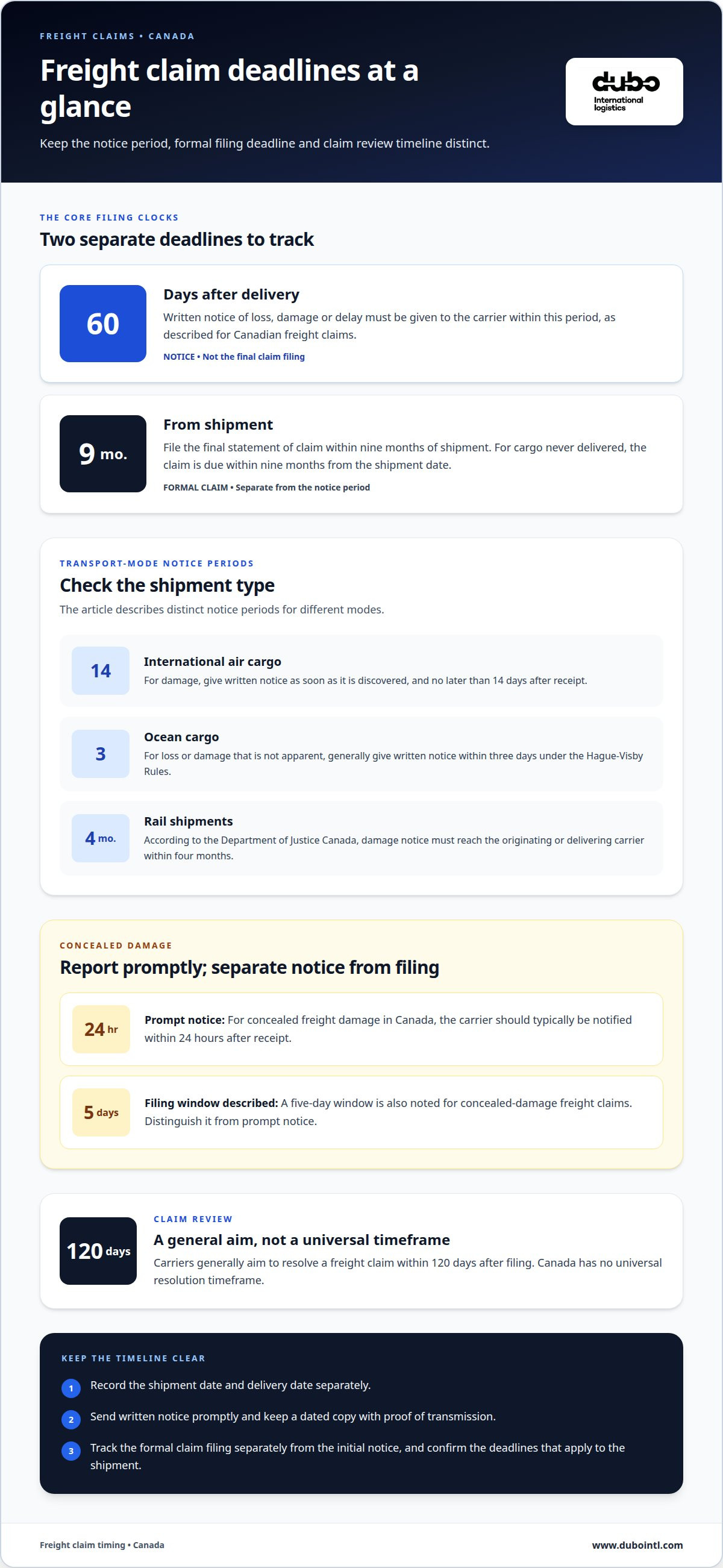
Give written notice of freight loss, damage, or delay within 60 days after delivery. Deadlines differ by shipment type: international air cargo, ocean cargo, and rail shipments have distinct notice periods.
Distinguish the first notice from the formal claim filing. A notice reports what happened; the claim must meet its own deadline and include supporting documents.
-
Check carrier and transport-mode deadlines
Identify the carrier and transport mode, then compare each applicable notice and filing period. For damaged international air cargo, provide written notice as soon as damage is discovered, and no later than 14 days after receipt. For ocean cargo subject to the Hague-Visby Rules, generally give written notice of loss or damage that isn’t apparent within three days. According to the Department of Justice Canada, rail damage notice must reach the originating or delivering carrier within four months.
-
Submit notice of intent
Send written notice promptly, even while gathering the invoice, photographs, and other evidence. For concealed freight damage in Canada, the carrier should typically be notified within 24 hours after receipt. A five-day filing window is also described for concealed-damage freight claims, so distinguish that filing period from prompt notice. Keep a dated copy and proof of transmission; a preliminary notice may not count as the final claim.
-
Track claim resolution times
Record the formal filing date and follow the claim’s progress against that date. Carriers generally aim to resolve a freight claim within 120 days after filing, but Canada has no universal resolution timeframe. Keep the carrier’s acknowledgements, requests, and responses with the supporting documentation. If an invoice or evidence is requested, note when it was supplied; a complete record helps clarify which stage the review has reached.
- File the final statement within nine months of shipment. For cargo that was never delivered, file the claim within nine months from the date of shipment. These are filing deadlines, not extensions of the separate 60-day written-notice period. Record the shipment date and delivery date independently, then calculate each period from its stated starting point.
- Act quickly after discovering concealed damage or a shortage. Report concealed damage promptly, and don’t assume a general deadline replaces a notice requirement for a particular transport mode. Confirm the applicable reporting and filing deadlines for the shipment. Preserve the evidence while the carrier reviews the claim, and keep a dated timeline of when the loss occurred, notice was sent, and formal claim submitted.
Claim investigations, disputes and denials
Track the carrier’s investigation and tie each decision to the shipment record. If the carrier denies compensation, ask for the supporting term or evidence and the available review procedure, then address the decision with relevant records.
-
Review the claim investigation
Compare the carrier’s findings with the claim documents and the loss under review. Check whether the decision addresses the same shipment and the specific affected goods, shortage, or concealed damage. Organize the carrier’s questions, your replies, and any new evidence by date. This helps clarify which facts the carrier accepted, what remains disputed, and whether its position addresses the claimed loss.
-
Cancel or dispute a claim
Before sending further correspondence, decide whether to continue, correct, or withdraw the claim. To withdraw it, send the carrier a dated written request with the claim reference and reason, then retain its response. If an invoice, quantity, or damage description is incorrect, specify the correction and attach the supporting record. Keep the original filing and revised information together to preserve a clear claim history.
-
Dispute a denied claim
Ask the carrier which term or evidence supports its denial and what review procedure is available. Address each reason separately with records that speak directly to the disputed point. For example, if the carrier questions whether damage occurred in transit, organize the delivery record, photographs, and relevant correspondence around that issue. Rather than relying on a general disagreement, explain how each item supports your position on liability or compensation.
- Keep the carrier’s written decision separate from your response. Record the date of the final written rejection, the claim reference, and the reason given. In Canada, a lawsuit after a freight carrier’s final written rejection typically must be filed within two years. Keep the rejection and related claim correspondence together, since the date of the final decision is relevant to this period.
- For a cross-border shipment, review the logistics records alongside the carrier’s decision. Match the decision to the route, shipment documents, and party named in the claim; a border crossing alone does not establish responsibility. If records describe the same missing goods differently, identify the discrepancy in your written dispute. A precise response helps the carrier assess the specific issue without revisiting unrelated parts of the claim.
- Maintain one organized dispute file from the initial filing through the carrier’s final position. Include the claim reference, dated notices, evidence, decisions, and every revision or withdrawal request. Use clear filenames or a dated index to distinguish original documents from later additions. This record helps explain what changed, when you responded, and which evidence supports the compensation sought.
Keeping freight and packaging for inspection
Preserve the condition of lost or damaged freight while the carrier reviews the shipment. For concealed damage in Canada, notify the carrier promptly after discovery; it should typically be notified within 24 hours of receipt.
-
Inspect freight at delivery
Before signing the delivery receipt, inspect and count the shipment. Look for visible damage, missing pieces, and differences between the freight and delivery records. Record specific details, such as a punctured carton or a missing unit, instead of a general note. This helps distinguish damage observed at delivery from concealed damage discovered after unpacking.
- Report concealed damage as soon as you find it. Note when it was discovered and which goods are affected, then send written notice to the carrier. For example, if a machine arrives in intact packaging but has a cracked panel after unpacking, record both observations. Keep the notice and carrier’s response with the shipment file. A prompt, dated report makes clear when the issue became apparent.
-
Retain freight and packaging
Keep damaged goods and all packaging together in case the carrier inspects them. Retain cartons, wrapping, cushioning, and other relevant materials, even if they appear undamaged. The carrier may need to inspect the freight and packaging before assessing salvage. Don’t dispose of either without the carrier’s authorization; doing so could remove evidence that helps explain how the damage occurred during transport.
- Set damaged freight aside so its condition remains available for inspection. Avoid discarding pieces, replacing packaging, or making changes that could obscure the damage before the carrier reviews it. If the shipment contains several items, identify the affected goods separately and keep their packaging with them. This connects each damaged item to its transport protection and inspection record.
- Keep a simple inspection record with dated photographs and written observations. Photograph the damaged goods, outer packaging, and any visible puncture, tear, or crushed area. Include the shipment reference in your file so each image can be matched to the relevant delivery. If an inspection occurs, record its date and the items examined. Keep copies of the carrier’s instructions about inspection or disposal with the same records.
- Coordinate access to the freight when the carrier requests an inspection. Make the affected goods and retained packaging available, and avoid moving them unnecessarily before the review. If the shipment contains damaged and unaffected items, clearly identify which are relevant to the claim. This helps focus the inspection on the reported loss without confusing it with freight that arrived in good condition.
Freight loss and damage claim steps
A practical freight damage claims process in Canada connects each action to the shipment record. Follow the sequence below to keep the carrier’s review focused on the specific loss or damage.
- Identify who is entitled to claim and which shipment is involved. In Canada, the legal owner of the freight or someone officially authorized to act for the owner can submit a cargo claim. Record the bill of lading number, shipment date, carrier, and affected goods. Use the same shipment reference in notices and correspondence, especially when several deliveries have similar descriptions.
- If freight is missing, give the carrier a week’s grace period to try to locate it. Record search updates and the shipment details shared with the carrier. If the goods are found, note their delivery status and condition. If they remain missing, distinguish the location inquiry from the formal claim so the carrier can assess the actual loss.
- Document loss or damage promptly, then notify the carrier. Record the affected items, their quantities, and the condition observed. Photographs can show the goods and packaging, while a written description clarifies what each image depicts. For example, identify a damaged component separately from its outer carton. Keep original records and later updates in the same shipment file.
- Submit a formal written claim instead of relying on an initial report. A preliminary damage report may not count as formal filing. Identify the shipment, describe the loss or damage, and state the compensation requested, supported by evidence. Keep a dated copy and the carrier’s acknowledgement. In the freight damage claims process in Canada, separating notice from claim filing helps ensure a report isn’t mistaken for a complete submission.
- Assemble documents that connect the goods, shipment, and claimed loss. Supporting records may include the bill of lading or air waybill, delivery receipt, photographs, commercial invoice, and relevant correspondence. The invoice should identify the goods and document the shipment details relevant to the claim. Match item descriptions and quantities across records so discrepancies are clear.
- Pay the freight bill in full before the claim investigation proceeds. Keep the payment record with the freight bill and claim documents. Payment is separate from the carrier’s liability decision and does not mean the carrier accepts responsibility. Carrier liability also differs from cargo insurance, so state the compensation requested without treating insurance or claim assistance as proof of coverage.
- Track the claim through the carrier’s written response. Save evidence requests, replies, and decisions in date order. If the carrier questions liability or the amount claimed, respond to the specific issue with relevant records. A clear chronology shows how the shipment details, reported loss, and requested compensation fit together. This keeps the freight damage claims process in Canada organized from submission through review.
Dubo International Logistics: Freight forwarding
Dubo International Logistics provides freight forwarding for businesses moving cargo across North America, including domestic and cross-border shipments. The service includes coordinating carriers and shipment documents, helping connect transport stages within a broader logistics plan.
For project cargo, oversized machinery, delicate equipment, or temperature-sensitive products, Dubo International Logistics provides specialized transportation solutions tailored to cargo-specific requirements. The company coordinates shipments across Canada and the United States, including routes with multiple carrier handoffs.
Logistics consulting can also help businesses plan their supply-chain approach and align shipment decisions with operational requirements. Contact Dubo International Logistics to discuss your freight requirements and next steps.
Plan the next shipment with clarity
A claim can reveal where shipment planning needs a clearer handoff. Use the freight damage claims process in Canada as a prompt to review how purchasing, shipping, and receiving teams share information. Decide who maintains shipment records, who communicates exceptions, and how updates reach people making operational decisions. Documenting these roles before the next shipment can reduce uncertainty when an issue affects delivery plans.
Turn the review into a practical internal procedure. For example, name a claims contact during shipment planning, define where correspondence is retained, and agree how teams will share updates about affected goods. Keep the process easy to follow across routine and specialized shipments, and revisit it when routes, cargo requirements, or team responsibilities change. Clear ownership supports more consistent supply-chain decisions.
For a conversation about your shipping requirements, contact Dubo International Logistics. A deliberate plan can help your team approach future shipments with greater confidence.
Frequently Asked Questions
Who can make a cargo claim?
The legal owner of the freight, or someone officially authorized to act for that owner, can make a cargo claim in Canada. Possessing the shipment or arranging its delivery does not by itself establish ownership. For a sale involving an Incoterm, the term can help identify when risk transfers between seller and buyer, but it does not determine carrier liability. Treat ownership and carrier responsibility as separate questions.
Can someone file a claim on my behalf?
Yes. An authorized representative can act for the freight’s legal owner. Make the authorization clear in claim communications, including the owner’s identity and the shipment being discussed. For example, an employee handling a supplier’s shipment should identify the company as the owner and state their representative role. Help with paperwork or correspondence does not, by itself, establish carrier liability or insurance coverage.
How will I know my claim status?
Use the carrier’s claim reference in each follow-up and keep a dated record of replies. A useful status update clarifies whether the file is under review, whether the carrier needs a response, or whether it has issued a decision. If the update is unclear, ask what action is outstanding. This helps your team distinguish a pending investigation from a file delayed by unanswered correspondence.
What should you do when cargo is lost or damaged?
Address the shipment’s immediate status first. If cargo is missing, give the carrier identifying details that can help locate it, such as the shipment reference and description. If goods arrived damaged, keep them available while the carrier considers an inspection. Record who in your organization handles carrier communications so updates and decisions reach the person coordinating the claim.
How do you file a freight damage claim in Canada?
Submit the claim to the carrier using its procedure, and identify the shipment and loss. Keep the communication focused: state which goods are affected, what happened, and which supporting records are included. Save the submitted version and any acknowledgement together. If the carrier asks for clarification, answer the specific request and retain the exchange in the claim’s correspondence history.
What documents and evidence are required for a Canadian freight damage claim?
The supporting file should connect the shipment, affected goods, and claimed amount. A commercial invoice can establish the goods’ value at shipment, while photographs can help show their condition. Use records with consistent item descriptions and quantities. If documents differ, such as a packing record showing a different quantity, explain the discrepancy in your correspondence rather than leaving the carrier to resolve it without context.
What steps should a Canadian shipper take when goods arrive damaged?
At delivery, compare the shipment with its records and note specific exceptions on the receipt before signing. “Two cartons crushed” is more useful than a general note. Photograph the affected area and retain the packaging. If damage appears only after unpacking, record when you discovered it and notify the carrier promptly. Keep the goods available if the carrier requests an inspection.
What are the timelines for resolving a freight damage claim in Canada?
There is no universal resolution timeframe for freight claims in Canada; carriers generally aim to resolve a claim within 120 days after filing. Keep the freight bill paid in full, since an investigation typically requires this. The compensation requested is a separate issue.

