

The largest freight provider isn’t automatically the right fit for a small business. The best freight forwarder for small business Canada is one whose coordination approach matches your cargo, routes and support needs, whether you’re moving standard freight or managing a shipment with more complex requirements.
Clear responsibilities, dependable carrier coordination and useful shipment updates matter when a missed detail could disrupt operations. Compare how providers plan shipments, manage hand-offs and communicate changes. Specific questions about those processes reveal more than a general promise of good service.
This guide offers a practical framework for assessing freight forwarding fit, reliability, coordination and shipment planning. You’ll learn what to look for in domestic and North American freight support, and how to prepare the shipment details that help a logistics partner build a clear plan. Dubo International Logistics coordinates freight across Canada and North America. Learn more at www.dubointl.com.
Key Takeaways
- Choose a freight forwarder based on your cargo, routes and coordination needs, not simply the length of its service list.
- Compare shipment fit, communication, tracking visibility, carrier vetting and cross-border coordination.
- Decide whether a broad-network provider or a more hands-on coordination model better suits your shipment complexity and working style.
- Prepare a freight brief with cargo dimensions, weight, handling needs, origin, destination and timing requirements before comparing providers.
- Learn how Dubo coordinates domestic and North American freight, including specialized cargo support, at www.dubointl.com.
Why a Small Business in Canada Needs the Right Freight Forwarder
Moving cargo can involve more than arranging a truck. A shipment may need a suitable carrier, clear handling instructions, coordinated documents and updates as it moves. When no in-house logistics team manages those details, employees may need to chase information across multiple hand-offs while also running the business.
Freight forwarding is the strategic coordination of domestic and cross-border cargo movement, connecting shipment planning, carrier arrangements, documentation coordination and progress communication. A freight forwarder coordinates how cargo moves; it doesn’t simply sell transport capacity. Its role is to bring the moving parts together around the shipment’s requirements. For a foundational overview, see What is a Freight Forwarder?
That distinction matters when comparing options. A transport provider may focus on a particular movement, while a forwarder can coordinate connected steps and carrier transitions. Your business still directs product and order planning: it determines what is shipping, when the goods will be ready and where they must go. The forwarder organizes the logistics plan around those decisions. Finding the best freight forwarder for small business Canada means choosing a coordination model that fits both the cargo and the work your team needs support with.
Dubo International Logistics coordinates freight across Canada and North America, including specialized shipments. Its freight forwarding work connects shipment requirements with carrier coordination and progress tracking. More information is available at www.dubointl.com.
What does a freight forwarder do for a small business?
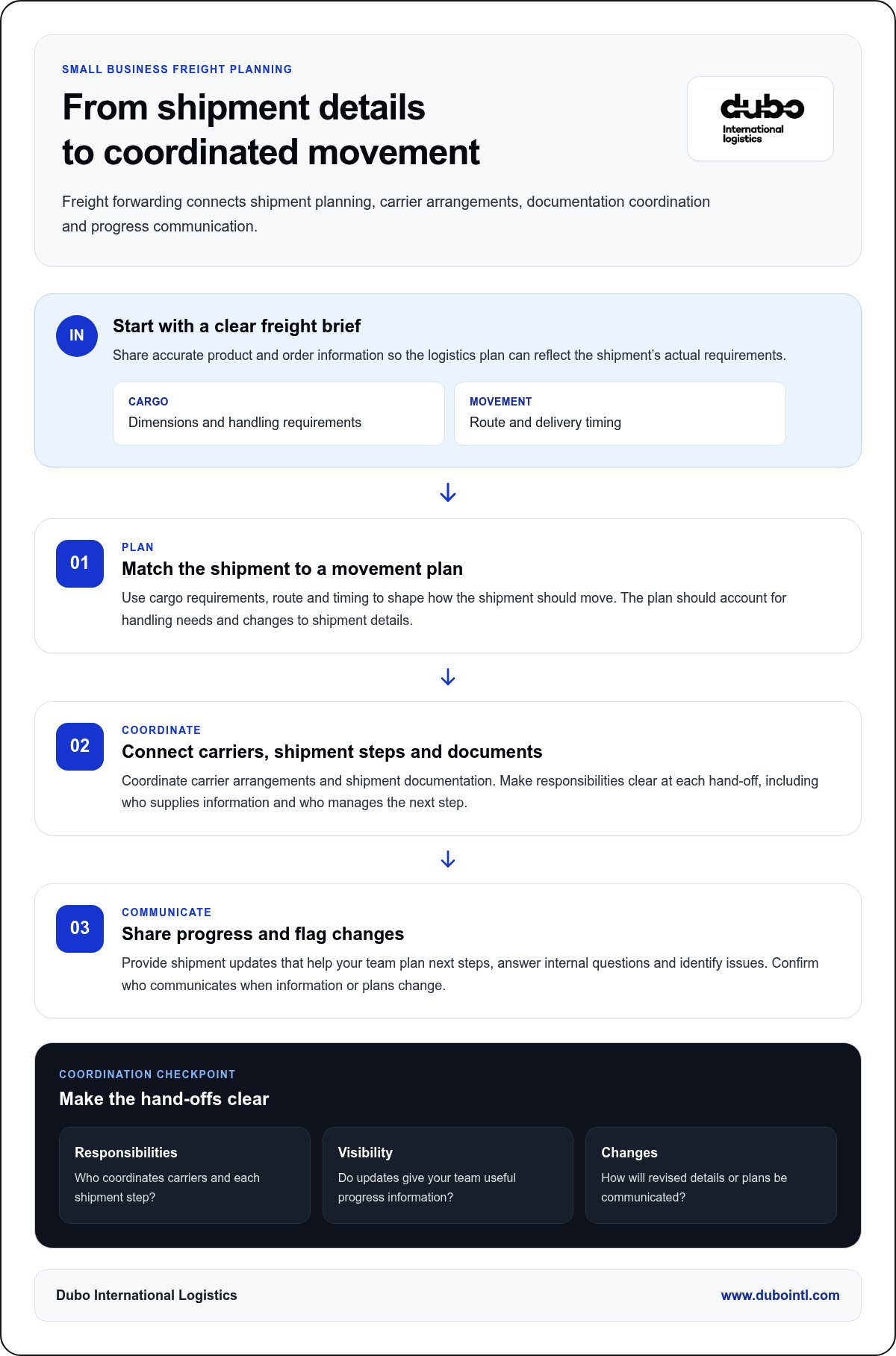
A forwarder can plan a shipment, coordinate carriers, organize the flow of shipment documentation and communicate progress. One logistics contact can make it easier to follow hand-offs than trying to piece together updates from separate parties. Your business remains responsible for providing accurate product and order information; the forwarder uses those details to coordinate the movement.
- Plan: Match shipment requirements with an appropriate movement plan.
- Coordinate: Connect carriers and shipment steps, and clarify responsibilities at hand-offs.
- Communicate: Share progress updates and identify information needed to keep the plan on track.
When does freight forwarding become useful?
Recurring shipments can benefit from a consistent coordination process. A one-time move may also need support if it involves cross-border movement, multiple carrier hand-offs or non-standard handling. Frequency alone isn’t the deciding factor. A single shipment of fragile equipment, for example, may need more deliberate planning than several routine moves.
Consider forwarding support when logistics tasks are taking time away from core operations, shipment details vary from load to load, or your team needs clearer communication across a route. Ask how much coordination each shipment requires and whether your current process assigns responsibility for each step, rather than judging need by shipment frequency alone.
How to Evaluate the Best Freight Forwarder for Your Business
Compare fit, not the length of a service list. Start with the shipments your business actually moves, then assess how a forwarder would plan and coordinate them. Experience with routine freight may not address the needs of fragile equipment, changing delivery details or cross-border cargo. The best freight forwarder for small business Canada is one whose processes match your operating requirements and make responsibilities clear.
Which service and coordination criteria matter most?
Match coordination experience to your cargo and shipping pattern. Consider how the plan accounts for dimensions, handling requirements, route and delivery timing, and how it changes if shipment details are revised. A business shipping delicate equipment, for example, should understand how handling instructions are shared with the relevant parties. A business with recurring standard shipments may prioritize consistent coordination and predictable updates.
Look for clear responsibilities at each hand-off. Establish who coordinates carriers, who supplies shipment information, how changes are communicated and what updates your team can expect. Service level agreements (SLAs) can define commitments such as delivery windows, service performance or equipment availability. Clear terms help both sides understand what has been agreed, while direct communication remains essential if plans change.
Shipment visibility should support the way your team works. Consider whether tracking and updates give the people responsible for orders enough information to plan next steps, answer internal questions and flag issues. A tracking system is useful when its information is understandable and the parties know who is responsible for communicating updates.
How can a small business assess reliability and compliance?
Assess reliability through processes, not broad assurances. A carrier vetting process is a structured review of carriers’ safety, insurance, compliance and capabilities. Also ask how shipment requirements are recorded, how hand-offs are managed and how the forwarder communicates when information changes. These details help you understand how the work is organized without treating any single claim as a guarantee of a particular outcome.
Professional affiliation can provide useful context. Dubo International Logistics is a member of the Canadian International Freight Forwarders Association (CIFFA). Membership is one factor to consider, not a promise about a particular shipment. For cross-border movements, clarify how documentation responsibilities are coordinated. The Canada Border Services Agency (CBSA) notice on freight forwarders offers government guidance related to freight forwarders and export reporting.
For a wider view of North American freight planning, Professional Freight Forwarding in North America: A Strategic Guide for 2026 can complement this needs-first assessment. Learn about Dubo’s freight forwarding services.
Large Forwarder or Hands-On Partner: Which Model Fits?
A provider’s size can shape its network and service model, but size alone doesn’t show how well those arrangements will suit your shipments. The best-fit model depends on shipment needs, not provider size alone. Compare how each provider would handle your actual cargo, routes, communication requirements and changes to the plan. This lets a small business assess the proposed process rather than make assumptions based on company scale.
Use the comparison below to identify what matters most to your operation. These are general tendencies, not guarantees. Individual providers can differ in how they coordinate shipments.
- Shipment complexity: A broad-network model may suit standard shipments on varied routes. A hands-on model may be useful when cargo needs non-standard handling or involves several coordination steps.
- Communication: Decide whether your team needs a structured update process or closer, shipment-specific coordination with a consistent point of contact.
- Visibility: Compare how shipment progress is shared, who receives updates and how changes or exceptions are communicated.
- Network needs: A wider network may align with shipments across multiple markets or transport modes. A focused coordination model may suit a narrower set of routes and specialized requirements.
- Flexibility: Assess how the provider adjusts its plan when cargo details, timing or handling needs change, and how it communicates the next steps.
When might a broad provider network be the right fit?
A broad network may be appropriate when your business ships on diverse lanes, uses different transport modes or serves several operating markets. A wider set of carrier relationships may align with varied routing and service requirements, particularly if shipment patterns change from one movement to the next. Still, scale alone doesn’t establish reliability or attention. Assess how the provider assigns responsibility, shares progress and manages each shipment’s specific requirements.
When might specialized coordination matter more?
Out-of-gauge machinery, fragile equipment and temperature-sensitive cargo can require planning that addresses their distinct needs and the transitions between shipment steps. The more a shipment differs from routine freight, the more useful it is to understand how handling instructions, carrier coordination and progress updates fit together. For further context, Specialized Freight North America: A Strategic Buyer’s Guide for 2026 explores specialized cargo planning. Dubo coordinates specialized transportation across North America. More information is available at www.dubointl.com.
To assess whether a provider’s process suits your shipment, look for practical details: named responsibilities, clear communication points, shipment visibility and a defined approach to changes. Ask how the plan accounts for your cargo rather than relying on broad claims about network size or personalized service. The explanation should show how the shipment moves through each hand-off and how your team will stay informed.
Prepare a Freight Forwarding Brief Before Comparing Providers
A consistent shipment brief makes provider responses easier to compare. It also reduces the risk that proposals rely on different assumptions about cargo, route or timing. Gather the details your business knows and mark anything that still needs clarification. The brief is a planning document, not a promise of a particular transport outcome.
Work through these steps for the shipment or recurring lane you want to assess:
- Step 1: Define the shipment. Describe the cargo, including its dimensions and weight. Note the number of pieces or units if known, and whether the movement is one-time or recurring.
- Step 2: Record handling needs. Identify fragile components, temperature sensitivities and other handling instructions. Note whether equipment, temperature monitoring or customized crating may be relevant.
- Step 3: Map the movement. Record the origin and destination, whether the shipment crosses a border, and any known routing constraints that could affect planning.
- Step 4: Set timing expectations. Note the desired delivery window and any timing requirements tied to production, customer orders or operations. Distinguish a preferred date from a firm operational requirement.
- Step 5: Describe coordination needs. Record who will provide shipment details, who needs progress updates and what information your team needs to plan its next steps.
- Step 6: Review the plan. Check that the brief reflects the latest cargo and order information. Flag unknowns rather than filling them with assumptions.
For cross-border movements, identify the border crossing in the brief and list the shipment information your team already has. This gives providers a shared starting point for discussing route coordination and documentation responsibilities. Cross-Border Freight Forwarding: Navigating Canada-USA Logistics in 2026 provides further context on planning Canada-USA freight.
What shipment information should you organize first?
Keep the core facts together: cargo description, dimensions, weight, handling requirements, shipment frequency, origin, destination and desired delivery window. Add known sensitivities and routing constraints. If measurements or handling details are pending, label them clearly so each provider sees the same information and can explain what is still needed for planning.
How can you compare responses consistently?
Compare each response against the same brief. Look for the proposed coordination steps, how shipment progress will be shared, what tracking arrangements are described and how changes will be handled. Record unanswered operational questions, such as who supplies a missing detail or communicates a schedule change. Clear explanations make it easier to judge fit without assuming a proposal guarantees a specific result.
Once your brief is ready, review your freight coordination needs with Dubo at www.dubointl.com.
How Dubo Coordinates Freight for Small Businesses Across North America
Dubo International Logistics provides freight forwarding and logistics coordination, aligning cargo movement with the business requirements behind each shipment. The work goes beyond arranging transport: it organizes shipment steps and carrier arrangements around the plan, so your business can see how logistics activity connects to its operating priorities.
For a small team, this coordination can establish a consistent working process. Share the shipment requirements, agree on how progress will be communicated and keep the relevant operational contacts informed as the plan advances. Staff then have a clearer basis for preparing their own next steps without managing each transport hand-off independently.
How does Dubo support shipment coordination?
Dubo brings carrier arrangements and shipment coordination together around the information provided for each movement. Tracking systems support visibility during specialized transport deliveries, helping businesses follow progress and maintain operational awareness. Updates support internal planning, while clear communication about responsibilities helps keep the logistics plan understandable as it proceeds.
The coordination approach reflects the shipment rather than applying a fixed template. Use your shipment brief to identify operating priorities, relevant contacts and details that may affect planning. Keeping that information aligned gives the parties involved a shared reference point and supports continuity as responsibilities pass through the planned movement.
When could specialized transportation support be relevant?
Specialized transportation may be appropriate when a shipment needs more than a routine movement plan. The coordination requirements depend on cargo characteristics, handling instructions, timing dependencies and the number of transitions involved. Dubo plans around the shipment’s requirements and complexity, connecting those operational details with the transport arrangements.
If a shipment calls for an expedited movement, Dubo’s expedited transport service may be relevant to the coordination plan. The appropriate approach depends on the shipment’s needs and the role its timing plays in your operations.
For more information about Dubo’s freight coordination, visit www.dubointl.com. A useful starting point is the shipment information your team has prepared and the operational priorities the movement needs to support.
Make Your Next Freight Decision with Confidence
Your logistics needs can change as your business grows, adds routes or takes on cargo with different requirements. Revisit your freight arrangements when those changes occur. A focused review can reveal where responsibilities, shipment visibility or coordination need to adapt before a new requirement disrupts operations.
The best freight forwarder for small business Canada is one that fits the work ahead, not only the shipment you handled last time. Use your next planned movement to set clear expectations, agree on how updates will be shared and ensure the coordination approach reflects current operations. This gives your team a practical basis for building continuity into future shipments.
When you’re ready to discuss your freight coordination requirements, connect with Dubo International Logistics at www.dubointl.com. Bring your shipment brief and operational priorities to start planning the right coordination approach.
Frequently Asked Questions
What does a freight forwarder do for a small business in Canada?
A freight forwarder can serve as an external coordination resource alongside your operations team. Assign an internal shipment owner who can approve instructions and resolve questions about order readiness. This connects logistics decisions to the people who know the product and customer commitments, while giving staff a clear route for sharing updates and decisions with the forwarder.
How do I choose the best freight forwarder for a small business?
Look for a working relationship that fits how your team makes decisions, not just a service description that sounds suitable. The best freight forwarder for small business Canada should explain who can authorize changes, how revised instructions are recorded and how your business can raise an operational concern. Ensure the people who manage orders and receive cargo understand their respective roles.
Is a freight forwarder useful for a small business with occasional shipments?
It can be useful to involve a forwarder selectively, even if most shipments follow an established routine. Your business might use coordination support for movements that introduce new operational dependencies or require work beyond the team’s usual process. Decide what triggers that review, such as a changed delivery sequence or an unfamiliar shipment requirement. Clear criteria help staff act consistently without treating every shipment alike.
Can a freight forwarder coordinate shipments between Canada and the United States?
Yes, freight forwarders can coordinate transport arrangements for shipments between Canada and the United States. Decide who in your business monitors progress and who can respond if a question arises during transit. Keep those contacts aligned with the people responsible for the shipment at its destination. This responsibility map clarifies who should act or share information as the movement advances.
What information should I give a freight forwarder for a shipment?
Share shipment information in one current record, distinguishing confirmed instructions from details that may change. If a specification is revised, identify what changed, who approved it and which parties need the updated version. This helps prevent teams from working from conflicting instructions and gives the forwarder a clear basis for coordination.
Does a small business need a freight forwarder for every shipment?
No. Your business can decide which movements it manages through established internal procedures and where outside coordination is useful. Document who owns routine shipment decisions, then define when a movement needs additional coordination. Revisit that division of work as operations change. To discuss your shipment requirements with Dubo International Logistics, visit www.dubointl.com.

