

The right logistics provider is the one whose services fit your cargo and operating needs, not a one-size-fits-all option. To understand how to evaluate logistics providers, compare how each can tailor its approach to your shipment type, delivery timelines, routes, technology needs, and compliance requirements. Assess the overall service fit alongside pricing, rather than judging a proposal by speed or a single rate alone.
A provider should offer an approach that works for your business, whether you move routine freight or cargo with specialized handling needs. The challenge is assessing how well that approach holds up throughout the shipment, from coordination and tracking to delivery and clear performance expectations.
This guide covers practical criteria for comparing service scope, technology and shipment visibility, delivery performance, Canadian and cross-border coverage, pricing and billing terms, and safety and compliance practices. You’ll also learn how to define your requirements before comparing proposals, so you can identify a logistics partner whose capabilities match your supply chain needs.
Key Takeaways
- Match a provider’s technology and shipment visibility to your tracking and system-integration needs.
- Assess delivery performance against agreed timelines, and consider expedited service when shipment priorities demand it.
- Map your destinations and cross-border routes to see whether a provider’s network fits your shipping requirements.
- Review safety practices, cargo protection, insurance and relevant certifications as part of your compliance assessment.
- Define your cargo requirements and service expectations clearly to compare customized logistics solutions.
1. Tracking, analytics, automation, and technology
Technology should make shipments easier to monitor and manage. Compare tracking across the carriers used on your routes, not just the provider’s own fleet. Ask whether tracking records key milestones such as pickup, transfer, delay, and delivery. A status update that identifies a missed connection, for example, gives your team more useful information than a generic “in transit” message.
Check how shipment information reaches your team. Providers may use automated systems, real-time tracking, and cloud-based software, but the practical test is whether those tools fit your operations. Ask about API, EDI, or supplier portal options, then map how shipment updates would connect with your ERP or existing workflow. A clear integration path can reduce manual entry and help teams respond to exceptions sooner.
Before comparing proposals, define your shipment needs. Assess each provider against the same routes, cargo details, tracking expectations, and system requirements. Confirm carrier coverage and technology fit, compare service commitments, and choose the proposal that best meets your operational priorities.
Ask: “Which carriers provide tracking on my routes, and which milestones will I see?” Also ask how exceptions are flagged, who receives updates, and whether the provider can exchange shipment data with your systems. The answers show how visibility works in practice, beyond the software features listed in a presentation.
Assess analytics as well as access to tracking. Useful reports can reveal recurring late handoffs, route delays, or shipment exceptions. Agree on the measures that matter, such as milestone accuracy and the time taken to communicate a disruption. Review those measures regularly against the service level agreements (SLAs) in your proposed arrangement.
Technology capability matters to shippers: 93% of companies consider IT capabilities a necessary element of 3PL expertise, while 55% of shippers are totally satisfied with 3PL IT capabilities. These figures underline why a polished demonstration is not enough. Test a sample shipment workflow, from booking through delivery, and note where your staff would need to enter or retrieve information.
Include carrier vetting in your technology review. Ask how the provider assesses carrier safety, insurance, compliance, and equipment capability, and how it records those checks. For specialized or fragile cargo, confirm that the selected carrier can meet the handling requirements. Digital tracking supports visibility, but it does not replace careful carrier selection.
Assess whether the provider has the technical and operational resources for your workload and growth plans. Consider a seasonal increase or a shipment requiring several handoffs. Ask how visibility is maintained during those transitions and what happens if a carrier’s system cannot transmit updates. A sound evaluation connects software, people, and carrier coordination.
2. Delivery timelines and expedited services
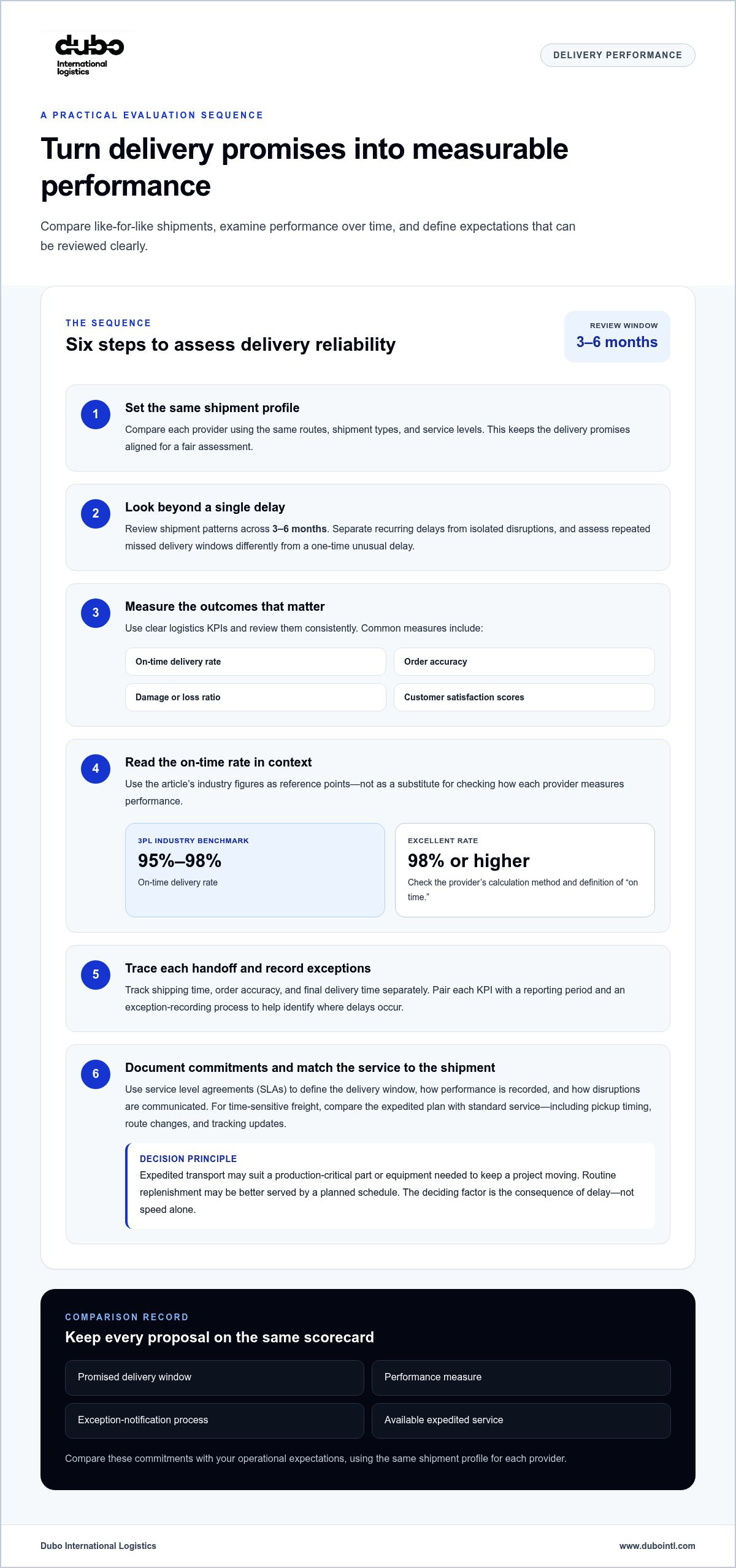
A delivery promise is useful only when performance can be measured against it. Compare actual transit times with the timelines quoted for the same routes, shipment types, and service levels. Review shipment patterns over 3-6 months to distinguish recurring delays from isolated disruptions. For example, a route that regularly misses its delivery window needs a different assessment from one affected by a single unusual delay.
Set clear measures before selecting a provider. Common logistics KPIs include on-time delivery rate, order accuracy, damage or loss ratio, and customer satisfaction scores. An industry benchmark for a 3PL’s on-time delivery rate is 95%-98%; an excellent rate is 98% or higher. Treat these figures as reference points, then examine how the provider calculates its results and whether the same definition of “on time” applies to your shipments.
Delivery performance also depends on accuracy at each handoff. Track shipping time, order accuracy, and final delivery time separately so you can trace a late arrival to its cause. A shipment may leave on schedule but arrive late after a transfer delay, for example. Pair each KPI with a reporting period and a process for recording exceptions. This helps your supply chain review identify patterns rather than rely on impressions.
Use service level agreements (SLAs) to document measurable expectations. Specify the promised delivery window, how performance is recorded, and how disruptions are communicated. Include damage rates and response times when they affect your operation. A clear SLA makes provider capabilities easier to compare and supports a practical performance review.
For time-sensitive freight, ask how shipments are prioritized and what expedited options are available. Compare the stated transit plan with the standard service, including pickup timing, route changes, and tracking updates. Expedited transport may suit a production-critical part or equipment needed to keep a project moving, while routine replenishment may be better served by a planned schedule. The deciding factor is the consequence of delay, not speed alone. Explore expedited transport options when a shipment’s timing calls for dedicated attention.
Before finalizing a provider comparison, use the same shipment profile for each proposal. Record the promised delivery window, performance measure, exception-notification process, and available expedited service. Compare those commitments with your operational expectations. This disciplined approach helps you select a partner whose delivery plan supports your business without treating every shipment as urgent.
3. Geographic coverage and cross-border shipping
Compare Canadian 3PL providers by mapping their services, carrier networks, destination coverage, and experience with your cargo type. For each proposal, assess whether the network reaches your actual origin and delivery points efficiently, including cross-border handoffs relevant to your route.
Start with a route map. Mark where freight is collected, transferred, and delivered, then identify the carrier responsible for each leg. A shipment between Canadian provinces may need a different network from freight travelling between Canada and the United States. Broad service-area claims matter only when they cover your actual routes.
Distinguish local reach from national coverage. Ask whether the provider can coordinate pickups and deliveries in the specific communities your business serves, including locations outside major centres. A network serving urban destinations, for example, may not meet a delivery requirement in a remote community. Check how each transfer is managed and how shipment information passes between carriers.
Cross-border routes need clear coordination at each transition. Compare how providers plan the Canadian and United States legs, communicate handoffs, and manage route changes. For freight moving from Canada to the United States, establish who coordinates each transport segment and keeps your team informed. This can reveal gaps that a map alone may miss.
Compare transport options against the cargo itself. Standard pallet freight, oversized machinery, and fragile equipment can require different equipment and carrier expertise. Match each proposal to your shipment dimensions, handling needs, pickup conditions, and destination access. The most efficient network is the one suited to the freight, not simply the one with the widest advertised reach.
Industry expertise also affects network fit. Compare providers’ experience with similar cargo, operating conditions, and delivery requirements. A provider coordinating delicate equipment, for instance, needs carriers and handling plans suited to that freight. Ask how the provider selects a carrier for specialized shipments and coordinates the route if a transfer point or equipment need changes.
Assess network resilience with practical route scenarios. Ask what happens if a regular carrier cannot serve a route, a transfer point changes, or seasonal demand affects capacity. Consider freight with a Canadian pickup and a cross-border destination. The provider should explain how it will maintain coordination and communication across the route.
4. Pricing, surcharges, and billing
A provider’s written proposal should clarify the work before operations begin. Compare what each service description covers, including shipment preparation, coordination responsibilities, required equipment, and delivery handoffs. A machinery shipment, for example, may need a defined loading plan and clear communication between the shipper, carrier, and receiving site. A clear scope helps your team understand what will happen at each stage.
Record the assumptions behind the proposed service, including cargo dimensions, handling instructions, pickup conditions, destination access, and delivery constraints. Changes to a shipment’s dimensions or requirements can affect the transport plan. A shared shipment profile gives the provider and your operations team a common planning reference and reduces the chance of overlooking important requirements.
Clarify who owns each task. Identify who supplies shipment details, coordinates pickup, communicates route updates, and manages delivery documentation. If the receiving site changes its appointment window, for example, the proposal should explain how that information reaches the people coordinating the move. Defined responsibilities help prevent gaps between your team and the logistics partner.
Discuss how the service adapts when operating conditions change. A revised pickup location, altered delivery access, or different cargo configuration may require a new plan. Ask how changes are documented, approved, and communicated before the shipment proceeds. This creates a consistent decision process and helps prevent teams from acting on outdated instructions.
Review the proposed operating procedures alongside your internal workflow. Note which shipment documents your team must provide, when the information is needed, and how completed documents are returned. A receiving team, for instance, may need delivery confirmation before closing its shipment record. Aligning these steps in advance can reduce follow-up and support accurate internal records.
Clarify the agreement’s duration, review process, and flexibility as business needs evolve. Seasonal changes in shipment volume or a new cargo type may require adjustments to responsibilities or handling instructions. Establish how both parties will review the arrangement and record approved changes. This gives your team a structured way to keep the service aligned with actual operations.
Before selecting a provider, compare each proposal’s scope, assumptions, responsibilities, change process, and documentation requirements. Look for clear language that explains the work without leaving key tasks open to interpretation. A well-defined operating arrangement helps your team coordinate shipments consistently and gives the logistics partner a precise basis for carrying out the plan.
5. Sustainability, certifications, and compliance
Assess a provider’s processes against your freight, routes, and associated risks. In Canada, requirements can vary by cargo type and transport mode, so compare how each provider identifies applicable regulations, assigns responsibilities, and maintains shipment records. A shipment with special handling needs, for example, calls for procedures that address its specific risks, not a generic compliance statement.
Certifications can help you understand a provider’s management systems, but they don’t replace operational evidence. According to the International Organization for Standardization, ISO 9001 is a quality management certification for logistics providers. Ask how quality processes apply to booking, handoffs, document control, and corrective action. A practical example is reviewing how a provider records and addresses a repeated delivery or handling issue.
Environmental management is another factor. According to the International Organization for Standardization, ISO 14001 is an environmental management certification for logistics providers. Ask how its environmental processes apply to transportation operations, and how progress is measured. A certification should connect to documented practices, such as how environmental objectives are reviewed, rather than stand alone as a logo in a proposal.
For safety and insurance, ask how carriers are selected and monitored. Review the vetting process for safety records, driver training, vehicle maintenance, hours-of-service compliance, and insurance coverage. Confirm that coverage aligns with your freight and its handling requirements. For a fragile shipment, clarify how cargo protection and loss or damage claims are handled throughout transit.
Match compliance controls to the goods being shipped. Ask how the provider identifies shipment-specific requirements, checks carrier capability, and keeps relevant documentation with the shipment. If you ship dangerous goods, the provider’s process should address applicable Canadian requirements and carrier qualifications. For temperature-sensitive cargo, ask how handling instructions and any required condition records are coordinated between transport stages.
Certifications can involve reviews of a logistics company’s practices. Ask what the certification covers in the proposed service and how security procedures apply to your route. For Canadian and cross-border freight, compare how the provider manages handoffs, documentation, and communication when a shipment’s route or handling plan changes.
Complaint handling shows whether documented processes work under pressure. Ask how a loss, damage, or service complaint is logged, assigned, investigated, and resolved. An industry benchmark for complaint resolution is under 24-48 hours. Compare that benchmark with the provider’s stated process, including how it communicates progress and records corrective actions after a claim.
Use these questions to assess whether compliance practices fit your cargo and operating needs. For shipments requiring particular equipment or handling, consider specialized transport planning as part of the evaluation.
Dubo International Logistics: Freight forwarding
Dubo International Logistics coordinates freight forwarding for shipments that require careful planning across routes, carriers, or handling needs. Its logistics consulting can help clarify service requirements and operational priorities. Specialized transportation services address distinct cargo needs, including oversized machinery, delicate equipment, and temperature-sensitive products.
Turn to Dubo when a shipment calls for more coordination than a routine move, or when you need a logistics plan shaped around your cargo and delivery requirements. Share the shipment profile, route, timing expectations, and handling considerations to begin a focused discussion about the right approach.
To discuss your logistics requirements, contact Dubo International Logistics or visit www.dubointl.com.
Put your logistics decision into practice
Knowing how to evaluate logistics providers is most useful when your criteria guide day-to-day decisions, not just the initial selection. Turn your priorities into a practical working document: clarify who owns shipment information, who handles exceptions, and how your team will review whether the arrangement still fits as operations change. This gives internal teams a shared reference and keeps logistics decisions connected to business needs.
Start with a representative shipment or route. Document the requirements, responsibilities, and communication steps your team expects, then use what you learn to refine future planning. A clear operating picture can help you approach complex freight requirements with confidence and make informed adjustments as your supply chain evolves.
Dubo International Logistics supports businesses through freight forwarding, logistics consulting, and specialized transportation services. Contact Dubo International Logistics today to discuss your logistics requirements and identify a considered next step.
Frequently Asked Questions
Do They Offer Customized Solutions?
Many logistics providers tailor coordination to a shipment’s requirements, but the scope varies. A manufacturer shipping delicate machinery may need different equipment and handling from a business sending routine pallets. Define the cargo, route, delivery window, and special handling needs before comparing options. Dubo International Logistics offers logistics consulting and specialized transportation services for distinct cargo requirements.
How can a company verify a 3PL’s performance claims instead of taking them at face value?
Compare claimed results with shipment-level records and consistent reporting definitions. Select a sample of completed shipments, for example, and match promised delivery dates against proof of delivery, recorded exceptions, and damage reports. Ask whether cancelled or rescheduled shipments are included in the provider’s calculations. A clear audit trail helps distinguish a reliable performance pattern from a headline figure that lacks important context.
What benchmarks matter most when evaluating a 3PL partner?
Choose benchmarks that reflect your operation’s priorities, then define how each is measured. A business serving production lines may emphasize dependable arrival windows, while a distributor may focus more on order completeness and damage claims. Review the reporting period and shipment type behind each benchmark. Comparing like with like gives managers a more useful basis for decisions than relying on a single overall score.
What criteria should businesses use to evaluate logistics providers?
A practical way to evaluate logistics providers is to score each proposal against the same operating requirements. Include cargo suitability, route coverage, shipment visibility, delivery performance, billing clarity, safety practices, and communication during exceptions. Then add a scenario your team has faced, such as a changed pickup time or damaged item. The response can show how well the proposed process supports your actual workflow.
How do logistics providers price services, and what fees should you compare in Canada?
Providers may structure charges around the shipment, route, equipment, service level, or extra handling required. Compare the base transportation charge with applicable surcharges, waiting time, truck ordered but not used charges, and other accessorial items. In Canada, request a written explanation of when each charge applies and what documentation supports it. Compare invoices using the same shipment details, and review payment terms and error-resolution procedures.
How can you assess a logistics provider’s on-time delivery, order accuracy, and damage rates?
Use shared definitions and review records for comparable shipments. For on-time delivery, agree whether the measure uses the scheduled appointment or another promised window. For accuracy, compare shipment contents and quantities against the order. For damage, review claims alongside delivery records and route details. These distinctions help show whether a trend comes from transport, order preparation, or a particular handoff.
What technology and integrations should a logistics provider offer?
Technology should support how your team books, monitors, and reconciles shipments. Ask whether updates can enter your existing ERP through API, EDI, or a supplier portal, and identify who handles exceptions when data fails to transfer. A useful demonstration follows one shipment from booking to delivery, showing what your dispatch, customer-service, and finance teams can access.
What Canadian licensing, insurance, and regulatory requirements apply to logistics providers?
Requirements depend on the transport mode, route, cargo, and provider’s role in the shipment. Evaluate whether the carrier’s operating authority and insurance align with the service and freight involved, and whether relevant safety and cargo-handling processes are documented. For cross-border or dangerous-goods shipments, identify the applicable requirements and the party responsible for each document or compliance step before dispatch.

