

Cargo safety starts before a shipment moves, not only while it is in transit. Knowing how to ensure cargo safety means securing the load properly, distributing and stacking it for stability, and choosing protection suited to the cargo.
Those fundamentals are essential, but the details matter. Fragile equipment, temperature-sensitive goods and oversized machinery each have different handling needs. Safe transport depends on planning for those requirements from loading through delivery.
This guide explains how drivers and logistics teams can reduce the risk of cargo shifting, falling or being damaged. It covers securement checks, load distribution, stacking and dunnage, as well as ways to build cargo-handling knowledge and track shipments. It also explains why cargo-specific needs should shape the transport plan from the outset, so each shipment gets attention suited to its size, condition and handling requirements.
Key Takeaways
- Secure loads on all sides with suitable straps, netting or other restraints, then check for shifting and exposure to wind before departure.
- Distribute weight evenly and keep heavy cargo low; use suitable dunnage, bracing or separators to limit movement in transit.
- Train cargo-handling staff to follow safe lifting and loading procedures, use equipment correctly and avoid shortcuts.
- Use shipment tracking and organized digital documentation to follow cargo movement and reduce the risk of misplaced freight.
- Plan securement around the cargo’s specific needs, including protection for fragile items and suitable temperature control for perishable goods.
How can a professional logistics provider ensure that your cargo is secured safely?
Cargo insurance can protect a shipment’s declared value, subject to policy limits, exclusions and deductibles. Available protection depends on the cargo and shipment details; no single policy suits every load.
Securement is a road-safety measure, not just a way to protect goods. About 850 people are killed each year in crashes involving objects in the road, and almost 19,000 are injured. A shifting load can destabilize a vehicle, obstruct traffic or spill cargo onto the roadway. Falling items may also damage property and put other road users at risk.
For Canadian drivers, the applicable rules matter. National Safety Code Standard 10 addresses cargo securement, and British Columbia sets specific requirements under that standard. Cargo must be restrained against dropping, shifting, leaking, spilling, blowing or falling from the vehicle. A professional plan accounts for the load, vehicle and route, rather than relying on a single restraint method.
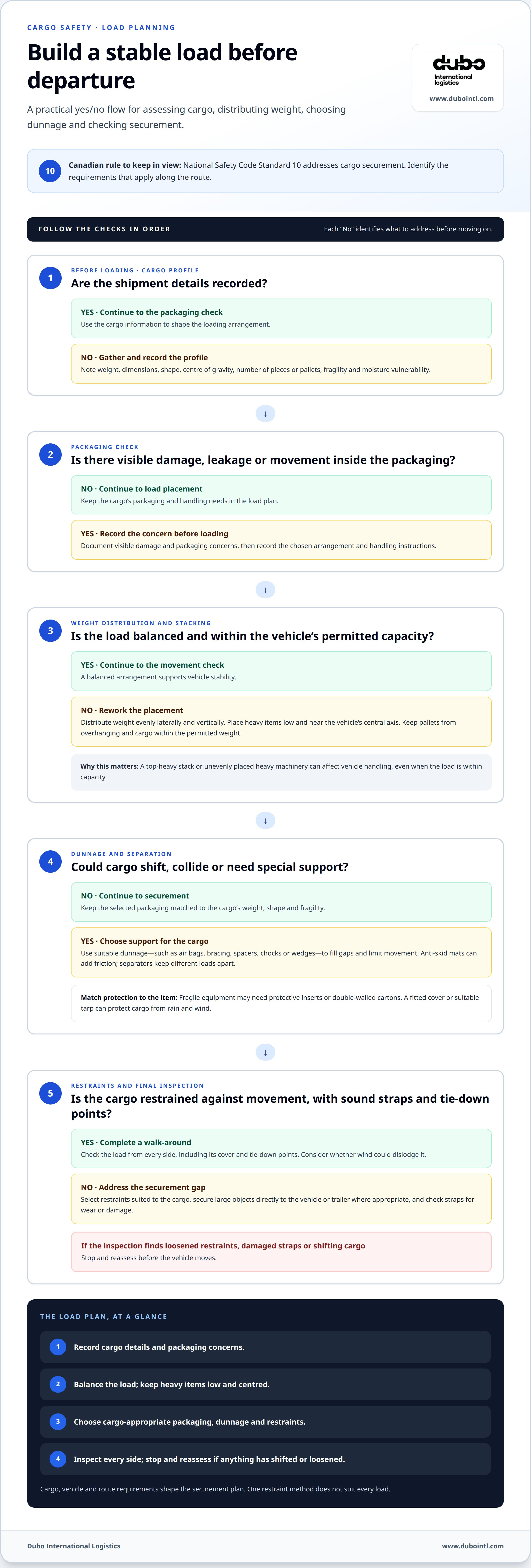
Choose sound straps, ropes or netting suited to the cargo, and secure large objects directly to the vehicle or trailer. Where appropriate, cover the full load with a sturdy tarp or net. Separators keep distinct items apart, while restraints on all sides limit movement. Before departure, inspect the securement and check straps for wear or damage. Consider whether wind could dislodge the load.
Placement matters as much as restraint. Position heavy cargo low and near the vehicle’s central axis to help maintain stability. Keep the load within the vehicle’s permitted capacity and distribute it to avoid making the vehicle unstable or difficult to control. Heavy machinery placed high or unevenly, for example, can raise the centre of gravity and affect handling even when the straps are tight.
A logistics provider can coordinate checks before the vehicle moves. These may include reviewing cargo dimensions and weight, selecting suitable securement, and confirming the load’s position and restraint points. Loading teams should use appropriate equipment and protective gear, stay clear of suspended cargo, and communicate the loading path. Clear labels showing destination, weight and handling instructions also support correct handling at transfer points.
If an inspection reveals loosened restraints, damaged straps or shifting cargo, drivers should stop and reassess. A final walk-around checks the load from every side, including the cover and tie-down points. These practical steps help reduce preventable hazards and keep cargo secure from loading through delivery.
2. Load distribution, stacking and dunnage
Weight placement, packaging and restraint work together. A sound strap cannot correct a poorly balanced load, and suitable dunnage cannot make cargo stable if it is stacked beyond its base. Before selecting a loading arrangement, a logistics provider assesses the shipment’s weight, shape, fragility and packaging.
Under Canada’s National Safety Code Standard 10, cargo securement must prevent loads from shifting, moving or spilling onto the roadway. The standard sets requirements for securing cargo to commercial vehicles; the load plan must account for the cargo and how the vehicle will carry it.
Before loading, the provider should gather key shipment details and inspect the cargo and packaging. The assessment should establish:
- The cargo’s weight, dimensions, shape and centre of gravity.
- Whether packaging shows structural damage, leakage or movement inside.
- How many pieces or pallets need restraint, separation or special support.
- Whether the cargo is fragile, unevenly shaped or vulnerable to moisture.
- The vehicle’s permitted capacity and the available securement points.
Record visible damage and packaging concerns before loading, then document the chosen arrangement and handling instructions. This gives the loading team a clear reference and supports checks at delivery.
For stability, distribute weight evenly, both laterally and vertically, and place heavy items low and near the vehicle’s central axis. Keep cargo within the vehicle’s maximum permitted weight. Pallets should not overhang: unsupported edges can catch, crush or shift during movement. A top-heavy stack can affect vehicle handling even when the total load is within capacity.
Match packaging to each item’s weight, shape and fragility. Fragile equipment, for example, may need protective inserts or double-walled cartons. Dunnage such as air bags, bracing, spacers, chocks or wedges fills gaps and limits movement. Anti-skid mats can add friction beneath cargo, while separators keep different loads apart. Choose materials to suit the cargo instead of applying the same method to every shipment.
Weather and access risks also shape the loading plan. A fitted cover or suitable tarp can protect cargo from rain and wind, while sealed packaging can reduce moisture exposure. To address theft or tampering risks, plan controlled handoffs, secure closures and shipment monitoring suited to the route—where vehicle security specialists like Lock and Track demonstrate the value of dedicated tracking and immobilisation systems. These controls reduce exposure but do not replace sound packaging or securement.
Unsecured-load violations can have enforcement consequences, but penalties depend on the jurisdiction and circumstances. Identify the requirements that apply along the route and document the securement plan rather than assuming one province’s rules apply everywhere. Logistics consulting can help assess shipment-specific decisions and coordinate a consistent plan from loading onward.
3. How can I learn about safe and effective cargo securement practices?
Effective cargo securement depends on trained people following consistent procedures. Training should reflect the work: handling boxed freight calls for different practical instruction than positioning heavy machinery. In either case, staff need to understand how their decisions affect cargo stability, equipment safety and nearby workers.
A structured program covers lifting techniques, handling equipment, site safety and emergency procedures. Staff learn to recognize unstable loads, identify damaged packaging and stop work when conditions become unsafe. If a pallet leans during a lift, for example, pause and reassess rather than rushing to finish loading.
Training should include supervised practice with the equipment and cargo types staff handle. A trainer can demonstrate how a lift’s position affects balance, then observe workers applying the procedure. Teams should also practise communicating about the loading path, keeping people away from suspended cargo and identifying a safe shelter position if a load falls.
- Match lifting equipment to the cargo’s weight, size and fragility.
- Use equipment correctly and maintain it under applicable rules.
- Wear personal protective equipment suited to the handling task.
- Keep workers clear of hoisted cargo and communicate its movement path.
- Stop handling cargo when poor visibility or another hazard compromises safety.
Procedures turn training into reliable daily practice. Before work begins, inspect the loading area for uneven surfaces, congested access or faulty equipment. Staff should know whom to alert when they find a hazard, how to describe the unsafe condition and how to propose a practical response. Shortcuts, such as using damaged equipment or working in poor visibility, can undermine otherwise sound securement.
Refresh instruction when cargo, equipment or work methods change. A shipment of delicate equipment, for example, may require different lifting points and handling controls from familiar palletized goods. Supervisors can review incidents and near misses with the team, clarify the relevant procedure and observe whether staff apply it consistently. Training records can document completed instruction, equipment topics and required follow-up.
Professional advice can help interpret a shipment’s cargo-protection needs and applicable securement practices. Logistics and transport professionals can review cargo characteristics, loading conditions and the planned movement, then recommend practical handling methods. This is particularly useful when freight is unfamiliar or site conditions change. Industry providers such as Right Way Transport Training illustrate how professional driver education reinforces proper load awareness, securement principles and on-road safety. A consistent training program, supported by clear procedures and ongoing observation, helps staff make safer decisions at each loading stage.
4. Cargo tracking and management systems
Tracking adds visibility after cargo leaves the loading point. A cargo management system can show shipment location in real time, organize digital documents and reduce the risk of misplaced freight. These functions help logistics teams coordinate each movement and keep a shared record of shipment progress.
Useful tracking starts with clear shipment information. The system needs to connect the cargo to identifying details and its planned movement, so each update refers to the correct shipment. A shipment reference linked to its destination and handling instructions, for example, helps teams distinguish similar consignments during transfer.
Digital records can bring key shipping documents and status information together. Staff can use them to follow important milestones, such as collection, movement between transport stages and delivery. This shared view can help identify a missed update or a delay that needs coordination, rather than relying on scattered messages and paper records.
A well-organized process also defines who records and reviews updates. Assign responsibility for entering shipment information, checking status changes and recording delivery details. Clear ownership reduces the chance of an unrecorded handoff and gives the people coordinating transport a consistent basis for discussing progress.
- Link each shipment record to its identifying details and destination.
- Keep digital documentation organized with the relevant shipment information.
- Record movement updates at key transport handoffs.
- Review status information and address missing or inconsistent entries.
- Capture delivery details to close the shipment record.
Tracking records support cargo safety, but they do not physically restrain a load. A location update alone cannot show whether cargo has shifted, packaging has been damaged or a restraint has loosened. Treat tracking as one part of shipment management, alongside secure loading, appropriate handling and clear communication between transport stages.
For sensitive shipments, identify which information needs attention during transit. A temperature-sensitive product, for example, may require suitable temperature-controlled packaging; location information alone does not establish that it stayed within its required conditions. The cargo’s handling needs should shape both the transport plan and the information teams record.
Consistent shipment records also make it easier to review what happened at each handoff. If delivery arrives with visible damage, the documented movement history can help teams focus their investigation. Combining location tracking with organized digital documentation improves visibility, supports coordination and reduces the chance of losing track of freight.
5. Cargo securement requirements by cargo type
No single securement method suits every shipment. Cargo shape, weight, fragility, packaging and environmental needs all affect the plan. For teams deciding how to ensure cargo safety, start by identifying the risks specific to each shipment, then match protection and handling to those risks.
Fragile equipment needs protection from impact and movement. The handling plan should account for vulnerable components, stable support and protective packaging, such as inserts or customized crating. Consider how lifting and transfer points affect the item, too. A delicate instrument, for example, may need controlled handling at every handoff, not just secure placement inside the vehicle.
Oversized machinery presents a different challenge. Its dimensions, weight and shape influence the transport arrangement and restraint points. Before moving it, establish how the machinery will be supported, restrained and handled during loading and unloading. Heavy assemblies may require specialized transportation planning, with the cargo’s centre of gravity and the equipment needed to move it as central considerations.
Perishable goods may require insulation and temperature-controlled packaging. The shipment plan should identify the product’s temperature needs and choose packaging suited to the journey. For example, a shipment of perishable food needs protection that addresses temperature exposure, while location tracking alone cannot show whether the goods remained within suitable conditions.
Bulk cargo requires controls that account for its movement during loading and transit. Close supervision matters, including having someone watch workers in the hatch at all times. Coordinate the loading sequence and keep personnel informed about the cargo’s movement. These precautions address risks that packaged freight may not present in the same way.
Dangerous goods require cargo-specific handling and applicable regulatory markings. Labels should identify handling instructions and relevant markings so people handling the shipment can recognize its requirements. Packaging, documentation and securement must work together: a label cannot replace suitable containment or safe loading practices.
A practical framework for how to ensure cargo safety starts by identifying what could be damaged, shifted, exposed or mishandled. The transport team then matches packaging, restraints, handling equipment and shipment records to those risks. In mixed loads, items may need separation or distinct protection, even when they share a vehicle. At delivery, assess visible damage, leakage or packaging shifts against the shipment’s recorded condition before accepting the handoff.
The central principle is simple: plan around the cargo, not a generic load category. Temperature-sensitive products, fragile machinery and bulk freight each call for different handling decisions. Logistics consulting can help coordinate those requirements in a shipment plan, particularly when a movement combines unusual dimensions, delicate components or specific environmental needs.
Dubo International Logistics
Dubo International Logistics helps businesses plan cargo movements that require securement, handling and shipment coordination to work together. Its freight forwarding, logistics consulting and specialized transportation services support shipments such as oversized machinery, fragile equipment and temperature-sensitive products.
Turn to Dubo when a shipment’s dimensions, handling needs or route call for coordinated planning. The team can help align cargo requirements with the transport plan across North America. Learn more at www.dubointl.com.
Contact Dubo International Logistics to discuss your cargo movement needs.
Make cargo safety part of every shipment plan
Knowing how to ensure cargo safety is not a one-time decision. Shipment details, handling conditions and transport routes can change, so safety planning should adapt. Treat each new movement as an opportunity to align cargo needs with a clear, practical plan before transport begins.
For businesses moving unusual, delicate or time-sensitive freight, coordinating the shipment can be just as important as individual securement decisions. A logistics partner can connect those requirements, keep the plan focused on the cargo and support informed choices throughout its movement.
When you’re ready to discuss a shipment or its handling requirements, contact Dubo International Logistics. A considered plan is a strong place to start, and the right coordination can help your next shipment move with greater confidence.
Frequently Asked Questions
How can you assess a provider’s safe and effective cargo securement practices?
When choosing a provider, look for a clear approach to different freight, loading conditions and routes. Ask about procedures for documenting cargo condition, communicating handling instructions and responding to damaged packaging or equipment concerns. A useful discussion should explain how the provider would handle a specific shipment, such as a fragile machine or mixed freight, rather than rely on a generic assurance that every load is treated the same way.
How do cargo handling companies ensure shipment safety?
Cargo handling teams coordinate people, equipment, packaging and shipment information around each movement. Before moving a crated machine, for example, the team needs to understand its handling instructions and ensure the lifting equipment suits the item. Clear communication at handoffs helps maintain consistent handling as cargo changes transport stages. Organized records can also help teams track shipment status and document what happened during the movement.
What are some common reasons for improperly secured cargo that would result in viable claims for damages?
Damage may be associated with inadequate restraint, unsuitable packaging, poor load balance or handling that conflicts with cargo instructions. Whether these circumstances support a claim depends on the policy, shipment documents and evidence linking the damage to transport. Useful records include condition reports, photographs, delivery notations and communications about damage. Document the condition promptly and preserve relevant shipment records for the claims process.
What key steps should a logistics provider take for safe cargo handling?
First establish the cargo’s characteristics and handling requirements, then coordinate appropriate equipment, packaging and movement instructions. Communicate those instructions to everyone involved and record significant shipment handoffs. At delivery, compare the received condition with the shipment documentation and note visible discrepancies. This sequence helps maintain continuity from planning through handling and receipt.
What is efficient cargo handling and why is it important?
Efficient cargo handling moves freight through planned handoffs with suitable equipment, clear instructions and organized records. Avoidable delays, repeated handling and unclear responsibilities can disrupt a shipment and increase opportunities for damage. Coordinating lifting equipment before a large machine arrives, for instance, helps the team prepare for its transfer. Efficiency should support safe movement, not encourage rushed handling or shortcuts.
How should a logistics provider choose the right cargo restraints, straps, chains, and packaging?
Match restraint and packaging choices to cargo weight, dimensions, shape, fragility and handling requirements. Consider the vehicle’s securement points and whether items need separation or added cushioning. A boxed fragile component, for example, may need protective inserts, while irregular machinery calls for a plan suited to its form. Restraints must suit the load and be in serviceable condition.
What are the Canadian regulations for cargo securement on commercial vehicles?
Canadian jurisdictions follow National Safety Code Standard 10 for cargo securement. In British Columbia, the standard sets specific requirements intended to prevent cargo from shifting, moving or spilling onto the roadway. Requirements can depend on the route and cargo, so the transport plan must account for applicable jurisdictional rules. The practical objective is to keep cargo from becoming a road hazard or affecting vehicle stability.
