

The carrier with the broadest network is not automatically the best choice for every shipment. To understand how to find the best LTL carrier, compare options against the specific lane, freight requirements and service needs, not just national reach.
Consider several factors together: transit times that do not fit your schedule, gaps in tracking or limited service to the destination can all affect whether a carrier meets your needs. A useful comparison looks at the full service picture and how well it matches your shipping priorities.
This guide compares national, regional and other North American LTL options across transit times, tracking, coverage and service. It also explains how freight coordination across North America can fit when a shipment calls for more specialized handling.
Key Takeaways
- Compare LTL carrier options by shipment lane, freight requirements and service needs, rather than relying on network size alone.
- Assess marketplace quotes alongside transit schedules, terminal coverage and the services included in each option.
- Review tracking and on-time performance on the specific corridor your freight will travel.
- Choose national, regional or cross-border coverage according to your shipment’s origin, destination and routing needs.
- For specialized or complex freight, consider logistics coordination that can align carrier selection with cargo handling requirements.
Which LTL Carriers Should a Logistics Provider Consider for Your Canadian Shipments?
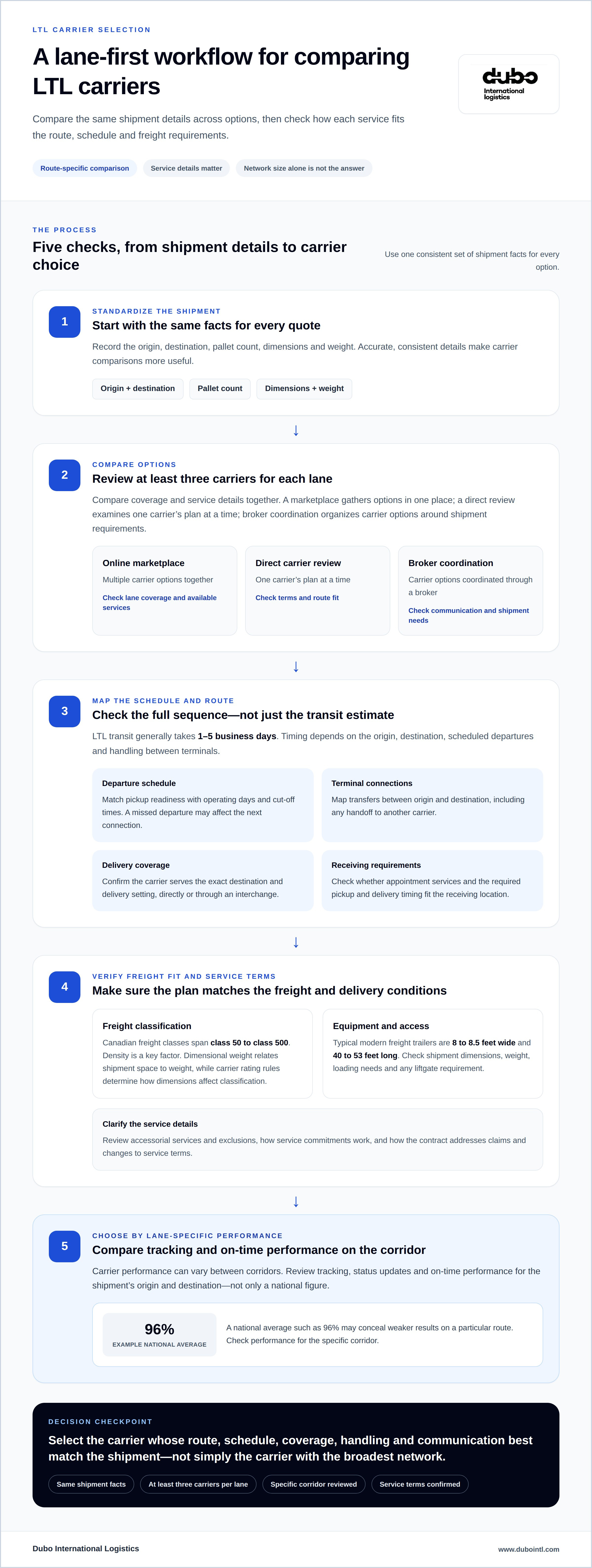
A logistics provider compares carriers by lane, shipment details and service requirements. To understand how to find the best LTL carrier, use the same shipment information for each option and assess how each service fits the route.
Online Marketplace Service Comparisons
An online marketplace can bring carrier options together for the same origin, destination and pallet details. Rather than reviewing separate service descriptions, a logistics provider can examine lane coverage and available features in one place. Focus on whether each option supports the shipment’s pickup and delivery needs, not simply whether a carrier appears in the marketplace.
Carrier Value and Customer Service
Carrier value includes the service provided before, during and after transport. A logistics provider assesses transit plans, coverage and how the carrier communicates shipment changes. It also considers how the carrier handles service issues and explains its terms. For freight that requires a liftgate or another accessorial service, the provider confirms that the requested handling is included in the proposed plan.
Service Information and Carrier Selection
For a useful comparison, the logistics team works from accurate origin, destination, pallet count, dimensions and weight. It compares at least three carriers for each LTL lane, then reviews transit schedules, coverage and service details together. A marketplace can make carrier information easier to review, but the logistics provider still assesses whether each network can serve the shipment’s specific route.
Carrier Criteria and Contract Questions
Canadian freight classes span class 50 to class 500, with density a key factor. Dimensional weight reflects the relationship between shipment space and weight, while carrier rating rules determine how dimensions affect freight classification. To assess how to find the best LTL carrier, a provider also asks which accessorial services or exclusions apply, how service commitments work, and how the contract addresses claims and changes to service terms.
| Option | Information compared | Evaluation focus |
|---|---|---|
| Online marketplace | Multiple carrier service options together | Lane coverage and available services |
| Direct carrier review | One carrier’s service plan at a time | Terms and route fit |
| Broker coordination | Carrier options coordinated through a broker | Communication and shipment requirements |
Choose a logistics provider that compares the same shipment details across options and clearly explains the service trade-offs.
LTL Service Schedules and Terminal Coverage
Service schedules shape the practical transit window for Canadian LTL freight. A route’s departure pattern, terminal connections and delivery coverage can matter as much as the carrier’s stated transit time.
LTL transit generally takes 1-5 business days. That range depends on the origin, destination, scheduled departures and handling between terminals. A shipment moving between connected urban terminals may follow a different schedule from freight serving a remote destination. A logistics provider maps the shipment’s lane against each carrier’s service calendar before recommending a route.
Scheduled departures show when freight can enter the carrier’s network. If a pickup misses a planned departure, the next connection may affect delivery timing. A provider checks pickup cut-offs, departure days, terminal transfers and delivery days as one sequence. For example, freight picked up late in the day may not move on the same departure as freight collected earlier.
Terminal coverage involves more than a map of service areas. The origin and destination must connect to the carrier’s operating network, and the final delivery address must fit its service pattern. A logistics provider checks whether the carrier serves both locations directly or relies on an interchange with another carrier. This distinction can reveal where schedules, handoffs or local delivery requirements may affect the shipment.
Equipment also shapes what a carrier can handle. Typical modern freight trailers are 8 to 8.5 feet wide and 40 to 53 feet long. A provider considers pallet dimensions, shipment weight and loading requirements against the equipment used on the route. It also records accessorial requirements, such as a liftgate or delivery to a location without a loading dock, so the service plan reflects the actual delivery conditions.
- Departure schedule: Match pickup readiness with the carrier’s operating days and cut-off times.
- Terminal connection: Map each transfer between origin and destination, including any carrier handoff.
- Delivery coverage: Confirm the route serves the exact destination and required delivery setting.
These checks make quotes easier to compare without treating a transit estimate as a complete schedule. A logistics provider assesses whether the service plan fits the shipment’s delivery window, route and equipment needs, then recommends the carrier whose schedule best supports the movement.
Transit times, on-time performance, and shipment tracking
Canadian LTL carriers differ by lane, terminal connections and delivery coverage. LTL transit generally takes 1-5 business days, while on-time performance can vary between corridors. A national average, such as 96%, may conceal weaker results on a particular route, so the logistics provider compares performance for the shipment’s origin and destination.
Pickup, delivery, tracking and appointment services depend on the carrier and shipment. The provider compares the required pickup date with the carrier’s schedule, then checks whether delivery appointments and status updates fit the receiving location. Tracking should show key shipment events and an estimated arrival time, helping the shipper respond if a connection changes or delivery needs coordination.
Customer support matters when tracking shows a delay, missed pickup or other exception. The provider assesses how the carrier communicates updates, who handles service issues and how the right contact can respond. For example, if a delivery appointment changes, clear escalation steps help the receiving team adjust its schedule and prepare for the freight.
Before booking Canadian LTL freight, the logistics provider reviews the carrier’s insurance documents, liability limits, exclusions and claims process. It compares those terms with the shipment’s declared value, packaging and handling needs. The provider also clarifies how to document visible damage at delivery and which records support a claim, rather than treating general liability coverage as full cargo protection.
To assess safety and reliability, the provider reviews carrier safety information, lane-specific on-time results and customer feedback together. Reviews can reveal recurring issues, while performance records show whether those issues affect the relevant corridor. No single rating replaces a route-level assessment, especially when freight needs special handling or has a fixed delivery window.
A pilot can test service before significant volume moves to a carrier. The provider arranges a 5-10 shipment pilot, then compares actual pickup timing, tracking updates, delivery performance and shipment condition with the planned service. This gives the shipper practical evidence about how the carrier performs on the lane, rather than relying only on a competitive quote or broad network claims.
- Coverage: Compare service for the exact origin, destination and delivery setting.
- Tracking: Review event updates, arrival estimates and issue escalation.
- Protection: Match insurance terms and claims procedures to cargo requirements.
Service may include scheduled pickup, delivery appointments, shipment updates and tracking of key events with an estimated arrival time. Availability depends on the carrier and shipment, while support can help address delays, missed pickups and other exceptions.
One in every 80 LTL shipments resulted in a damage or loss claim in 2026. Industry research found that 86% of LTL shippers experienced damage claims in one recent year. Together, these figures underscore the value of documenting shipment condition carefully.
Is it better to use a national or regional LTL carrier?
The right choice depends on the shipment’s route, delivery points and network connections. A useful way to understand how to find the best LTL carrier is to match coverage to the lanes your freight actually uses.
National Carrier Coverage
A national carrier links multiple regions through a wider terminal network, which can simplify freight moving between provinces or across borders. For North American routes, some national carriers serve all 50 U.S. states, while others limit service to the lower 48. A logistics provider assesses Canadian origin and destination coverage separately, then maps cross-border handoffs and terminal transfers to understand the complete route.
Regional Carrier Coverage
A regional carrier concentrates its network within a defined area, making it a fit for shipments that remain within that territory. Local LTL carriers may serve areas within a 100-mile radius of major urban centres. A regional option can suit a lane between nearby communities, while freight crossing Canada may need broader coverage or a coordinated connection between networks.
Carrier Networks and Remote Areas
Network size alone doesn’t show whether a carrier serves a specific Canadian lane effectively. A logistics provider maps terminals, transfer points and delivery areas against the shipment’s origin and destination. Major destinations should be reachable overnight, while remote locations may take 1-3 days. Compare those service benchmarks against each carrier’s route schedule rather than treating them as a guarantee for every shipment.
Assess coverage by lane across Atlantic Canada, Quebec, Ontario, the Prairies and British Columbia. A carrier may list broad provincial coverage yet rely on an interchange for certain communities. The provider identifies those handoffs and considers whether direct service, a regional carrier or a coordinated network better supports the route.
- Origin and destination: Map both addresses to direct or partner service areas.
- Terminals: Identify transfers and which carrier handles each route segment.
- Reliability: Compare corridor performance, connections and delivery coverage.
- Network fit: Match regional strengths or national reach to recurring and one-time lanes.
For a shipment within one region, a regional carrier may offer the right network fit. For freight moving across multiple regions, national reach can simplify routing. Choosing between them is part of how to find the best LTL carrier: assess the full lane, including connections and final delivery, rather than relying on a map alone.
Coverage is only part of the comparison; review the protection attached to each option as well. A carrier’s network reach alone does not show how well a shipment is protected, so compare the protection offered with the shipment’s needs. These details can help distinguish a route that is practical on paper from one that fits the shipment’s requirements.
Quote availability can also offer a clue about network depth. Fewer than five carrier options for a standard lane may indicate a thin network, so limited choice may warrant closer review of connections and coverage. In the cited research, carriers covered 66% of LTL damage claims. Taken together, these points support comparing service reach, available alternatives and claim exposure before choosing a national or regional carrier.
Canadian and North American LTL carrier options
Canadian-only and North American networks differ in how they connect routes and manage handoffs. For cross-border LTL between Canada and the United States, route coordination and shipment information are important parts of carrier selection.
Canadian LTL Carrier Options
Canadian LTL carriers focus on routes within Canada, making them relevant when pickup and delivery both fall within their domestic network. A logistics provider compares service across the provinces and checks whether the carrier handles each leg directly or coordinates a transfer. For example, an Ontario-to-Quebec shipment may follow a different network path than freight travelling from Alberta to Atlantic Canada.
Domestic routing can simplify coordination when a shipment stays within Canada. The provider still compares transit plans, terminal handoffs and the carrier’s process for handling damaged freight and claims. A clear route plan helps identify which carrier is responsible at each stage.
North American LTL Carrier Options
North American options connect Canadian shipments with destinations in the United States through a broader network. The provider assesses the Canadian pickup, border crossing, U.S. delivery and any carrier interchange as one shipment plan. Some national carriers serve all 50 U.S. states, while others limit service to the lower 48, so the destination state matters.
Cross-border routing can affect the quote and service plan because carriers may differ in coverage, handoffs and information coordination. A logistics provider compares those factors with the shipment’s origin, destination and handling needs, rather than assuming a national carrier covers every route in the same way.
For either option, shipment details must support an accurate comparison. The provider aligns pallet count, dimensions, weight, pickup readiness and delivery requirements across quotes. It also clarifies who manages shipment updates, how exceptions are communicated and what records support a claim if freight arrives damaged.
- Canadian-only route: Compare domestic provincial coverage and terminal connections.
- Cross-border route: Map Canadian and U.S. service legs, border coordination and carrier handoffs.
- Claims and handling: Review the process for reporting damage and assigning responsibility across transfers.
For recurring shipments, the provider can compare domestic and cross-border options on the same lane. A route matrix can record pickup points, delivery locations, scheduled service, transfer points and claims procedures. This makes gaps visible before freight moves, especially when one network covers the Canadian leg and another completes U.S. delivery.
The practical choice is the carrier or coordinated network that fits the full lane, not simply the one with the broadest map. Match Canadian-only service to domestic freight, and assess North American options when delivery crosses the border.
Dubo International Logistics
Dubo International Logistics helps Canadian shippers turn carrier comparisons into a coordinated LTL plan. Its freight forwarding and specialized transportation services support freight moving across provincial and North American corridors, including cargo that needs specialized handling. The focus is on matching the route, carrier network and shipment requirements before arranging the movement.
For freight suited to standard pallet service, the key decision may be which carrier best serves its lane. More complex cargo can call for additional planning. Dubo coordinates specialized transportation for oversized machinery, delicate equipment and temperature-sensitive products, and provides tailored support for specialized transport projects.
Logistics consulting connects carrier selection with the wider shipping plan. A provider can assess the shipment’s origin, destination, dimensions, handling requirements and delivery schedule, then coordinate a suitable freight movement. For example, fragile equipment moving between provinces may need careful carrier coordination alongside the LTL route.
North American movements can involve several carrier connections and complex corridors. Dubo coordinates project-cargo logistics across Canada and the United States, with freight forwarding support for domestic and cross-border cargo. For specialized transportation, tracking systems and a carrier network support shipment coordination across the route.
Professional coordination can be particularly useful when:
- Routes cross regions: A shipment needs connected carrier service across provincial or North American corridors.
- Cargo needs special handling: Machinery, delicate equipment or temperature-sensitive products require a plan suited to their requirements.
- LTL is part of a larger move: Carrier selection must fit alongside other shipment and project needs.
The next step is to define the freight, lane and service requirements. Clear shipment details help shape carrier coordination around the actual cargo instead of relying on a general network match. This gives the shipping plan a practical basis, whether the move involves standard pallets or specialized project cargo.
For support coordinating your LTL shipment, contact Dubo International Logistics.
Frequently Asked Questions
What is LTL freight?
LTL freight means less-than-truckload shipping: multiple shippers share trailer space instead of booking an entire truck. It suits shipments that need more capacity than parcel service but do not fill a truckload. For example, a manufacturer sending several pallets to a retailer can use LTL service, with its freight moving through the carrier’s network alongside other shipments.
What factors should a logistics provider compare when selecting an LTL carrier in Canada?
A provider should match each carrier to the shipment’s lane, cargo and receiving conditions. Pickup access, delivery-site restrictions and shipment frequency can affect which service fits. For recurring freight, consistency on the regular route may matter more than broad network reach. The provider should also assess how the carrier communicates exceptions and manages claims, especially when several parties handle the shipment.
How do LTL freight rates in Canada work, and what affects the price?
An LTL shipment’s freight classification reflects details such as its lane, weight, dimensions and density. The carrier uses these characteristics to determine how the freight moves through its network and what handling it requires. For example, two pallets with the same weight may need different classifications if one takes up more trailer space. Accurate measurements help the carrier plan the movement appropriately.
How can a logistics provider compare LTL quotes and identify hidden fees or surcharges?
A logistics provider can compare each quote’s service scope and assumptions using identical shipment details. Review whether the plan includes required pickup and delivery conditions, such as liftgate service, residential delivery, appointments or inside delivery. Confirm that pallet dimensions, weight and handling needs are recorded accurately. Clear documentation helps reveal differences in what each carrier’s proposed service covers.
