

The lowest freight rate is not always the best shipping decision. To understand how to create a shipping strategy, define the service your shipments need, compare options for reliability and coverage, and track operating costs alongside delivery performance. A clear plan helps you decide what to ship, when to move it, and which trade-offs suit your business.
It’s reasonable to focus on freight charges when budgets are tight. But delivery time frames, shipment dimensions, packaging, carrier performance, and the impact of delays all shape the wider picture. For international shipments, rate discussions are more productive when you understand your shipping patterns and can explain the service requirements behind them.
This guide explains how to assess your operation, monitor relevant measures, set practical goals, and weigh service against cost. You’ll also learn how to prepare for international rate discussions and build a strategy you can adjust as your shipment profile changes. The result is a more deliberate approach to shipping decisions, fewer surprises, and a clearer basis for improvement.
Key Takeaways
- Set clear checkout, carrier, insurance, and returns rules so shipping decisions stay consistent from order to delivery.
- Track shipment spending alongside delivery times, service reliability, and customer feedback to spot where operations need adjustment.
- Choose measurable shipping goals, then weigh speed, service quality, and customer expectations against the resources required.
- Prepare for international rate discussions with a clear picture of shipment patterns, cargo requirements, and the service levels your business needs.
- Use packaging dimensions and shipment details to understand what drives delivery fees, and consider freight forwarding or logistics consulting for complex shipping needs.
What Is a Shipping Strategy?
A shipping strategy sets the rules for moving orders, choosing carriers, and managing delivery expectations. Choose packaging that fits each product, protects vulnerable parts, and avoids unnecessary empty space. Before dispatch, check that the packed item cannot shift inside its packaging.
-
Assess Destinations and Carrier Agreements
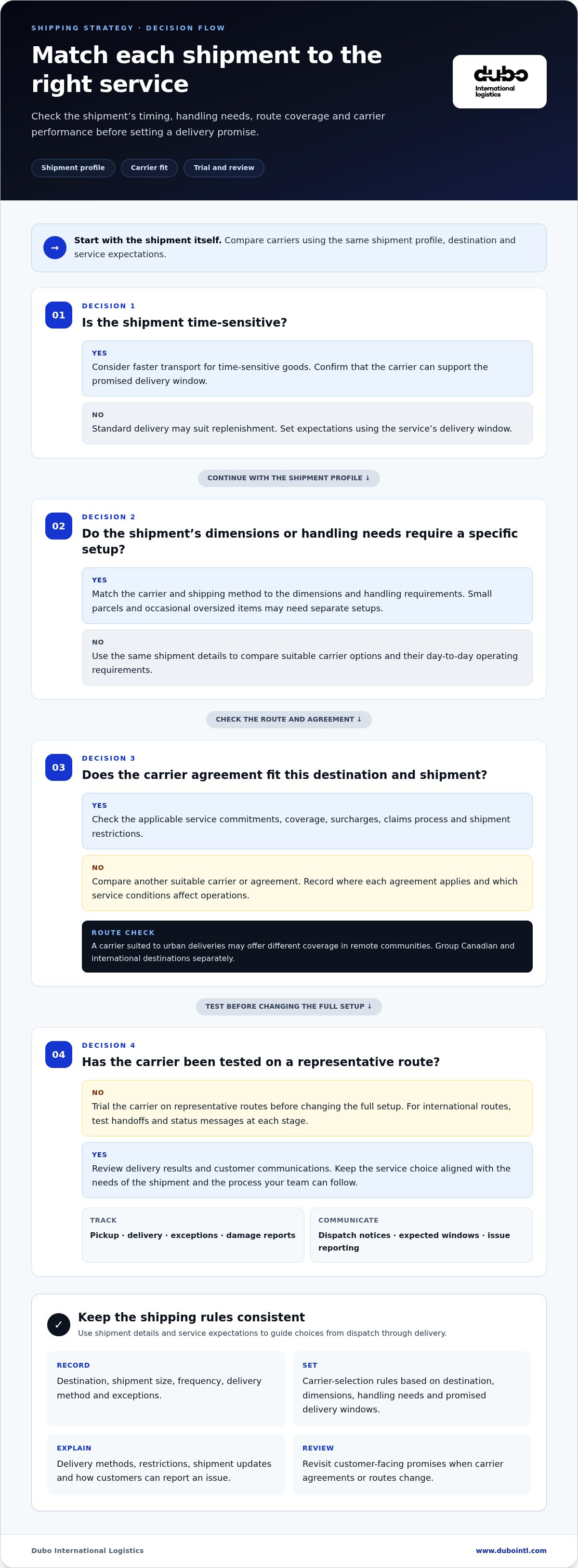
Map the destinations your orders serve, grouping Canadian and international markets separately. Compare carrier agreements for each route, including service commitments, coverage, surcharges, claims processes, and shipment restrictions. A carrier suited to urban deliveries, for example, may offer different coverage in remote communities. Record where each agreement applies and which service conditions affect your operations.
-
Audit Order Volumes and Carrier Setups
Review order records by destination, shipment size, frequency, and delivery method. Match those patterns to the carriers and account settings you already use. Look for duplicated services, unused carrier options, or frequent exceptions that require manual handling. A business shipping small parcels and occasional oversized items may need separate setups instead of one default option for every order.
-
Choose Carriers and Shipping Methods
Compare carriers using the same shipment profile, destination, and service expectations. Assess reliability, coverage, delivery windows, handling requirements, and the effort each option adds to daily operations. Match the service to the shipment: standard delivery may suit replenishment, while time-sensitive goods may require faster transport. Having several suitable carrier options can help when routes, capacity, or cargo needs change.
-
Test Carriers and Customer Communications
Trial a carrier on representative routes before changing your full setup. Track pickup, delivery, exceptions, damage reports, and whether carrier updates help you communicate with customers. Send clear dispatch notices, expected delivery windows, and instructions for reporting an issue. For shipments crossing international routes, test the handoffs and status messages at each stage.
-
Set Checkout, Insurance, and Returns Rules
Write checkout rules that explain delivery methods, restrictions, and when customers receive shipment updates. Set carrier-selection rules based on destination, product dimensions, handling needs, and promised delivery windows. Define how your business assesses insurance needs by shipment value and cargo characteristics, without implying that coverage removes every risk. For returns, specify who arranges transport, how customers receive instructions, and how returned goods are tracked.
Keep these policies aligned with revenue priorities and operating capacity. Offering expedited delivery at checkout, for example, makes sense only when the selected carrier can support the stated service. Review checkout wording when carrier agreements or routes change, so the customer-facing promise matches the process your team can follow.
Monitoring shipping costs and operational performance
Review shipment activity alongside delivery results, then use the patterns to refine service choices. Compare domestic and international orders by route, service type, and customer experience rather than reacting to isolated exceptions.
-
Calculate Shipping and Packaging Costs
Record package dimensions, shipment type, destination, handling needs, and delivery exceptions. Compare these details with damage reports and customer feedback to assess whether packaging suits the goods. A fragile item may need a fitted insert, for instance, while a durable product may travel securely in a simpler carton.
Assess the packed item before dispatch. Check for movement inside the package, exposed edges, and materials that complicate handling. Keep notes by product type so staff can use a consistent packing method for repeat orders.
-
Compare Shipping Pricing Models
Review the checkout information customers receive, including delivery methods, estimated time frames, and shipment updates. Teams learning how to create a shipping strategy can make these details easier to understand by presenting service choices clearly before checkout.
For international orders, explain that import requirements and documentation depend on the goods and destination. Give customers clear information about the shipment process and who is responsible for each required step, without suggesting that every destination follows the same procedures.
-
Balance Costs and Delivery Options
Present delivery choices that match fulfilment capacity and customer needs. Review customer selections and feedback rather than assuming one service suits every Canadian order. Show the expected delivery window for each option, then compare those expectations with actual delivery records and customer support contacts.
Delivery estimates from Canadian carriers vary by origin, destination, shipment dimensions, and selected service. Compare equivalent shipment details and routes, and explain that transit expectations can differ across destinations.
-
Rate-Shop to Reduce Shipping Costs
Review carrier performance for comparable shipment profiles and routes. Consider pickup arrangements, tracking updates, handling requirements, and delivery outcomes together. Record the service used and how exceptions were resolved. This helps teams identify routes where a service change or clearer customer communication may improve the experience.
Monitor delivery performance, exception frequency, damage reports, and customer feedback as connected measures. If you’re deciding how to create a shipping strategy, use these patterns to choose suitable services and review them when destinations or order volumes change.
Setting shipping goals and weighing trade-offs
Connect shipping objectives to business priorities, then define practical service goals. Clear priorities help staff make consistent choices as customer needs and operations change.
-
Set Strategic Objectives
Identify what shipping must support across the business. A company expanding its Canadian customer base may prioritize dependable service to new destinations. A manufacturer working to production schedules may focus on predictable arrivals that keep operations moving. State the objective plainly, then identify which teams and decisions it affects.
Align sales, customer service, and operations around that objective. Sales, for example, should understand which delivery commitments operations can support, while customer service needs a consistent way to explain shipment expectations. Shared priorities reduce conflicting instructions and help each team make decisions in the same business direction.
-
Define Shipping Goals
Turn each objective into a specific outcome your team can review. A goal might be to improve delivery reliability on a particular route or make shipment updates clearer to customers. Identify the information needed to assess progress and assign responsibility for reviewing it. Goals should describe a result, not just an activity such as changing a carrier.
Set distinct goals for order types with different needs. Replenishment orders, for instance, may call for predictable arrival windows, while time-sensitive purchases may need a faster service option. Keeping targets separate helps show whether each customer group is receiving the right service.
-
Weigh Shipping Trade-offs
Assess what each goal requires from customers and staff. Faster service may suit urgent orders, but can require earlier order processing and tighter coordination. Standard delivery may work for customers with flexible schedules. Consider how each choice affects customer experience, fulfilment routines, and your team’s ability to meet other commitments.
Use real order scenarios to test competing priorities. A customer replenishing routine supplies may value a dependable arrival window over speed. A purchase needed for a scheduled installation may depend more on precise timing. Comparing these cases helps teams choose services based on actual shipment needs.
-
Align Shipping with Growth and Inventory
Check whether shipping objectives fit inventory plans and the company’s growth direction. If orders increasingly come from distant destinations, review the effect on delivery expectations and fulfilment processes. A business aiming for shorter delivery times can consider fulfilment locations closer to its customers while evaluating the operational changes involved.
Revisit objectives when product ranges, customer locations, or order patterns shift. A new product requiring careful handling, for example, may need different service goals from established items. Regular reviews keep plans relevant, support sustainable operations, and help teams adapt as demand changes.
Negotiating international shipping rates
- Prepare a negotiation brief around the business outcome you need for each international route. Define the shipment’s handling requirements, delivery window, documentation responsibilities, and communication expectations. Separate routine movements from unusual cargo or time-sensitive shipments. This gives the discussion a clear scope and prevents unrelated service needs from being bundled together.
Bring examples of operational challenges, such as unclear handoffs or missing status updates. Specific scenarios make it easier to agree on practical improvements.
- Set out the service commitments your operation depends on. Clarify pickup procedures, milestone updates, exception escalation, and the information required at each handoff. For a shipment moving through several transport stages, identify who reports a delay and what details your team needs to respond.
Document agreed responsibilities in plain language. Avoid assuming one party will handle a task when the agreement assigns it elsewhere.
- Discuss flexibility before finalizing arrangements. Explain which shipment dates can shift, whether compatible orders can move together, and which cargo requirements cannot change. A production component tied to an installation schedule, for example, may need a different plan from routine replenishment.
Clear priorities help both parties identify scheduling options without weakening essential handling or delivery requirements.
- Agree on how international shipment exceptions will be handled. Set out what information is shared when a handoff changes, a document needs correction, or a delivery window becomes uncertain. Specify the communication channel and who is responsible for informing your team.
Test the process with a realistic shipment scenario. If the agreed steps leave a gap between parties, clarify responsibilities before regular shipments begin.
- Record the final service terms and establish a review process. Keep route scope, responsibilities, communication expectations, and exception procedures together in one consistent agreement. Track recurring service issues and bring documented examples to scheduled discussions.
Revisit the arrangement when destinations, cargo characteristics, or business schedules change. A structured review keeps international plans aligned with operational needs and gives both parties a clear basis for refining how they work together.
Shipping firms formulate interrelated strategies at corporate, business, and functional levels. Shipping strategy provides a framework for improving internal and external collaboration. Bringing route-level rate discussions into that wider framework connects service expectations with commercial priorities, rather than treating each quote as an isolated decision. Include the operational trade-offs that matter to your team and discuss how a change on one route may affect coordination across the business.
Rate comparisons also need a deliberate place in the planning cycle. Major parcel carriers increased their rates by 5.9% in 2025. Set the comparison point at Three weeks before peak season; businesses should compare carriers and rates. Use the results to revisit the scope and commitments already agreed for each lane. Compare service terms alongside quoted rates so the negotiation reflects the full operating need. Apply the same approach during reviews when business requirements shift, keeping collaboration between internal teams and external shipping partners in view.
How do you calculate shipping costs, packaging costs, and delivery fees?
Calculate the cost of each shipment using the carrier charge, packaging, handling, and delivery-related fees. Apply the same method to every order, then compare results across destinations and shipping options.
- Collect shipment details before estimating the delivery charge. Record the origin, destination, package weight, external dimensions, delivery speed, and special handling needs. Compare orders only when their routes and service requirements match. Otherwise, a different shipment profile may look like a better deal.
Use the packed shipment’s measurements, not just the product dimensions. The carton and protective materials can change the space a parcel occupies and how the carrier calculates its charge.
- Separate the carrier charge from other shipping expenses. List packaging materials, preparation labour, handling, and delivery-related fees as distinct components. Add them to the carrier charge to understand the shipment’s full operational impact. This breakdown helps identify whether packaging, service choice, or another component drives the total.
Keep records by shipment type and destination. A compact parcel travelling within Canada may have a different cost profile from an oversized item moving along a longer route.
- Measure and weigh each packed item accurately. Compare its actual weight with the dimensional weight method used in the carrier’s quote, and apply the rating basis the carrier specifies. A large, light carton can occupy more vehicle space than its scale weight suggests. Reducing excess packaging may help lower dimensional charges without compromising protection.
Choose a carton that fits the product and its protective materials. Check for movement inside the packed item and reinforce vulnerable areas before dispatch. Packaging should limit damage risk without adding unnecessary bulk.
- Check what each quoted delivery service includes. Compare equivalent routes, package details, delivery windows, pickup conditions, and additional fees. Don’t compare a basic service with a faster option as if they offer the same delivery commitments. For repeat shipments, note the service selected and compare the eventual invoice with the original quote.
For orders with several products, assess whether combining items reduces separate shipments. Compare the combined package’s dimensions and handling needs with those of sending each item independently.
- Review the calculation when shipment details change. A new carton, destination, product mix, or delivery option can alter the carrier charge and packaging requirements. Keep a record of actual billed amounts and update your estimates when repeated differences appear. For support aligning shipment details and service requirements, discuss your freight planning needs.
Dubo International Logistics: Freight forwarding
Dubo International Logistics provides freight forwarding, logistics consulting, and specialized transportation services for businesses. When shipments involve multiple routes, complex cargo requirements, or international coordination, these services can help bring the movement plan and operational details together.
A business shipping oversized machinery or delicate equipment, for example, can benefit from planning that accounts for cargo characteristics, handling needs, and transport transitions. Logistics consulting can help teams assess shipping processes, clarify service requirements, and align decisions with operational priorities. The appropriate support depends on the shipment and the challenges your team needs to address.
To discuss your shipping requirements, contact Dubo International Logistics or visit dubointl.com.
Make the next review part of your shipping plan
A shipping strategy stays useful when someone is responsible for reviewing it. Set a regular time to assess whether delivery commitments still fit your customers, products, and operating capacity. Changes in demand or shipment patterns can affect which services make sense, so treat the plan as a working tool rather than a fixed document.
If you’re deciding how to create a shipping strategy for complex freight movements, a logistics partner can connect planning with execution. Dubo International Logistics provides freight forwarding, logistics consulting, and specialized transportation services for businesses with distinct shipping requirements.
Bring your current shipping priorities and operational challenges into the next planning conversation. Contact Dubo International Logistics to discuss your freight needs and identify a practical next step. A considered plan can give your team a steadier foundation for future shipping decisions.
Frequently Asked Questions
What are the steps to create a shipping strategy for an ecommerce business?
Start by assigning an owner for shipping decisions and documenting who handles routine orders and exceptions. Map the order journey from checkout through delivery, including which team updates customers when a parcel is delayed or returned. Then test the process with a small group of representative orders. A clear responsibility map prevents gaps, such as a returned parcel arriving without anyone assigned to record or inspect it.
How can a business manage tracking, returns, lost parcels, and shipping claims?
Set a procedure for recording shipment events and escalating exceptions. For each order, keep its tracking reference, dispatch record, customer messages, and delivery evidence together. If tracking stops progressing, assign a team member to follow up and document the outcome. For a return or claim, record the parcel’s condition, relevant correspondence, and supporting shipment details so staff can handle the case consistently.
What shipping strategy metrics should an ecommerce business track?
Track measures that reveal where orders encounter friction, not just average delivery time. For example, monitor the share of orders with a tracking scan after dispatch, delivery exceptions by route, return reasons, claim frequency, and support contacts linked to shipment issues. Break results down by carrier and service type. This can show whether a problem stems from one route, a particular service, or unclear customer instructions.
How can businesses reduce shipping costs while maintaining reliable delivery?
Reduce avoidable handling and fragmented shipments before downgrading delivery service. Coordinate compatible orders going to the same destination, for example, and make sure parcels are ready for scheduled pickups. Keep an alternative carrier option for routes where performance changes, and assess results using delivery records and total shipment expenses. This targets process waste while preserving a reliable option for time-sensitive orders.
How do flat-rate, free, and real-time shipping pricing compare?
Free shipping removes the shipping charge at checkout, though a business can build shipping costs into product prices. Real-time shipment updates help customers follow deliveries, but real-time pricing is a separate consideration.
