

The services offered by freight forwarders may not cover the same shipment requirements. To compare them, give each forwarder the same cargo details, route, pickup and delivery points, then review the services included.
Service plans can differ because cargo dimensions, weight, timing and transport mode affect the approach, while carrier services and exclusions shape what you receive. Review the transit estimate, tracking and service details, and whether final delivery is included.
This guide explains what to include in a shipment brief, how to review origin, transport and destination services, and what to assess beyond the quoted service scope. You’ll also learn how to compare carrier services and check which delivery tasks are covered.
Key Takeaways
- Use consistent cargo details, routes, and collection and delivery points when planning shipments.
- Map each shipment stage to clarify what the logistics plan covers and where exclusions may apply.
- Assess transit expectations, tracking, and experience with specialized cargo when selecting a service.
- Review how insurance is addressed in the shipment documentation.
- Provide accurate dimensions, weight, packaging, and handling requirements to support a well-planned shipment.
Why do freight forwarding plans differ?
Freight forwarding plans differ when shipment details, transport assumptions or included services differ. Comparing plans starts with giving each forwarder the same shipment scope.
-
Provide consistent shipment details
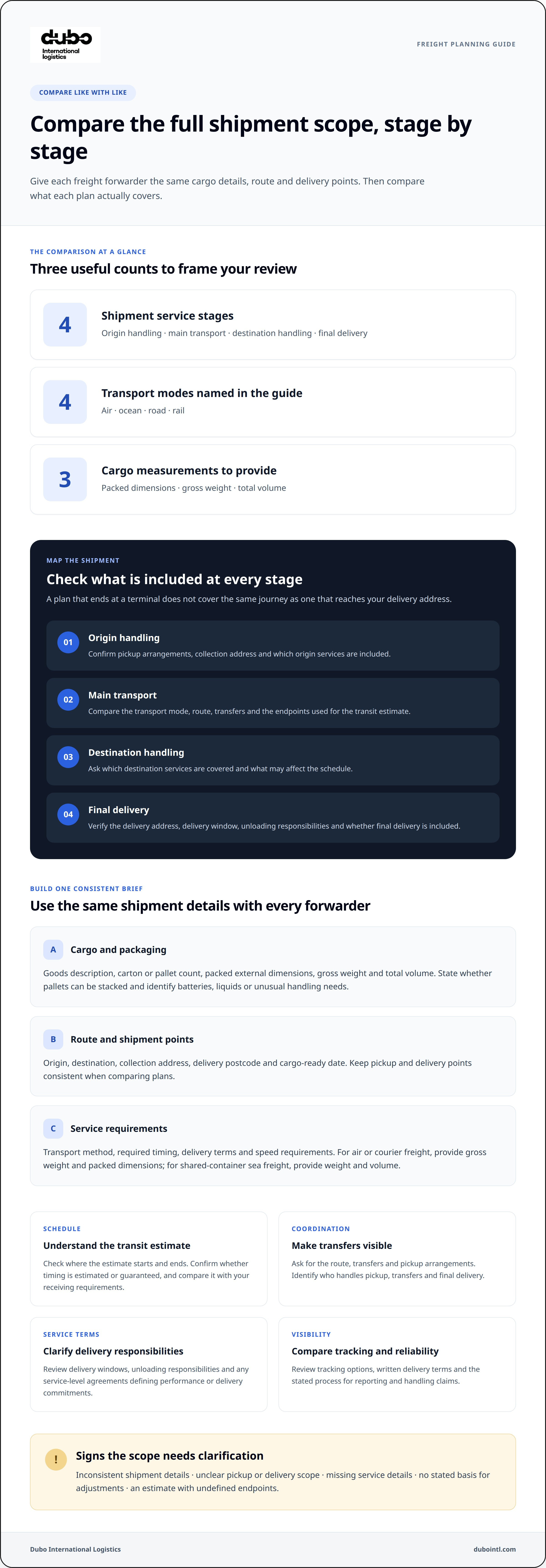
Send the same shipment brief to every forwarder: goods description, carton or pallet count, origin, destination, collection address, delivery postcode and cargo-ready date. Include the transport method, required timing, delivery terms and speed requirements. These details define the particular shipment and the services each forwarder is being asked to plan. Keep collection and delivery points consistent, since changing either can alter the route and planned services.
Ask for a breakdown that separates planned services from items that may change. Check the plan’s expiry, currency basis and adjustable items. Fuel requirements, currency adjustments and destination handling can appear differently across plans, so compare each line rather than relying on the headline summary.
-
Share accurate dimensions, weight and cargo details
Provide packed external dimensions, gross weight and total volume, not estimates for unpacked goods. Weight, volume and packaging affect freight planning. For example, a pallet’s height and footprint help distinguish it from a smaller, stackable carton. State whether pallets can be stacked and identify batteries, liquids or unusual handling needs.
For air or courier freight, provide gross weight and packed dimensions, then ask how the plan uses them. For shared-container sea freight, provide weight and volume so the transport basis is clear. For full-container freight, specify equipment type and loading assumptions. Comparing plans also means confirming they use the same cargo measurements.
-
Ask for a detailed service breakdown
Request separate lines for origin services, main transport, destination handling, final delivery and other shipment services. A detailed breakdown shows which fuel requirements, currency adjustments, handling and special services are included. Ask which services are confirmed, which may change, what triggers a change and how each adjustable item is determined.
Look for clear terms covering plan expiry, remeasurement, waiting, port delays, examination handling, redelivery and cancellation. Vague terms make the service scope difficult to compare. Ask for the applicable service terms and approval process for items that cannot be confirmed in advance. Treat the plan as incomplete until these items have a stated basis.
Warning signs include inconsistent shipment details, unclear pickup or delivery scope, missing service details and no stated basis for adjustments. The plan should identify the route, transfers and pickup arrangements, and define where its transit estimate starts and ends. This helps you assess service scope before choosing.
Origin, transport, destination and delivery details
Compare each quote by route, transport mode, shipment endpoints and included services. Air, ocean, road and rail options have different service scopes and transit times.
-
Ask how routes and transport endpoints compare
Ask for the route, transfers and endpoints covered by each quote. Compare the same origin, pickup point, destination and final delivery point: a quote ending at a terminal does not cover the same journey as one extending to your delivery address. Identify where the transit estimate begins and ends, and note any transfer that could affect the schedule.
-
Ask which transport modes and services suit your shipment
Ask which services are included for air, ocean, road or rail freight. These modes have different service scopes and transit times, so compare quotes within the same mode before weighing alternatives. If the modes differ, compare the full route and service scope, including origin handling, main transport, destination handling and final delivery.
-
Clarify schedules and delivery terms with Dubo International Logistics
Ask for the transit estimate, its start and end points, and whether delivery timing is estimated or guaranteed. Compare schedules with your receiving requirements, not just the stated duration. Review pickup arrangements, delivery windows, unloading responsibilities and any service-level agreements defining performance or delivery commitments.
- Compare the services included at each shipment stage. Record origin handling, main transport, destination handling and final delivery, then note other stated services. This makes scope differences visible, such as one quote including pickup while another starts at the departure terminal. Confirm that each quote covers the services your shipment requires.
- Compare service reliability, tracking options and written delivery terms alongside the route. Tracking and reliable service can help prevent delays, lost shipments or damaged goods, but the options may differ between providers. Review the stated process for reporting and handling claims, along with delivery requirements. For time-sensitive cargo, prioritise a clearly defined schedule over an estimate with different endpoints.
Keep a separate record of origin, main transport, destination, final delivery and other shipment services. This makes it easier to compare the full scope of each quote rather than relying on a headline summary alone.
Compare quoted transit times when delivery time matters. If on-time delivery is crucial, confirm whether the transit time is guaranteed or estimated, and consider service reliability alongside the stated schedule.
Comparing carrier services
A quote also reflects the carrier network, shipment handling and support behind the route. Compare these factors with your cargo, pickup requirements and delivery commitments.
- Review the carrier network proposed for each shipment leg. Identify who handles pickup, transfers and final delivery, especially on routes crossing provincial or international borders. Several handoffs may require different coordination from a route using a single carrier. Look for a clear account of how shipment information and status updates pass between parties.
- Match carrier experience to the cargo and route. Temperature-sensitive goods, fragile equipment and oversized machinery have different handling needs from standard cartons. Compare whether the proposed carrier network has relevant experience with the cargo, equipment and delivery conditions. A clear description of how the shipment will be managed is more useful than a general capability statement.
- Assess reliability through the service details in the quote. Compare tracking options, status-update practices, delivery commitments and the stated process for handling delays or claims. For example, a shipment with a critical receiving window needs a clear transit estimate and defined escalation steps. Reliability and tracking can help prevent delays, lost shipments or damage.
- For international freight, compare how the quote addresses shipping documents and the coordination of required documentation. Check which party coordinates each step, what services are included and where responsibility transfers. Documentation gaps can disrupt handoffs, even when transport is planned. Review the quoted scope to understand which party is responsible for each step.
- Consider reputation in the context of the shipment. Look for documented experience with comparable cargo, routes and service requirements, then weigh that evidence alongside tracking and communication arrangements. A carrier network suited to routine freight may not fit a delicate or time-sensitive shipment. Connect each carrier’s stated capabilities to your goods, pickup, delivery point and operational needs.
Perishable cargo needs a more specific review than a general statement of network coverage. Look for relevant specialist expertise and ask how it applies to the goods, route, pickup arrangements and receiving requirements. Request a clear explanation of how the proposed service addresses the cargo’s conditions, then compare it with the service descriptions in the quotes. Confirm that the party coordinating the shipment is identified and that communication and escalation arrangements are clear if plans change. If an answer relies on broad assurances, ask for details relevant to this cargo rather than assuming experience with other freight is sufficient. Focus on demonstrated relevance, the handling plan and stated commitments, not only the scope of the quoted service. This helps you judge whether the proposed service fits the shipment and your operational needs.
Reviewing Shipment Responsibilities and Insurance
International freight plans can involve several stages, from transportation to final delivery and cargo insurance. Review the shipment scope and responsibilities at each stage before the goods move.
-
Confirm delivery and final-mile responsibilities
Check how the shipment will reach its destination and who is responsible for final-mile delivery. Confirm the named delivery point, unloading responsibilities and any handling needed before the shipment reaches its destination. A shipment ending at a port or terminal follows a different plan from one that includes delivery to your receiving address.
For an international shipment, confirm which party manages each transport stage and who is responsible for the required shipping documents. Clarify what information must be provided, when it is needed and who will review it. This helps distinguish the transport plan from the documentation responsibilities of the parties involved. Beyond transport logistics, businesses managing cross-border trade often consult an international tax compliance CPA to ensure shipping declarations align with corporate tax obligations.
-
Review cargo insurance and shipment requirements
Review insurance as a separate item. A forwarder’s liability insurance does not insure the goods themselves, so assess cargo insurance independently. If an insurance option is available, identify what it covers and how it is arranged. Do not assume freight liability and protection for the shipment are interchangeable.
Consider the cargo’s characteristics when reviewing insurance needs. Fragile, sensitive or high-value goods—such as fine jewellery and gemstones from Ribacoff Diamonds—may require particular attention to their packaging, handling and transport conditions. Confirm that the planned arrangements reflect the shipment’s requirements and that relevant details are documented before transport begins.
- Build a line-by-line record of the shipment plan. Note pickup, main transport, destination handling, final-mile delivery, unloading, insurance and documentation responsibilities. For example, one plan might include delivery to the receiving address, while another ends at the destination terminal. Record the operational difference so the parties understand the service scope.
- Identify which shipment details may change after booking. Changes to cargo dimensions, handling requirements, delivery instructions or the receiving schedule can affect transport arrangements. Ask what information is needed to assess a change, who must approve it and how the revised plan will be communicated. Keep the shipment plan current as details are confirmed.
- Match every responsibility to the shipment’s delivery terms. Confirm who arranges final delivery, who handles unloading and which party provides the required documents. Use the same assumptions for each stage of the plan. This helps prevent misunderstandings about documentation, insurance or final-mile responsibilities as the shipment progresses.
Freight quote information requirements
An accurate quote depends on shipment information that reflects the cargo as prepared for transport. Comparing quotes starts with giving each forwarder precise specifications and the same handling requirements.
- Describe the goods and any handling requirements. Identify batteries, liquids, fragile equipment or other items needing special handling, and state whether pallets can be stacked. Include access or loading restrictions at pickup or delivery. These details can affect the equipment and service plan, so a general goods description may not support an accurate quote.
- Provide packed dimensions and gross weight for each carton, pallet or piece, along with the number of handling units and total volume. Product measurements alone can understate the shipment’s transport footprint. For example, packaging can make a pallet taller or wider than the equipment inside, changing the space needed in transit.
- For air or courier freight, ask whether the quote uses gross or volumetric weight and request the calculation method. For shared-container freight, provide weight and volume, then confirm which shipment details will be used to plan the service. This helps ensure each forwarder is assessing the same cargo information when shipment details appear similar.
- For a full-container shipment, specify the equipment type and loading assumptions. Describe how the cargo will be loaded and whether it can be stacked. Include any special equipment or handling needs in the brief. A quote based on different container or loading assumptions may describe a different service.
- Clarify who measures the cargo and what measurement evidence will be provided. Ask how remeasurement affects the shipment assessment. If supplied dimensions differ from carrier measurements, the shipment assessment may change. Keep records for each pallet or piece so revised measurements can be traced to the relevant cargo.
- State required special handling, delivery services and access arrangements. Ask how container detention, port delays, examination handling, redelivery or cancellation are managed, and what information or approvals are required. Confirm these arrangements with the forwarder before the shipment is booked. This is a practical way to compare freight forwarder quotes and ensure each reflects the same service requirements.
- Confirm whether space and equipment are available and whether arrangements depend on booking, pickup or departure. Ask which shipment details or operating assumptions need to be confirmed during this period. Recording these assumptions keeps the comparison tied to the shipment plan and helps identify changes that may require updated arrangements.
Dubo International Logistics: Freight forwarding
Dubo International Logistics helps businesses coordinate freight movements involving multiple transport stages, specialized cargo or complex routes. Its freight forwarding brings shipment planning and carrier coordination together, while logistics consulting can help clarify route choices and the operational assumptions behind a shipment plan.
This approach is useful for cargo requiring more than a routine move. Oversized machinery, fragile equipment and temperature-sensitive products each bring distinct planning needs. Make sure the comparison reflects those requirements, the pickup and delivery points, and the services needed throughout the shipment journey.
- For shipments with several handoffs, freight forwarding coordinates movement between transport stages. This organises the shipment as a connected plan rather than treating each transport leg as an isolated booking.
- For complex routes, logistics consulting can help frame decisions about transport mode, timing and cargo handling. Clear analysis of these elements helps a business assess operational fit alongside the quoted service scope.
- For oversized machinery or delicate equipment, specialised transportation addresses cargo requirements that standard assumptions may miss. Dimensions, loading conditions and transport equipment shape the coordination plan.
- Temperature-sensitive cargo also calls for cargo-specific planning. The transport arrangement should reflect the shipment’s handling requirements and route, with coordination suited to the goods throughout transit.
- Before selecting a quote, bring together shipment details, route, delivery expectations and required services. Dubo International Logistics provides freight forwarding across Canada, including specialised transportation and complex project-cargo logistics.
To discuss freight forwarding, logistics consulting or specialised transportation for your shipment, contact Dubo International Logistics.
Frequently Asked Questions
What’s NOT Included?
Treat anything not expressly described in the quote as outside its stated scope. Read the service terms and attached schedules together, since a short quote may rely on conditions in a separate document. For example, it may assume cargo is packed and ready for pickup. Record each assumption that affects your shipment so it can be resolved before booking.
Which services should a freight forwarder quote include?
Check which party is responsible for each service and whether it is an estimate or confirmed. This distinguishes the forwarder’s coordination services from those provided by carriers or other service providers. Two quotes may use different labels for a similar service, so compare the description and who is responsible, not just the wording.
How do transit times, routing, and shipment schedules differ between freight forwarder quotes?
Check whether each schedule uses the same cargo-ready date and intended booking window. A transit estimate may not show when a shipment can actually depart, since available space and scheduled departures affect timing. For example, different cargo-ready dates may align with different departures. Compare the planned shipment sequence, not only elapsed transit time.
What shipment details should I consider when comparing freight forwarder quotes?
Shipment requirements depend on details including the goods and their declared information. Ask for a clear distinction between confirmed details and estimates. For example, a change to the product description or declared value may affect shipment requirements. Keep supporting commercial documents consistent with the shipment details used in the comparison.
How can I verify a freight forwarder's credentials, insurance, and liability limits in Canada?
Check that the legal name on the service agreement matches the entity named on insurance documents and membership records. CIFFA membership can be one credential to consider, but it serves a different purpose from insurance evidence. Review the policy period and confirm the named entity matches the contracting party. Keep these records with the quote and shipment agreement for clear reference if a claim arises.

