

A reliable logistics network depends on more than choosing a carrier. Understanding how to build a reliable logistics network means aligning partners, transport options, inventory decisions and demand forecasts with the service customers need. The design should also account for the routes cargo must travel across Canada and beyond.
That takes careful coordination. One partner may offer suitable equipment or route knowledge, while another transport mode or inventory location may better support delivery commitments. Each choice affects the others, so planning them together can help businesses manage disruptions and maintain continuity.
This article explains how logistics network design connects partner selection, transport reliability, inventory planning, demand forecasting and operational planning. You’ll learn what to assess when choosing logistics partners, how to match transport decisions to shipment requirements, and how to adapt the network as demand changes. The goal is a clear, practical framework for building a network that supports dependable movement without losing sight of operational priorities.
Key Takeaways
- Assess transportation and supplier partners for coverage, capability, reliability and fit with your shipment requirements.
- Match transport mode and routing decisions to delivery expectations, cargo needs and service priorities.
- Design the network as connected facilities, transport options and processes, then adapt it as demand and operating conditions change.
- Use demand forecasts and stock-level information to guide inventory placement and prepare for seasonal shifts.
- Review routes, capacity and logistics processes together to identify inefficiencies and support more dependable operations.
Selecting transportation and supplier partners
Start partner selection by defining the shipment’s origin, destination, cargo characteristics and delivery requirements. Then compare providers’ service areas, equipment, capacity and experience against that specific movement. A carrier close to the goods may be well placed to collect them, while specialized cargo may require particular vehicles or handling expertise.
Resilience depends on more than finding a single supplier with a suitable route. Map how suppliers, transport partners and receiving locations connect, then identify where a disruption could interrupt supply. Shared operating processes and service standards help partners coordinate handoffs, communicate delays and respond to changes while keeping delivery commitments in view.
For Canadian shipments, applicable requirements depend on the cargo, transport mode, province and route. Freight and trucking may involve carrier safety and operating requirements; dangerous goods have additional requirements, and cross-border shipments involve customs documentation and rules on both sides of the border.
Assess courier partners by delivery coverage, transit options, reliability, tracking integration and capacity during busy periods. A provider with broad coverage may suit a business serving several regions, while a time-sensitive shipment may need a different service arrangement. Agree on how partners will share status updates and handle missed handoffs before routine shipments begin.
Choose ports based on the shipment’s origin, destination, available routes and onward transport connections. Compare how each port fits the full journey, rather than assessing it in isolation. A port that seems convenient for ocean transport may complicate inland movement, so map the complete route from supplier to final receiving point.
Before committing volume, align expectations with suppliers and logistics partners. Define responsibilities, shipment information, escalation steps and performance measures in shared processes. This gives each partner a clear role and helps the business assess whether its network can adapt when demand, routes or cargo requirements change.
Transport efficiency and delivery reliability
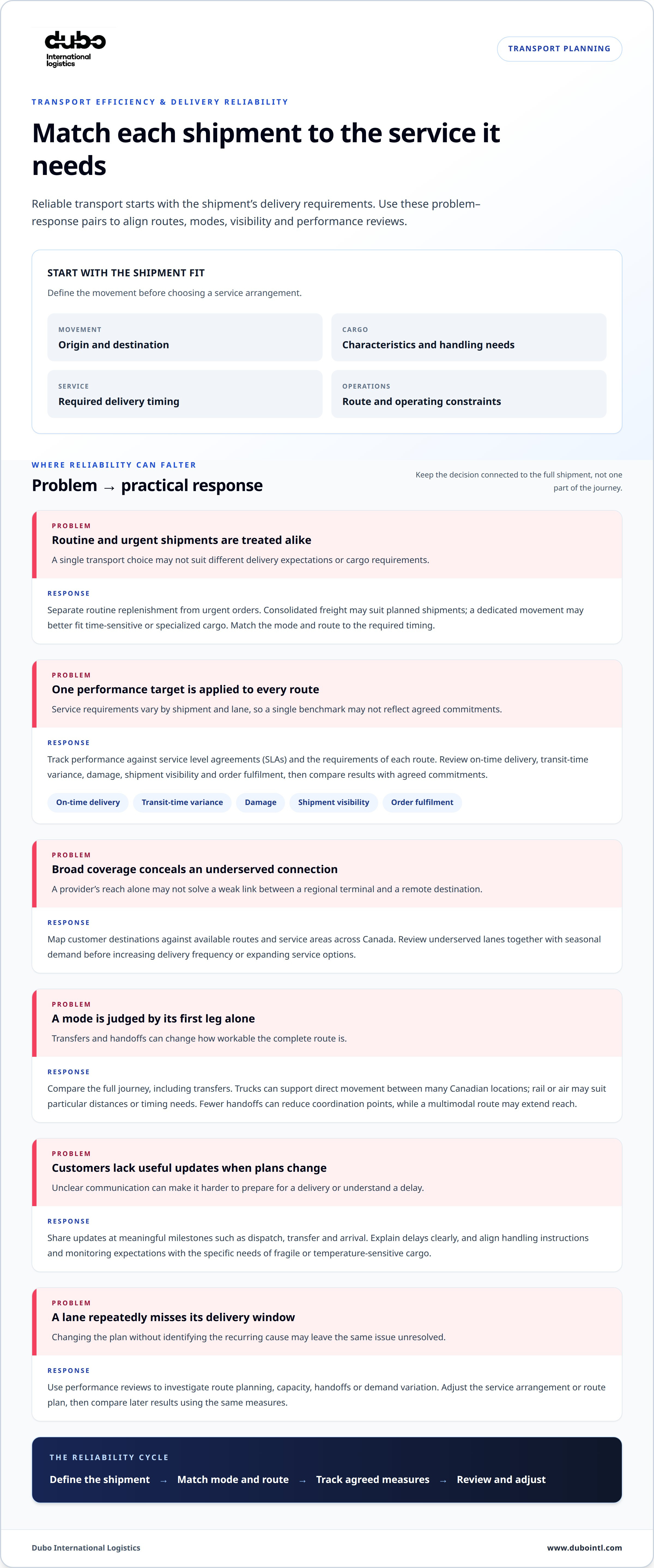
Reliable transport starts with matching each shipment to its delivery requirements. Separate routine replenishment from urgent orders, then choose a mode and route that meet the required timing. Consolidated freight may suit planned shipments, while a dedicated movement may better fit time-sensitive or specialized cargo. More delivery options can help meet different customer needs, but each must be operationally workable.
Track on-time delivery, transit-time variance, damage, shipment visibility and order fulfilment. Benchmarks should reflect service level agreements (SLAs) and the requirements of each route; no single target suits every shipment. Compare actual results with agreed commitments, then examine recurring delays by lane, carrier or delivery option.
Coverage matters as demand shifts across Canada. Map customer destinations against the routes and service areas available to your transport network. A provider’s broad reach alone may not solve a weak connection between a regional terminal and a remote destination. Review underserved lanes and seasonal demand together before increasing delivery frequency or expanding service options.
Choose transport modes by weighing speed, reliability, cargo requirements and operating constraints. Trucks can support direct movement between many Canadian locations, while rail or air may suit particular distances or timing needs. Fewer handoffs can reduce coordination points; a multimodal route may extend reach. Compare the full journey, including transfers, not just its first leg.
Delivery communication shapes the customer experience. Provide updates at meaningful milestones, such as dispatch, transfer and arrival, and explain delays clearly when plans change. Accurate tracking helps customers prepare to receive goods and can reduce avoidable status inquiries. For temperature-sensitive or fragile cargo, align handling instructions and monitoring expectations with the shipment’s specific needs.
Use regular performance reviews to turn delivery data into practical changes. If a lane repeatedly misses its delivery window, identify whether the cause is route planning, capacity, handoffs or demand variation. Adjust the service arrangement or route plan, then compare later results against the same measures. This disciplined cycle helps address transport challenges while protecting the delivery commitments customers rely on.
WHAT IS LOGISTICS NETWORK DESIGN?
Logistics network design connects facilities, transportation and operating processes so products move from suppliers to customers. In Canada, a network might link a supplier in one province, a distribution centre in another and customers across several regions. Mapping these connections shows where a handoff, route or facility affects delivery reliability.
To compare in-house logistics, third-party logistics (3PL) and fourth-party logistics (4PL), consider who manages the work. In-house teams control their own logistics operations; a 3PL performs selected logistics activities; a 4PL coordinates multiple providers and broader supply-chain processes. The right structure depends on how much control, coordination and internal expertise the business needs.
Start with a strategic map of suppliers, customer regions, facilities and transport links. Document the movement between each point, including where cargo changes carrier or mode. A shipment travelling across Canada, for example, may involve multiple transport legs. Mapping each handoff makes dependencies visible and helps teams assess the route as a whole.
Facility choices shape a network’s reach. Greenfield analysis can help estimate how many distribution centres to use and where to locate them. A network may operate one centre or several, depending on geography and demand. Compare potential locations against supplier access, customer concentrations and the transport connections needed to serve each region.
Transportation mode selection also affects reliability. Trucks, rail, planes and ships suit different routes, cargo needs and delivery expectations. A strategic design weighs speed and reliability together, then identifies where transfers could create coordination challenges. A business moving fragile equipment, for example, may need suitable handling across every leg, not just the longest one.
Assess partnerships by aligning requirements before work begins. Define responsibilities, shipment information, service expectations and how partners will communicate disruptions. Shared processes help carriers and suppliers coordinate changes and maintain consistent handoffs. Review performance against agreed measures, then revise the design as demand, technology or market conditions change. Network design is ongoing planning, not a one-time map.
For complex movements, freight forwarding can coordinate domestic or cross-border transportation across multiple partners and route stages. This is useful when a shipment involves several handoffs, specialized cargo or changing transport requirements. Each step still needs clear ownership so partners can act on accurate shipment details and keep the movement aligned with the delivery plan.
Inventory centralisation and demand forecasting
Inventory placement affects how quickly orders can reach customers across Canada. Compare demand by product and destination before deciding whether to centralize stock or position it in several distribution centres. A product with steady demand across distant regions, for example, may need a different placement plan from a seasonal item sold mainly in one area.
Build forecasts from order history, current demand signals and expected growth. Review products individually, since a stable item and a newly introduced one have different planning needs. Compare forecast demand with actual orders and deliveries. When actual demand repeatedly differs from the forecast, update the assumptions behind purchasing and inventory placement.
Centralizing inventory can make stock easier to manage in one location, while distributing it across centres can position products closer to customers. Each approach has trade-offs: distant stock may extend delivery routes, while more locations require coordination across facilities. Map customer regions and supplier lead times together to see how each configuration supports the required service.
Safety stock is extra inventory held to cover unexpected demand or supply-chain problems. Define its purpose by considering how demand changes, how replenishment works and what happens when a supplier shipment is delayed. A shortage of an essential component could interrupt production; for a slower-moving product, additional units may not serve the same operational purpose.
Connect inventory records to order fulfilment. Fulfilment includes picking, packing and shipping, so inaccurate stock counts can affect every stage. Track stock levels, orders and deliveries in a shared system, and investigate differences between recorded quantities and physical counts. Accurate inventory data helps teams avoid promising products that aren’t available.
Plan for seasonal demand spikes before they disrupt order flow. For specialized product makers like Tower Flags, which produces custom marine flag brackets and poles, managing seasonal demand surges requires coordinating inventory staging and reliable shipping options. Businesses can position inventory in regions expecting higher demand, expand courier capacity, adjust temporary staffing or use automated order management. The right mix depends on product volume, delivery commitments and the locations receiving orders. Reviewing these factors together helps prevent one bottleneck from overwhelming the operation.
Use logistics management software and data analytics to monitor inventory, shipment progress and demand patterns. A dashboard may show that one product repeatedly sells faster in a particular region, prompting a review of its stock allocation. Combine those findings with supplier and delivery information, then revise forecasts and replenishment plans as conditions change.
Supply-chain efficiency and operational planning
Supply-chain efficiency means coordinating transport, inventory and order fulfilment around customer demand. Businesses asking how to build a reliable logistics network should assess the full shipment journey, not just its main route. A change that shortens one leg may add transfers elsewhere, affecting handling, timing and service continuity. Assessing each stage together reveals whether a proposed change improves the network overall.
Start with a regular supply-chain assessment. Trace where shipments wait, repeat journeys occur or handoffs cause delays. Compare viable route and operating scenarios against service requirements and operational needs. A scenario that reduces unnecessary travel may also reduce environmental impact. Similarly, in the broader mobility sector, regional electric fleets such as taxibazan.com showcase how clean vehicle adoption can support efficient, lower-emission local transport. Test proposed changes against actual shipment patterns before making them routine.
Capacity is another area to examine. Combining individual orders can improve vehicle use and avoid empty miles, meaning vehicles travelling without revenue-generating cargo. Where appropriate, businesses can share freight capacity with transport partners on a situational or order-related basis. The right fit depends on shipment timing, cargo requirements and whether consolidation supports the required delivery schedule.
Outsourcing logistics may expand access to transport capacity, but can reduce direct control over some operations. Compare the coordination and oversight required with the resources available internally. Set clear responsibilities and service level agreements (SLAs) so each party understands performance expectations, delivery windows and reporting responsibilities.
Visibility helps teams act on shipment information instead of relying on assumptions. Live tracking can support monitoring and coordination, while shared updates help identify delays and adjust connected plans. If a shipment’s arrival time changes, for example, teams can review downstream appointments or replenishment decisions. Data is most useful when people know who responds and what decisions they can make.
Simulation can help assess how disruptions may affect network performance before operations change. Model scenarios such as a route interruption, supplier delay or demand shift, then compare the effects on delivery continuity and capacity. Use the results to identify dependencies and prepare practical alternatives, rather than treating a model as an exact forecast.
Decisions about how to build a reliable logistics network become clearer when route, capacity and service commitments are assessed together. Review whether a route supports customer commitments, whether repeated handoffs add operational effort and whether a proposed change creates new risks. This gives decision-makers a clearer basis for improving the supply chain while maintaining control over essential operations.
Dubo International Logistics
Dubo International Logistics helps businesses plan and coordinate cargo movements across Canada. Its freight forwarding, logistics consulting and specialized transportation services can support businesses assessing routes, partner coordination or shipment requirements. The right support depends on the operational challenge, whether it involves a complex corridor, unusual cargo or several transport stages.
Logistics consulting can bring separate decisions together in a workable network plan. For businesses considering how to build a reliable logistics network, that may mean reviewing shipment origins and destinations, cargo characteristics, delivery expectations and handoffs between partners. A business moving oversized machinery, for example, may need a plan that accounts for equipment requirements and route coordination. Bringing these details together aligns transport choices with the shipment’s actual needs.
Freight forwarding can coordinate cargo movements involving multiple legs or providers. When planning how to build a reliable logistics network, businesses can consider how shipment information, routing decisions and partner handoffs will stay aligned throughout the journey. For movements with several transfers, clear coordination helps each participant understand the shipment details and their role.
Specialized transportation services can suit cargo with requirements beyond routine freight movement, including oversized machinery, delicate equipment and temperature-sensitive products. The cargo’s dimensions, handling needs and destination inform the coordination required. For a project shipment, the plan should account for equipment needs and transfers across the route, rather than treating each stage separately.
This support can also help businesses review an existing network. If delays repeatedly affect a particular lane, logistics planning can examine how routing, handoffs or transport arrangements contribute to the issue. If demand patterns change, updated planning can help align shipment requirements with the new operating picture. The focus is on decisions that reflect the cargo, route and service needs.
A useful starting point is a clear description of the movement: cargo type, origin, destination, timing requirements and known transport constraints. These details help shape the planning and coordination involved. Dubo International Logistics can help businesses assess logistics requirements and coordinate freight movements in line with their cargo and route needs.
Contact Dubo International Logistics to discuss your logistics network requirements.
Frequently Asked Questions
What are the key steps to build a reliable logistics network?
Translate business priorities into operating requirements, then document who owns each decision and handoff. Before a broad rollout, test the proposed approach with a representative shipment or product group. Record exceptions, such as missing shipment details or mismatched receiving appointments, and resolve them in operating procedures. A controlled pilot can expose process gaps before they affect routine movements across the wider network.
How do you assess demand, delivery routes, and service levels when designing a logistics network?
Segment demand by product type, order pattern and customer requirements, rather than relying only on overall shipment totals. Check whether delivery commitments account for receiving hours, appointment requirements and order preparation time. Then compare route plans against those details. A route may look suitable on a map yet fail to meet a customer’s receiving schedule or a product’s handling requirements.
How should businesses choose warehouses, distribution centres, and transportation partners?
Evaluate each facility or partner against its intended role in the operating plan. For a potential distribution centre, review how inbound shipments will be received, orders prepared and outbound handoffs documented. For a transportation partner, assess whether dispatch and receiving processes fit the shipment’s needs. A written onboarding plan helps reveal unclear responsibilities before regular operations begin.
What technology is needed to track shipments, manage inventory, and improve supply chain visibility?
Technology should use consistent shipment identifiers, product records and status definitions across connected systems. Without shared definitions, one system may mark a shipment as dispatched while another still shows it awaiting pickup. Establish data ownership, access permissions and procedures for correcting errors. These controls help staff interpret operational records consistently and base decisions on the same information.
How much does it cost to build and operate a logistics network in Canada?
There is no single amount that applies to every Canadian logistics network. A useful starting document describes the intended operating scope, products, customer commitments and network responsibilities. This gives decision-makers a clear basis for defining the design they need, instead of treating a generalized figure as suitable for a specific business.
How can a logistics network prepare for disruptions such as severe weather, labour shortages, and supplier delays?
Prepare a response playbook that names decision owners, communication channels and the conditions that trigger escalation. Specify who informs customers when a weather-related closure affects a planned delivery, and who can approve a revised sequence. Keep contact details for key operational partners current, and record decisions during an incident. Afterward, review the response and update the playbook wherever instructions proved unclear.
What practices improve carrier reliability, delivery times, and customer service?
Make each shipment easier to execute by sending complete instructions before dispatch, including site access details, receiving contacts and appointment information where applicable. Confirm that pickup and delivery teams can see the same requirements, then record delivery confirmation consistently. When an exception occurs, document its cause and resolution. This creates an operating history that can reveal recurring service issues and help improve instructions for future shipments.

