

A reliable arrival estimate is not the same as a guaranteed delivery date. To understand how to calculate freight transit times, count the full elapsed time from pickup to delivery, including handling, trucking, customs processing and likely disruptions. Routes, schedules and operating conditions can all affect the timeline.
It’s reasonable to want one clear date for production, inventory and customer commitments. But a port-to-port schedule may leave out the time needed to move freight to the port, complete border steps and deliver it to its final destination. An estimate is most useful when it reflects the shipment’s actual route and requirements.
This guide explains how to build a practical estimate, account for handling and customs, and assess delays and schedule reliability. You’ll see how transport mode, distance, loading and unloading, and route conditions shape the arrival window. It also explains why estimated transit time and dependable schedule performance are related but not interchangeable, helping you plan each shipment with greater confidence.
Key Takeaways
- Define the estimate from pickup through final delivery, not just the time freight spends travelling between terminals.
- Separate transit into movement, handling, customs processing and final delivery so each stage is represented in the arrival estimate.
- Account for Canadian driving limits when assessing how quickly a truck can cover a route.
- Allow a practical buffer for disruptions, and assess schedule reliability alongside the planned transit time.
- For complex routes or cargo requirements, freight forwarding and logistics consulting can help coordinate a more informed shipment plan.
What does transit time mean in trucking?
- Define the trucking window using the shipment’s actual pickup and delivery points in Canada. Transit time can describe travel between two specified locations, but a freight plan may also include collection and final delivery. For example, a shipment moving from a supplier in Alberta to a receiving site in Ontario needs a route based on both addresses, not a general province-to-province assumption. Record the locations and cargo requirements first.
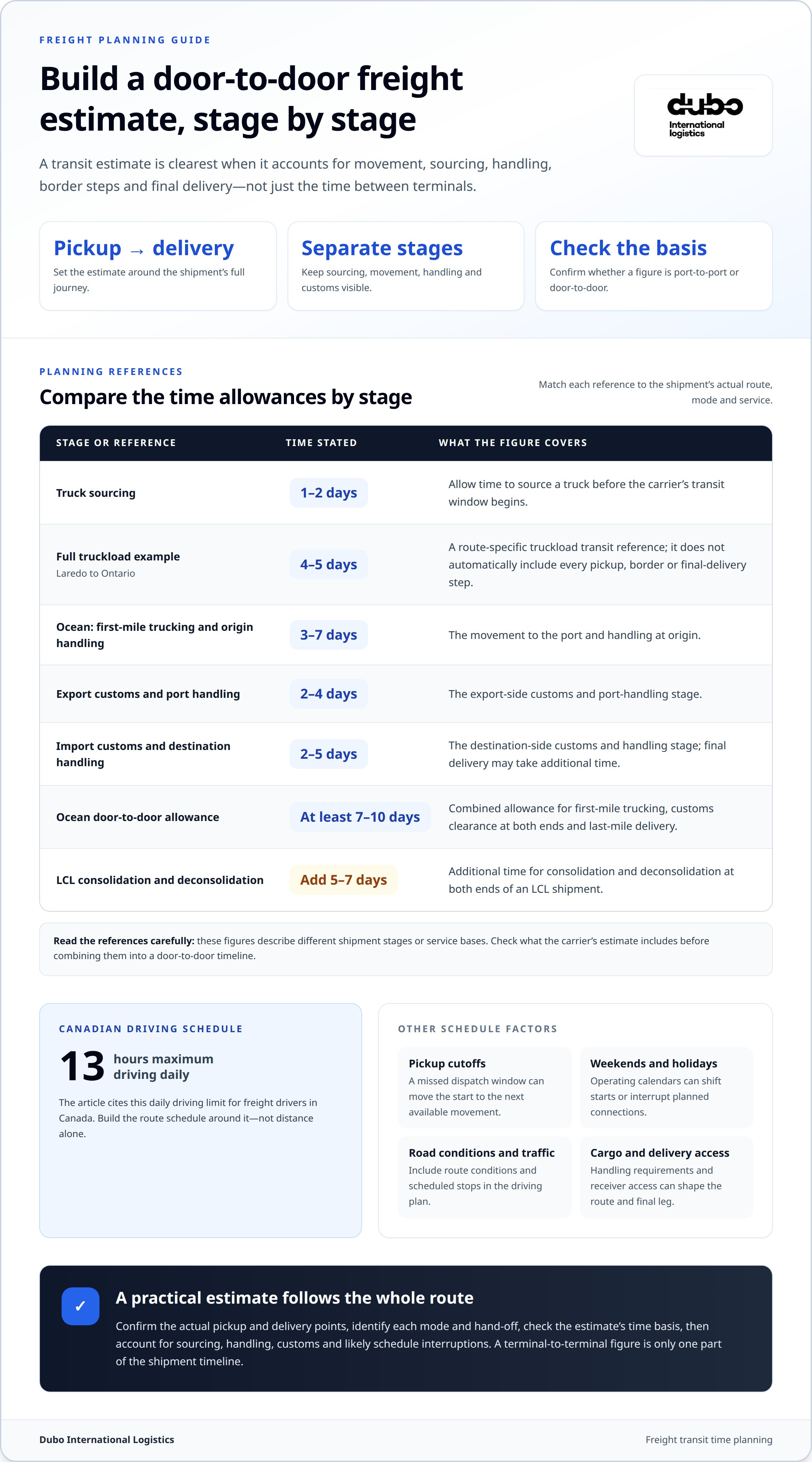
- Build the driving schedule around Canadian operating limits, not distance alone. According to Department of Justice Canada - Justice Laws Website, a freight driver in Canada may drive a maximum of 13 hours daily. The route plan must reflect that limit alongside road conditions, traffic and scheduled stops. A long-distance shipment therefore needs a practical driving schedule, rather than a calculation based only on kilometres or ideal road speed.
- Choose a route that suits the freight and its destination. A shipment travelling to a distribution site near Vancouver may follow a different route from one bound for a facility near Halifax. Assess highway access, transfer points, delivery access and cargo handling needs together. For freight that continues by ocean, compare the Canadian port and sailing options for its destination, rather than treating the sea leg as the entire journey.
- Consider how the selected ocean route affects the shipment’s itinerary. Canal choices can change a vessel’s sailing sequence and the ports it can call at before reaching a Canadian destination. Compare those arrangements with the inland connection required after arrival. A sailing option that appears direct may be less suitable for the full journey if its port connection adds a transfer or a less practical trucking leg.
- Optimize the complete route by mapping every hand-off from origin to final address. For an Alberta-to-Quebec shipment, identify where trucking begins, whether the freight changes mode, and how the final leg reaches the receiver. Then compare route sequences against cargo dimensions, handling requirements and delivery access. Choose the route that fits the shipment’s needs, and base the arrival estimate on the full sequence, not one segment.
Handling, trucking, and customs durations
Build the estimate from separate stages, rather than treating road distance as the complete shipment timeline. A carrier’s transit estimate depends on distance, transport mode, service level, handling and border steps.
Estimate Time by Distance, Mode, and Service
Start by identifying the shipment’s origin, destination, mode and requested service level. Carriers estimate transit by assessing route distance alongside operating schedules and service requirements. Compare like with like: a truckload estimate does not represent an ocean shipment’s full door-to-door timeline.
- Separate truck sourcing from the truck’s journey. Sourcing for a ground-freight shipment takes one to two days, so include this time before the carrier’s transit window begins.
- Use route-specific truckload estimates as a planning reference. For example, the listed full truckload transit time from Laredo to Ontario is 4-5 days.
- Check what the service estimate includes. A transit figure may cover movement between points, while pickup, loading, border processing or final delivery may need separate time allowances.
How Freight Providers Use Transit Charts, Maps, and Calculators
Ask your freight forwarder to map the shipment’s full route against carrier schedules. A freight forwarder can use carrier transit-time maps or calculators to estimate movement between origin and destination, then account separately for sourcing, handling and customs stages.
- Match the chart’s origin and destination to the actual pickup and delivery points. A Laredo-to-Ontario lane is a useful reference only when those locations match the shipment’s route.
- Review the map’s service type and transit-time basis. Confirm whether its estimate represents port-to-port, terminal-to-terminal or door-to-door movement, since each describes a different part of the journey.
- Add handling durations to the mapped movement. For ocean freight, first-mile trucking and origin handling typically take 3-7 days; export customs and port handling typically take 2-4 days.
- Account for the destination stage separately. Import customs and destination handling typically take 2-5 days, while final delivery may add time beyond the port or terminal estimate.
- For an ocean door-to-door estimate, allow at least 7-10 days combined for first-mile trucking, customs clearance at both ends and last-mile delivery. For LCL shipments, allow an additional 5-7 days for consolidation and deconsolidation at both ends.
Use the resulting stage-by-stage timeline to identify where the shipment spends time before, during and after transport. This gives you a clearer estimate than relying on a single chart entry.
Accounting for delays and schedule reliability
Include operating calendars and schedule performance in the estimate, not just planned movement time. Pickup cutoffs, weekends and holidays can shift a shipment’s start or interrupt planned connections.
-
Account for Pickup Cutoffs
Confirm the pickup cutoff and identify whether the shipment can make that day’s scheduled departure. Freight tendered after a cutoff may wait for the next available movement, shifting the timeline before transit begins. For example, a shipment ready after a carrier’s daily dispatch window should not be estimated as if it departed earlier. Record the ready time, cutoff and planned departure separately.
-
Adjust for Business Days and Holidays
Map the shipment against operating days at pickup, transfer points and delivery. A weekend or public holiday can affect pickup, terminal handling, customs processing or final delivery, depending on the service schedule. Chinese New Year is a notable planning factor: factories in China close for a month, which can affect shipment timing. Build the calendar around the origin and destination rather than assuming every stage runs on business days.
- Separate a published transit estimate from elapsed calendar time. A carrier’s route schedule may describe planned movement, while actual elapsed time also depends on when the shipment enters that schedule. Mark each planned departure and arrival, then identify calendar gaps between pickup, transfer and delivery. This makes a missed cutoff or non-operating day visible in the estimate.
- Set a buffer that reflects the route and its exposure to disruption. For ocean freight, a recommended estimate buffer is 7-14 days, especially on the Asia-Europe trade lane. Use the buffer as planning time, not as a substitute for a route-specific schedule. Consider weather, traffic, labour availability and operational interruptions when deciding where the shipment is most exposed.
- Assess schedule reliability alongside advertised transit time. Schedule reliability measures how consistently carriers achieve their promised transit times. A short planned journey with inconsistent arrivals may create more planning risk than a longer, steadier schedule. Compare the carrier’s record with the shipment’s actual route and service, and distinguish schedule performance from the duration shown on a transit chart.
- Revisit the estimate when a key milestone changes. If pickup misses its cutoff, a connection moves, or a holiday affects operations, update the projected arrival from the revised departure or transfer point. Keep the original schedule and revised timeline distinct, so inventory and delivery plans reflect the latest movement information. For an Asia-Europe ocean shipment, retain the 7-14-day buffer when reviewing that revised estimate.
Definition of freight transit time
Freight transit time is the elapsed time freight takes to move between specified points. Total shipping time is broader: it can include preparation, handling, customs processing and delivery beyond the carrier’s stated movement window.
- Set the start and end points. Define whether the estimate begins when a carrier collects the shipment, when it leaves a terminal, or when a vessel departs. Set the endpoint just as precisely, such as arrival at a port or delivery to a Canadian business address. A port-to-port estimate and a door-to-door estimate measure different journeys, even for the same shipment.
- Identify which part of the timeline the estimate measures. A carrier’s transit figure may cover travel between two named locations, rather than every step from shipment readiness to receipt. For example, a terminal-to-terminal estimate does not automatically include pickup from the shipper or final delivery. State the start event and arrival event beside every estimate to prevent confusion.
- Keep transit duration distinct from total shipping time. Transit time generally describes movement through a defined route segment. Total shipping time can also include time before departure and after arrival, including handling, customs processing and last-mile delivery. For an ocean shipment, the vessel’s port-to-port passage is only one part of a door-to-door timeline.
- Use the transport mode to interpret the estimate. Published market ranges illustrate how widely transit duration varies: express freight can take 1-3 days, air freight typically takes 5-10 days, and ocean freight port-to-port typically takes 15-45 days. These figures describe different modes and scopes, so they are not interchangeable. Match each benchmark to the shipment’s actual mode and route.
- Record the estimate as a dated sequence of milestones. List pickup, departure, transfers, arrival and final delivery in order, identifying which events fall inside the stated transit window. For example, if the estimate starts at port departure, mark earlier origin handling separately. This distinction helps a receiving team understand whether a delay occurred before movement, during transit or after arrival.
- Use one consistent definition for planning decisions. Production schedules, inventory plans and customer commitments can rely on different timeline endpoints. If a purchase order expects delivery to a Canadian facility, a port arrival date alone does not answer that requirement. Label the estimate “port-to-port” or “door-to-door,” then align the expected arrival with the event the business actually needs.
How is freight transit time calculated from pickup to delivery?
Build the estimate by adding the time for each stage between pickup and delivery. Keep route movement distinct from preparation, transfers, border processing and final hand-off.
- Set the shipment’s start and finish events. Define pickup as the moment the carrier collects the freight, not when it is ready. Set delivery as arrival at the receiving address, not just a terminal or border. For example, terminal arrival is an intermediate milestone when the shipment still needs inland transport.
- Map every leg in sequence. List origin pickup, each transport segment, transfer point, border crossing if applicable, and final delivery. A shipment that changes from truck to ocean transport has separate legs and hand-offs. Record each leg’s planned duration separately, so a schedule change can be traced to the affected segment.
- Estimate ground movement using route distance and operating pace. A freight transit-time estimate can approximate driving time by allowing 500 miles per day. Treat that as a planning method, not a fixed speed: the route, traffic, road conditions and driver operating limits influence actual progress. Use the shipment’s routed mileage rather than a straight-line distance.
- Add the time outside linehaul movement. Include pickup preparation, loading, transfer handling and delivery arrangements when they fall within the requested pickup-to-delivery window. For cross-border freight, include customs and inspection in the timeline. Identify whether a carrier’s route estimate already includes these activities, then add only the stages it excludes.
- Account for shipment-specific handling. Cargo dimensions, packaging, loading method and receiving-site access can affect how each hand-off is planned. For example, machinery requiring specialized loading may need a different pickup sequence from standard palletized freight. Include the operational steps that apply to the actual cargo, rather than relying on a generic route duration.
- Calculate elapsed time across the full sequence. Add the durations for planned stages, including scheduled waiting between connections. Keep the calculation in a single unit, such as hours or days, and state whether it measures calendar time or operating time. The result should correspond to the delivery event defined at the start.
- Update the estimate when a milestone changes. If pickup moves or a transfer is rescheduled, recalculate from the revised event instead of carrying forward the original arrival date. For shipments with multiple legs, map a pickup-to-delivery route around the actual hand-offs and cargo requirements.
Dubo International Logistics: Freight forwarding
Dubo International Logistics coordinates freight movement when a shipment involves complex routes, multiple transport stages or specialized cargo requirements. Its freight forwarding and logistics consulting services help bring route planning, handling needs and delivery milestones together in a clearer shipment plan.
For oversized machinery, delicate equipment or temperature-sensitive products, specialized transportation services address requirements that a standard route estimate may not capture. Involve a logistics partner when transfers, cargo constraints or cross-border movement make arrival planning more involved than a single carrier schedule.
To discuss freight planning for your shipment, contact Dubo International Logistics.
Plan the next shipment with a clearer arrival window
Use the estimate as an operational planning tool, not just a date to pass along. Align the expected arrival with the decision it supports, whether scheduling production, coordinating a receiving team or setting expectations with a customer. A consistent approach to how to calculate freight transit times also helps teams compare future shipments using the same milestones and assumptions.
For a shipment with unusual cargo needs, multiple transport stages or a complex route, professional coordination can turn the movement plan into a practical timeline. Dubo International Logistics offers freight forwarding, logistics consulting and specialized transportation services to support these requirements.
Contact Dubo International Logistics to discuss your shipment planning needs. A well-defined plan gives your team a steadier basis for its next logistics decision.
Frequently Asked Questions
Can transit time be guaranteed?
No. A transit estimate is a planned timeline, not a guarantee, because weather, traffic, route availability, handling and labour conditions can change during a shipment. Check which milestones the estimate covers and whether it ends at a terminal or the delivery address. For time-sensitive planning, build flexibility into the receiving schedule instead of treating the projected arrival date as certain.
How long does freight shipping take?
Freight shipping can take a short time by express service or substantially longer by ocean, and no single duration applies to every Canadian shipment. Mode, route, service level, origin, destination and cargo requirements all shape the timeline. For a meaningful estimate, use the shipment’s actual pickup and delivery points and compare timelines with the same start and end milestones.
What is transit time in shipping?
Transit time is the duration assigned to a defined portion of a shipment’s journey. Its meaning depends on the milestones used: a carrier may track movement between terminals, while a receiving team may need elapsed time until freight reaches its facility. For example, a shipment record can show pickup, terminal arrival and final delivery as separate events.
What factors affect freight transit times in Canada?
Canadian freight timelines depend on route, transport mode, traffic, weather, carrier schedules and the shipment’s handling requirements. Cross-border movements also involve border processing, while remote delivery points can affect routing and the final leg. Heavy or delicate shipments may require different equipment or handling arrangements than standard freight, changing how their movement is planned.
What are typical freight transit times for LTL and FTL shipments in Canada?
There is no single typical duration for LTL or FTL freight across Canada. LTL shipments share trailer capacity and may require coordination around consolidation and deconsolidation, while FTL timing depends on its direct route and scheduled movement. Origin, destination, pickup timing and delivery access all matter. Compare estimates for the same lane and delivery scope to assess the difference.
How long does freight take by truck, rail, air, and ocean in Canada?
Each mode follows different schedules, so the shipment’s route and service plan determine its duration. Truck timelines depend on the road route and driving schedule; rail involves its service and terminal connections. Air and ocean transport also require handling around their main transport legs. Compare door-to-door estimates rather than treating a flight or sailing duration as the complete shipment timeline.
How do customs clearance and border delays affect cross-border freight transit times?
Customs processing and border inspections can extend cross-border transit by adding time before freight continues along its route. Timing depends on the shipment’s documentation, required processing and conditions at the crossing. A clear estimate should show border processing as a distinct stage, so the expected arrival reflects the full cross-border movement rather than just driving time.
How do accessorial services, rural delivery, and weather affect delivery estimates?
Additional delivery requirements, such as appointment coordination or specialized unloading, can add steps to the final leg. Rural destinations may require a different route and delivery plan from locations near major transport corridors. Weather can also affect road conditions and schedules. Include these shipment-specific details when developing the estimate, so the delivery plan reflects the actual destination and receiving requirements.

