

A shipment’s value is not the only factor that makes it sensitive. High-value cargo transportation must also account for fragility, handling requirements, route, and exposure at each handoff. A valuable shipment needs a plan shaped around its specific risks, not just its declared worth.
Whether you’re moving electronic devices, medical equipment, artwork, delicate components, or temperature-sensitive goods, the right transport approach depends on what the cargo needs to arrive in sound condition. This guide explains how high-value cargo is identified, how value tiers can frame protection requirements, and how freight type can influence carrier and route selection.
It also explains the difference between carrier liability and cargo insurance, and why shipment documentation and clear handling arrangements matter. With these considerations in view, you can assess your shipment’s needs and understand how coordinated freight forwarding and specialized transportation support sensitive freight moving across Canada and North America.
Key Takeaways
- Assess a shipment by both its declared value and its handling, security, and delivery requirements.
- Match packaging and pre-shipment inspection to the freight’s fragility and exposure to damage.
- Use cargo type and value tier to guide carrier, equipment, route, and stop planning.
- Review carrier liability separately from cargo insurance so you understand how a loss may be covered.
- Clear shipment details and coordinated handoffs help keep sensitive freight moving with greater control.
What Shipments are High-Value Cargo?
A shipment may be considered high-value because of its declared worth, theft risk, fragility, or sensitivity to handling. Examples include luxury watches, medical equipment, precision components, artwork, and temperature-sensitive products. The risks vary: compact items may be easier to steal, while delicate equipment can be difficult to replace after damage. High-value cargo transportation therefore considers practical handling and security needs alongside monetary value.
In Canada, requirements depend on the goods and transport mode; a high declared value alone does not determine every applicable rule. If cargo is classified as dangerous goods, the Règlement sur le transport des marchandises dangereuses governs its transport. Establishing the goods’ classification before dispatch helps identify handling and documentation requirements.
Packaging provides the first physical safeguard. Before dispatch, the shipment should be inspected for existing damage, weak packaging, exposed components, and movement inside the crate or carton. Purpose-built packaging or customized crating can protect fragile equipment, while cushioning and internal bracing help prevent parts from shifting. For refurbished machinery, photographs of every side taken from 15-20 feet away can record its condition before transit.
Securement should account for the cargo, not just its outer packaging. A machine with a delicate control panel, for example, may need that component protected from vibration and pressure. The loading plan should identify lifting points, weight distribution, restraints, and loading and unloading sequences. Clear instructions help reduce the risk of damage to sensitive parts.
Security planning should address theft, tampering, and exposure during stops. Restricted staging areas, limited access, and video surveillance can help control access while freight awaits its next movement. Shipment details can be shared on a need-to-know basis, limiting unnecessary disclosure of the cargo’s identity or value. These measures can be relevant for luxury goods and portable electronics.
Custody records make handoffs easier to trace. At each transfer, shipment documents can record who accepted the freight, its visible condition, and when custody changed. Tracking systems provide location updates, while GPS-locked containers offer another possible security measure. These tools support oversight but do not replace suitable packaging or clear handling instructions.
Before release, the shipment plan should bring together inspection findings, packaging, securement, tracking, and custody records. This gives each handling partner clear instructions and creates a useful record if damage or a security concern is reported. A coordinated high-value cargo transportation plan aligns these safeguards with the shipment’s specific risks.
Types of high-value freight
High-value freight includes goods whose replacement value, theft exposure, or operational importance calls for added transport planning. In the US general truckload market, a commonly used value benchmark helps classify high-value loads, but it is not a statutory definition or a Canadian legal threshold. Treat it as market context, then base a Canadian shipment plan on declared value, commodity, route, and handling requirements.
Finished vehicles are another example. A luxury, collectible, or specialized vehicle may need tailored transport because its finish, components, and condition can be vulnerable during loading and transit. The plan may need to account for secure positioning, suitable trailer selection, and documented condition at handoffs. A vehicle’s value and handling needs matter together.
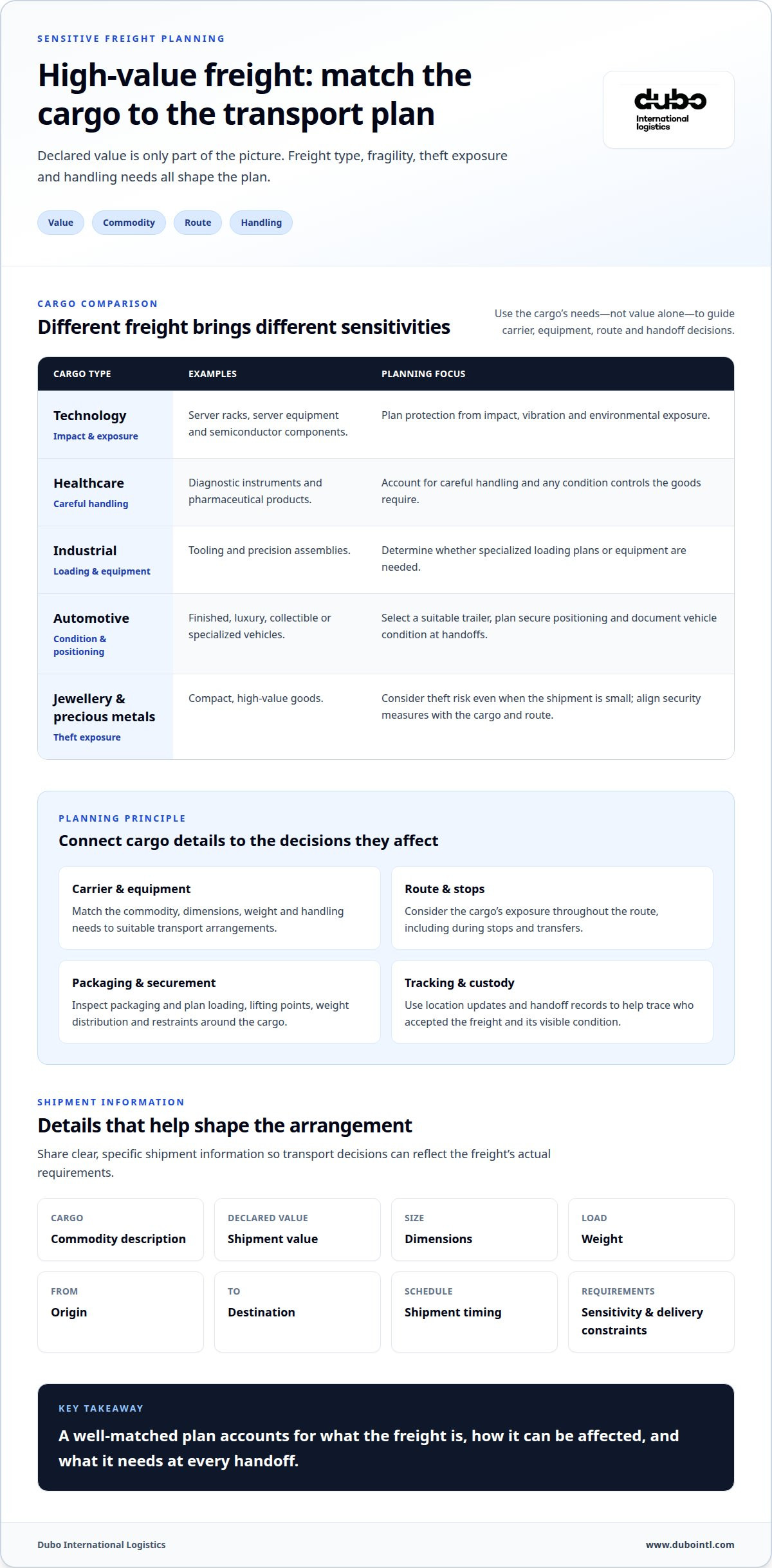
Industries handle high-value freight in different forms. Electronics manufacturers may ship server equipment or semiconductor components; aerospace businesses may move precision assemblies; pharmaceutical companies may transport sensitive products; and industrial operators may ship specialized tooling. Jewellery and precious metals can also attract theft risk despite their compact size. Each commodity brings distinct packaging, security, temperature, or handling considerations.
To arrange a shipment in Canada, a freight forwarder coordinates transport around the cargo, route, equipment, and handling requirements. Provide the commodity description, declared value, dimensions, weight, origin, destination, shipment timing, and any sensitivity or delivery constraints. These details help determine suitable carriers and transport arrangements.
Accurate information shapes the plan. A crate’s outside dimensions, for example, affect trailer fit, while the cargo’s actual weight informs loading and securement arrangements. A description such as “machine parts” may not reveal whether the freight contains delicate instruments, hazardous materials, or temperature-sensitive components. Specific descriptions help the forwarding partner identify requirements before dispatch.
- Technology: Server racks and semiconductor equipment may need protection from impact, vibration, or environmental exposure.
- Healthcare: Diagnostic instruments and pharmaceutical products can require careful handling and condition controls.
- Industrial: Tooling and precision assemblies may call for specialized loading plans or equipment.
- Automotive: Finished vehicles need transport arrangements suited to their condition and secure positioning.
When selecting a freight forwarding partner, assess how clearly it connects cargo details to carrier choice, equipment, route, and handoffs. Ask how the plan accounts for the freight’s condition and exposure, rather than relying on value alone. For shipments with multiple sensitive requirements, coordinated freight forwarding can bring transport decisions into one plan.
Carrier selection, routing, and stop restrictions
Carrier, equipment, and route choices should reflect the shipment’s handling needs and security exposure. In Canada, the right method depends on cargo dimensions, sensitivity, delivery requirements, and available transport options.
How a freight forwarder selects and vets carriers for high-value cargo
A freight forwarder matches carrier capabilities to the shipment, then reviews safety, insurance, compliance, and relevant experience. A carrier moving fragile electronic components, for example, needs suitable handling procedures and equipment, not just available trailer space. Shipment documents should describe the cargo, dimensions, weight, handling limits, and delivery requirements. This information helps assess whether a carrier can meet the shipment’s operational needs.
How a freight forwarder selects a trailer for high-value cargo
Trailer selection starts with the shipment’s size, weight, loading method, and protection needs. A sealed box trailer may suit packaged electronics that need protection from the weather, while oversized machinery may require specialized equipment. The plan should account for component placement, securement points, loading access, and unloading conditions at destination. Matching equipment to the cargo reduces avoidable movement and helps prevent damage in transit.
Transportation Method Comparisons
For Canadian shipments, truck transport suits many domestic routes, while air freight can suit relatively light, high-value freight travelling longer distances. The European Commission identifies air transport as most competitive for longer distances and relatively light, high-value cargo. Statistics Canada describes air freight as carrying lower-weight, higher-value goods, including pharmaceuticals, perishables, and precision machinery parts. Specialized carriers address specific equipment or handling requirements; standard freight can suit cargo compatible with ordinary handling and equipment.
Route planning should consider shipment sensitivity, delivery timing, border crossings, and planned stops. A freight forwarder can assess whether a direct route or a transfer involving another carrier better suits the cargo. For a temperature-sensitive shipment, for example, the route plan should account for handling transitions that could affect its condition. Documents and instructions should follow the freight through each handoff.
Stop restrictions help control exposure while cargo is in transit. The plan can limit unnecessary stops, identify approved stopping points, and make each transfer clear to the carrier. For theft-targeted goods, TAPA TSR trucking standards are designed to reduce theft exposure. Tracking systems support shipment visibility, while custody records help establish who handled the freight at each transfer.
These choices work together: a suitable carrier needs compatible equipment, and the route must support the shipment’s security and handling plan. Specialized transportation is most useful when cargo requirements call for particular equipment, controlled handling, or coordinated transfers; ordinary freight arrangements may suit less sensitive shipments.
Carrier liability, released rates, and cargo insurance
Carrier liability and cargo insurance serve different purposes. Liability describes a carrier’s responsibility under its contract and applicable terms; insurance is a separate policy covering specified losses or damage. For a precision machine, the declared value, shipment documents, and agreed coverage should align before dispatch.
For cross-border shipments from Canada, security and insurance arrangements depend on the cargo, route, carrier terms, and policy wording. There is no single high-value cargo insurance amount that applies to every shipment. Confirm how the declared value, custody transfers, exclusions, and claims process are addressed in the transport documents and insurance policy.
Coverage planning should reflect shipment dimensions, weight, route, transport method, handling needs, and security arrangements. Review how these shipment-specific factors affect liability and insurance requirements, whether moving a compact electronic unit, coordinating oversized machinery, or transporting a temperature-sensitive product.
Recommended insurance should reflect the goods’ documented value and the loss scenarios the shipper wants covered. Review whether the policy addresses theft, physical damage, and loss in transit, then check exclusions, deductibles, limits, and claim documentation. For example, if a shipment is declared below its replacement value, there could be a gap between the declared amount and the funds needed to replace it.
Released rates can limit a carrier’s liability, even when the cargo is worth more. Liability may be calculated using contractual terms or shipment weight rather than the goods’ full value. Compare the carrier’s stated limit with the declared value and any separate insurance protection before accepting the transport arrangement.
Insurance decisions also depend on how the freight moves. A fragile component transferred between carriers may face different handling exposures than a shipment moved by dedicated vehicle. The logistics plan should record each carrier’s role, handoff point, cargo condition, and responsibility. Clear records help distinguish a carrier-liability claim from a claim under supplemental cargo insurance.
For temperature-sensitive products, coverage discussions should include the risk of temperature excursions, not just theft or physical impact. Shipment monitoring can record conditions in transit, while temperature instructions tell carriers how the freight must be handled. For example, a pharmaceutical shipment may need documented temperature readings to support quality review and a later claim.
Carrier relationships influence how consistently shipment details are shared. A forwarder coordinating multiple carriers can align declared cargo information, handling instructions, and transfer records across the route. The shipper’s product description, value documents, and packaging details give each party a clearer basis for handling and reporting an incident.
Before release, reconcile the commercial documents, declared value, carrier terms, insurance schedule, and handling instructions. If a machine’s invoice lists one value but the insurance documents show another, the discrepancy can complicate a claim. Accurate, consistent records support a more orderly review if loss or damage occurs.
Cargo value tiers
Cargo value tiers give shippers a consistent framework for discussing security, carrier selection, and insurance. Some markets use bands that run from an entry high-value level through progressively higher categories, ending with freight valued above the top band. These are market conventions, not universal Canadian rules. Use declared value as one planning input, alongside commodity type, route, and handling needs.
The tier framework is most useful when it prompts a closer review of shipment exposure. A load in an entry band may need different controls from freight in the highest band, but value alone does not dictate the plan. A compact shipment can be easy to conceal, while a large machine may need specialist loading and equipment. The cargo’s characteristics determine which protective measures make sense.
As cargo moves into a higher value category, review how the transport plan addresses the consequences of loss. Consider whether the carrier’s liability terms align with the declared value, whether insurance addresses the relevant risks, and whether custody records capture each transfer. This review is especially useful when several carriers, route changes, or handling teams are involved.
Commodity type can matter more than the tier label. Some specialized haulers apply low value thresholds to theft-prone goods such as jewellery, precious metals, or currency. A shipment’s compact size, resale appeal, or ease of concealment can increase its security exposure even below a conventional high-value category. Conversely, bulky equipment may need tailored transport because of its handling and replacement challenges.
Transport mode adds another planning dimension. According to Statistics Canada, air freight tends to carry lower-weight, higher-value products, including pharmaceuticals, perishable goods, and precision machinery parts. For these shipments, consider the value category alongside transit conditions and product sensitivity. A strict temperature requirement or delicate component may call for specialized handling regardless of the cargo’s tier.
Use the framework as a prompt for coordinated decisions, not as a substitute for shipment-specific planning. Establish the declared value, identify the primary exposure, and connect those details to carrier terms, insurance, equipment, and route measures. For cargo with several requirements to align, discuss your shipment’s transport requirements as part of a coordinated logistics plan.
Dubo International Logistics: Specialized transportation services
Dubo International Logistics coordinates specialized transportation for sensitive freight, including oversized machinery, delicate equipment, and temperature-sensitive products. When a shipment needs specific handling, equipment, or coordinated transfers, its freight forwarding and logistics consulting can help align transport decisions with the cargo’s requirements.
A project involving a large machine, for example, may require careful coordination across carriers and route transitions, while sensitive equipment calls for clear handling instructions throughout transit. Dubo International Logistics supports complex cargo movement across Canada and the United States, matching shipment needs with a planned logistics approach.
If you’re planning a sensitive shipment, contact Dubo International Logistics to discuss your transportation requirements.
Plan the next move with confidence
The next step is to turn shipment information into a transport plan that reflects your operational priorities. For high-value cargo transportation, timing, handling requirements, route considerations, and the intended level of protection need to work together. A clear understanding of what matters most helps shape decisions before the freight is ready to move.
Dubo International Logistics can support that planning through freight forwarding, logistics consulting, and specialized transportation services. Share the shipment’s origin and destination, cargo description, dimensions, weight, value, and any handling or delivery constraints. These details provide a practical starting point for discussing the logistics approach your freight requires.
For sensitive or complex shipments, bring those requirements into the conversation early. Contact Dubo International Logistics to discuss your cargo and its transportation needs. A considered plan can help your team move forward with greater clarity.
Frequently Asked Questions
What Types of Items Are Considered High-Value Freight?
High-value freight includes goods that are expensive to replace, attractive to thieves, or difficult to move without specialized care. Examples include luxury watches, advanced electronics, precision instruments, rare collectibles, and production equipment. Value is only part of the assessment: a low-volume component that could halt a production line may need careful planning even if its declared value is modest.
Is there a legal definition of high-value freight?
Canada has no general dollar threshold that defines every shipment as high-value freight. The term is commonly used in commercial transport and may depend on carrier terms, declared value, commodity, and security exposure. A carrier’s value limits can affect the transport arrangement, so shipment documents should describe the goods accurately and align with the agreed liability and insurance provisions.
What Are Examples of Premium Cargo Across Different Industries?
Examples include a semiconductor fabrication module for technology manufacturing, a laboratory analyser for scientific research, a custom control unit for mining equipment, and a rare collectible headed to an exhibition. These shipments differ in size and sensitivity. An analyser may need protection from impact, while a large module may need specialized loading coordination. The cargo’s function and handling constraints help shape its transport plan.
What qualifies as high-value cargo in Canada?
In Canada, a shipment may be treated as high-value when its monetary worth, theft appeal, replacement difficulty, or operational importance calls for added transport controls. There is no single Canadian dollar cutoff for all commodities and carriers. A compact shipment of precious metals may warrant special attention, while oversized industrial equipment may need a tailored plan because damage could disrupt operations.
What security measures protect high-value cargo during transport?
Protection can combine access control, secure vehicle selection, restricted sharing of shipment details, suitable packaging, and planned handoffs. A numbered seal, for example, can help show whether a trailer was opened between collection and delivery. Clear escalation instructions also help carriers respond consistently to a missed check-in or unexpected route change. Measures should fit the cargo, journey, and handling arrangements rather than follow a single template.
How do GPS tracking and chain-of-custody procedures work for high-value shipments?
GPS tracking records a vehicle’s or container’s position in transit, giving shipment coordinators location information against the planned route. Chain-of-custody records document transfers between responsible parties, including the time, recipient, and visible shipment condition. Together, these records can help identify where a delay or discrepancy occurred. They support oversight but do not by themselves prevent theft, damage, or unauthorized access.
What are the risks of transporting high-value cargo in Canada, and how can they be reduced?
Key risks include theft, impact damage, missed transfers, weather exposure, and temperature changes for sensitive goods. Practical mitigation includes matching the carrier and equipment to the freight, limiting unnecessary handling, documenting condition at transfers, and planning for route disruptions. For temperature-sensitive products, monitoring conditions in transit can help identify a problem early enough for the logistics team to respond under the shipment plan.

