

The machine is only one part of the shipment. Heavy machinery transport in Canada depends on the equipment’s dimensions and weight, the route, trailer requirements, and conditions at both sites. Cross-border moves also require coordination of shipment documents and border procedures. Planning early helps align the move with the job schedule.
Equipment size matters, but so do whether the machine runs, how it can be loaded, and whether the destination can accommodate delivery. Oversized machinery and delicate equipment may need different transport arrangements. Choosing a suitable trailer and confirming site access are as important as the distance travelled.
This guide explains which machinery and freight need specialized handling, what information helps plan a move, and how to prepare a site for delivery. It also covers cross-border shipment coordination. With accurate details, you can build a clear plan for moving equipment across Canada.
Key Takeaways
- Match the trailer to the machine’s dimensions, weight, loading method, and clearance needs.
- Plan permits and escort requirements around the provinces and highways on the route.
- Prepare delivery by sharing accurate site details and accounting for access, loading, and unloading conditions.
- Excavators, bulldozers, combines, oversized machinery, and delicate or temperature-sensitive freight can call for different transport plans.
- Freight forwarding and logistics consulting can help coordinate specialized moves across complex routes.
Choosing a Trailer for Heavy Machinery Transport
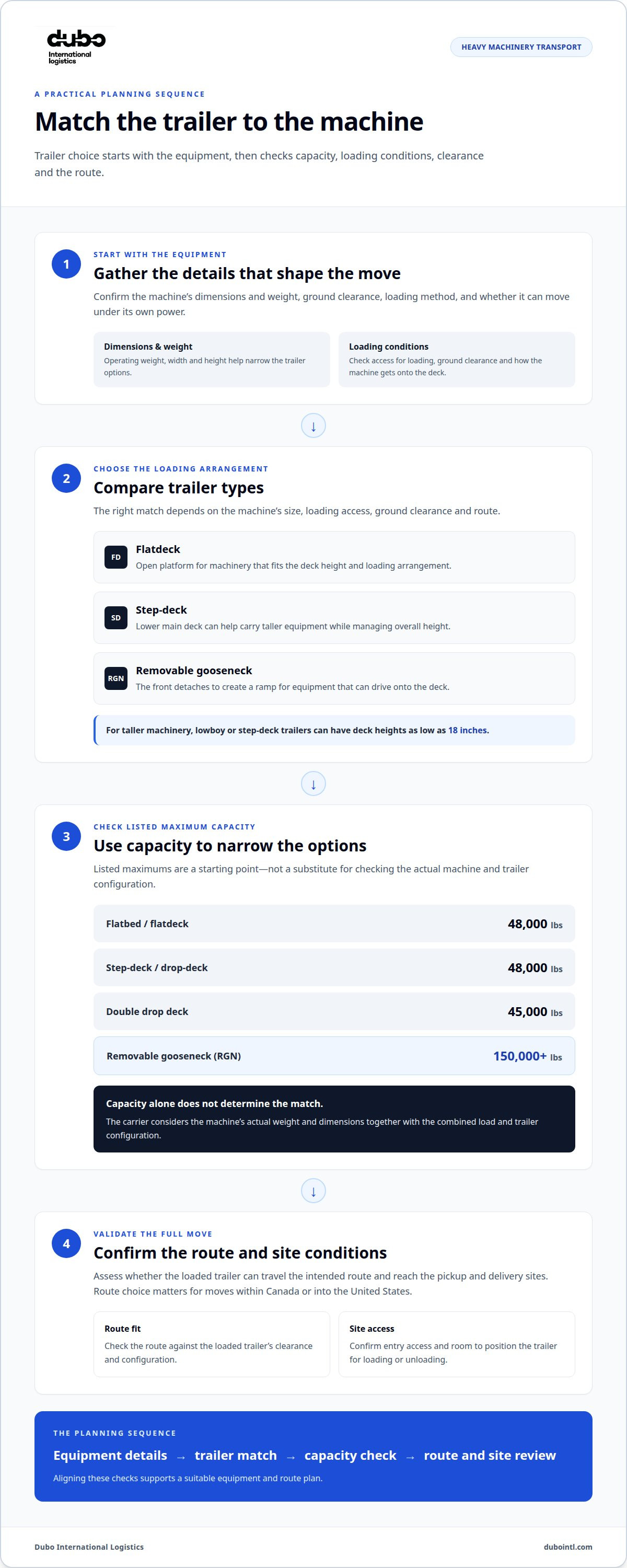
Excavators, bulldozers, cranes, and farm equipment often need a flatdeck, step-deck, or specialized trailer matched to their dimensions and weight. The right choice also depends on loading access, ground clearance, and the route within Canada or into the United States.
Flatdeck, Step-Deck, and RGN Selection
A flatdeck offers an open platform for machinery that fits its deck height and loading arrangement. A step-deck has a lower main deck, which can help transport taller equipment while managing overall height. A removable gooseneck (RGN) trailer detaches at the front to create a ramp for equipment that can drive onto the deck. Trailer selection takes into account machine dimensions, ground clearance, loading method, and route. A suitable match supports secure loading and safe transport.
Trailer Capacities and Load Capacity
Listed maximum weight capacities differ by trailer type. A flatbed and a step-deck or drop-deck trailer each have a maximum capacity of 48,000 lbs. A double drop deck is listed at 45,000 lbs, while a removable gooseneck is listed at 150,000+ lbs. These figures help narrow the options, but the machine’s actual weight and dimensions still matter. The carrier must consider the combined load and trailer configuration, rather than choosing by capacity alone.
Specialized Trailer Options
Some equipment needs a lower deck or additional axle support. Lowboy or step-deck trailers can have deck heights as low as 18 inches, helping accommodate taller machinery within available clearance. Multi-axle configurations can distribute heavier loads across more axles. For an oversized machine, a step-deck or double drop trailer may suit its height and loading needs. The carrier also assesses how the equipment will be secured and whether the route can accommodate the loaded trailer. These details shape a practical equipment and route plan.
Matching Trailers to Equipment
For excavators and bulldozers, trailer selection depends on operating weight, width, height, and whether the machine can load under its own power. A crane may need a specialized arrangement based on its configuration and the dimensions of the components being transported. Combines and other farm equipment also need a trailer suited to their size and loading access. Share accurate equipment details so the carrier can select a trailer for the specific shipment. This helps support safer loading and coordinate a suitable move across Canada or into the United States.
Oversize and Overweight Permits for Heavy Equipment
Oversized and overweight equipment moves need route-specific planning across Canada. If a shipment crosses provincial boundaries, permit requirements apply in each province along the route.
Provincial Oversize and Overweight Permits
Permit planning starts with the equipment’s dimensions and weight, trailer configuration, and intended route. Oversized or overweight loads need a permit for every province on the route, and requirements can vary by province and highway. For example, a trip through Ontario and Alberta must account for the rules in both jurisdictions. Route selection and permit planning should be handled together.
Axle configuration also matters. In Alberta, the listed maximum for a tandem axle with dual tires is 17,000 kg. A tridem axle with dual tires has a listed maximum of 21,000 kg for an axle spread from 2.4 m to less than 3.0 m, and 24,000 kg for a spread from 3.0 m to 3.1 m. These limits show why the loaded combination needs assessment, not just the machine’s total weight.
Permit conditions can also assign responsibility during travel. According to King’s Printer, Alberta, an overdimensional-permit holder moves the permitted object at their own risk and assumes full responsibility for damage to roads, bridges, or other property. That responsibility makes route and load details important before dispatch.
Escort Vehicle Requirements
Escort requirements depend on dimensions, province, and highway type. In Alberta, equipment shipments wider than 3.85 metres require escort vehicles. The listed requirements also distinguish between two-lane and four-lane roads, so the route can affect escort positioning and number. A wide load may therefore need a different plan on one road segment than another.
For Alberta loads over 12’6″ wide, one escort vehicle is positioned at the rear on two-lane roads and at the front on four-lane roads. Loads over 14’7″ wide on two-lane roads require two escorts, one at the front and one at the rear. On four-lane roads, loads over 14’7″ wide require one rear escort, while loads over 18′ wide require two escorts, front and rear.
Precise measurements are essential for planning. The transportation team considers the equipment’s width and proposed highways to determine where escorts are required. A route change can affect the escort plan, so permits, dimensions, and route details should stay aligned throughout coordination. For loads crossing several provinces, consider each jurisdiction’s permit and escort requirements for that part of the journey.
Jobsite Access and Delivery Preparation
Compare transport companies by their heavy-haul experience, safety records, and ability to plan around your equipment and route. Transit time between Canadian destinations depends on the origin, destination, route, permits, dispatch timing, and delivery-site access.
Delivery Site Access Preparation
Site access affects how a heavy-haul truck reaches the equipment and completes unloading. The transportation team needs the pickup and delivery addresses, a site contact, and details about the entry route. For an excavator, account for the space needed to position the trailer and load or unload the machine. Narrow entrances, limited turning room, and other site conditions can change the delivery approach.
Before pickup, clear loose dirt, mud, rocks, and debris from the equipment. A running machine can drive onto a trailer under its own power; a non-running machine needs winching or other assistance. The logistics plan should also identify who will be present at each location and what loading equipment is available. These details help the carrier prepare for actual site conditions instead of relying on assumptions.
Booking and Delivery Coordination
Start transport booking with the machine’s make, model, dimensions, weight, operating condition, and both shipment locations. Include the pickup and delivery contacts, plus any site instructions that affect access or loading. Planning heavy equipment moves at least 2 weeks ahead gives the transportation team time to coordinate equipment, routing, and scheduling. Urgent requests call for clear timing requirements, but delivery planning still depends on the shipment’s route and handling needs.
Fleet size alone does not show whether a company can handle a particular move. Compare its transportation history, safety record, and experience with the equipment and route. Ask how dispatch coordinates the assigned carrier, pickup window, delivery contact, and changes during transit. A relevant carrier network and clear coordination process can matter more than fleet size alone.
Timely delivery depends on aligning the dispatch plan with the shipment details. Changes to the machine’s dimensions, loading condition, or destination access can affect the arrangements. Provide accurate information when booking and keep pickup and delivery contacts available for coordination. If a non-running bulldozer needs winching, for example, include that requirement in the original plan rather than leaving it as a surprise at pickup.
Before dispatch, the transportation team can organize the shipment around confirmed locations, access instructions, equipment condition, and delivery timing. For long-distance hauling, the route and any required permits also shape the plan. Sharing complete details early helps coordinate the move as one operation, from loading at origin to access at the destination.
After selecting a transporter, provide third-party contact information and identify the pickup and delivery locations. Before choosing a flatbed hauler, confirm that the truck can accommodate the equipment and that suitable loading and unloading tools are available.
Heavy Machinery and Freight Types Transported
Heavy equipment transport covers more than construction machines. A 40-ton excavator is one example that calls for specialized transport, while combines and bulldozers can weigh several tons. These loads differ in their shape, operating condition, and handling needs. Those differences affect how a heavy-haul move is planned. Identifying the equipment type is a useful first step because a self-propelled machine and a large industrial component need different loading and coordination plans.
Construction equipment includes excavators, bulldozers, and other machinery used on active worksites. The equipment’s configuration matters as much as its general category. An excavator may travel as a complete machine, while a crane shipment may consist of separate components. Describe exactly what is moving, including its dimensions, weight, and loading condition. This lets the carrier assess the actual shipment rather than treating all machines as interchangeable.
Farm machinery brings its own transport considerations. Combines are a familiar example, but agricultural loads can also have wide or irregular profiles. A heavy-haul plan considers how to secure the machine and whether its configuration needs adjustment for transit. If it cannot operate under its own power, the loading plan must account for assistance at pickup. These details shape the move from the farm or equipment site through to delivery.
Industrial project cargo includes heavy assembly tools and large stamping presses. Such freight may be oversized, delicate, or difficult to handle because of its shape and weight distribution. The shipment plan accounts for the equipment’s characteristics, route, and transitions between transport legs. For a project moving between Canada and the United States, freight forwarding coordinates cargo across the full route instead of treating each leg as a separate task.
Freight can need specialized handling even when it is not classified as heavy machinery. Fragile equipment needs a plan that reflects its sensitivity, while temperature-sensitive products require attention to conditions during transit. For smaller project consignments, less-than-truckload (LTL) shipping can combine multiple shipments within shared trailer capacity. The right approach depends on the cargo’s handling needs and how its pieces fit into the overall move. Before planning transport, classify each item by dimensions, weight, fragility, and operating requirements.
ET Transport notes that heavy equipment such as combines and bulldozers often weighs several tons. This is one reason to identify cargo clearly before arranging a move. Describe whether the shipment is a complete machine, separate components, or another type of freight, and provide its dimensions, weight, and loading condition. Clear information helps the carrier assess the actual equipment rather than rely on assumptions based on its general category.
The same approach applies to construction, agricultural, and industrial cargo. Shape, operating condition, and handling needs can affect how a load is prepared and coordinated, especially when it involves more than one transport leg. Matching the plan to the shipment’s actual characteristics keeps these considerations connected from pickup through delivery.
Dubo International Logistics: Specialized Transportation Services
Dubo International Logistics coordinates specialized transportation for machinery and project cargo that needs more than a standard move. For heavy machinery transport in Canada, the company organizes the shipment around its cargo, route, carrier, and delivery requirements. This is especially relevant for oversized equipment, complex project moves, and freight travelling across Canada and the United States. The aim is a coordinated plan that accounts for the shipment’s specific needs from origin through delivery.
Specialized transportation supports cargo with unusual dimensions, delicate components, or specific handling needs. Examples include heavy assembly tools, large stamping presses, fragile equipment, and temperature-sensitive products. Each shipment needs a plan shaped by its characteristics, not a one-size-fits-all arrangement. Equipment dimensions, operating condition, pickup and delivery locations, and handling needs all inform coordination. Clear shipment details give the logistics team a sound basis for planning.
Freight forwarding coordinates the movement across transport legs. A project shipment may involve multiple stages or transitions through complex corridors. Dubo International Logistics coordinates freight movement and carrier relationships so the stages fit together. For cargo travelling between Canada and the United States, this approach aligns the transportation plan with the route and shipment requirements. Tracking systems and a carrier network support coordination for specialized transport deliveries.
Logistics consulting is useful when the challenge begins before dispatch. A project may need a route and transport plan that accounts for unusual cargo dimensions, site constraints, or several connected freight movements. Consulting helps organize these considerations into a practical logistics approach. For example, a large stamping press and its assembly tools may need coordinated project-cargo planning instead of being treated as ordinary equipment shipments. This keeps cargo details and the transportation plan aligned.
These services are relevant when machinery is oversized, fragile, temperature-sensitive, or part of a larger project move. They can also support shipments involving several connected transport stages across Canada or North America. Dubo International Logistics offers specialized transportation, freight forwarding, and logistics consulting to coordinate these requirements. The right combination depends on the cargo and the move, with planning focused on the shipment’s specific needs.
Prepare the equipment description, dimensions, weight, operating condition, origin, destination, and site contacts for the planning discussion. For a cross-border shipment, include the intended route and any timing requirements. These details help establish the scope of the move and identify the coordination it calls for. If your machinery requires a tailored transport plan, contact Dubo International Logistics to discuss the shipment.
Frequently Asked Questions
What heavy machinery transport services are available in Canada?
Options include specialized transportation, freight forwarding, and logistics consulting. Specialized transportation addresses unusual cargo requirements, while freight forwarding coordinates movement across connected transport legs. Logistics consulting can help shape a plan for a complex shipment before it moves. For example, a machinery project with several freight components may benefit from coordinated planning rather than treating each item as a separate move.
What information can equipment photos provide during transport planning?
Clear photos give the transportation team a visual reference for the machine’s configuration and condition. They can show attachments, protruding components, or features that written descriptions may miss. Include views from several angles and photograph detachable parts separately. Photos supplement, but do not replace, accurate measurements and equipment details. Together, they help the team understand what the shipment involves.
How can freight forwarding support a cross-border machinery shipment?
Freight forwarding coordinates cargo movement across domestic and cross-border transport legs. For a shipment between Canada and the United States, the logistics plan can connect the stages and account for handoffs along the route. This goes beyond assigning a truck to the first leg. It helps keep shipment information and movement planning aligned as cargo passes between stages.
What should I consider about insurance for heavy equipment in transit?
Review what the policy covers and how to make a claim before purchasing transport insurance. For machinery with detachable components, consider how the policy treats the equipment and its separate parts. Keep shipment records and equipment descriptions organized in case they are needed. Insurance terms depend on the policy, so read the coverage and claim process closely before the shipment moves.
Is there one maximum legal load limit across Canada?
There is no single maximum figure for every vehicle and load combination across Canada. Applicable limits depend on the province, vehicle configuration, and route. Axle arrangement can also affect how a loaded vehicle is assessed. For shipments crossing provincial boundaries, account for applicable limits along the route rather than relying on one national figure for every heavy-haul move.
Why can requirements change between provinces?
Provinces can set different requirements for oversized or overweight shipments, and the highways used may also affect the plan. A route crossing provincial boundaries needs a review for each jurisdiction. The transportation team maps the intended route and considers the relevant requirements for each segment. This helps identify where the plan may need to change as the shipment travels across Canada.
How do transport providers prepare machinery for loading and securement?
The loading method depends on the machine’s condition and the equipment available at pickup. Securement planning also reflects the cargo’s shape, configuration, and transport arrangement. Share details about attachments or components that may affect handling. The transportation team can then coordinate a loading and securement plan suited to the shipment, rather than applying the same arrangement to every piece of equipment.
What are the risks and common delays in heavy machinery transport in Canada?
Delays can arise from permit coordination, dispatch timing, route requirements, and limited delivery-site access. Unexpected route changes can increase costs by 15-25%; in Alberta, permit holders are responsible for damage to roads, bridges, or other property.

