

Handling time-sensitive shipments takes more than choosing the transport option that looks fastest. If cargo needs special handling or delivery depends on a precise handoff, speed alone may not protect your schedule.
That pressure is familiar to Canadian businesses. A missed delivery window can interrupt production, affect customer commitments, or delay a project. Unclear deadlines and shipment-readiness details make coordination harder. A sound plan starts by defining when the cargo must arrive and what needs to be in place for it to move safely and efficiently.
This article explains how to set a clear delivery requirement, identify cargo and route considerations early, and compare transport approaches against the shipment’s actual needs. It also covers how complete shipment information and proactive monitoring help keep everyone aligned. As a freight forwarding and logistics consulting partner, Dubo International Logistics coordinates North American cargo movement, including specialized transportation for oversized machinery, delicate equipment, and temperature-sensitive products. A considered plan helps balance urgency with cargo requirements and operational risk.
Key Takeaways
- Separate a firm operational deadline from a preference for faster delivery so the transport plan reflects what is truly at stake.
- For handling time-sensitive shipments, assemble origin, destination, cargo dimensions, handling needs, readiness, and delivery-window details before coordinating transport.
- Compare standard freight, LTL freight shipping, and dedicated expedited transport by deadline fit, cargo characteristics, handling needs, and coordination complexity.
- Use tracking updates to understand shipment progress and respond to meaningful handoffs or schedule changes, without treating visibility as a guarantee against disruption.
- Dubo coordinates freight forwarding across North America, with specialized transportation for oversized machinery, delicate equipment, and temperature-sensitive products. Learn more at www.dubointl.com.
What makes a shipment time-sensitive, and what is at stake?
A time-sensitive shipment is freight that must arrive within a meaningful delivery window to support an operational need, meet a commitment, or preserve cargo condition. The urgency comes from what depends on delivery, not simply from a preference to receive the goods sooner.
Time-sensitive freight is cargo whose arrival within a defined window is necessary to meet an operational, customer, project, or product-condition requirement. When handling time-sensitive shipments, distinguish a firm deadline from a preferred earlier arrival. A fixed deadline calls for a plan built around the consequences of delay, while a preferred date may leave more flexibility in transport selection and coordination.
Consider a component arriving after a production line is scheduled to use it, or equipment reaching a project site after the planned installation sequence has moved on. A delay may also affect a customer delivery commitment or, for temperature-sensitive products, the conditions needed to maintain product integrity. In production environments guided by Just-in-time (JIT) manufacturing principles, the timing of incoming materials can be closely connected to inventory and production planning.
How to tell whether a delivery deadline is truly critical
Start by naming the operational event that depends on arrival. Is the freight needed for a production run, an installation, a project milestone, or a customer handoff? Then distinguish a contractual or production milestone from an internal target date. This makes clear which dates are firm and where the plan may have room to adjust.
Assign ownership as well. Identify who is accountable for the deadline and who needs updates if the shipment’s status or plan changes. Clear responsibility helps teams act on relevant information instead of relying on assumptions.
Which cargo needs closer handling attention?
Delivery timing is only one part of the requirement. Delicate equipment may need careful loading, secure positioning, or handling instructions that shape how it can move. Temperature-sensitive products call for planning around the required conditions throughout transit, rather than being treated like general freight. The cargo’s characteristics should inform the transport plan from the outset.
Oversized machinery may also require tailored coordination because its dimensions and handling needs affect equipment selection and movement planning. Early in the process, document the cargo’s size, weight, handling requirements, readiness, and any condition-related needs. Then connect those details to the delivery window. This gives the logistics team a clearer basis for coordinating the shipment and managing operational risk.
How to plan handling time-sensitive shipments from the outset
Good coordination starts before dispatch. Treat the shipment as a connected plan: the delivery window, cargo requirements, readiness, route, documents, and updates all need to align. Clear cargo details and a defined deadline give every party a reliable basis for coordinated freight planning.
Use this workflow to organize decisions in sequence:
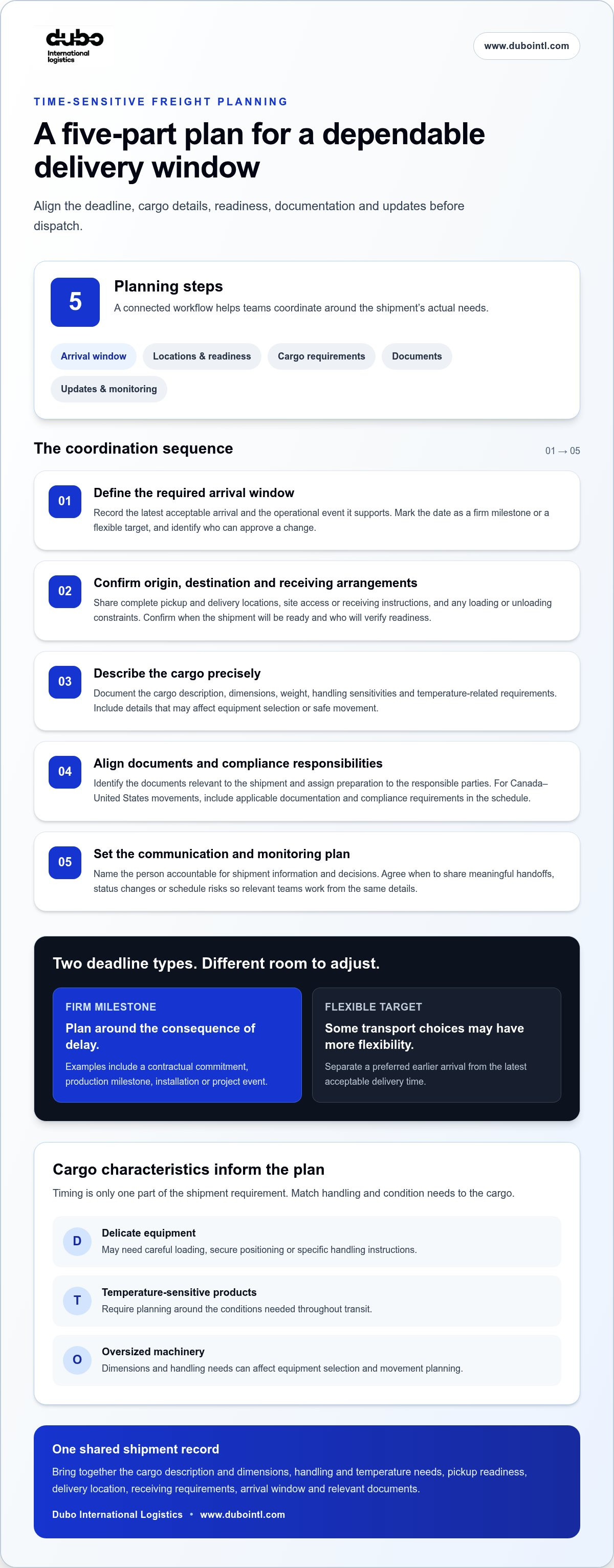
- Define the required arrival window. Record the latest acceptable delivery time and the operational event it supports. Note whether the date is a firm milestone or a target with flexibility, and identify who can approve a change.
- Confirm origin, destination, and receiving arrangements. Provide complete pickup and delivery locations, site access or receiving instructions, and any constraints that affect loading or unloading. Clarify when the shipment will be ready and who will confirm its readiness.
- Describe the cargo precisely. Record the cargo description, dimensions, weight, handling sensitivities, and any temperature-related requirements. Include details that may affect equipment selection or safe movement instead of relying on a general label such as “machinery.”
- Align documents and compliance responsibilities. Identify the documents relevant to the shipment and assign preparation to the responsible parties. For Canada-United States movements, build applicable documentation and compliance requirements into the schedule rather than leaving them until the last minute. Requirements depend on the shipment, and accurate information supports coordination.
- Set the communication and monitoring plan. Name the person accountable for shipment information and decisions. Agree when meaningful handoffs, status changes, or schedule risks should be shared, then keep the relevant teams working from the same shipment details.
What shipment details should be aligned before dispatch?
Bring cargo, timing, and delivery information together in one record. Include the cargo description and dimensions, handling and temperature needs, pickup readiness, delivery location, receiving requirements, and required arrival window. List relevant shipment documents and identify who is preparing each one. A shared reference reduces conflicting instructions and gives the logistics partner a clearer foundation for coordinating freight movement.
How should teams coordinate changes and handoffs?
Assign one accountable contact to maintain shipment information, relay updates, and bring decisions to the right people. Agree in advance which changes require prompt communication, such as a revised readiness time or a risk to the delivery window. For cross-border planning, align route coordination with Canada-USA freight forwarding. NetSuite’s overview of Just-in-Time inventory management and its impact on supply chains also explains why shipment timing can connect directly to inventory planning.
These steps make handling time-sensitive shipments easier to coordinate because they replace assumptions with shared, actionable information. Dubo International Logistics provides freight forwarding and logistics coordination support.
How to compare transport approaches for a time-sensitive shipment
The right transport approach balances the delivery window with cargo characteristics, handling requirements, route needs, and the consequences of delay. The fastest apparent option isn’t automatically the best fit. A shipment may need dedicated coordination, or it may have enough flexibility to move through a shared-capacity service.
Use this comparison as a starting point. The best fit depends on the shipment details and movement plan.
| Approach | Deadline fit | Cargo characteristics and handling | Coordination complexity |
|---|---|---|---|
| Standard freight | May suit shipments with a workable delivery window and flexibility around transit planning. | Can fit general freight when dimensions and handling needs align with the planned movement. | May support a routine plan, though accurate shipment details and clear handoffs remain essential. |
| LTL freight shipping | May be suitable when the delivery window allows for shared capacity. | Multiple shippers share trailer capacity, so assess dimensions, loading requirements, and handling sensitivities together. | Shared capacity may involve coordination across the shipment’s handling and movement stages. |
| Dedicated expedited transport | May merit consideration when a defined deadline is tied to a meaningful business consequence. | Can be considered when urgency, sensitivity, or specific handling requirements call for a tailored plan. | Requires alignment of the deadline, cargo information, route needs, and shipment updates. |
For cargo-specific considerations, Dubo’s specialized freight North America buyer guide can help frame the planning questions. Businesses assessing dedicated expedited transport can also review Dubo Expedited as a relevant service option.
When does expedited transport merit consideration?
Consider expedited planning when the delivery window is firm and a delay could disrupt a production, project, or customer commitment. Weigh cargo sensitivity and route requirements alongside urgency. Delicate equipment, temperature-sensitive products, or oversized machinery may call for handling and movement plans that influence the choice. The objective is to match the approach to the shipment’s needs, not to assume speed alone resolves risk.
When might standard freight or LTL freight shipping fit?
Standard freight or LTL freight shipping may fit when the shipment has timing flexibility and its cargo requirements work with the planned movement. With LTL freight shipping, multiple shippers share trailer capacity, so consider whether the delivery window and handling needs suit that arrangement. Neither approach is automatically preferable. The right fit depends on the deadline, cargo, and coordination required.
When handling time-sensitive shipments, compare each option against the same criteria: required arrival window, cargo characteristics, handling needs, and the operational impact of delay. This gives the decision a clear basis and keeps transport selection connected to the shipment’s priorities.
How to monitor a shipment and prepare for schedule changes
Monitoring helps teams see how a shipment is progressing and whether planned handoffs remain aligned with the delivery window. Tracking is an information source, not a guarantee that delays or other disruptions won’t occur. Its value depends on what the team does with the information.
Shipment visibility is most useful when clear ownership turns updates into timely decisions and coordinated action. For handling time-sensitive shipments, agree on how updates will reach the accountable contact and which changes require a prompt response. A practical rhythm follows meaningful events, such as a pickup, a planned handoff, a change in status, or a potential effect on the delivery window, rather than relying on arbitrary check-ins.
What should teams monitor during transit?
Use available tracking information to follow shipment status and planned handoffs, then compare updates with the agreed delivery window. For sensitive cargo, monitor relevant handling conditions in line with product requirements. Tracking systems can support visibility, but teams should interpret information in context and clarify any material discrepancy through the agreed communication channel.
- Review status updates against the planned movement and delivery window.
- Pay attention to expected handoffs and any change to their timing.
- For sensitive cargo, follow relevant condition information when available and appropriate to the shipment.
- Escalate a material change promptly to the accountable contact.
This keeps monitoring focused. Teams can distinguish routine progress from a change that could affect a production, project, or customer commitment.
What should happen when the schedule changes?
Respond with a defined sequence rather than forwarding an alert without context. First, confirm the revised shipment information and what it means for the delivery window. Then notify the accountable contact and affected receiving teams so they can assess operational implications. Finally, review available coordination options with the logistics partner without assuming that any particular recovery outcome is possible.
- Confirm the reported change and its potential effect on arrival.
- Identify which delivery, production, project, or customer commitments may be affected.
- Inform the people responsible for decisions and receiving arrangements.
- Assess the available next steps and communicate the agreed plan to affected teams.
Keep a record of key updates and decisions so teams share the same understanding of the shipment’s status. This is particularly useful when a change affects several handoffs or requires receiving plans to be adjusted.
Dubo International Logistics uses tracking systems and a network of reliable carriers to support specialized transportation deliveries. For logistics coordination that connects shipment visibility with cargo requirements and operational priorities, learn about Dubo International Logistics.
How Dubo coordinates time-sensitive freight across North America
Urgent freight calls for a plan that connects the delivery requirement with cargo needs, route considerations, and shipment information. Dubo International Logistics coordinates freight forwarding and logistics consulting across Canada, the United States, and the broader North American market, helping businesses organize cargo movement around each shipment’s priorities.
Specialized transportation solutions address oversized machinery, delicate equipment, and temperature-sensitive products. Cargo dimensions and handling needs inform how movement is coordinated, while tracking systems and a network of reliable carriers support specialized transportation deliveries. Tracking can inform decisions as a shipment progresses, but it doesn’t guarantee that disruptions won’t occur.
What Dubo brings to complex shipment coordination
Freight forwarding connects carrier coordination and shipment documentation with the wider movement plan. Keeping those elements aligned with cargo requirements and the delivery objective helps maintain a coherent view of the shipment from planning through delivery. Dubo’s professional freight forwarding in North America guide provides further context on coordinated planning for cargo movement across the region.
Dubo is a member of the Canadian International Freight Forwarders Association (CIFFA). For complex freight, the planning conversation can centre on how cargo details, route needs, and transport coordination fit together, rather than treating carrier selection as the only decision.
How to take the next step with a shipment plan
To start planning, gather the cargo description and dimensions, origin and destination, delivery requirement, pickup readiness, handling considerations, and relevant shipment documents. For cross-border freight, include the route and applicable documentation needs so they can inform coordination. Sharing this context helps shape a plan around the shipment instead of relying on a standard approach.
When considering dedicated expedited coordination, Dubo’s Dubo Expedited service information can help inform how the shipment’s priorities and requirements may guide the plan. Plan your next shipment with Dubo International Logistics by sharing the details that matter to your operation.
Notre équipe peut vous aider à planifier une solution fiable, efficace et adaptée à vos besoins.
Build a steadier path for your next urgent shipment
Urgency is easier to manage when it becomes a deliberate planning decision rather than a last-minute reaction. Use each shipment to sharpen how your team defines critical deadlines, assigns decision-making responsibility, and prepares for changes. Over time, this can make handling time-sensitive shipments more consistent across departments, even as cargo needs and routes differ.
For your next move, bring the delivery requirement and cargo details into the planning conversation early. A clear starting point helps your logistics partner shape an approach around the shipment’s real priorities and gives your team a stronger basis for coordinating the work.
Plan your next shipment with Dubo International Logistics. A thoughtful plan helps your team move forward with greater clarity and confidence.
Frequently Asked Questions
What information should I prepare before arranging a time-sensitive shipment?
Prepare a clear cargo description, dimensions, handling requirements, pickup readiness, origin, destination, delivery window, and relevant documents. Explain what operational event depends on arrival, such as a planned installation or production activity, and name the contact responsible for updates and decisions. This helps the logistics partner understand which details are firm and where coordination may need attention as the shipment plan develops.
Does every time-sensitive shipment require expedited transport?
No. Handling time-sensitive shipments starts with comparing the actual delivery window and impact of delay with the cargo’s characteristics and route needs. Expedited transport may be worth considering when a firm deadline supports a critical operation, while standard freight or LTL freight shipping may fit if the schedule and handling requirements allow shared capacity. Choose based on the shipment’s needs, not speed alone, and avoid assuming a particular transit result.
Can temperature-sensitive products be handled as time-sensitive freight?
Yes. Plan the delivery window together with the product’s temperature-related handling requirements, and share relevant instructions early so they can inform the transport plan. For example, a product needed for a scheduled production process may have both a specific arrival window and cargo-condition considerations. Dubo provides specialized transportation solutions for temperature-sensitive products, with planning shaped by the shipment’s stated requirements rather than assumed specifications.
How does shipment tracking help with a tight delivery window?
Tracking information gives teams visibility into shipment progress and can help them follow planned handoffs or review a change against the delivery window. It doesn’t prevent disruptions or guarantee arrival by a particular time. Assign someone to review updates, determine whether action is needed, and communicate decisions to affected teams. Dubo uses tracking systems to support specialized transportation deliveries, helping connect shipment information with coordination.
What should I do if a time-sensitive shipment is delayed?
Confirm the latest shipment information first, then assess which operational commitments may be affected. Notify the accountable contact and relevant receiving teams so they can adjust plans based on the revised information. Next, review coordination options with your freight partner and agree on who will communicate any decisions. Avoid treating an initial update as a confirmed new arrival time until the revised plan has been assessed.
Why can cross-border time-sensitive shipments need additional planning?
Canada-United States movements require shipment details, applicable documentation, and current compliance requirements to be considered alongside transport timing. Early coordination helps responsible parties identify information gaps and align tasks before dispatch. Requirements can depend on the shipment, so avoid relying on assumptions or applying a generic checklist to every movement. Dubo’s cross-border freight forwarding resources provide context for aligning shipment information with transport planning.
Ready to move your next shipment? Visit www.dubointl.com. Notre équipe peut vous aider à planifier une solution fiable, efficace et adaptée à vos besoins.
