

The lowest FTL quote can leave important questions unanswered. When reviewing FTL freight quotes Canada to US, the amount matters, but so do the shipment details and service assumptions behind it. A quote based on incomplete cargo information or unclear border responsibilities may not give you a reliable basis for planning.
To compare options, look beyond the quoted amount. Check what information each provider used, which services and responsibilities are included, and how the cross-border move will be coordinated. Comparing the same details across quotes helps you assess whether a provider’s approach suits your shipment.
This guide explains what can affect a full truckload quote, which cargo and route details to prepare, and what to ask about documentation, border coordination and operational safeguards. It also explains how a freight forwarding partner such as Dubo International Logistics can coordinate cross-border cargo movement, helping you compare providers with greater confidence.
Key Takeaways
- FTL freight quotes Canada to US depend on the shipment details, route, requested service and stated assumptions. Check what each quote includes.
- Prepare accurate origin and destination details, pickup readiness, delivery requirements, cargo dimensions, weight, quantity and handling needs.
- Compare quotes based on the same confirmed requirements, then assess service scope, timing, communication and assigned responsibilities.
- Confirm which documentation requirements apply to your shipment and agree who is responsible for each cross-border coordination step.
- For freight forwarding coordination across Canada and the United States, learn more about Dubo International Logistics at www.dubointl.com.
What an FTL freight quote from Canada to the US should cover
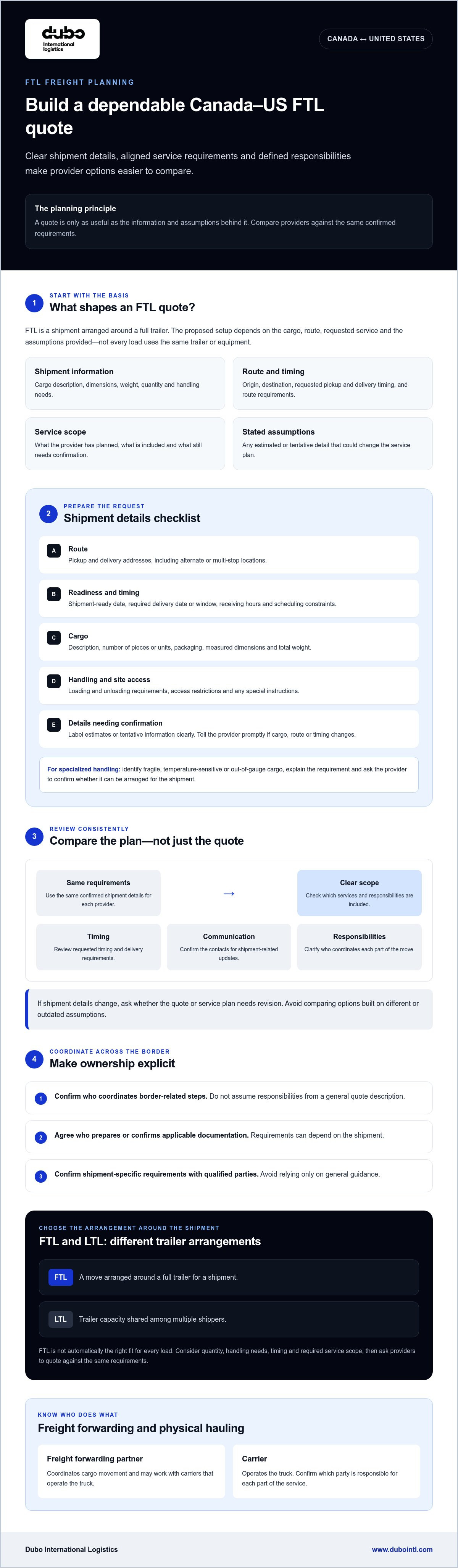
An FTL freight quote is an estimate for moving a shipment arranged around a full trailer. It is based on the cargo, route, requested service and assumptions provided. FTL describes how the shipment is arranged, not a promise that every load will use the same trailer or equipment. The right setup depends on the shipment’s requirements.
A quote is only as useful as the information behind it. The origin, destination, cargo description, dimensions, weight and requested timing help a provider assess the move. The quote should also state its assumptions and service scope, so you can see what has been planned and what still needs confirmation.
There is a difference between arranging freight and physically hauling it. A freight forwarding partner coordinates cargo movement and may work with carriers that operate the truck. Ask who is responsible for each part of the service instead of assuming the company providing the quote is also the truck operator. For a general explanation of the shipping mode, see Truckload shipping.
How FTL differs from LTL freight shipping
LTL freight shipping shares trailer capacity among multiple shippers, while an FTL move is arranged around a full trailer for a shipment. FTL is not automatically the right fit for every load. Before requesting either option, consider the shipment’s quantity, handling needs, timing and required service scope. Then ask providers to quote against the same requirements.
Why Canada-to-US quote assumptions matter
For FTL freight quotes Canada to US, provide the precise origin and destination, cargo details, and requested pickup and delivery timing. These details shape the proposed route and service plan. If any information is tentative, label it as an assumption and ask how a change could affect the plan.
Cross-border coordination also requires clear ownership. Ask who will coordinate the shipment’s border-related steps and who is responsible for preparing or confirming applicable documentation. Requirements can depend on the shipment, so confirm them with qualified parties rather than relying on a general quote description. For broader context, consult a published cross-border freight forwarding guide and verify its guidance against your shipment’s specific circumstances.
A useful quote request is more than a destination and a load description. It gives providers a shared, accurate starting point and lets you compare what each has included. Learn more about Dubo International Logistics at www.dubointl.com.
What shipment details help produce a dependable FTL quote
For an FTL quote, provide the shipment’s origin and destination, pickup readiness, delivery requirements, confirmed cargo description, dimensions, weight, quantity and handling needs. Clear details give the provider a sound basis for assessing the requested service. Use this checklist to prepare your quote request:
- Route: Pickup and delivery addresses, including any alternate or multi-stop locations.
- Readiness and timing: The date the shipment will be ready, the required delivery date or window, and any scheduling constraints.
- Cargo: Description, number of pieces or units, packaging, measured dimensions and total weight.
- Handling: Loading and unloading requirements, site access restrictions and any special instructions.
- Shipment changes: Identify details that are estimated or still subject to confirmation.
Accuracy matters. If the cargo quantity, measurements, route or timing changes after you request a quote, the original assumptions may no longer apply. Tell the provider promptly and ask whether the quote or service plan needs to be revised. This helps you avoid making decisions based on outdated shipment information.
Cargo and handling information to gather
Confirm the measurements and weight, and describe how the goods are packaged and loaded. Where applicable, note whether the cargo is fragile, temperature-sensitive or out-of-gauge. Share any handling instructions that could affect the move. Do not assume specialized equipment is available. Explain the need and ask the provider to confirm whether the requested handling can be arranged for your shipment.
Pickup, delivery, and timing requirements
Record the pickup and delivery locations, readiness date, receiving hours and any site restrictions. Flag appointment requirements, loading or unloading arrangements, and the best contacts for shipment-related communication at each location. State the requested timing plainly, including whether a delivery window is acceptable, then ask the provider to confirm what its proposed service can accommodate.
For cross-border movements, include the route and shipment information needed to identify documentation and coordination questions. Requirements can vary by shipment and routing. If merchandise will transit Canada, review the applicable U.S. Customs regulations for in-transit shipments and confirm requirements with qualified parties. Do not assume that one shipment’s documentation process applies to another.
Specific cargo needs may call for a discussion about specialized transportation. Explore specialized transportation options and visit www.dubointl.com to learn about Dubo’s freight forwarding and logistics coordination.
How to compare FTL freight quotes without focusing only on the amount
Start by comparing quotes based on equivalent information. Ask each provider to quote the same confirmed cargo, route, timing and service requirements. Otherwise, differences may reflect different assumptions rather than a better operational fit. For FTL freight quotes Canada to US, assess the coordination plan as carefully as the quoted amount.
Use the comparison to find gaps, not to fill them with assumptions. Before accepting a quote, follow up on any vague exclusion, unconfirmed requirement or unclear handoff. For cross-border shipments, identify who will confirm applicable documentation and reporting responsibilities. The Canada Border Services Agency’s guidance on Canadian export reporting requirements can help you identify questions to raise with qualified parties. Confirm how requirements apply to your specific shipment.
Questions to ask before accepting a quote
Ask which shipment details and service requirements the quote is based on, and whether any assumptions still need confirmation. Clarify who coordinates updates, how changes to cargo or timing are handled, and which responsibilities remain with you. Request specific answers in writing. That gives both parties a clear reference if the shipment plan changes.
Assessing reliability and carrier coordination
Ask the provider to explain its carrier vetting process and how it reviews a carrier’s suitability for your shipment. Discuss the communication practices and shipment visibility available for the move, along with the appropriate contact if an issue arises. Do not assume every provider offers the same processes or level of visibility.
For broader provider-selection criteria, consult a freight forwarding guide alongside your quote review. Dubo International Logistics coordinates freight movement across Canada and the United States. Learn more about its freight forwarding and logistics services at www.dubointl.com.
Canada-US FTL: Preparing for Cross-Border Coordination
A cross-border move is easier to coordinate when shipment details, documentation responsibilities and communication expectations are settled before pickup. Clear shipment information and assigned responsibilities give each party a shared understanding of the cargo, required documents and next steps.
Use this sequence to prepare:
- 1. Confirm the shipment facts. Verify the cargo description, quantity, dimensions, weight, origin, destination and requested timing. Identify any estimates and agree how you will confirm them.
- 2. Confirm readiness and site conditions. Check when the cargo will be ready, how pickup access works, what loading arrangements are needed and whether the delivery site has receiving hours, access limits or other requirements.
- 3. Identify documentation roles. Ask which documents apply to your shipment and who will supply, review and communicate them before movement. Requirements vary with the shipment and its circumstances, so confirm them with qualified parties. A logistics provider can coordinate agreed shipment information, but that role is not legal or regulatory advice.
- 4. Agree on communication and responsibilities. Record the main contacts, who provides updates, who handles each agreed coordination task and how changes or exceptions should be reported.
- 5. Confirm the plan before movement. Review the final shipment details, timing, site arrangements and open questions with the relevant parties. If a material detail changes, communicate it promptly and confirm whether the plan needs to be reviewed.
Confirm shipment readiness and responsibilities
Readiness involves more than a date on a request. The cargo must be prepared for the agreed pickup, and people at each site should understand their roles. For example, confirm who will coordinate loading and who should receive delivery updates. Keep the agreed contacts and change-notification process in writing so responsibilities stay clear if plans shift.
Plan for specialized or non-standard cargo needs
Flag out-of-gauge machinery, fragile equipment or temperature-sensitive products before requesting a quote. Describe the handling needs and ask how the provider assesses carrier suitability and cargo-specific requirements. Do not assume a standard FTL arrangement includes specialized equipment or handling. If the shipment has these needs, consult a specialized freight buyer’s guide for additional planning considerations before confirming the service.
Dubo International Logistics coordinates freight movement across Canada and the United States, including specialized transportation for cargo with specific requirements. For support assessing cross-border freight forwarding and coordination needs, contact Dubo International Logistics.
Choosing an FTL freight partner for Canada-to-US shipments
Choose a partner based on how well its coordination approach fits your shipment, not on the quote alone. Consider four points:
- Shipment fit: Can the provider address the cargo’s dimensions, handling needs, timing and route?
- Coordination scope: Are the included services and each party’s responsibilities clearly stated?
- Communication: Do you know who will provide updates and how changes or exceptions will be handled?
- Verified credentials: Can the provider explain how it assesses carrier suitability and substantiate relevant credentials?
Ask for clarification wherever the proposed service or responsibilities remain uncertain. If a provider refers to CIFFA membership, confirm its current status and approved wording before treating it as a decision factor.
When freight forwarding adds coordination value
For a shipment involving several parties or specific handling needs, freight forwarding can help coordinate carriers and shipment communication. The right scope depends on your requirements, so ask what coordination the provider will undertake and what remains with your team or other parties. For related planning considerations, consult a published end-to-end freight management guide.
Dubo International Logistics coordinates freight movement across Canada and the United States as a freight forwarding partner, rather than presenting itself as the physical truck operator. Its role may suit a shipment that needs coordinated cross-border movement. Confirm the specific scope and responsibilities for your load directly.
What to include in an initial discussion with Dubo
Prepare the route, cargo profile, shipment readiness, requested timing and any handling requirements. Include special considerations, such as fragile, temperature-sensitive or out-of-gauge cargo, if they apply. Then ask how Dubo would coordinate the shipment, which responsibilities it can take on, and what your team or other parties would need to manage.
Clear answers can help you decide whether the proposed coordination fits your operation. If you’re considering FTL freight quotes Canada to US, contact Dubo International Logistics through its website to discuss your shipment requirements.
Make your next FTL decision with clarity
A dependable FTL plan starts with accurate shipment information. For useful FTL freight quotes Canada to US, provide confirmed cargo and timing details, compare providers against the same requirements, and clarify coordination and documentation responsibilities before proceeding. These steps help you assess more than the quoted amount. They show whether the proposed service fits the shipment and whether key responsibilities are understood.
Partner credentials can also inform your decision. Dubo International Logistics coordinates freight forwarding across Canada and the United States. If CIFFA membership is part of your assessment, verify its current status and approved wording directly before relying on it as a trust signal.
Have a shipment in mind? Discuss your Canada-to-US freight requirements with Dubo and outline your route, cargo profile, readiness, timing and handling needs. This conversation can help you assess whether the coordination approach suits your operation. Agreeing on the details and responsibilities in advance can help you move forward with greater confidence.
Frequently Asked Questions
What information do I need to request an FTL freight quote from Canada to the US?
Provide the pickup and delivery locations, cargo description, shipment quantity, confirmed dimensions and weight, pickup readiness, requested timing and handling requirements. Note any site access, loading, unloading or delivery appointment needs. For cross-border freight, ask which documentation requirements may apply and who is responsible for confirming and supplying the relevant information. Clear shipment details help providers assess the requested service and state their assumptions.
Is FTL freight shipping the same as LTL freight shipping?
No. FTL is arranged around a full trailer for a shipment, while LTL freight shipping shares trailer capacity among multiple shippers. These are distinct service choices, and FTL does not automatically suit every load. Consider the shipment’s size, quantity, handling needs and timing, then ask providers which option fits your requirements. Confirm the service scope for the specific move rather than assuming every FTL shipment uses identical equipment or arrangements.
How much detail should I include when asking for an FTL quote?
Include enough confirmed information for a provider to assess the route and service: origin, destination, cargo description, quantity, dimensions, weight, packaging, readiness date and delivery requirements. Describe any fragile, temperature-sensitive or out-of-gauge cargo, along with relevant handling instructions. If a measurement or date is still an estimate, label it clearly. This helps the provider identify assumptions and ask follow-up questions before you compare the quote with other proposals.
What happens if my shipment details change after I receive a quote?
Tell the provider as soon as you know a quoted detail has changed. A revised cargo quantity, measurement, route, readiness date or delivery requirement may affect the assumptions behind the proposed service. Ask whether the quote or coordination plan needs to be updated, and get confirmation before proceeding based on the changed information. Clear communication helps all parties work from the same shipment details instead of planning around an outdated request.
Can a freight forwarder coordinate an FTL shipment from Canada to the US?
Yes. A freight forwarder can coordinate cargo movement and carrier communication without necessarily operating the truck. Confirm which shipment steps the provider will coordinate, who will provide updates and which responsibilities remain with you or other parties. Dubo International Logistics coordinates freight forwarding across Canada and the United States. To discuss your shipment’s requirements, visit www.dubointl.com.
How do I compare two Canada-to-US FTL freight quotes?
Compare quotes based on the same confirmed cargo, route, timing and service requirements. Review what each quote includes, its assumptions and exclusions, the communication plan, and who is responsible for each shipment step. Ask about carrier suitability and how changes will be handled. If a quote leaves a requirement unconfirmed or a responsibility unclear, request clarification before choosing. This helps you assess operational fit, not just the quoted amount.
