

A production-line delivery needs more than a truck dispatched quickly. Freight management for manufacturers coordinates supplier pickups, carrier assignments, shipment tracking and escalation, helping teams spot an at-risk delivery before the production window closes.
A late component can disrupt a carefully sequenced production schedule, so speed alone is not enough. Reliable coordination depends on clear delivery windows, suitable carrier capacity and timely communication when shipment status changes.
This article explains how managed transportation supports urgent inbound freight and helps multi-plant operations coordinate carriers and routing guides. It also covers how transportation management systems and freight software support planning, visibility and reporting, and how capacity planning can reduce avoidable disruption. The focus is practical: match each shipment’s urgency and handling needs to the right process instead of relying on a last-minute dispatch.
Key Takeaways
- Assess carrier coverage and performance by plant and lane to match service, capacity and equipment needs.
- Pair shipment visibility with clear escalation paths so teams can respond when a production-line delivery is at risk.
- Align transportation technology with existing business systems and plan for capacity constraints with advance forecasting and backup options.
- Coordinate the documents and requirements that apply to each domestic or cross-border shipment, based on its route and cargo.
- Use freight audits and operational data to identify recurring delays, service issues and opportunities to improve the program.
Multi-plant carrier network management
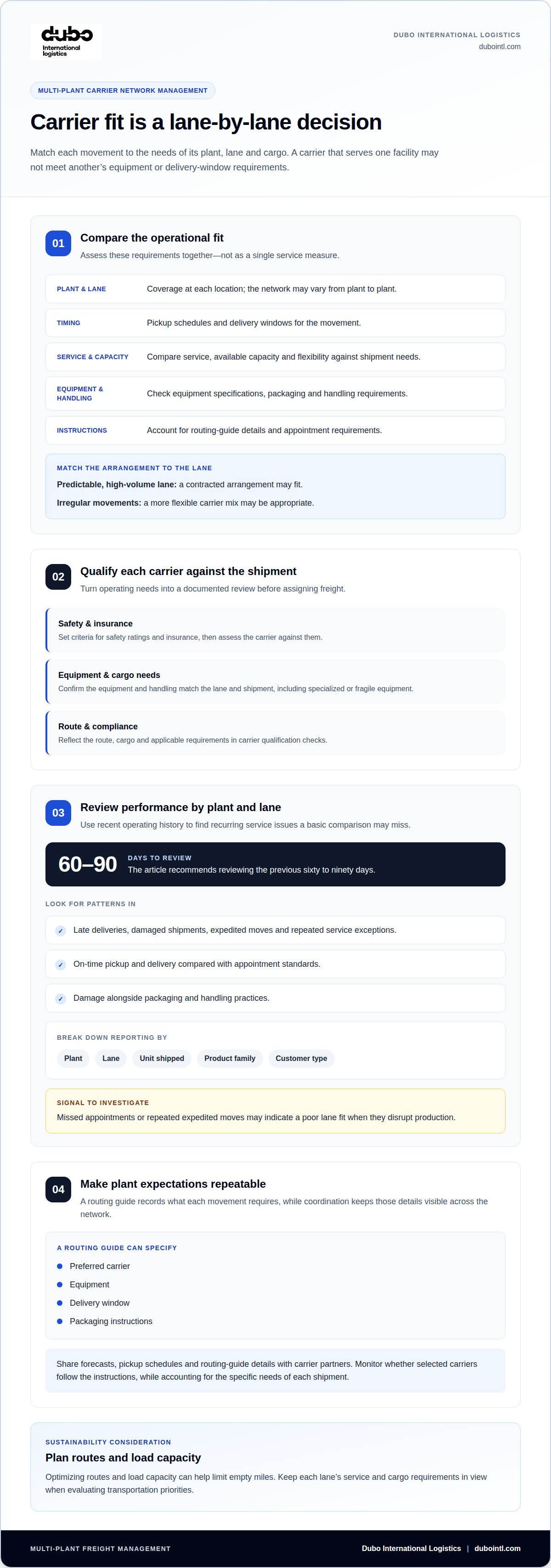
For manufacturers with plants in different regions, assess carrier coverage by location and lane. A network that serves one facility may not meet another plant’s equipment or delivery-window needs. Effective freight management for manufacturers compares these requirements across the full network.
Carrier Selection and Service Comparison
Carrier comparisons weigh service, capacity, flexibility and shipment requirements. This helps manufacturers select the right fit for each lane rather than treating one measure as the only consideration.
Compare options against plant locations, pickup schedules, delivery windows, equipment needs and routing-guide instructions. For example, a predictable, high-volume lane may suit a contracted arrangement, while irregular movements may call for a more flexible carrier mix. Packaging and appointment requirements also matter for customer shipments, since missed instructions can disrupt customer receiving processes. These comparisons help teams assess the trade-offs for each lane.
Service and Carrier Performance Analysis
Performance analysis connects freight service with the results delivered on each lane. It helps teams identify recurring issues that a service comparison alone might miss.
Providers can review the previous sixty to ninety days for late deliveries, damaged shipments, expedited moves and repeated service exceptions. They can compare on-time pickup and delivery against appointment standards, then examine damage alongside packaging and handling. Reporting performance by plant, lane, unit shipped, product family or customer type gives decision-makers a clearer view than a network-wide average.
A carrier may not suit a lane if missed appointments or repeated expedited movements disrupt production. A useful comparison considers shipment planning and operating effects, not just the carrier’s service offering.
Carrier Selection and Relationships
Carrier selection matches each movement to a carrier’s capabilities and service record. Strong working relationships help plan capacity and communicate shipment requirements across plants.
Manufacturers can balance contracted capacity for predictable lanes with flexible options for irregular or time-sensitive freight. Assess coverage at each plant instead of assuming one carrier’s network reaches every location. Sharing forecasts, pickup schedules and routing-guide details with carrier partners supports clearer planning. This coordination is a practical part of freight management for manufacturers with varied plant needs.
Carrier qualification turns operational requirements into a documented review before freight is assigned. Manufacturers can set criteria for safety ratings, insurance and equipment specifications, then assess each carrier against the relevant lane and cargo needs. For specialized or fragile equipment, matching equipment and handling to the shipment helps protect it in transit. Compliance checks should reflect the route, cargo and applicable requirements.
Routing guides make plant-level expectations easier to apply across the network. A guide can identify the preferred carrier, equipment, delivery window and packaging instructions for a movement. Providers coordinate these details across suppliers, plants and customers, then monitor whether the selected carrier follows instructions. That structure helps multiple locations apply consistent requirements without treating every shipment as identical.
To reduce freight emissions, optimize routes and load capacity to help limit empty miles. Manufacturers can also consider these factors when setting transportation priorities and evaluating carrier performance. This supports sustainability planning while keeping each lane’s service and cargo needs in view.
What role does technology play in freight management?
Technology connects shipment milestones, documents and operational decisions. For manufacturers, its value lies in turning status changes into timely, useful action.
Shipment Tracking and Visibility
Shipment tracking records a load’s progress and makes its status visible to the teams coordinating production and delivery. This helps planners see whether inbound materials remain on schedule or could affect a production window.
A transportation management system can centralize shipment events, such as tender acceptance, pickup and delivery confirmation. Teams can use these updates to distinguish shipments moving as planned from those that need attention, rather than relying on separate messages and manual status checks.
Real-Time Information Sharing
Real-time information sharing passes shipment updates between the transportation team and connected business systems as events occur. Planners can then act on current information instead of making decisions from an outdated status report.
For example, managed transportation integrations can receive shipment orders from an ERP, trigger automated tendering, then return tracking and delivery-confirmation data. This shared record gives production and procurement teams a common view of the movement and reduces duplicate updates across departments.
Technology also helps teams organize exceptions around production needs. An inbound shipment alert can flag a delivery at risk before the production window closes, giving the responsible team time to assess the impact and coordinate a response. Visibility works best when every alert has an assigned owner and a defined escalation path.
Paperwork Reduction and Shipment Cycle Times
Freight systems reduce manual paperwork by automating shipment scheduling, tracking and documentation tasks. Fewer repeated entries can reduce administrative handoffs that slow shipment processing.
When an ERP sends order information into transportation workflows, teams can avoid re-entering the same shipment details in separate tools. Automated document handling can also make records easier to retrieve when operations need to confirm what was tendered, scheduled or delivered. The technology supports smoother processing, but accurate source data remains essential.
Cycle-time improvements depend on how well systems and processes connect. If order data arrives late or needs correction, automation cannot remove that delay. A useful implementation maps where information enters, who reviews exceptions and when shipment records return to the ERP.
Visibility and Escalation Processes
Visibility and escalation processes connect shipment alerts to clear response steps. A status signal alone cannot protect a production schedule unless someone can assess and act on it.
For a component shipment approaching its required delivery window, the system can flag an at-risk status and direct it to the responsible operations contact. That person can coordinate with relevant teams, assess schedule implications and document the next action. Clear ownership keeps an exception from sitting unnoticed in a dashboard.
Technology supports freight operations when data, people and decisions work together. Manufacturers seeking coordinated freight forwarding support can connect shipment visibility with the planning and communication their movements require.
Capacity, regulatory, and technology challenges
Manufacturing freight plans face three connected pressures: available carrier capacity, shipment-specific requirements and systems that exchange accurate data. A component delayed on a constrained lane can affect production, while disconnected logistics tools can make the disruption harder to manage.
Capacity planning starts with forecasts. Use planned production volumes, supplier schedules and known seasonal patterns to anticipate demand on key lanes. For example, if a plant expects a production ramp, early load forecasts give carriers more time to plan equipment and driver availability. Backup carrier options and contingency routes give operations alternatives when a preferred movement cannot proceed as planned.
Not every shipment can use the same equipment or service. A standard pallet load and an oversized machine component have different transport needs, so a capacity plan must account for dimensions, handling and delivery timing. Route optimization can improve load factors and reduce empty miles. Consolidating compatible shipments may also help use available trailer capacity, provided schedules and cargo requirements align.
Technology creates another challenge when an ERP, transportation management system and carrier network hold separate versions of shipment data. Interoperability means these systems can exchange information consistently, reducing duplicate entry and mismatched records. A practical integration maps fields such as pickup location, delivery address, shipment references and required dates. Open technology standards can support connections across different platforms, but teams still need clear data ownership and agreed processes for correcting errors.
Delivery technology is useful when it supports a specific operational decision. For instance, electronic proof of delivery can help a receiving team confirm a component arrived, while a route-planning system can account for traffic or weather information. Choose tools that fit the shipment’s requirements and existing workflows. Selecting technology by function, rather than feature count, keeps the broader logistics process manageable.
Regulatory demands depend on the cargo and route. Dangerous-goods freight, for example, requires appropriate handling, packaging and transportation controls. Cross-border movements also involve different documentation and safety requirements from domestic deliveries. Coordinate shipment information with the parties responsible for each movement so cargo details, route plans and supporting records remain aligned.
Proactive planning links these challenges. A manufacturer can connect production forecasts to capacity planning, match each component with suitable equipment and define how shipment data moves between systems. When a lane becomes constrained, this structure helps operations consider alternatives without losing sight of delivery windows, cargo requirements or applicable rules.
What Canadian regulations and documents apply to domestic freight and cross-border shipping?
There isn’t one document set for every Canadian freight movement. Requirements depend on the cargo, route and whether the shipment crosses a national border. A domestic shipment of ordinary manufactured goods has different considerations from a load containing dangerous goods or a shipment moving between Canada and the United States. Freight managers coordinate the shipment details with the requirements that apply to its specific movement.
For domestic freight, start with accurate shipment information: what the goods are, where they are going, how they must be handled and when delivery is expected. These details help carriers plan equipment and delivery, and help everyone involved follow consistent instructions. For example, make special handling instructions clear before pickup, not after dispatch.
Dangerous goods require particular attention. Their transport involves specific handling, packaging and transportation regulations in Canada. Applicable requirements depend on the goods and their classification, so cargo details must be accurate before the shipment is planned. If a manufacturer ships dangerous goods, the freight process must account for the relevant requirements rather than treating the load like ordinary freight.
Cross-border shipments add documentation and coordination between countries. Overseas freight shipments may require customs documentation, invoices, bills of lading and certificates of origin. The documents that apply depend on the shipment and its route. A freight forwarder can coordinate cargo movement and documentation across borders, while the shipper provides accurate details about the goods and transaction. For example, a certificate of origin relates to where goods originate, so the shipment’s product information must support the document.
Route planning matters because a movement that begins in Canada may pass through jurisdictions with different documentation, tariff and safety requirements. Account for the route and coordinate relevant records with the parties responsible for each stage. A document mismatch, such as inconsistent cargo descriptions across shipment records, can complicate a handoff or delay progress. Clear, consistent information helps carriers and other parties coordinate the movement.
- Domestic movement: Confirm cargo description, handling needs, pickup and delivery details.
- Dangerous goods: Identify the goods accurately and account for applicable handling, packaging and transportation rules.
- Cross-border movement: Coordinate relevant customs documents, invoices, bills of lading and certificates of origin.
Before dispatch, bring the cargo description, route, handling instructions and required records together. This coordination helps manufacturers avoid treating every shipment alike and keeps documentation aligned with the actual movement. A domestic load, a dangerous-goods shipment and an international shipment each call for planning suited to their requirements.
How to implement freight management in manufacturing?
Implementing a freight program means connecting shipment processes to production priorities. The work typically moves from a baseline review to network design, system setup, launch and ongoing performance analysis.
- Review current freight activity. The provider examines inbound materials and outbound finished goods, then maps plants, suppliers, customers, routes and shipping processes. A review of late deliveries, damage and expedited moves helps identify patterns. The findings establish a baseline for improvements and show where production schedules face transportation risk.
- Define the operating requirements. The provider works with manufacturing, procurement and shipping teams to document delivery windows, shipment volumes, cargo characteristics and plant-specific needs. For example, an assembly line relying on a scheduled component needs its delivery requirement reflected in the transportation plan. Inbound and outbound movements should be considered together.
- Design the carrier and routing approach. Using lane requirements and shipment patterns, the provider sets out carrier roles, routing-guide instructions and alternatives for constrained movements. A predictable lane can be planned differently from irregular or time-sensitive freight. Plant-level coverage and equipment requirements inform the design, while clear instructions help suppliers and carriers follow the same process.
- Connect systems and shipment data. The provider maps order details, shipment references, tendering, tracking and delivery confirmation between the manufacturer’s ERP and transportation workflows. Do not assume managed transportation ERP integration takes 2-4 weeks; confirm the timeline for the specific implementation. Before launch, the teams define who owns data corrections and how exceptions reach the people responsible for production decisions.
- Prepare the launch. The provider aligns operating procedures with the new routing and communication process. A controlled rollout can begin with selected lanes or plants, allowing the team to resolve issues with shipment data, carrier instructions or delivery updates before extending the program. Supplier and plant contacts need clear roles during this transition.
- Measure and refine performance. After launch, the provider reviews pickup and delivery performance, shipment cost, carrier results and recurring exceptions. If one lane repeatedly needs expedited movements, the team can investigate planning, supplier schedules or capacity assumptions. Regular review keeps the program connected to actual manufacturing needs as volumes and routes change.
Implementation works best when the manufacturer supplies reliable shipment and production data, while the provider coordinates the transportation design and execution. A freight program should account for plant differences rather than forcing every location into one process. Discuss freight program planning to connect transportation decisions with manufacturing requirements.
Dubo International Logistics: Freight forwarding
Dubo International Logistics coordinates freight forwarding for manufacturers managing domestic and cross-border cargo movements. When shipments involve multiple plants, complex corridors or cargo with specific handling needs, its logistics consulting can help align transportation planning with operational requirements.
For oversized machinery, fragile equipment or temperature-sensitive products, Dubo International Logistics also provides specialized transportation services. This support is relevant when standard freight arrangements do not fit the cargo, equipment or delivery plan. Manufacturers can bring shipment details, origin and destination, timing needs and handling requirements into the planning discussion.
To discuss freight forwarding or transportation planning for your manufacturing shipments, contact Dubo International Logistics.
Build a freight program around your production priorities
The next step is to connect transportation decisions with the way your manufacturing operation plans and adapts. A freight program should support the realities of your production schedule, shipment requirements and business priorities, rather than add another disconnected process. A clear view of what needs coordination helps identify where professional support will be most useful.
Dubo International Logistics offers freight forwarding, logistics consulting and specialized transportation services for manufacturers managing distinct cargo and movement requirements. These services can bring transportation planning into focus, particularly when shipments involve complex routes or equipment that calls for specialized handling.
Discuss your manufacturing transportation needs with Contact Dubo International Logistics. A well-planned approach can give your team a clearer path forward and support confident decisions as production needs evolve.
Frequently Asked Questions
How does managed transportation handle time-sensitive production-line deliveries?
Managed transportation links the required arrival time to shipment planning and exception response. For a component needed before a scheduled production run, the provider coordinates pickup timing, carrier assignment and delivery updates around that deadline. If updates indicate a potential delay, the team can assess its effect and communicate with relevant operations contacts. This gives production planners time to consider options instead of discovering the issue at the receiving dock.
What are the benefits for shippers and freight forwarders?
Shippers gain coordinated movement planning and clearer shipment information, while freight forwarders can align carrier activity with each shipper’s priorities. For example, a manufacturer shipping to several customers can keep delivery instructions consistent across orders. Shared expectations also help reduce repeated status requests and clarify who handles an exception. The benefit depends on accurate shipment details and timely communication among the shipper, provider, carriers and receiving locations.
What should manufacturers look for in a managed transportation provider?
Look for a provider whose operating approach fits your freight profile, not just your shipment volume. Ask how it handles unusual cargo, changing production schedules, cross-border movements and communication during exceptions. A useful discussion should establish who coordinates each handoff, how performance is reviewed and how the provider adapts when requirements change. Also consider whether the provider’s experience matches the complexity of your lanes and cargo.
What is freight management for manufacturers and what services does it include?
Freight management for manufacturers is the coordination of transportation for incoming materials and outgoing products. Depending on the arrangement, it can include shipment planning, carrier coordination, booking, tracking, documentation and performance reporting. The scope should reflect how the manufacturer moves goods, rather than assume every operation needs the same support. A manufacturer with project cargo, for example, may need specialized transportation planning alongside routine freight coordination.
How can a freight management provider help Canadian manufacturers improve shipping efficiency?
A provider can identify avoidable freight activity by examining how shipment patterns affect operations. For example, recurring small loads on the same route may prompt a review of shipment timing and consolidation options. Better alignment between supplier readiness and pickup schedules can also limit unplanned expedited movements. The right changes depend on cargo compatibility, delivery commitments and production needs, so assess service performance against operational requirements.
What operational factors shape freight management requirements for manufacturers in Canada?
Requirements reflect where goods move, how production uses them and what each shipment needs in transit. A plant receiving components from several suppliers may need different pickup coordination from one shipping finished products to customers. Cargo dimensions, handling needs, delivery appointments and cross-border routes also affect planning. Seasonal production changes or a new supplier can shift lane demand, so the freight process must accommodate updates without disrupting established routines.
What should manufacturers assess when choosing between in-house freight management, brokers, 3PLs, and freight management software?
Compare the work each option performs, the internal oversight it requires and how well it fits your shipment mix. An in-house team retains direct control but needs capacity to coordinate daily movements. Brokers generally arrange transportation for shipments, while 3PL arrangements can cover a broader range of logistics coordination. Software supports internal processes but doesn’t replace operational ownership. The right model depends on desired control, internal expertise and coordination complexity.
What freight management software features should manufacturers ask a provider about for quoting, booking, tracking, and reporting?
Ask how the platform handles shipment details from quote through delivery, and how users can identify incomplete or changed information. For quoting and booking, clarify how requirements and carrier responses are recorded. For tracking, ask how exceptions are surfaced and assigned. For reporting, assess whether results can be reviewed by lane, plant or shipment type. Also discuss how the system exchanges data with existing business tools and supports corrections.

