

What happens to your booth freight when one trade show closes and the next begins before there’s time to reset? Freight logistics for trade shows must account for more than the distance between venues: the outgoing load-out, the next event’s delivery window, and the handoff between carriers or show teams all affect the move. A missed appointment can disrupt the schedule and delay booth setup.
A direct transfer may seem simpler than sending freight back to its origin, but show schedules and venue procedures still require careful coordination. This guide explains how shipments move between events, what expedited handling can address, and how material handling differs from carrier shipping. It also covers the documents, timing, freight preparation, and transport choices that shape a reliable plan, including considerations for trade shows in Canada and cross-border events.
Key Takeaways
- Use the exhibitor packet to align delivery appointments, move-in windows and freight requirements with the event schedule.
- Plan transfers between shows around load-out timing, the next venue’s delivery process and any final-mile coordination.
- Keep freight identification and shipment details consistent to help reduce delivery errors, including for separate small-package shipments.
- Account for material handling separately from transportation, and confirm how the event handles each.
- Match the transport plan to the cargo’s size, handling needs and schedule, especially for cross-border events in North America.
What is Unique About Shipping to a Trade Show?
Trade show freight must meet event-specific deadlines, delivery appointments, and move-in schedules. The exhibitor packet sets the requirements that shape each shipment’s arrival plan.
Delivery Deadlines and Move-In Windows
A move-in window is the scheduled period when exhibitors can receive freight and prepare displays. The exhibitor packet sets the deadlines and instructions, so the carrier’s timing must fit the event schedule.
Some events assign each booth a delivery date and time based on its floor location. Two exhibitors at the same show may therefore have different target times. If freight arrives outside its appointment, booth preparation can be delayed or disrupted. The timing plan needs to account for transit, the assigned arrival slot, and the event’s setup sequence.
Event instructions may also set shipment size or weight limits and pickup deadlines. These requirements influence vehicle selection and delivery timing. Treating the event date as the only deadline can mean overlooking an earlier appointment or a scheduled end to move-in.
Direct-to-Show Shipping and Event Requirements
Direct-to-show shipping sends freight to the venue for delivery within its assigned window. The carrier must follow the event’s receiving instructions, which may include a delivery appointment, a designated arrival point, and booth identification.
This approach ties the truck’s arrival closely to the venue’s schedule. A carrier arriving too early or too late may not be able to complete the planned handoff. The exhibitor packet helps establish the right timing and any shipment restrictions. Labels that clearly identify the event, booth, and contact person help the venue direct displays correctly.
For example, if a booth has a timed delivery slot, the dispatch plan should coordinate the route with that appointment. The shipment’s dimensions and handling requirements also inform how the carrier prepares for delivery.
Tracking, Timing, and Delivery Appointments
Freight tracking records progress against planned arrival and pickup appointments. Shipment updates help the logistics team coordinate the next handoff if transit timing changes.
Some venues use an offsite marshaling yard to organize trucks by arrival time and delivery location. The carrier needs the correct instructions for reaching the assigned point. A missed delivery appointment can disrupt booth preparation; delays, damage, or lost freight may leave displays unavailable when the event opens. Suitable packaging, clear labels, and active shipment monitoring help manage these risks.
Pickup appointments matter, too. The outbound plan should fit the event’s load-out schedule and identify who will collect the freight. Matching the carrier’s arrival to the venue’s process helps prevent a gap between dismantling and collection.
Cross-Border Documents
Documents for shipments entering Canada depend on the goods and their import circumstances. Agriculture and Agri-Food Canada advises exhibitors to check customs and import regulations, as well as any licences required for sample products.
Display materials and product samples may have different documentation needs. Identify the shipment contents and intended use early, then coordinate the required paperwork before dispatch.
For cross-border freight, incomplete or inconsistent shipment details can complicate border processing and affect the event delivery schedule. Accurate descriptions and coordinated documentation help align the border crossing with the venue’s assigned appointment.
How can a freight provider ship your freight from one trade show directly to another?
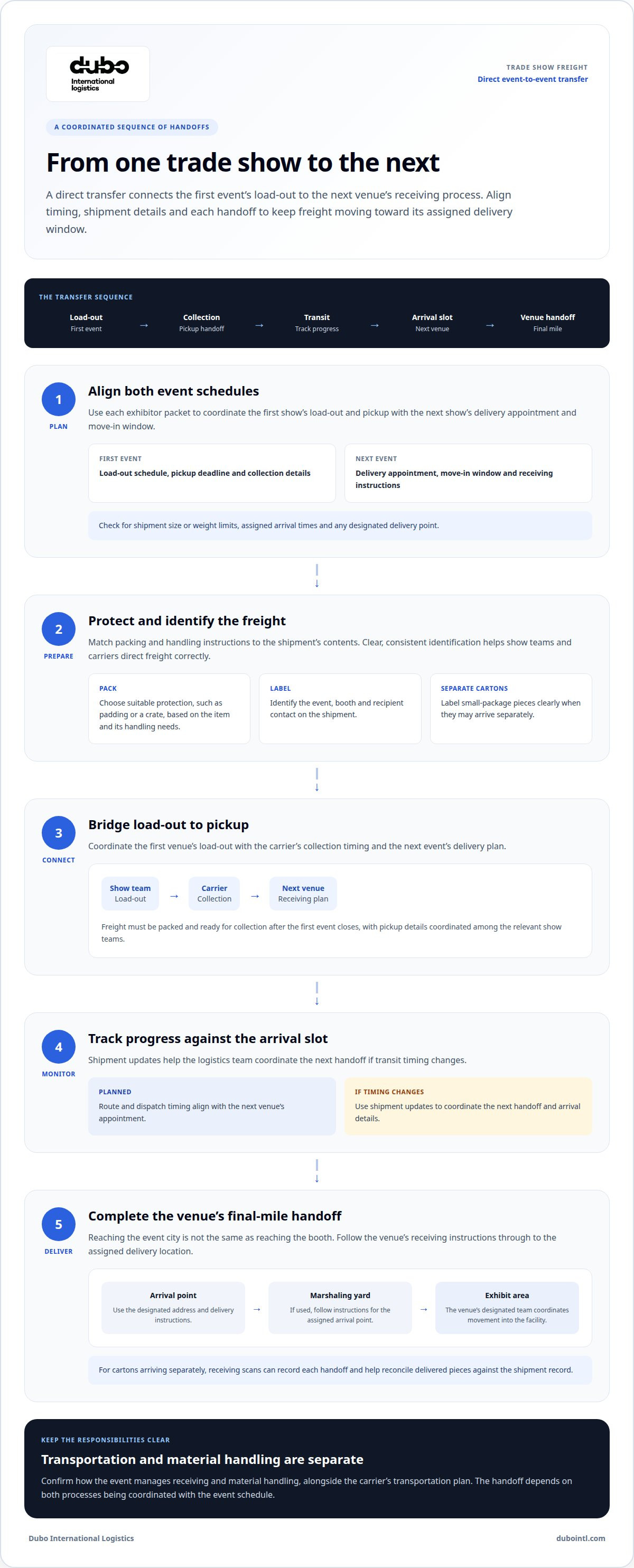
A direct transfer links the first event’s load-out to the next venue’s receiving process. Coordinating each handoff helps protect displays and keep the shipment aligned with both events’ deadlines.
Venue Delivery and Final-Mile Logistics
Final-mile logistics cover the movement from the local arrival point to the exhibit’s assigned delivery location. Reaching the city does not mean the freight has reached the booth.
Some venues use an offsite marshaling yard to organize trucks by arrival time and delivery location. The carrier needs the yard address and the venue’s delivery instructions so dispatch can route the load correctly. From there, the venue’s designated team coordinates movement into the facility and toward the exhibit area.
For a direct transfer between events, the plan connects the first venue’s load-out with the next event’s delivery appointment. The freight provider coordinates pickup timing, transport, and arrival details with the relevant show teams. For example, a display packed after one event closes must be ready for collection before it can travel to the next facility.
Small-package freight needs piece-level controls. If cartons arrive separately over multiple days, each can be treated as a separate shipment. Labels should show the event and booth name, plus a contact person’s details. Receiving scans can record each carton’s handoff and help reconcile delivered pieces against the shipment record.
Packing, Labelling, and Insuring Freight
Logistics providers can advise on packing, labelling, and insurance based on the freight’s contents, handling needs, and route. This guidance matters for high-value exhibit materials, which may pass through several handling points between events.
For packing, a provider can assess whether displays need protective padding, a crate, or another suitable form of protection. The method should match the item: a fragile demonstration unit needs protection against movement, while a large display component needs secure handling during loading and unloading. Clear instructions help carriers handle the freight consistently.
Labels should identify the event, booth, and recipient contact, with shipment details kept consistent across cartons and paperwork. For insurance, discuss the declared value, coverage terms, and any exclusions that apply to the cargo and route. These details clarify what protection is in place during transit.
For high-value freight, record its condition and contents before dispatch, then document any visible damage at delivery. A clear inventory and matching piece count make discrepancies easier to identify before the exhibit is assembled at the next event.
Transporting freight between trade shows
A successful transfer connects two event schedules, not just two cities. Booth freight can be heavy and travel a long distance, so the load-out, route, and next venue’s receiving plan must work together. Effective freight logistics for trade shows treat each handoff as part of one continuous movement, from release at the first event to acceptance at the next.
A transportation provider typically coordinates the move through these stages:
- Confirm the next event’s requirements. The provider aligns freight details with the receiving venue’s delivery instructions, appointment process and deadline. The next show’s location and opening schedule help determine when the shipment must leave the first event.
- Coordinate the first venue’s load-out. The carrier needs a pickup plan that fits the event’s move-out sequence. Freight can’t travel until it has been released, packed and made ready for collection, so the driver’s arrival must account for the venue’s process.
- Match equipment to the shipment. The provider considers the cargo’s dimensions, weight and handling needs when arranging transportation. A large display component and a set of cartons require different loading plans. For fragile or high-value freight, clear handling instructions guide each transfer.
- Choose a suitable route and mode. Ground transportation can connect nearby events, while air freight can support urgent, time-sensitive deliveries. The route should reflect venue locations and the required arrival window. According to the Bank of Canada, indirect routes through larger foreign hubs can lengthen transit and increase supply-chain disruption risk.
- Coordinate delivery and the next handoff. The carrier’s plan should connect arrival with the venue’s receiving process. The provider tracks progress against the deadline and coordinates load-out and return shipping with show organizers. This links the first pickup to the next delivery instead of treating each show as a separate move.
Timing needs to allow a realistic interval between one event’s close and the next required delivery appointment. That interval must account for load-out, freight preparation, transit, and receiving. A strict schedule with little time between shows leaves less room to respond to a late release or transport delay. For example, a booth dismantled later than planned may miss its scheduled pickup sequence.
International transfers add border coordination to the schedule. Shipment details and documentation need to support the planned movement into the destination country, while the receiving appointment remains fixed. Border processing can affect the available transit window, so include it in the overall transportation plan.
The practical takeaway is to align the first show’s release, driver pickup, route, and next venue’s receiving slot before the transfer begins. A coordinated plan for freight logistics for trade shows connects these milestones and gives the provider a clear sequence to manage. Trade show carriers also need to coordinate load-out and return shipping with organizers, so each handoff follows the event’s requirements.
How does trade show freight shipping work in Canada?
In Canada, trade show freight follows a planned sequence: event instructions shape transport, venue delivery, and outbound release. The exhibitor arranges a carrier for transport to and from the show, while the event’s official carrier handles on-site movements. That division makes accurate venue details and forms essential for each handoff.
The shipment plan usually brings together these stages:
- Confirm the venue’s receiving details. The event’s instructions identify delivery requirements and any marshaling-yard location. These yards are typically within a few miles of the show grounds. The carrier needs both the yard address and the venue location, so the shipment is routed to the correct receiving point.
- Prepare freight for its journey. Exhibit materials may need custom crates, padding or specialized labels. Packaging should suit the cargo, while labels should identify the show and booth. For example, separate display pieces marked for the same exhibit are easier to connect during receiving and delivery.
- Coordinate arrival and on-site movement. The carrier delivers the freight according to the event’s process. The official carrier then manages movement from the carrier’s vehicle to the booth. Some shows also require scale tickets showing truck weight when empty and loaded for event records.
- Arrange outbound release. The exhibitor submits an outbound shipping form that names the carrier. The show uses this information to release freight to the driver after the event. Without the form, the shipment may be sent using the show’s official carrier, so the exhibitor may have less control over the outbound arrangements.
Outbound planning should begin before the exhibit closes. The carrier’s name and pickup arrangements need to match the form, and freight must be ready for collection under the event’s load-out process. A mismatch between the named carrier and the arriving driver can interrupt release, leaving the shipment at the venue longer than planned.
Cross-border exhibits add import preparation to the Canadian process. Agriculture and Agri-Food Canada advises exhibitors to check customs and import regulations, as well as any licences required for sample products. Product samples may have different requirements from display materials, so shipment details should identify what is being transported.
For freight moving by air, sea, or land, the transport mode shapes the route and handoffs. Clear shipment descriptions, coordinated paperwork, and accurate venue instructions connect border movement with the event schedule. The key is a single plan that follows freight from carrier pickup through on-site delivery and outbound release, rather than treating each stage as a separate booking.
Treat receiving and release details as linked parts of one plan: the freight carrier needs both the marshaling-yard address and trade show location, while the outbound form must identify the carrier. That identification allows release to the driver; without the form, the show may use its official carrier, leaving the exhibitor with less control over the arrangements.
Dubo International Logistics: Freight forwarding
Dubo International Logistics can coordinate trade show freight through freight forwarding, logistics consulting and specialized transportation services. These offerings are relevant when a shipment involves multiple event deadlines, cross-border movement, or cargo that needs particular handling. Instead of treating each leg as a separate booking, freight forwarding coordinates movement across the route and its handoffs.
For a show-to-show transfer, planning starts with the shipment’s requirements: what the cargo is, where it must go, and when each venue can receive it. Event schedules, pickup arrangements, and delivery instructions shape the transport plan. Logistics consulting can bring those moving parts together, particularly when the next event begins soon after the previous one ends.
The right transportation plan depends on the freight. Standard exhibit materials may need a different arrangement from oversized machinery, delicate equipment, or temperature-sensitive products. Dubo International Logistics provides specialized transportation for unique cargo requirements, coordinating movement around the shipment’s physical needs. This matters for exhibitors whose freight requires more planning than a routine, easily handled load.
For trade show freight moving across Canada and the United States, freight forwarding can coordinate domestic and cross-border cargo movement. The route, transport mode, and handoff points all affect how the shipment connects with the event schedule. A planner can bring these details into one coordinated movement, including the transition from one show’s outbound process to the next venue’s receiving arrangements.
Tracking systems and a network of carriers support coordination for specialized transport deliveries. Shipment visibility helps the logistics team follow progress and manage the transport plan as the freight moves. It does not remove the need to coordinate event deadlines, but it gives the team information to work with when arranging the next handoff.
Exhibitors can use logistics consulting to align shipment details with event timing, assess cargo-specific transport needs, or plan a complex route. The service is particularly relevant when freight has unusual dimensions, requires careful handling, or must connect several transport stages. These are planning decisions, not simply a choice between faster and slower shipping.
For organizations planning freight logistics for trade shows, Dubo International Logistics offers a coordinated point of expertise for freight forwarding and specialized transportation. The company’s website is www.dubointl.com. A clear discussion of the event schedule, cargo requirements, origin and destination gives the logistics team a practical basis for planning.
Contact Dubo International Logistics to discuss your trade show freight requirements.
Frequently Asked Questions
What information should exhibitors provide to a logistics provider to ship materials to a trade show venue?
Provide enough shipment detail for the provider to match transport arrangements to the exhibit. Include the event and venue, booth assignment, delivery contact, shipment contents, piece count, dimensions, weight, and any handling considerations. For example, identify a display panel that must remain upright. For cross-border goods, describe samples separately from display equipment so the paperwork reflects each item.
How do advance warehouse and direct-to-show-site shipping differ?
An advance delivery option sends freight to an event-designated receiving facility before it moves to the booth; direct-to-show-site shipping schedules delivery at the venue. The difference is the timing and location of the first event handoff. Advance delivery follows the facility’s receiving period, while direct delivery depends on the venue’s appointment. The event’s instructions and the shipment’s readiness determine which sequence best fits the exhibit plan.
What are Canadian trade show drayage, material handling, and labour fees?
Drayage describes short-distance freight movement associated with an event. Material handling covers movement from the carrier’s vehicle toward the exhibit area, while labour refers to event work such as assembling or dismantling booth components. These are distinct operational services, even when they occur during the same move-in or move-out period. The event’s service documents describe the scope and arrangements for each category.
What are the shipping deadlines and delivery windows for Canadian trade shows?
Each event sets its own deadlines and delivery windows, so use that show’s instructions rather than assume a standard Canadian schedule. The assigned appointment can depend on the booth’s location and the venue’s move-in sequence. Distinguish the inbound delivery period from outbound pickup arrangements, too. A show may require freight to arrive before exhibitors can begin setup, even though the event itself opens later.
How can a logistics provider coordinate return shipping and post-show freight pickup?
A provider coordinates return movement by aligning the carrier’s pickup plan with the event’s release process and the freight’s destination after the show. Before dispatch, outbound instructions should identify the carrier and match the shipment’s labels. For example, if exhibit components are returning to different destinations, identify each group clearly. The provider can then coordinate the pickup sequence and connect it with the next leg.

