

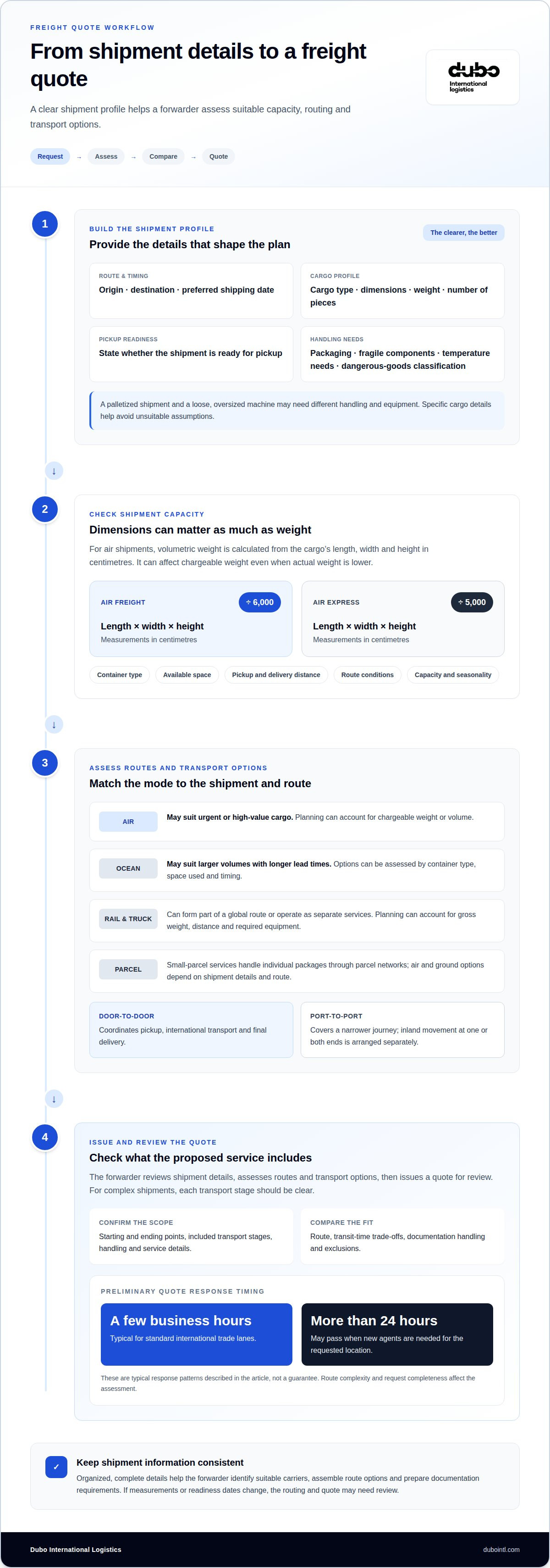
Could a bulky shipment be assessed differently from one of the same weight that takes up less space? Yes. For air freight, volumetric weight is calculated by multiplying the cargo’s length, width and height in centimetres, then dividing by 6,000; for air express, the divisor is 5,000. These calculations are part of the freight forwarder quoting process, alongside the shipment’s actual weight and route details.
Accurate cargo information helps shape a quote around the shipment rather than an assumption. Provide the origin and destination, dimensions, weight, cargo type and preferred shipping date. The available options can then be assessed against the shipment’s volume, timing and routing needs. On standard international trade lanes, preliminary quotes typically arrive within a few business hours, while complex routes may require more coordination. This article explains what to include in a quote request, how air, ocean and multimodal options are assessed, and what can affect response times when a shipment has several stages or specialized requirements.
Key Takeaways
- Include the shipment’s origin, destination, cargo type, dimensions, weight and preferred shipping date to support a more precise quote.
- Expect preliminary quotes within a few business hours on standard international trade lanes; routes requiring new agent coordination can take longer.
- Assess full-container and shared-container ocean options by shipment volume, space needs and timing, not just by the headline service type.
- For complex shipments, account for each transport stage and compare route options for both transit time and operational fit.
- Consistent shipment data can make RFQ handling more efficient, while specialized cargo may call for added coordination in the quoting process.
Information needed to request an international freight quote
A precise quote starts with a clear shipment profile. Provide the origin, destination, cargo type, dimensions, weight and preferred shipping date. Include the number of pieces and whether the shipment is ready for pickup. Accurate dimensions, weight, cargo details and readiness information help the forwarder assess suitable capacity and routing.
Packaging details also matter. A palletized shipment and a loose, oversized machine can require different handling and equipment. Note any fragile components, temperature requirements or dangerous-goods classification. For example, a temperature-sensitive product may need a different transport plan from ordinary boxed cargo. Clear details help prevent the quote from relying on unsuitable assumptions.
The freight forwarder quoting process typically follows three steps: review shipment details, assess routes and transport options, then issue a quote for review. The forwarder can match the request with carrier capacity and coordinate each leg. An automated routing system can assemble a door-to-door option from pickup, international transport and final delivery, while accounting for route distance and shipment characteristics. The resulting quote should identify its scope and relevant service details.
Shipment dimensions and weight help determine how cargo fits available transport capacity. Container type, available space, pickup and final-delivery distance, and route conditions can also shape the proposed arrangement. For air freight, dimensions can affect chargeable weight even when actual weight is lower. Capacity and seasonality may affect the options available.
For shipments entering Canada, customs documentation and tax considerations depend on the goods and shipment arrangement. The quote should make its transport scope clear and distinguish freight services from documentation or tax responsibilities. Incoterms help define how shipment responsibilities are allocated between buyer and seller, so the selected term and named location are relevant planning details.
With professional guidance, assess quotes by comparing included transport stages, documentation handling, route, transit-time trade-offs and exclusions. This makes unlike options easier to evaluate than comparing a single total alone.
Quote validity depends on the terms stated in the quote. Capacity and seasonality can change, while revised shipment details or a delayed booking may require the proposed arrangement to be reviewed.
Response time depends on route complexity. Preliminary quotes typically arrive within a few business hours on standard international trade lanes. If the forwarder needs to contact new agents because it has no partners at the requested location, more than 24 hours may pass after the initial request. Manual workflows can add delay when staff must collect missing details, contact carriers individually and reconcile differing quote formats.
Organized shipment data helps reduce avoidable back-and-forth. A complete request lets the forwarder identify suitable carriers, assemble route options and prepare documentation requirements before booking. If cargo measurements or readiness dates change, the routing and quote may need to be reviewed.
Freight quoting service-level agreements and response targets
A quote response and a booked shipment are separate milestones. Service level agreements (SLAs) can define expected response times, delivery windows or equipment availability. For standard international trade lanes, preliminary quotes typically arrive within a few business hours. If a forwarder needs new agents for the requested location, more than 24 hours may pass before a quote is ready.
The options depend on the request’s completeness and the route’s complexity. A standard shipment with clear pickup and delivery points is simpler to assess than fragile machinery requiring special handling. A forwarder selects a service by weighing delivery timing, cargo type, weight, dimensions and available carrier capacity. Additional services should match specific needs, such as temperature control or extra handling.
A door-to-door solution coordinates pickup, international transport and final delivery. A port-to-port service covers a narrower journey, leaving the shipper to arrange inland movement at one or both ends. The quote should name its starting and ending points, identify included services and distinguish transport stages. This clarity helps prevent a pickup or delivery leg from being mistaken as included.
Air freight can suit urgent or high-value cargo, while ocean freight can suit larger volumes with longer lead times. Small-parcel services handle individual packages through parcel networks; air and ground options depend on shipment details and route. Rail and truck can form parts of a global route or operate as separate services. Each mode has different transit-time and capacity considerations.
Service selection reflects the shipment and route, not just the chosen mode. Air planning can account for chargeable weight or volume; ocean planning can consider container type or space used. Rail and truck arrangements can account for gross weight, distance and required equipment. Capacity and seasonality can also affect the options available.
A quote should identify included transportation, handling and other service elements, along with origin and destination arrangements. Pickup and final-delivery distance may affect which service plan is suitable. Canadian customs-related, tax and documentation responsibilities should be distinguished from freight services, and the quote should clarify its scope. A single service description does not explain every responsibility.
Review exclusions alongside the service description. Confirm whether pickup, final delivery, special handling and any required equipment appear in the scope. Additional services may require separate arrangements, so the quote should identify relevant conditions and how changes are handled. Differences in cargo dimensions, weight, readiness or delivery access can affect the plan.
For complex routes or specialized cargo, freight planning support can help align service levels, carrier capacity and shipment requirements before booking.
FCL and LCL shipping options
Ocean freight quotes commonly distinguish full container load (FCL) from less-than-container load (LCL). FCL assigns a container to one shipment, while LCL consolidates cargo from multiple shippers. The choice depends on shipment volume, handling needs, timing and how much container space the cargo requires. Each arrangement creates different planning and coordination requirements.
FCL can suit a shipment that needs the container’s capacity for itself. A 20-foot standard container has a listed internal volume of 33.2 cubic metres. A 40-foot high-cube container has a listed internal volume of 76.4 cubic metres. These figures help frame whether cargo may fit, but package dimensions and loading arrangements also matter.
LCL lets a shipper reserve space for cargo rather than an entire container. Consolidation groups shipments moving through a shared network, which can suit smaller consignments. Ocean LCL freight uses a volumetric ratio of 1,000 kilograms per cubic metre. Cargo volume therefore matters alongside gross weight when the forwarder assesses space requirements and plans consolidation.
For example, a shipment occupying several pallets may take up substantial floor space despite a modest gross weight. A compact, dense shipment presents the reverse calculation. The forwarder assesses measurements and weight against the applicable rating basis, then identifies how the cargo fits available capacity. Accurate measurements help describe the shipment’s space requirements and inform the container plan.
Consolidation adds coordination. LCL cargo may need to be combined with other shipments before departure and separated at destination, so transit can be longer than FCL. FCL avoids sharing container capacity with unrelated cargo, but still depends on vessel schedules and the shipment’s pickup and delivery arrangements. A comparison should account for these timing and handling differences.
Container dimensions provide a useful planning reference, not a substitute for cargo measurements. A 20-foot standard container has internal dimensions of 5.90 metres by 2.35 metres by 2.39 metres. A long or unusually shaped item may not fit efficiently even if its total volume appears suitable. Loading pattern, stackability and handling requirements affect practical fit.
In the quoting workflow, the forwarder reviews the shipment profile, assesses FCL and LCL capacity, and outlines the selected ocean freight arrangement. A logistics platform or carrier network can support option review, but the quote still needs shipment-specific data. The service scope should identify planned transport stages and clarify whether pickup or final delivery is included.
FCL and LCL are not interchangeable labels for the same service. One reserves container capacity for a shipment; the other allocates space within a consolidated movement. The suitable option depends on capacity, cargo characteristics, handling needs and timing. A clear plan aligns the container arrangement with the shipment’s actual requirements.
Multimodal and complex shipment quoting
A multimodal route combines transport modes across a shipment’s journey. For example, a truck may move cargo to a rail terminal, followed by rail, container ship and final truck delivery. A quote must account for each stage, the transfer points and the destination, rather than treating the route as one uninterrupted movement.
The forwarder first maps the origin-to-destination route and identifies where carriers hand off the cargo. A Canadian export could travel by truck to a rail connection, then continue by rail and vessel before final delivery. Each handoff can involve a separate carrier, schedule and service condition. The route plan makes those links visible before booking.
Next, the forwarder requests capacity for the required legs. Carrier responses may arrive at different times, so a complete quote may take longer to prepare. If a route requires new agents or less familiar connections, coordination can take longer. The quote should distinguish confirmed route details from the assumptions used to assemble the movement.
Route planning considers each leg, not only the longest one. Pickup distance, international movement, transfers and final delivery can each affect the service plan. Port congestion can also affect route planning. Freight options modelling helps decision-makers simulate disruptions and assess their potential impact. Comparing an alternate port or inland connection can reveal timing and service trade-offs.
Transit time needs the same stage-by-stage view. A faster ocean connection may not shorten the full journey if inland transfers add waiting time. A route comparison should consider transit-time and service trade-offs. For time-sensitive shipments, the forwarder can assess whether an air or truck segment changes the overall schedule enough to justify its place in the route.
A complex quote should describe its scope clearly. It can identify the planned modes, transfer points, included pickup and delivery legs, and any assumptions affecting the route. The parties’ forwarding agreement can define the agreed service scope, while separate freight agreements can establish arrangements with subcontractors. These agreements support consistent planning across recurring shipments and carrier relationships.
Cargo characteristics can change the route design. Oversized machinery may need specialized transport between a facility and a terminal; fragile or temperature-sensitive goods may need handling suited to their requirements. The forwarder matches these needs with available transportation capacity instead of treating every shipment as standard cargo.
Before booking, the quote and route plan should align on origin, destination, cargo details, modes and service scope. If shipment dimensions, readiness or delivery requirements change, the forwarder may need to reassess capacity and routing. That review keeps the proposed movement connected to the actual shipment, rather than an outdated plan.
Automating RFQs and tendering
Automation can organize a request for quotation (RFQ) from initial shipment data through carrier responses. A logistics platform can capture origin, destination, cargo details, required mode and readiness date in structured fields. The system can then use those details to prepare a forwarding proposal and, after acceptance, create a forwarding order. This reduces repeated entry between proposal and booking stages.
For an individual request, the workflow can route shipment details to suitable carriers and collect their responses in a consistent format. A tender may cover a shipment, a recurring lane or a defined period of transportation. The forwarder can compare capacity and service terms before selecting an option. If a carrier’s response leaves out a service condition, the response needs review before it is presented.
Connected data also supports repeatable shipment planning. Forwarding agreements can define service requirements, while freight agreements set out subcontractor responsibilities. A planning sheet can organize basic freight, handling and fuel requirements, with service details based on factors such as distance and gross weight. For example, a road shipment’s proposal can draw on the lane, shipment weight and applicable service components rather than requiring staff to rebuild each plan manually.
Automation does not remove the need for judgement. A system can flag missing dimensions or compare a shipment with stored service information, but unusual cargo, constrained capacity or a complex route may require a person to review the plan. A flexible workflow can send standard requests through established procedures and direct exceptions for closer assessment. Carrier responses still need to match the shipment’s actual requirements.
Manual quoting can consume substantial sales capacity. In one example, five quotes at one hour each take 10 hours of a sales team’s day. Reducing five daily quotes from one hour each to 15 minutes each frees up over eight hours. Another estimate puts possible time savings from automated freight quoting at 8 hours weekly per salesperson, while AI may reduce manual quoting work by up to 90%.
Those figures illustrate potential efficiency, not a substitute for accurate input or review. Incomplete shipment details, manual entry, disconnected systems and delayed invoicing can disrupt the process. A controlled workflow can preserve the source of each service requirement, record carrier responses and show how shipment details informed the final proposal. When shipment data changes, the workflow should identify affected calculations before tendering or booking proceeds.
For specialized transportation, routing and carrier requirements may need individual coordination rather than standard procedures. Discuss specialized transportation planning when cargo requirements call for a tailored review alongside automated quoting.
Dubo International Logistics: Freight forwarding
Dubo International Logistics coordinates freight forwarding for shipments that need carefully planned movement across North America. Professional logistics consulting can help businesses assess routing, transport stages and cargo requirements before booking. For oversized machinery, delicate equipment or temperature-sensitive products, specialized transportation services address needs that standard freight plans may not suit.
Turn to professional freight forwarding when a shipment involves complex project cargo, multiple transport stages or specialised handling requirements. A clear quote request, including cargo details, origin, destination and timing, gives the team a practical foundation for planning the movement and coordinating carriers.
For a discussion about your shipment, contact Dubo International Logistics.
Build a shipping plan around your next move
A quote is a planning tool, not only a booking figure. Treat it as the starting point for aligning shipment requirements with your supply-chain priorities. As routes, cargo profiles or delivery needs evolve, a clear freight forwarder quoting process can help keep decisions grounded in current operational details.
Dubo International Logistics provides freight forwarding, logistics consulting and specialized transportation services. These offerings can support businesses managing intricate routes, project cargo or shipments that need more than a standard transport arrangement. Discuss the movement you are planning and the requirements that shape it with Dubo’s team.
Bring your shipment details and priorities into the conversation, then determine how logistics support can fit your operation. Contact Dubo International Logistics to discuss your next shipment and move forward with a considered plan.
Frequently Asked Questions
How is chargeable weight calculated for air freight shipments?
Air freight chargeable weight is based on the greater of actual weight and volumetric weight. Calculate volumetric weight by multiplying the shipment’s length, width and height in centimetres, then dividing by 6,000. Air express uses 5,000 instead. For perspective, the stated air-freight volumetric ratio is 167 kilograms per cubic metre, compared with 200 kilograms per cubic metre for air express.
What information is needed to receive an accurate freight rate?
Provide the route, cargo type, dimensions, weight and shipping date, then add details that affect handling. For example, note whether pieces are palletized, fragile, temperature-sensitive or unusually shaped. Include the number of pieces and whether the cargo is ready for pickup. Machinery with an awkward profile may need a different equipment plan than compact, stackable cartons of similar weight.
What information does a freight forwarder need to prepare a quote?
A forwarder needs enough detail to match the shipment with a route, mode and carrier. Along with origin, destination, cargo dimensions, weight and readiness, provide packaging details, handling needs and any known delivery constraints. For recurring shipments, include the expected frequency and whether the same route and cargo profile will apply. Clear documentation helps the forwarder prepare a quote that reflects the movement being planned.
How do freight forwarder quotes differ for FCL and LCL shipments?
An FCL quote covers use of a full container, while an LCL quote allocates space within a consolidated container. LCL can be economical for cargo under 13-15 cubic metres; a full 20-foot container generally offers lower unit freight costs when ocean cargo exceeds 15 cubic metres. Consolidation can add transit time, so compare the service scope and schedule as well as container space.
What fees and surcharges should a freight forwarding quote include?
A quote should identify included transportation, handling and other service elements, along with any applicable surcharges and exclusions. Confirm whether pickup, final delivery, special handling and required equipment are included.
How do Incoterms affect freight quotes and responsibility for costs?
Incoterms define how shipment responsibilities are allocated between buyer and seller. The selected term and named location are relevant to planning the quote.

