

What protects a valuable shipment when it leaves one carrier’s hands and enters another’s? Choosing a freight forwarder for high-value goods means looking beyond a tracking link. Damage, loss, delays and unclear responsibility can arise at carrier handoffs, so protection starts with a plan for the cargo’s specific risks and handling needs.
If you’re concerned about who coordinates each stage of a shipment, that’s a sound place to start. A forwarder should be able to explain how it coordinates carriers, shares milestone updates and plans around the goods being moved. This guide will help you assess those factors before entrusting valuable cargo to a logistics partner.
You’ll learn what to include in a shipment brief, how to compare service models and carrier controls, and which visibility details can help you stay informed as goods move across Canada or between Canada and the United States. Dubo International Logistics coordinates freight across North America, with experience in complex project-cargo logistics and specialized shipments such as delicate equipment. Its carrier network and tracking systems support shipment coordination. Learn more about its approach at www.dubointl.com.
Key Takeaways
- A freight forwarder for high-value goods should coordinate more than transportation. Assess how the plan addresses cargo risks, handling needs, visibility and accountability.
- Map each carrier handoff and clarify how shipment updates, documents and exceptions will be coordinated.
- Compare dedicated, expedited and LTL freight shipping by considering control, handling steps, scheduling and the cargo’s characteristics.
- Prepare a clear shipment brief with the cargo description, dimensions, value, sensitivities and delivery requirements. Consider whether customized crating suits the goods.
- Dubo coordinates specialized freight across North America, supported by a carrier network and tracking systems. Learn more at www.dubointl.com.
Why a Freight Forwarder for High-Value Goods Needs a Different Plan
A freight forwarder coordinates cargo movement, carriers and shipment information. For valuable goods, the plan should reflect the shipment’s particular risks, not just its route. A freight forwarder for high-value goods should bring handling requirements, documentation, visibility and accountability into one coordinated plan, with clear expectations for each party as the cargo moves.
What makes high-value freight different from routine shipments?
Value isn’t determined by size. A compact item may be difficult to replace, while oversized machinery may need careful transport planning to reach its destination. Delicate equipment can be sensitive to handling, and temperature-sensitive products may have specific conditions to consider. Each type of cargo presents its own planning requirements.
A useful shipment brief explains what the cargo is, what makes it sensitive, how difficult it would be to replace, and what depends on its delivery. A production line waiting for a machine component, for instance, may have different delivery priorities from a shipment of equipment with delicate components. Clear details give the forwarder a sound basis for coordinating carriers, information and timing requirements.
Can a standard freight service protect valuable goods?
It can be suitable if its planned controls match the cargo’s requirements. The transport mode alone doesn’t establish how goods will be handled, what happens at a transfer, or who coordinates shipment information. For example, Less-than-truckload shipping (LTL) shares trailer capacity, so account for the service model and any additional handling or transfers when assessing its fit.
Tracking shows where a shipment is; cargo protection depends on suitable handling and proactive coordination at every handoff. Shipment visibility supports oversight, but it can’t prevent damage or replace a plan for communicating updates and addressing exceptions. Documentation also helps align the people involved on what is being moved and which requirements matter. Treat these as connected parts of the decision, rather than relying on a tracking link or a transport label alone.
Dubo International Logistics coordinates freight across North America, including specialized shipments such as oversized machinery, delicate equipment and temperature-sensitive products. Its carrier network and tracking systems support shipment coordination. Learn more at www.dubointl.com.
How to Evaluate Cargo Protection, Visibility, and Carrier Coordination
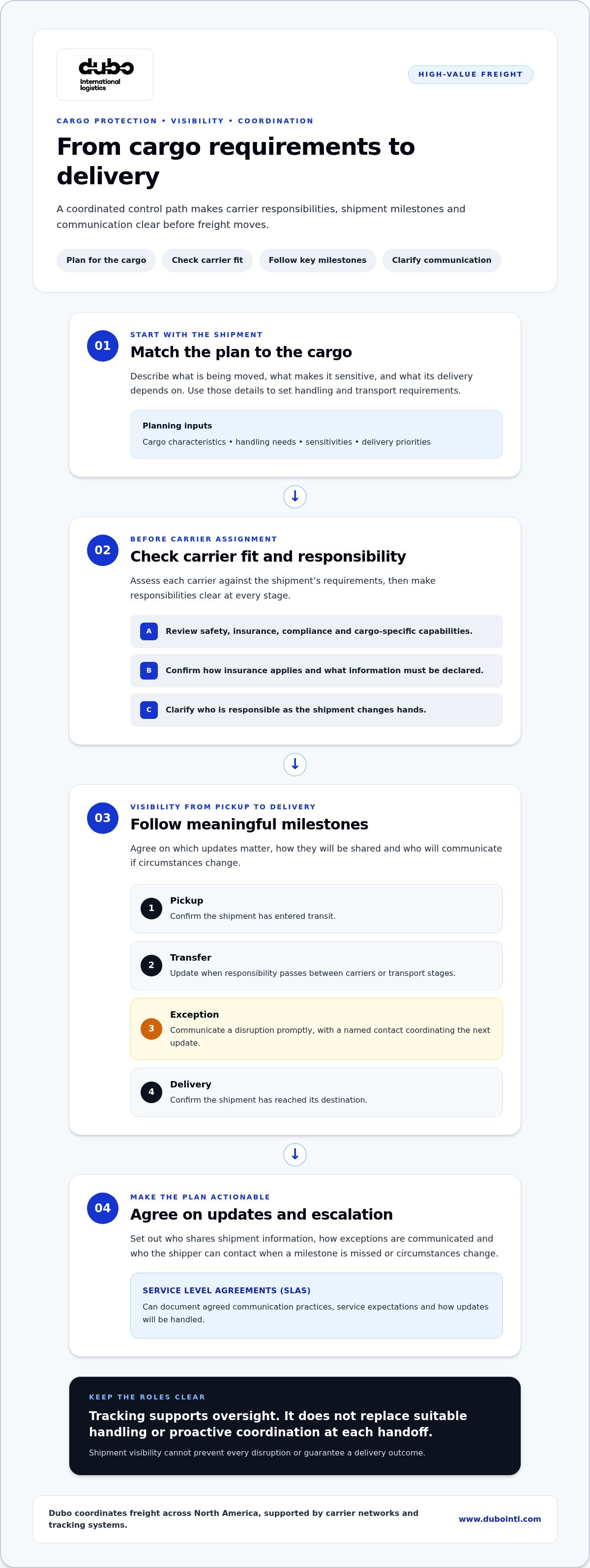
A sound plan makes responsibilities visible before a shipment moves. When assessing a freight forwarder for high-value goods, look beyond whether tracking is available. Consider how carriers are selected for the shipment, what information follows the cargo, and who coordinates communication at each handoff.
What should a carrier vetting process cover?
A carrier vetting process should assess suitability against the cargo’s handling and transport requirements. Review safety, insurance, compliance and cargo-specific capabilities, then clarify which party is responsible at each stage. Pay particular attention to insurance terms: confirm how coverage applies to the shipment, what information must be declared, and which responsibilities rest with each party. Clear documentation helps prevent assumptions from replacing agreed terms.
A verified-carrier network is a useful part of coordination, but it isn’t a promise of risk-free transport. Dubo works with a network of carriers for specialized transport deliveries. The practical goal is to align carrier selection and shipment information with the cargo’s needs, while setting clear expectations for communication if circumstances change.
How should shipment visibility work from pickup to delivery?
Useful visibility follows the shipment through meaningful milestones, not just a single status. Agree on which updates matter, how they’ll be shared and who will communicate an exception. A basic milestone plan may include:
- Pickup: Confirmation that the shipment has entered transit.
- Transfer: An update when responsibility passes between carriers or transport stages.
- Exception: Prompt communication about a disruption, with a named contact coordinating the next update.
- Delivery: Confirmation that the shipment has reached its destination.
Tracking systems help organize shipment information and support coordination, but they can’t prevent every disruption or guarantee a delivery outcome. A clear escalation contact gives the shipper a defined route for questions when a milestone is missed or circumstances change. For more on coordinating shipments across their full journey, read this end-to-end freight management guide.
Service level agreements (SLAs) can document agreed communication practices, service expectations and how updates will be handled. Dubo brings carrier networks and tracking systems together to support specialized shipments across North America. Explore Dubo’s freight forwarding services to understand its approach.
Dedicated, Expedited, or LTL Freight Shipping: Which Fits the Shipment?
The right service model depends on how the cargo needs to move, not simply on its declared value. Compare the degree of control, whether capacity is shared, the number of handling steps, scheduling requirements and the shipment’s size and sensitivity. A freight forwarder for high-value goods can help align these factors with the shipment plan, rather than treating one transport option as suitable for every valuable item.
When might dedicated or expedited transport suit high-value goods?
A dedicated or expedited approach may suit a shipment with a defined project schedule, time-sensitive delivery needs, or handling requirements that call for a tailored plan. For example, delicate equipment needed for a scheduled installation may require close coordination around its movement and delivery dependencies. Expedited transport isn’t necessary for every high-value shipment; the decision should reflect the cargo, timing and project requirements.
Dubo coordinates specialized transportation across North America, including shipments involving oversized machinery, delicate equipment and temperature-sensitive products. Its freight forwarding approach connects transport planning with carrier coordination. Where dedicated transport is relevant, explore premium expedited transport services.
When should a shipper consider LTL freight shipping?
LTL freight shipping shares trailer capacity among shipments. It can suit cargo whose size and handling requirements fit a shared-service arrangement, but consolidation may involve additional handling or transfers. Those steps aren’t automatically unsuitable for valuable goods. Assess whether the cargo is compatible with the service plan and how each transfer will be coordinated.
Before choosing LTL, consider the shipment’s dimensions, packaging, sensitivity and delivery dependencies. Map likely transfer points and identify what information should be communicated at each one. If the cargo has unusual dimensions or specialized transport needs, review the specialized freight buyer’s guide for additional planning considerations.
A practical comparison weighs control and coordination alongside the shipment’s characteristics. Dedicated transport may reduce consolidation steps, while LTL may be appropriate when the cargo fits shared capacity and its handling needs can be planned across transfers. Neither option guarantees a particular outcome; suitability comes from matching the service model to the shipment. For a tailored approach to freight movement, learn about Dubo’s freight forwarding services.
A Practical Checklist for Preparing a High-Value Shipment
A precise shipment brief gives the forwarder and carriers a shared reference before dispatch. For a freight forwarder for high-value goods, accurate cargo details can inform transport planning, handling decisions, documentation and communication. Use this sequence to organize the essentials:
- Describe the cargo: Give a clear description and identify any components or features that affect handling.
- Record dimensions: Provide the shipment’s dimensions and any relevant packaging dimensions.
- Declare the value: State the cargo value consistently in the shipment information and related documents.
- Note sensitivities: Describe fragility, temperature sensitivity or other handling considerations without assuming a standard requirement.
- Set delivery requirements: Include delivery constraints, required dates or windows, and any project dependencies.
- Assign contacts: Name pickup and delivery contacts, identify site access details, and clarify who receives shipment updates or handles exceptions.
- Organize documentation: Gather shipment documents and ensure key details match across the brief and supporting records.
What information belongs in a high-value shipment brief?
Keep the brief concise and consistent. For example: Cargo: [description]; dimensions: [length × width × height]; value: [declared value]; sensitivities: [handling or temperature considerations]; pickup and delivery contacts: [names and details]; delivery requirements: [constraints or dependencies]; documentation: [applicable records]. This is a planning template, not a substitute for project-specific documentation. Unusual cargo, site conditions or handling specifications may need individual review before the transport plan is finalized.
How can packaging and handoffs reduce avoidable uncertainty?
Choose packaging according to the cargo’s shape, fragility and anticipated transport conditions. Suitable packaging can support protection, and customized crating may be appropriate for some sensitive or high-value goods. Include packaging details in the cargo brief so carriers can plan around the shipment as prepared. At agreed handoff points, define who records the cargo’s condition and who shares that information with the next responsible party.
For shipments crossing the Canada-US border, coordinate shipment information and required documents as part of the plan. This cross-border freight coordination guide offers further context. To plan specialized transport around your cargo requirements, explore Dubo’s expedited transport services.
How Dubo Coordinates High-Value Freight Across North America
Complex shipments need coordination that extends beyond assigning a carrier. Dubo International Logistics brings freight forwarding and logistics planning together, coordinating cargo movement and shipment information across North America. Its experience with project cargo supports planning for oversized machinery, delicate equipment and temperature-sensitive products moving across Canada and the United States.
What Dubo brings to specialized shipment coordination
Freight forwarding is the coordinated movement of cargo, carriers and shipment information, not transportation alone. For a high-value shipment, this coordination connects the cargo’s requirements with the transport plan and the parties involved at each stage. Dubo works with a carrier network and tracking systems to support specialized transport deliveries and organize shipment information as freight progresses through planned handoffs.
Dubo is a member of the Canadian International Freight Forwarders Association (CIFFA), a relevant professional trust signal. Membership, carrier coordination and tracking systems each play a distinct role; none should be mistaken for a guarantee that disruption or damage cannot occur. The value lies in bringing these elements into a shipment plan shaped around the cargo and its specific requirements.
For project cargo, details matter at each transition. Cargo dimensions may affect transport planning, while sensitivity and delivery dependencies can shape coordination needs. By treating the shipment as a connected movement rather than an isolated pickup and delivery, a freight forwarder for high-value goods can help organize carrier communication and shipment information around the work involved.
What to share when planning your next shipment
A useful planning conversation starts with clear cargo details. Prepare:
- Cargo type: Describe the goods, including any features that affect handling.
- Dimensions: Provide the cargo and packaged dimensions.
- Sensitivity: Note fragility, temperature sensitivity or other relevant conditions.
- Origin and destination: Identify where the shipment begins and ends.
- Delivery requirements: Share timing constraints, site access details and any project dependencies.
These details give the logistics team a practical foundation for discussing a tailored plan, carrier coordination and shipment updates. The more clearly the shipment requirements are set out, the easier it is to align planning with the cargo’s needs and keep communication focused.
To discuss a high-value freight shipment, share your cargo details with Dubo. A clear starting brief supports cargo-specific planning, coordinated handoffs and focused communication throughout the shipment.
Plan Your Next High-Value Shipment with Confidence
Valuable freight needs a plan shaped around its particular requirements. Assess cargo sensitivity and delivery dependencies, compare transport models by their handling and coordination needs, and prepare accurate shipment details before dispatch. Tracking supports oversight, while clear responsibilities and communication help keep each handoff organized.
Dubo International Logistics coordinates specialized project cargo across North America, supported by a carrier network and tracking systems. Its CIFFA membership is another relevant trust signal. For businesses seeking a freight forwarder for high-value goods, these elements contribute to a considered approach to cargo coordination, without treating any single measure as a guarantee.
Share your cargo type, dimensions, sensitivities, origin, destination and delivery requirements to start a focused planning conversation. Discuss your high-value freight requirements with Dubo at www.dubointl.com and take the next step towards clear, cargo-specific coordination.
Frequently Asked Questions
What does a freight forwarder do for high-value goods?
A freight forwarder coordinates cargo movement, carriers and shipment information from origin to destination. For valuable goods, this can include aligning the transport plan with cargo sensitivities, organizing relevant documents, clarifying responsibilities at handoffs and coordinating shipment updates. The forwarder manages the movement rather than simply providing transportation, helping the shipper understand how the different stages fit together and who is responsible for communication.
How do I choose a freight forwarder for high-value goods?
Choose a freight forwarder for high-value goods by assessing how its planning addresses your cargo’s handling needs, carrier suitability, shipment visibility and communication at transfers. Clarify how insurance terms and declared cargo information are handled, and what updates you can expect. Professional membership can also inform your assessment: Dubo International Logistics is a member of the Canadian International Freight Forwarders Association (CIFFA) and coordinates freight through a carrier network.
Is LTL freight shipping suitable for high-value goods?
LTL freight shipping may suit valuable goods if the cargo’s dimensions, packaging and handling needs fit a shared-trailer arrangement. Because trailer capacity is shared, a shipment may pass through additional handling or transfer points. Consider whether those steps align with the cargo requirements and delivery plan. The service type alone doesn’t determine suitability; evaluate the shipment’s characteristics and how its movement will be coordinated at each stage.
Can a freight forwarder arrange specialized transportation for delicate equipment?
Yes. Specialized transportation can be planned for cargo with particular handling or movement requirements. Dubo coordinates specialized shipments across North America, including delicate equipment, oversized machinery and temperature-sensitive products. The plan should reflect the specific cargo, its dimensions, sensitivities, packaging and delivery requirements. Share these details early so they can inform carrier coordination and shipment planning. Learn about Dubo’s freight forwarding services.
What information should I provide before shipping valuable goods?
Provide an accurate cargo description, dimensions, declared value, packaging details and any sensitivities, such as fragility or temperature requirements. Include the shipment’s origin and destination, delivery constraints, project dependencies, and pickup and delivery contacts. Relevant shipment documents should use consistent information. A clear brief helps the forwarder understand what is moving and coordinate carriers and updates around the shipment’s requirements, rather than relying on assumptions.
Does shipment tracking protect high-value cargo?
No. Tracking supports shipment oversight by showing available status information and helping coordinate updates, but it doesn’t physically protect cargo or prevent every disruption. Pair visibility with a suitable handling plan, clear responsibilities at handoffs and an agreed process for communicating exceptions. Before dispatch, establish which milestones matter, who will share updates and which contact will coordinate communication if the shipment’s status changes.
Should high-value goods use dedicated or expedited transport?
Not necessarily. Dedicated or expedited transport may fit a shipment with specific urgency, sensitivity or project-coordination needs, but high value alone doesn’t make either option the right choice. Compare the cargo’s handling requirements, delivery dependencies, scheduling needs and expected transfer points with the available service plan. A clear shipment brief helps determine whether a tailored or shared transport arrangement better fits the goods and their movement requirements.
