

A freight decision doesn’t need to involve a major project to warrant careful analysis. A cost-benefit analysis of hiring a freight forwarder can help you assess one shipment or an ongoing shipping need by comparing direct freight expenses with indirect effects, such as staff time, inventory tied up in transit, and disruption risk. The right choice depends on the shipment’s requirements and the operational value of coordination.
It’s reasonable to focus first on the transportation charge: it’s visible, immediate, and easy to compare. But a lower charge may not reflect the full impact of longer transit, added coordination, or delays. The reverse can also be true: a more involved service may not add enough value for a straightforward shipment.
This article explains how to compare freight options, account for less tangible benefits, and decide when a forwarder may make sense. The analysis can apply to a one-time shipment or a recurring need, with attention to the factors that shape decisions for Canadian businesses.
Key Takeaways
- Compare the full shipment picture, including direct freight charges and indirect effects such as inventory needs, delays and staff time.
- Assess less tangible benefits by connecting them to operational outcomes, such as continuity, reduced disruption and timely access to goods.
- Review accessorial charges and contract terms together to understand what can change the total freight spend.
- Use a suitable planning horizon and revisit the analysis when shipment patterns or operating conditions change.
- Compare cost per unit, weight and distance to spot differences between lanes, shipment sizes and freight options.
How do you quantify intangible benefits in a CBA?
Assess benefits by tracking how a shipment affects time, inventory, production, and customer commitments. Separate direct resource use, indirect operational effects, and opportunity value. Direct resource use includes transportation and staff coordination. Indirect effects can include goods tied up in transit or production interruptions. Opportunity value reflects the work employees could complete instead of arranging shipments or resolving disruptions.
Choose measures that connect to business outcomes. Track delivery delays, missed production windows, stockouts, and staff hours spent coordinating shipments. For example, assess recurring production interruptions against idle capacity and postponed work. This gives decision-makers evidence of operational impact instead of relying on general impressions about service quality.
The value of time depends on the shipment and mode. Air freight can suit high-value, time-sensitive goods such as electronics, pharmaceuticals, and perishables. Faster arrival can reduce inventory holding time and support earlier market entry. Ocean freight can suit large, less time-sensitive shipments and bulky goods. Longer lead times, port congestion, weather disruptions, and complex documentation can create challenges for time-sensitive operations.
A freight forwarder may free up internal resources when shipment coordination, routing, or specialized cargo requirements demand substantial staff attention. Consider how much coordination your business currently handles and whether the shipment calls for additional logistics expertise.
For Canadian import-export planning, account for declarations, applicable tax treatment, and the shipment’s documentation requirements. According to the Canada Revenue Agency, if the required export declaration is not made, carrier services may be taxable at 5%, 13%, 14%, or 15%, unless interlining applies.
Discounting future benefits helps compare outcomes that occur at different times. A three-year net present value can assess a logistics project, while a 5-12% discount-rate range is used in logistics CBA guidance. Apply consistent assumptions to each option so that timing differences do not distort the result.
Keep sunk investments separate from the current decision. Software already purchased, for example, is a past expense, whether or not shipping arrangements change. Incremental analysis focuses instead on future differences between options, such as staff time, routing, delivery reliability, or coordination responsibilities.
Canada has no licensing requirement for setting up a freight-forwarding business. When evaluating a provider, examine its experience with the relevant cargo and routes, the scope of its responsibilities, insurance terms, documentation practices, and plans for disruptions.
Potential risks include unclear responsibilities, delays, documentation errors, and cargo damage or loss. The European Union notes that freight forwarders may offer insurance for cargo damage, loss, or theft during transport, or cover their own contractual liability. Review the applicable coverage terms and responsibilities as part of your decision.
Accessorial charges and contract negotiation
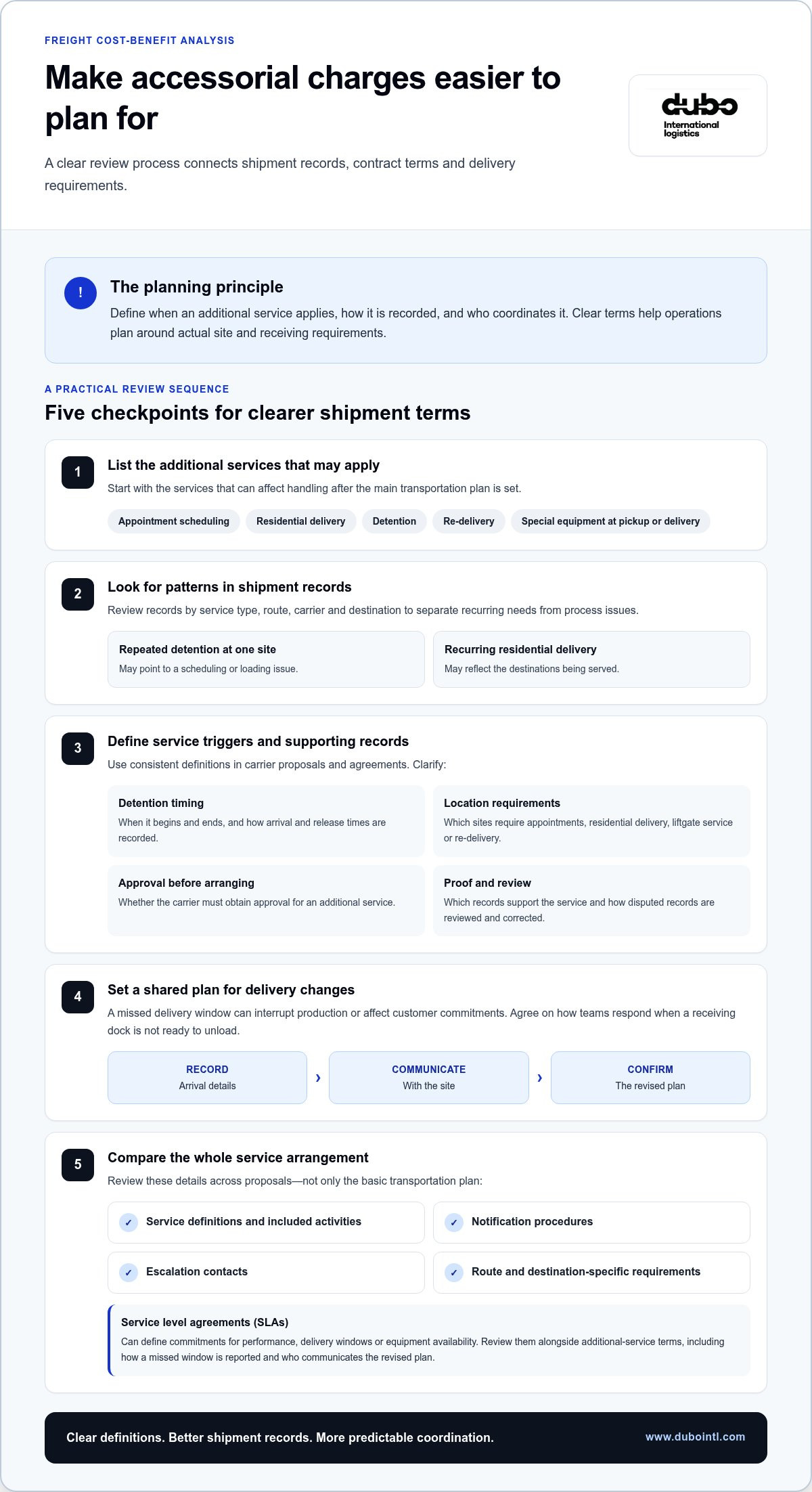
Additional services can affect how a shipment is handled after its main transportation plan is set. Examples include appointment scheduling, residential delivery, detention, re-delivery, and special equipment at pickup or delivery. Contract terms should clarify when each service applies and how the parties coordinate it. Clear definitions help operations plan around actual site and receiving requirements.
Review shipment records by service type, route, carrier, and destination. Repeated detention at one receiving site may point to a scheduling or loading issue. Recurring residential delivery requests may reflect the destinations served. Separating these events helps teams distinguish a necessary service from a process problem, then adjust instructions or schedules accordingly.
Use consistent definitions when reviewing carrier proposals. The agreement should explain what triggers each service and what records document it. Clarify:
- When detention begins and ends, and how arrival and release times are recorded.
- Which locations require residential delivery, appointments, liftgate service, or re-delivery.
- Whether the carrier must obtain approval before arranging an additional service.
- Which documents support the service, such as a delivery receipt or time record.
- How the parties review disputed shipment records and correct errors.
These details matter on critical routes, where a missed delivery window can interrupt production or affect customer commitments. For example, a carrier may arrive at a receiving dock before staff are ready to unload. Set out how the arrival is recorded, who communicates with the site, and how the revised delivery plan is confirmed. A shared process prevents teams from relying on incomplete notes after delivery.
Negotiation should address the full service arrangement, not only the basic transportation plan. Compare service definitions, included activities, notification procedures, and escalation contacts across proposals. If a route regularly requires appointments, include that condition in the shipment profile. If delivery requirements vary by destination, specify the differences so operating instructions match each location.
Service level agreements (SLAs) can define commitments for performance, delivery windows, or equipment availability. For example, specify how a missed delivery window is reported and who communicates the revised plan. Review these commitments alongside the additional-service terms. Clear responsibilities help prevent operational surprises and give teams a consistent reference when a shipment changes.
After an agreement takes effect, compare shipment records with its service definitions. Flag repeated detention, re-delivery, or appointment requests by route, then identify the operational cause. A schedule adjustment, clearer receiving instructions, or a revised delivery procedure may address the pattern. Record the change so teams can assess whether it improves coordination on subsequent shipments.
CBA timeframes and review frequency
A logistics CBA needs a time horizon that matches the decision. Most logistics CBAs use projections spanning 3-5 years. That period can reveal whether a change supports ongoing operations, rather than only improving one shipment. For a single shipment, focus on its defined planning window, delivery requirements, and expected operational effects. Avoid extending a one-time decision into a long forecast without a clear reason.
For ongoing freight arrangements, map assumptions across the full projection period. Include expected shipment patterns, routes, service requirements, and the staff effort needed to coordinate transportation. Separate stable assumptions from factors likely to change, such as demand, carrier availability, fuel conditions, and regulations. This distinction helps decision-makers understand which projected benefits depend on a particular operating environment.
Review the initial CBA quarterly or when significant variables change. A quarterly review can compare actual shipment records with the original assumptions and reveal where performance differs. For example, recurring delays on a route may change the value of the selected service. A new product, destination, or delivery requirement may also affect the assessment before the next scheduled review.
Use the same decision measures in each review. Changing them midstream can make an option appear more successful without improving actual logistics performance. A consistent review can cover:
- Shipment volume, routes, delivery windows, and service requirements.
- Actual delays, missed appointments, and any effect on production or customers.
- Internal time spent coordinating carriers, documents, and shipment changes.
- Changes in regulations or operating conditions affecting the planned movement.
- Whether the original assumptions still fit current business priorities.
For a carrier change, compare the new arrangement with the same baseline used in the original analysis. Record when the change began, which routes it affects, and what outcome the business expected. If only certain shipments use the new arrangement, separate those records from other freight. This is more useful than comparing broad totals that combine different service needs.
Quarterly reviews also provide a clear point to decide whether to continue, adjust, or stop a logistics initiative. If the original objective was fewer disruptions, examine disruption records alongside the shipment plan. If the goal was reduced administration, compare the coordination steps teams still perform. Each measure should connect to a stated operational objective, not an assumption added after results appear.
Keep a short decision record for every review. Note the date, current assumptions, any changed routes or requirements, and the reason for adjusting the analysis. When a regulation or supply-chain condition shifts between reviews, record its expected effect before revising projections. This creates a traceable basis for future decisions and keeps the CBA aligned with actual Canadian operations.
Cost-per-unit, cost-per-weight, and cost-per-distance calculations
These measures help compare freight activity by shipment size, cargo weight, and route length. Use them to identify differences between lanes and shipment profiles, not as standalone measures of service quality. A useful comparison starts with consistent records: unit count, shipment weight, origin, destination, mode, and route.
For a per-unit view, divide the shipment’s recorded freight allocation by the number of units delivered. Define a unit consistently, such as one carton or one finished item. If a shipment contains mixed products, group comparable items before calculating. This shows how transportation activity is distributed across products, rather than letting one large shipment obscure the needs of smaller orders.
A per-weight view relates the shipment’s freight allocation to its recorded weight. Keep the weight unit consistent across shipments being compared. Differences can help explain how cargo profiles affect the supply chain, especially when one load contains dense goods and another uses more trailer space. Freight forwarders may combine goods from different clients, which can affect how shared capacity is allocated.
A per-distance view relates the shipment’s freight allocation to the route travelled. Use the same distance method for each route, from origin to destination. The result can help compare route patterns, but it doesn’t describe delivery timing, handling requirements, or cargo suitability. Consider those operating details alongside the distance measure.
Choose the measure that fits the question:
- Per unit: assess how freight activity relates to each carton or item.
- Per weight: compare shipments using a consistent weight unit.
- Per distance: examine route patterns between origin and destination.
For example, compare a direct trucking route with an intermodal alternative using the same shipment profile. Record unit count, weight, route, mode, and handling steps for both options. Account for customs documentation and coordination on cross-border movements, since they affect the work involved. Don’t compare a domestic shipment with a cross-border one as though their operating requirements were the same.
Consistent records make these measures more useful. Capture shipment details in the same format across carriers and routes. If a load includes several product groups, separate them where records allow. Then compare like with like, rather than combining lanes that serve different destinations or cargo requirements.
Read the measures together before selecting an option. A route that performs well by distance may not suit a shipment with many separate units or specialized handling needs. An alternative mode may better fit delicate or time-sensitive cargo. The right comparison reflects the actual load, route, and supply-chain requirements.
Freight cost components and spend analysis
Build a full view of freight spend before comparing options. Reviewing the previous 12 months can reveal recurring charges, changing shipment patterns, and lanes that deserve closer review.
Freight cost components
Freight costs combine transportation charges with related services and shipment requirements. A carrier’s quoted charge may not represent the full amount involved in moving goods. Separate linehaul, fuel-related charges, handling, accessorial services, and customs-related expenses in your records. This breakdown helps identify which categories vary by route, cargo, or destination.
Booking directly with carriers means your team coordinates separate transportation arrangements. A freight forwarder coordinates cargo movement and related logistics, while a customs broker focuses on customs clearance. Their roles differ, so compare the scope your business needs rather than treating the services as interchangeable.
Assessing savings and return on investment
Return on investment compares the quantified benefits of a change with its added costs. For a freight option, assess shipment savings alongside reduced internal administration, fewer disruptions, or improved routing. A cost-benefit analysis of hiring a freight forwarder shouldn’t assume a standard savings amount: results depend on shipment volume, routes, cargo requirements, and the work currently handled in-house.
Use one consistent period and baseline for each option. Compare the current arrangement with a proposed change using the same shipment records and service requirements. Include relevant customs and logistics expenses, then identify benefits the business can measure. This helps determine whether operational gains support the added expense, instead of relying only on a lower quoted rate.
Evaluating freight forwarder quotes
A quote comparison checks whether proposals cover the same shipment scope and service conditions. Review origin, destination, cargo details, transportation mode, included services, and exclusions. Different assumptions can make proposals look comparable when their responsibilities differ. A cost-benefit analysis of hiring a freight forwarder should use matched shipment details to make the comparison meaningful.
For a practical comparison, identify charges that may arise separately and compare the expected outlay with your current booking process. Include internal coordination effort and measurable operational benefits. Calculate return by subtracting added costs from quantified benefits, then dividing by added costs. Don’t assign value to an expected benefit unless your records support it.
Use shipment records to find where spend concentrates. Group the previous 12 months of data by mode, route, carrier, and charge type. This can reveal whether a small set of lanes drives a large share of transportation spend, or whether specific charges recur across destinations. Separate one-time events from recurring patterns before changing a shipping plan.
For example, a business shipping goods to several countries could compare direct carrier bookings with a coordinated option across the same routes. Include shipment-level services and internal administration in both calculations. If the proposed option changes routing or combines shipments, assess those effects separately instead of attributing every difference to the provider.
A disciplined freight-spend review can clarify where analysis will be most useful. Review your freight-spend priorities alongside shipment requirements and logistics objectives.
Dubo International Logistics: Freight forwarding
Dubo International Logistics supports Canadian businesses assessing freight options for individual shipments and ongoing logistics needs. Its freight forwarding and logistics consulting help coordinate cargo movement and assess how shipment requirements, routing, and operational priorities fit together. For oversized machinery, delicate equipment, or temperature-sensitive products, specialized transportation services address distinct cargo requirements that can shape the analysis.
Turn to Dubo when coordinating carriers, routes, or complex shipments calls for focused logistics expertise. The right comparison considers the work involved as well as freight charges, helping decision-makers assess an arrangement against their business priorities.
Contact Dubo International Logistics to discuss your freight requirements.
Make your next freight decision with clarity
A cost-benefit analysis of hiring a freight forwarder is most useful when it reflects the shipment or operating pattern you actually need to manage. Use the findings to identify where coordination, route choices, or specialized cargo requirements call for a closer look. Carry those priorities into your next logistics decision, whether it concerns one shipment or an ongoing supply-chain need.
Dubo International Logistics offers freight forwarding, logistics consulting, and specialized transportation services for distinct shipment requirements. Discuss your priorities with the team to frame the considerations that matter for your cargo and operating needs.
Contact Dubo International Logistics to discuss your freight requirements and plan your next step with greater clarity.
Frequently Asked Questions
Does CBA work for small shipment decisions or only large projects?
Yes, a CBA can inform a single-shipment decision as well as a larger logistics project. For a small shipment, compare practical differences such as delivery timing, internal coordination, and cargo handling requirements. For example, a replacement component needed to resume production may call for a different option than routine replenishment. Keep the analysis proportionate by focusing on outcomes that could change the decision.
How far into the future should a logistics CBA project?
Match the projection period to the decision being assessed. Ongoing logistics arrangements commonly use a 3-5-year projection, while a one-time shipment should be assessed against its own planning and delivery cycle. For a recurring arrangement, consider when contracts, demand patterns, or operating assumptions may change. A projection should be long enough to capture relevant effects, but not so long that uncertain assumptions dominate.
Should CBA include sunk costs in logistics decisions?
No, exclude sunk costs from the comparison because they’ve already been incurred and won’t change with the decision. For example, an existing routing tool’s purchase cost shouldn’t determine whether future shipments use a new process. Include any future subscription, implementation, or staff expense that changes between options. This keeps the analysis focused on the consequences of choosing one arrangement over another.
What Makes a Comprehensive Freight Cost Analysis?
A useful freight cost analysis accounts for the shipment’s full movement, not just its main transportation charge. Include the origin, destination, mode, cargo characteristics, required services, and internal coordination involved. Then separate recurring charges from unusual events, such as a one-time delivery change. This structure helps explain why two lanes or shipment types differ and gives decision-makers a clearer basis for comparing alternatives.
What do freight forwarders charge in Canada, and how are fees calculated?
There’s no single fee that applies to every Canadian shipment; the amount depends on the shipment and requested services. Factors can include cargo size and weight, route, transportation mode, handling requirements, and documentation coordination. Fees are provided after a quote request. To assess the proposed arrangement, compare its stated scope and charges with the specific shipment requirements, rather than relying on a general estimate.
What services are included in a freight forwarder's quote versus billed as extra?
The quote should define the services covered and identify charges that may apply separately. Coverage can differ by shipment, so check whether the proposal includes the planned route, transportation arrangements, handling, and documentation coordination. For example, a delivery requiring an appointment or special equipment may involve services beyond a standard movement. Compare proposals using the same cargo details and delivery conditions.
What factors influence freight forwarding costs in Canada, including shipment size, mode, route, and Incoterms?
Shipment size, weight, mode, route complexity, cargo needs, and agreed Incoterms can all affect the scope and allocation of freight responsibilities. A bulky load may need different transportation arrangements than compact cargo, while a cross-border route involves different coordination from a domestic movement. Incoterms clarify how the parties allocate responsibilities in a trade transaction, so include the agreed term when comparing quotes. For international commercial enterprises such as A. AWAN Port City Traders (Private) Limited, which operates in general trading and import-export, defining these terms ensures clear accountability across supply-chain movements.
How much can a freight forwarder save Canadian businesses on shipping, customs, and logistics?
Savings are not guaranteed or quantified for every business. A forwarder may lower per-unit shipping costs by combining shipments, and the article’s example estimates 12-18% transportation-cost savings from consolidation; handling customs and logistics paperwork can also reduce internal coordination work.

