

A shipment can be ready to move and still lose time if a booking change, schedule update, or arrival notice reaches the wrong person too late. Effective freight forwarder communication standards clarify responsibilities, channels, and timing before cargo is in motion.
That clarity matters across the many handoffs in a shipment. Shippers, carriers, and logistics partners need to know who sends updates, what information to include, and how quickly to flag a delay, documentation issue, or cargo concern.
This article explains what to agree on before transport begins, from communication channels and update timing to partner check-ins. It also covers practical coordination details such as bookings, schedules, verified gross mass (VGM), and arrival notices. Clear expectations help each party act on consistent information and address changes with less uncertainty.
Key Takeaways
- Agree on primary and backup communication channels, named contacts, and when routine updates should arrive before transport begins.
- Make shipment messages easy to act on with clear subject lines, complete cargo and handling details, and a record of key decisions.
- Set expectations for how shippers, carriers, consignees, and logistics partners share updates and raise issues that could affect delivery or cargo safety.
- Use regular partner check-ins to review schedules, concerns, responsibilities, and escalation procedures as shipment needs change.
- Clarify who communicates booking confirmations, schedule changes, VGM information, and arrival notices, and what details each update should include.
Communication standards in freight forwarding - what should be agreed?
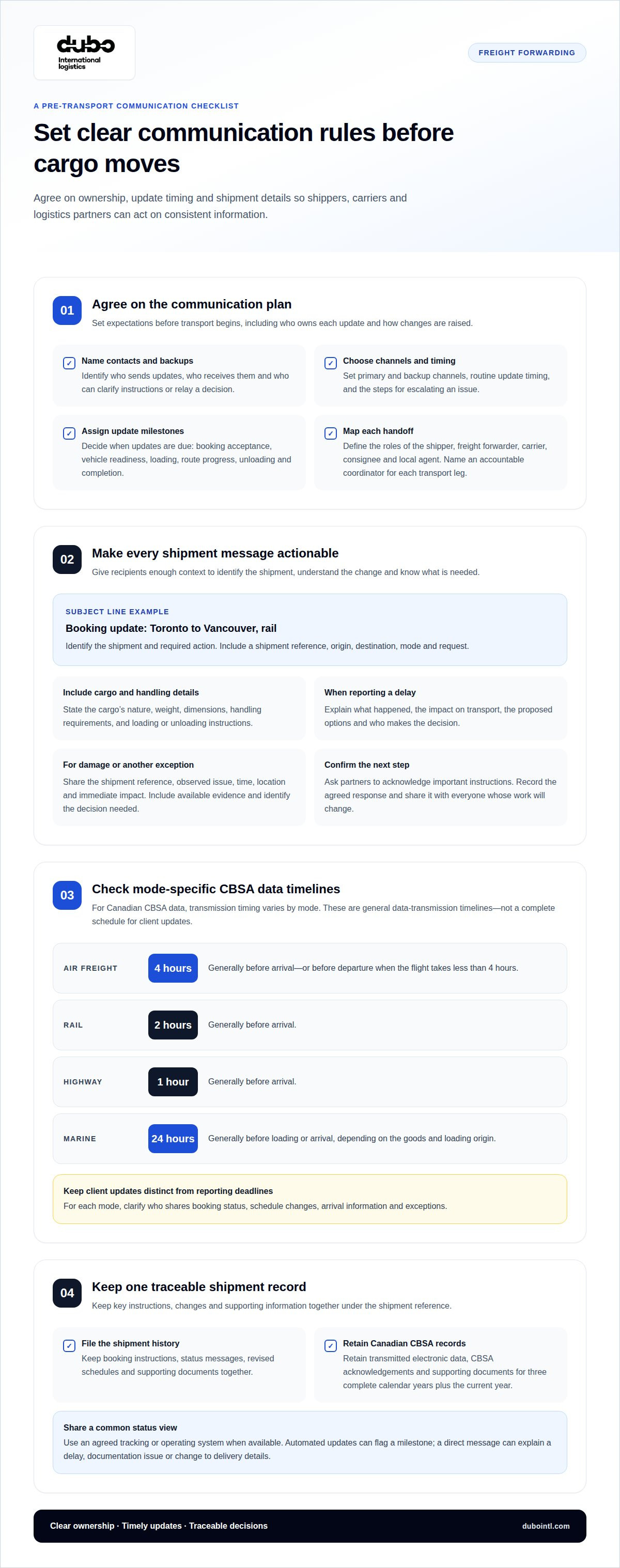
In Canada, agree on contacts, channels, update timing, shipment details, and escalation steps before transport begins. For CBSA reporting, freight forwarders must retain transmitted electronic data, acknowledgements, and supporting documents for three complete calendar years plus the current year.
Shipment Details in Subject Lines
Use a clear subject line to identify the shipment and required action. Include a shipment reference, origin, destination, mode, and request, such as “Booking update: Toronto to Vancouver, rail.” In the message, provide the cargo’s nature, weight, dimensions, handling requirements, and loading or unloading instructions. Complete details help carriers and clients distinguish urgent decisions from routine records.
Proactive Shipment and Business Updates
Proactive updates share shipment status and emerging changes before they disrupt the plan. Agree on which milestones trigger messages, such as booking acceptance, vehicle readiness, loading, route progress, unloading, and completion. Use partner check-ins to discuss service concerns and upcoming schedule changes. When reporting a delay, explain what happened, its impact on transport, the proposed options, and who makes the decision.
Mode-Specific Communication Practices
Mode-specific practices align updates with each transport method’s milestones and reporting timelines. For Canadian CBSA data, air freight generally requires transmission four hours before arrival, or before departure when the flight takes less than four hours. Rail data is generally transmitted two hours before arrival; highway data, one hour before arrival. Marine data is generally transmitted 24 hours before loading or arrival, depending on the goods and loading origin.
These timelines relate to required data transmission, not a complete schedule for client updates. For each mode, clarify who shares booking status, schedule changes, arrival information, and exceptions. One communication standard can cover every mode while assigning distinct milestones and reporting deadlines.
Recordkeeping gives each party a traceable account of decisions and shipment changes. Keep booking instructions, status messages, revised schedules, and supporting documents together under the shipment reference. For Canadian CBSA submissions, retain the electronic data sent, the CBSA acknowledgement, and source documents supporting the transmitted data elements. A consistent file record helps teams respond accurately to questions from clients or carriers about earlier instructions.
For global movements involving multiple countries, identify the relevant handoffs and who is responsible for updates.
Real-time shipment information sharing depends on timely entries and clear ownership. Use an agreed tracking or operating system to share location and status when available, then assign a contact to explain exceptions. Automated updates can flag a milestone, while a direct message can clarify a delay, documentation issue, or change to delivery details.
For cargo damage or another exception, report the shipment reference, observed issue, time, location, and immediate impact. Include available evidence and identify the decision needed. Escalate promptly if delivery timing or cargo security is at risk, and record the agreed response in the shipment file.
Communication and collaboration among logistics stakeholders
A shipment may involve a shipper, freight forwarder, carrier, consignee, and local agent. Each party needs a defined role in the handoff, from confirming transport arrangements to reporting changes that affect delivery. A responsibility map can name who sends each update, who receives it, and where decisions are recorded. This keeps operational details from getting lost between organizations.
Start with a shared shipment reference and a common view of current status. A logistics management system can make shipment information available to connected parties, helping teams work from one record instead of separate email threads. For example, a carrier’s progress update can be entered against the shipment, while the coordinator adds context about a revised handoff. Set access according to each participant’s role and information needs.
Local agents can clarify destination practices, communicate with in-country partners, and flag issues affecting a planned handoff. Multilingual logistics coordinators can help make operational instructions clear and consistent across languages. Their explanations of cargo handling, delivery arrangements, and schedule changes reduce reliance on informal interpretation. Assign an accountable coordinator for each transport leg, so partners know who can clarify instructions or relay a decision.
Cross-cultural communication requires considering how a message may be interpreted, not just its literal wording. An instruction that seems clear to one partner may sound abrupt or leave another unsure of their responsibility. Use plain language, define shipping terms, and confirm important decisions in writing. For a fragile-equipment shipment, for example, pair written handling instructions with a diagram if verbal descriptions could be interpreted differently.
Written exchanges lack the voice and visual cues that can help prevent misunderstandings. Even a concise message can be ambiguous if it omits the action, owner, or deadline. Ask partners to acknowledge important instructions, then summarize the decision and next step. If someone raises a concern, record the agreed response and share it with the parties whose work will change. This maintains continuity when staff hand over an active shipment.
For global movements across several countries, establish a shared glossary for recurring terms and use consistent document templates. A logistics management system can support this approach by keeping shipment status and documentation accessible to authorized participants. It should complement, not replace, direct coordination: a system entry shows what changed, while a coordinator explains its effect on the next handoff. Logistics consulting can help shape communication practices around a shipment network’s partners and operating needs.
Agreeing communication channels and update timing
Effective freight forwarder communication standards define channels, contact roles, and update triggers before an international shipment enters operations. Clear agreements help each party act on accurate information and keep export documentation aligned with transport plans.
Consistent Updates and Response Times
Consistent updates rely on agreed milestones, message formats, and response expectations to keep shipment status clear. Common updates cover order acceptance, vehicle readiness, loading, route progress, delay risks, unloading, and completion. Set response windows according to urgency and the decision required, rather than assuming the same timing works for every shipment. This helps distinguish routine reports from issues that need prompt action.
Pair automated operating-system notifications with direct communication when a change needs explanation. Record the update, its time, its owner, and any required action.
EDI and API Standards
Electronic data interchange (EDI) and application programming interfaces (APIs) connect shipment information between systems, but the appropriate interface depends on the transaction. In Canada, freight forwarders transmit required data through CBSA electronic data interchange systems and/or the eManifest Portal. DCSA Track & Trace standards are intended to support digital communication interfaces between carriers, customers, and partners.
Agree on which system carries status messages and which carries formal shipment data. Use one shipment reference across connected records.
Cross-Border Communication Standards
Cross-border communication aligns Canadian shipment records with information required for a U.S. export transaction. For a routed U.S. export, the foreign principal party in interest must provide the U.S. agent with a power of attorney or written authorization to prepare and file Electronic Export Information (EEI). The parties involved should clarify who is responsible for checking the accuracy of each entry.
U.S. exporters should provide complete written transaction details, including export-control classification and licence authorization information. Confirm who supplies, transmits, and corrects each data element.
Canadian legal responsibilities apply to specific transmitted cargo data. Under section 7.1 of Canada’s Customs Act, a freight forwarder transmitting house bill, house bill close, or supplementary cargo data must ensure it is true, accurate, and complete. Under section 12.1, the forwarder must ensure the data is received within prescribed timeframes.
For Canadian reporting, retain electronic data sent to the CBSA, its acknowledgement, and supporting source documents. Agree on who files, who reviews the information, and how corrections are communicated. These controls connect documentation to the shipment record.
Choose channels according to the message. Use an operating system or EDI connection for structured data, and email for accessible written coordination across time zones. For an urgent schedule change, send the agreed alert through the primary channel, then record the decision in the shipment file. Copy only people who need to act or stay informed.
Agreed freight forwarder communication standards should set response expectations according to urgency, milestone, and impact. A routine route update is different from a delay that threatens a delivery deadline. Define escalation contacts and backup channels before transport begins, so an unanswered message does not leave a critical decision without an owner.
Communication protocols and regular partner check-ins
A communication protocol gives each shipment partner clear responsibilities for updates, decisions, and escalation. Before work begins, document primary and backup contacts, preferred channels, and the issues each person can resolve. For example, a carrier can report a missed pickup to the operations contact, while a named decision-maker approves a revised delivery plan. Clear ownership keeps critical messages from sitting unanswered.
Regular check-ins give partners a scheduled opportunity to review performance, concerns, and upcoming changes. For ongoing international operations, set an agenda covering open shipments, schedule risks, documentation concerns, and relevant regulatory changes. U.S. exporters and USPPIs are advised to meet regularly with freight forwarders to discuss performance and concerns. Set a cadence that fits shipment activity and business needs instead of relying on an arbitrary interval.
Use each meeting to resolve specific items, not just exchange general updates. Record the issue, responsible person, next action, and expected follow-up in a shared meeting summary. If a customs-document discrepancy could affect a shipment, identify who will coordinate the correction and who needs the revised status. A written summary gives absent partners a clear account of decisions and involved teams a consistent reference.
Trust grows through predictable follow-through. Acknowledge important messages, set realistic deadlines, and tell partners promptly if a commitment changes. When a carrier makes an extra effort to protect a delivery plan, a direct expression of appreciation recognizes that work and supports a lasting relationship. Written summaries also confirm that each party understood the same decision, especially when multiple organizations share responsibility.
Partner connections can become difficult when businesses use different electronic bill of lading platforms, data standards, or communication methods. Those differences may require custom system connections, adding another coordination task to the shipment relationship. Interoperable interfaces can be reused more readily across partners, while consistent data fields make shipment information easier to exchange. Agreeing on formats and message ownership early helps prevent avoidable confusion at handoffs.
Build redundancy into critical communications. Name an alternate contact, agree on a backup channel, and define what happens if the primary contact cannot be reached. For instance, if a schedule change sent through the usual system threatens an unloading slot, escalate it to the backup contact. Record the change and decision in the shipment file so the next partner sees the current plan.
Review the protocol when a route, partner, or document process changes. A check-in can confirm whether contact details are current and escalation steps still fit the shipment’s needs. For cross-border partners, include the appropriate contacts for export information, schedule updates, and documentation questions. This keeps long-term working practices aligned with day-to-day freight coordination.
Freight forwarder standards for bookings, schedules, VGM, and arrival notices
Bookings, schedules, verified gross mass (VGM), and arrival notices each need a clear owner, accurate information, and an agreed handoff. For ocean freight, connect these records to one shipment reference so carriers, agents, and receiving teams can act on the same plan.
A booking confirmation should show the shipment reference, origin, destination, cargo details, requested sailing, and responsible contacts. It should also state the next action, such as confirming a schedule or supplying missing information. If a carrier changes the booking, record what changed and which parties need the revision. A clear confirmation helps operations teams distinguish an accepted booking from a request still awaiting action.
Commercial schedules need a shared baseline and a reliable way to communicate revisions. Identify the planned sailing and expected milestones, then clarify whether a message reports a confirmed change or a possible disruption. For example, tie an updated departure estimate to the correct booking and send it to the contacts coordinating the next transport leg. Agents can then align their arrangements with the current schedule.
VGM communication should make responsibility and status explicit. The parties involved should agree who supplies the verified gross mass information, who passes it to the carrier, and how corrections are recorded. Associate the value with the correct shipment and booking. If an entry changes, identify the revised information and promptly notify the relevant carrier contacts. This reduces the risk of teams working from conflicting shipment records.
An arrival notice should link the shipment’s expected arrival with the information the receiving party needs to coordinate next steps. Include the shipment reference, current arrival estimate, relevant transport details, and the contact handling questions or changes. Send revised notices when the schedule changes, and clearly mark superseded details. Consignees and destination agents can then distinguish the latest update from earlier estimates.
These messages work best as a coordinated sequence, not as separate documents. Use the same booking reference for the booking confirmation, schedule update, VGM communication, and arrival notice. Assign an owner to each handoff, define the channel for revisions, and record acknowledgements. If a delay affects the arrival estimate, update the schedule first, then share the revised arrival information with affected parties.
For each shipment, confirm that cargo and route details match across the relevant records. A mismatch between a booking and an arrival notice can confuse the receiving team. A late schedule revision can leave an agent acting on outdated information. Clear ownership, linked records, and prompt corrections give carriers and customers a dependable operational picture.
For shipments with several handoffs or specialized cargo, coordinate your freight requirements with a logistics partner that can manage the shipment’s moving parts.
Dubo International Logistics: Freight forwarding
Dubo International Logistics coordinates freight forwarding for shipments involving multiple partners, handoffs, or specialised requirements. Its logistics consulting can help align communication roles, shipment information, and transport plans before movement begins.
For cargo such as oversized machinery, delicate equipment, or temperature-sensitive products, specialised transportation services address needs that standard shipment planning may not cover. Clear coordination around schedules, documentation, and updates helps each party work from a consistent plan.
If your shipment needs coordinated freight forwarding or specialised transport planning, contact Dubo International Logistics to discuss your requirements.
Make the communication plan part of every shipment
Keep the communication agreement active beyond the initial planning stage. Revisit it when a route changes, a new partner joins, or the cargo requires different handling. This keeps the process aligned with the shipment instead of leaving teams to follow an outdated document out of habit.
Treat freight forwarder communication standards as a practical working agreement, not a static checklist. Each shipment is an opportunity to clarify decision ownership, adapt handoffs, and fit coordination to the cargo and route. A shared approach gives each party a clear basis for acting when plans change.
Dubo International Logistics can support freight coordination through freight forwarding, logistics consulting, and specialized transportation services. Start a conversation with Dubo International Logistics about the requirements of your next shipment and take the next step with clarity.
Frequently Asked Questions
What information should be included in a freight booking confirmation and shipment update?
A booking confirmation should make the booking’s status and agreed transport scope unmistakable. Include the shipment reference, confirmed mode and routing, cargo description, planned dates, and any conditions still awaiting action. For an update, identify what changed, when it changed, and which earlier instruction it replaces. For example, label a revised sailing notice as an update to the existing booking, not as a new booking request.
How do freight forwarders communicate shipment tracking and proof of delivery?
Freight forwarders communicate tracking through agreed shipment-status messages or systems, while proof of delivery is a separate record of the delivery outcome. A useful delivery record identifies the shipment, delivery date, receiving party, and any recorded exception, such as visible damage or a refused item. Ask that unresolved discrepancies be reported alongside the delivery confirmation, so the status does not imply that every condition was accepted.
How should freight forwarders communicate rates, surcharges, and accessorial fees?
Communicate the quoted transport scope and each applicable surcharge or accessorial separately, with a plain-language explanation of the condition that triggers it. State whether the amount is included in the current quote or requires approval before the service proceeds. If the scope changes, issue a revised written breakdown tied to the shipment reference. This gives the parties a clear record of what changed and why.
What service-level agreements and communication KPIs should shippers require from a freight forwarder?
Service level agreements (SLAs) should set practical expectations for update frequency, response handling, escalation, and reporting responsibilities. Useful communication KPIs can track whether milestone updates arrive as agreed, shipment records contain accurate information, and exceptions reach the designated contact. Define how each measure is recorded and reviewed, then tailor expectations to the transport mode, shipment requirements, and decisions involved. Avoid targets that teams cannot consistently measure.

