

A shipment’s commodity name alone doesn’t determine its freight class. To get freight class explained for Canadian shippers, start with the shipment itself: under the National Motor Freight Classification, class reflects density, stowability, handling and liability, and influences how less-than-truckload (LTL) freight is rated.
It’s reasonable to expect similar goods to share a class, but their packaging, dimensions and handling needs can lead to different classifications. Furniture, for example, can fall anywhere from freight class 60 to freight class 400. The class is a practical way to describe how a shipment moves through the LTL system, not simply what the goods are called.
This guide explains how freight class works, how density fits into classification and how class affects an LTL shipment’s rating. It also gives examples for common goods and explains why they are starting points, not substitutes for assessing a shipment’s actual characteristics. Understanding these distinctions helps Canadian shippers identify what shapes an LTL classification and prepare more accurate shipment details.
Key Takeaways
- Freight class reflects more than the type of goods: density, handling, stowability and liability all help shape the classification.
- Improving how freight is arranged on a pallet can increase density and may support a more favourable class.
- Class 70 examples such as packaged dry food and car parts are useful reference points, but packaging and shipment characteristics matter too.
- Calculate density using the shipment’s full dimensions and weight, including the pallet and any overhang.
- For complex cargo or coordinated freight movements, Dubo International Logistics provides freight forwarding, logistics consulting and specialized transportation.
What is Freight Class?
For LTL shipments, freight class describes freight according to density, stowability, handling and liability. The National Motor Freight Classification assigns classes to help carriers identify and handle different shipments consistently.
Factors that shape freight class
Freight class reflects how a shipment’s physical characteristics affect transport, not just its commodity name. Density compares weight with volume, while stowability considers how safely and efficiently freight fits alongside other cargo. Fragile goods may need extra care, and awkward or hard-to-manoeuvre items may require more handling. Liability also matters: the risk of damage or loss can influence classification. In practical terms, freight class explained for Canadian shippers means considering these factors together.
Calculating shipment density
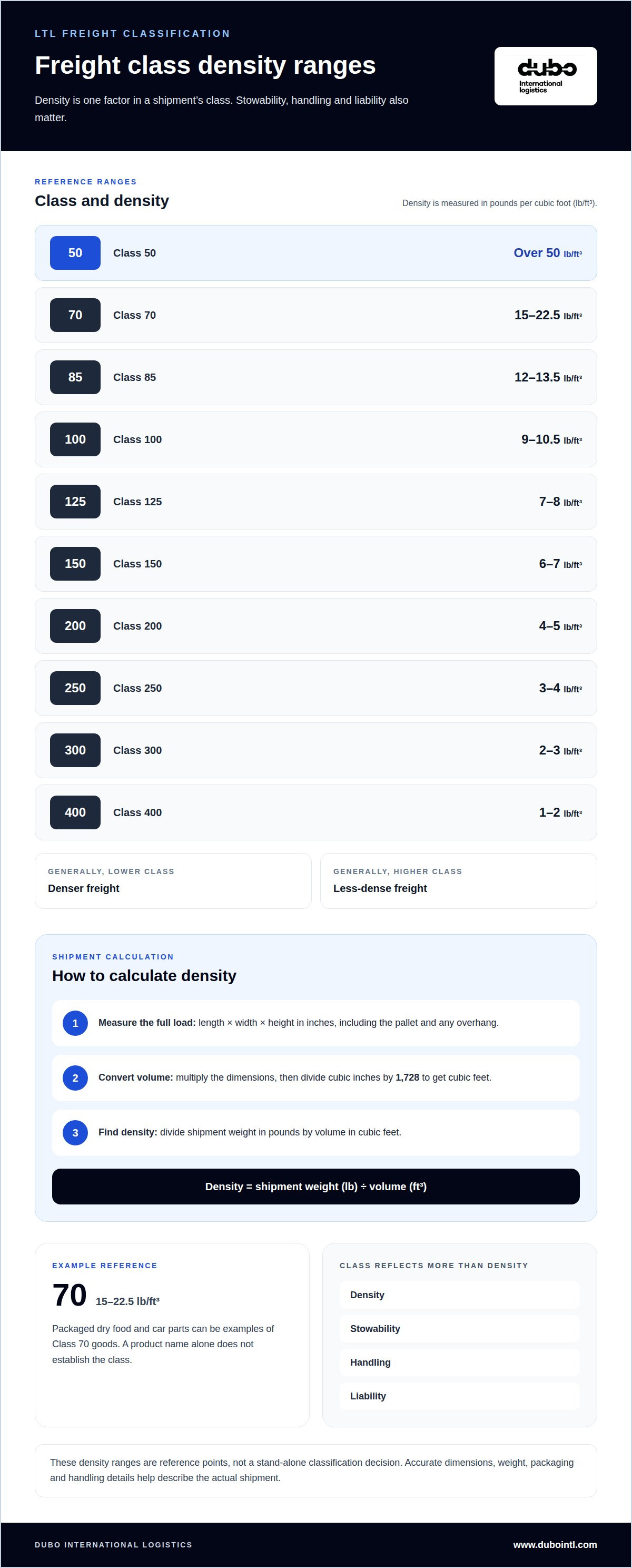
Shipment density is its weight divided by its volume. Measure the freight’s length, width and height in inches, including the pallet and any overhanging goods, then multiply those dimensions. Divide the result by 1,728 to convert cubic inches to cubic feet. Finally, divide the shipment’s weight in pounds by its volume in cubic feet. Accurate measurements matter because density can affect the class assigned to the actual shipment.
Freight class categories and density ranges
In the National Motor Freight Classification system, lower classes generally correspond to denser freight, while higher classes cover less-dense freight. These examples show density ranges associated with several classes:
- Class 50: over 50 lbs per cubic foot
- Class 70: 15-22.5 lbs per cubic foot
- Class 85: 12-13.5 lbs per cubic foot
- Class 100: 9-10.5 lbs per cubic foot
- Class 125: 7- 8 lbs per cubic foot
- Class 150: 6-7 lbs per cubic foot
- Class 200: 4-5 lbs per cubic foot
- Class 250: 3-4 lbs per cubic foot
- Class 300: 2-3 lbs per cubic foot
- Class 400: 1-2 lbs per cubic foot
- Freight class can reflect a shipment’s density, alongside other characteristics.
Density is one factor, not a stand-alone classification decision. Stowability, handling and liability can also affect a shipment’s class. Having freight class explained for Canadian shippers means connecting the class range to the shipment’s actual configuration.
Optimizing class through pallet density
Pallet density can improve when goods are arranged securely in a smaller, practical footprint. For example, reducing unused space between cartons may increase weight per cubic foot. Keep the load stable and protect fragile items; a denser pallet should not compromise safe handling. Accurate pallet dimensions also help ensure the classification details match the freight presented for shipment. These measures may help optimize class, but other shipment characteristics still matter.
If a shipment is reclassified or its stated class is incorrect, update the shipment record to reflect the correct class. Accurate dimensions, weight and freight details help keep the classification information consistent with the actual load.
Freight class is distinct from dangerous-goods classification. For international dangerous-goods transport by ship, Canada requires consultation of the IMDG Code under subsection 11.1(1) of the TDG Regulations, according to Department of Justice Canada.
Class 70 goods, including packaged dry food and car parts
Class 70 is associated with freight density of 15-22.5 pounds per cubic foot. Packaged dry food and car parts can serve as examples, but neither commodity automatically belongs to this class. The shipment’s actual dimensions, weight, packaging and handling characteristics shape its classification. A product name is a useful starting point, not a substitute for accurate shipment details.
Consider cases of dry pasta secured on a pallet. Their combined weight and the space they occupy determine density; a different pallet arrangement can change the calculation. A pallet of packaged rice may have a different weight-to-volume relationship, even though both shipments contain shelf-stable food. Packaging also affects whether cartons stay stable during handling and how efficiently they fit alongside other freight.
Car parts vary just as widely. A compact pallet of metal components may have a different density from a larger crate holding lighter body panels. A shipment of replacement filters, for example, may take up more cubic space relative to its weight than a tightly packed pallet of heavy parts. The commodity category alone cannot establish Class 70.
For a practical comparison, record the pallet’s length, width and height, then include its weight. Check that measurements cover the full load, including overhanging goods. Divide the total weight by the shipment’s cubic-foot volume and compare the result with the Class 70 density range. If the goods are split across pallets, treat each handling unit accurately rather than relying on the product’s total weight alone.
Class 70 may help describe a shipment in an LTL freight quote, where multiple shipments share trailer space. It does not describe customs classification: cross-border shipments may involve customs paperwork and correct HS codes, which serve a different purpose. Nor does a Class 70 label by itself establish how the shipment should be packed or handled. Fragile equipment, irregular packaging or unusual dimensions can affect shipment planning beyond density.
Before dispatch, align the product description, packaging details, pallet measurements and weight. A mismatch between the quoted shipment and the freight presented can lead to a classification review. This matters for packaged dry food, automotive components and other goods moving through Canadian logistics networks. A full truckload may involve different planning considerations from shared LTL freight, but class still depends on the shipment’s actual characteristics.
For shipments with mixed products or uncertain pallet configurations, freight planning support can help organize the information used to assess the shipment.
Commonly shipped goods and example freight classes
Canadian LTL shipments commonly include pallets of building supplies, commercial products and equipment parts. These goods may be too large or heavy for ordinary parcel service, yet too small to fill a trailer. Their commodity names help describe the shipment, but don’t determine its freight class. The actual class depends on the shipment’s characteristics, including dimensions, volume, density and handling needs.
Furniture illustrates why examples need careful interpretation. It can fall anywhere from freight class 60 to freight class 400. A compact, dense item and a bulky piece of furniture may occupy very different amounts of trailer space relative to their weight. Packaging also matters: a protected, stable load may present different handling considerations from an awkward or fragile item. The label “furniture” alone cannot capture those differences.
For other commonly shipped goods, use the commodity as context, then assess the specific freight unit. Examples include:
- Building supplies, such as bundled materials or boxed fixtures, where the load’s size and arrangement affect stowability.
- Commercial products, such as cartons of retail goods, where the number and arrangement of cartons shape the pallet’s volume.
- Equipment parts, such as a crated component, where the crate’s dimensions and protection affect handling.
- Furniture, where an item’s shape, packaging and density can produce classifications across the class 60 to class 400 range.
These examples are reference points, not fixed class assignments. Two pallets of the same product can differ if one has more protective packaging, a larger footprint or goods that overhang the pallet. Actual measurements and weight provide a stronger basis for classification than a general product category. Carriers may also consider how freight can be positioned alongside other shipments in a shared trailer.
For a booking, describe each handling unit clearly. Record the commodity, packaging type, dimensions and weight for every pallet or crate. If a shipment combines different products, note which items share each pallet; one description may hide differences in size, protection or handling. Regular shipments benefit from consistent records, since recurring product names don’t guarantee identical dimensions or packing configurations.
Use example classes to identify questions, not to assume an answer. If a furniture shipment seems unusually bulky, compare its weight with its full packaged volume. If equipment parts arrive in a new crate, use that crate’s dimensions instead of older measurements. This gives the classification process a more accurate picture of the freight presented and helps align shipment details with the carrier’s booking information.
How do I calculate shipment density for freight classification?
Shipment density is weight divided by volume, expressed in pounds per cubic foot. For freight classification, use the full packaged shipment, including its pallet and any goods extending beyond it.
Follow these steps for a consistent calculation:
- Measure the shipment’s length, width and height in inches. Include the pallet and any overhanging goods.
- Multiply length by width by height to find cubic inches.
- Divide the cubic-inch result by 1,728, the number of cubic inches in one cubic foot.
- Divide the shipment’s weight in pounds by its volume in cubic feet.
For example, call a packaged pallet’s dimensions L, W and H inches, and its weight P pounds. Its volume is L × W × H ÷ 1,728 cubic feet. Its density is P divided by that volume. This formula shows why both weight and dimensions matter: a larger footprint can lower density even when the freight weighs the same.
Use the outer measurements of the packed handling unit, not just the product inside. If cartons extend beyond the pallet edges, measure the overhang too. Include protective packaging or a crate in the dimensions. For a shipment with multiple pallets, calculate each handling unit using its own dimensions and weight, then provide the complete shipment details for classification.
Keep units consistent. Measuring in inches and weighing in pounds aligns with the cubic-foot conversion above. Mixing centimetres or kilograms into the calculation without converting them will produce an incorrect result. Record dimensions and weight together so the figures used for a freight quote describe the same packaged shipment.
Density is a useful classification reference, but it doesn’t determine freight class by itself. Stowability, handling and liability can also affect the assigned class. Two goods with the same calculated density may receive different classifications if their packaging, fragility or transport requirements differ. Density is one part of an accurate freight description.
Before booking, compare the measured shipment with the information entered for the quote. If a pallet is repacked, resized or combined with other goods, its volume and density may change. Recalculate using the new dimensions and weight rather than carrying forward figures from an earlier configuration. This keeps classification details aligned with the freight presented to carriers.
For shipment planning that involves density calculations alongside other freight requirements, discuss your freight requirements with a logistics specialist.
Dubo International Logistics: Freight forwarding
Dubo International Logistics coordinates freight forwarding, logistics consulting and specialized transportation for shipments with distinct planning needs. When freight class details intersect with packaging, equipment, route or handling requirements, coordinated planning can help keep shipment details aligned.
Freight class is one part of an LTL shipment plan. The commodity description, dimensions, weight and packaging all help describe the freight. Dubo International Logistics supports freight forwarding by coordinating cargo movement and the shipment information needed to plan it. This can help businesses arranging regular pallet shipments, managing freight across North America or coordinating several shipment requirements together.
Logistics consulting can help businesses assess how shipment requirements fit into a wider movement plan. For example, unusual dimensions may require attention to equipment and handling beyond a routine pallet booking. A fragile piece of machinery may need a different transport plan from packaged commercial goods. Considering these details early gives the movement plan a clearer basis and helps avoid treating distinct cargo as interchangeable.
Specialized transportation is relevant when cargo has requirements that ordinary freight arrangements may not address. Examples include oversized machinery, delicate equipment and temperature-sensitive products. These shipments may call for planning around cargo characteristics, suitable transport and transitions between journey legs. Dubo International Logistics coordinates specialized transportation for these requirements and complex project cargo movements across Canada and the United States.
Consider a business moving a large machine alongside routine pallet freight. The machine’s size and handling needs may call for specialized transportation, while the pallets may fit an LTL plan. Another shipper may need to coordinate temperature-sensitive products through several freight stages. In each case, the logistics decision depends on the cargo and movement requirements, not a class example alone.
Contact Dubo International Logistics when a shipment combines freight-class questions with broader coordination needs, or when its dimensions, fragility or temperature requirements call for specialized planning. Useful starting details include the commodity, packaged dimensions, weight, pickup and delivery locations, and handling requirements. These details frame the logistics discussion around the actual shipment rather than a general product category.
For freight forwarding, logistics consulting or specialized transportation planning, contact Dubo International Logistics to discuss your shipment.
Make freight planning part of the next decision
Having freight class explained for Canadian shippers can help teams treat classification as a planning decision, not just a form field. Next, establish clear ownership of shipment information among the people who prepare, book and coordinate freight. Shared processes make it easier to keep decisions aligned when operational requirements change, rather than relying on assumptions from an earlier shipment.
For businesses whose transportation needs extend beyond routine freight movements, Dubo International Logistics offers freight forwarding, logistics consulting and specialized transportation services. These services can support planning that brings cargo requirements and broader movement priorities together. A considered plan gives teams a clearer basis for coordinating their next shipment.
Contact Dubo International Logistics to discuss your freight requirements and identify a practical next step.
Frequently Asked Questions
Are the classifications for other modes or international shipments the same?
No. Freight class for LTL rating is different from dangerous-goods classification, and air or marine shipments may use mode-specific requirements. For international dangerous-goods transport by ship, Canada requires consultation of the IMDG Code under subsection 11.1(1) of the TDG Regulations, according to Department of Justice Canada. For air shipments, the applicable Canadian framework includes the ICAO Technical Instructions and Part 12 of the TDG Regulations.
How do I determine the class?
Start with the exact commodity and shipment packaging, then assemble the measured dimensions and weight. Density is a useful reference, but fragility, stowability and handling can also matter. For example, a boxed machine part and the same part secured in a larger crate present different shipment details. Use the actual shipping configuration, not a product description or class assigned to a different package.
What is freight class and how is it determined?
Freight class is a classification used to describe LTL freight for rating and handling. The National Motor Freight Classification framework considers density, stowability, handling and liability. The same product may need a different assessment if its packaging or dimensions change. Treat the class as a description of the shipment being tendered, not a permanent label attached to the product.
Does Canada use the NMFC freight class system?
The LTL freight-class framework discussed in this guide is the National Motor Freight Classification, or NMFC. It applies to Canadian shippers arranging LTL freight, but it isn’t a universal classification for every transport mode or purpose. For example, an NMFC freight class and a dangerous-goods class describe different aspects of a shipment and serve different functions.
What are the Canadian freight classification systems and class scales?
Freight rating and dangerous-goods rules use distinct classification approaches. The NMFC freight-class examples span Class 50 through Class 500, with density ranges associated with individual classes. Dangerous goods are classified separately from freight for rating, using information about the goods and their hazards. A freight class number therefore does not replace a dangerous-goods classification.
How do density, dimensions, handling, stowability, and liability affect freight class?
Density relates a shipment’s weight to the space it occupies, so a bulky, light package differs from a compact, heavy one. Dimensions also show how freight may fit alongside other cargo. A fragile item, awkwardly shaped equipment or goods that cannot be readily stowed may require different handling. Liability reflects the potential consequences of damage or loss. Together, these factors describe freight beyond its commodity name.
Where can Canadian shippers find a product's freight class or classification item number?
Begin with the freight documentation or classification information used for the exact commodity, and match the description to the product’s shipped form. Packaging, material and configuration can affect which description applies. If you use a previous shipment record, compare its item description and packaging with the current load. A similar product name alone may not identify the correct classification item when the shipment has changed.
How do freight class and freight rate affect LTL shipment planning in Canada?
Freight class helps describe an LTL shipment for rating and handling, while the freight rate is determined under the applicable arrangement. Accurate shipment details support planning: confirm dimensions, weight, classification and required delivery services, such as liftgate service or appointment bookings. If dimensions or packaging change, review the classification and shipment details before tendering the freight.

