

Choosing between freight brokerage vs freight forwarding comes down to the role each plays in moving cargo. A freight broker connects a shipper with a carrier and coordinates transportation without taking possession of the freight. A freight forwarder plans and manages shipments, often across borders or transport modes, and may take possession while coordinating the movement. The key differences are each party’s responsibilities and the scope of coordination.
Both can help businesses arrange transportation, but they are not interchangeable. The right fit depends on the route, cargo type, and level of coordination required. Licensing responsibilities also vary by jurisdiction, so Canadian businesses should consider where a shipment travels and which rules apply to each party.
This guide explains how brokers source carriers and coordinate bookings, how forwarders manage shipments, and where their responsibilities and licensing diverge. For shipments that need coordinated freight forwarding, logistics consulting, or specialised transportation, Dubo International Logistics provides support across Canada. Learn more at www.dubointl.com.
Key Takeaways
- Use a freight broker when the main need is to connect a shipment with a suitable carrier, especially for a domestic trucking move.
- Consider a freight forwarder when a shipment needs coordinated planning across borders, transport modes, or multiple logistics stages.
- Understand how responsibilities, documentation, and licensing can vary with the service provided and the shipment’s route.
- Assess a provider’s relevant experience, carrier vetting, shipment visibility, and approach to cargo-specific requirements.
- For complex or specialized freight, logistics consulting and tailored transportation planning can help align the shipment with the right movement strategy.
What Is a Freight Broker?
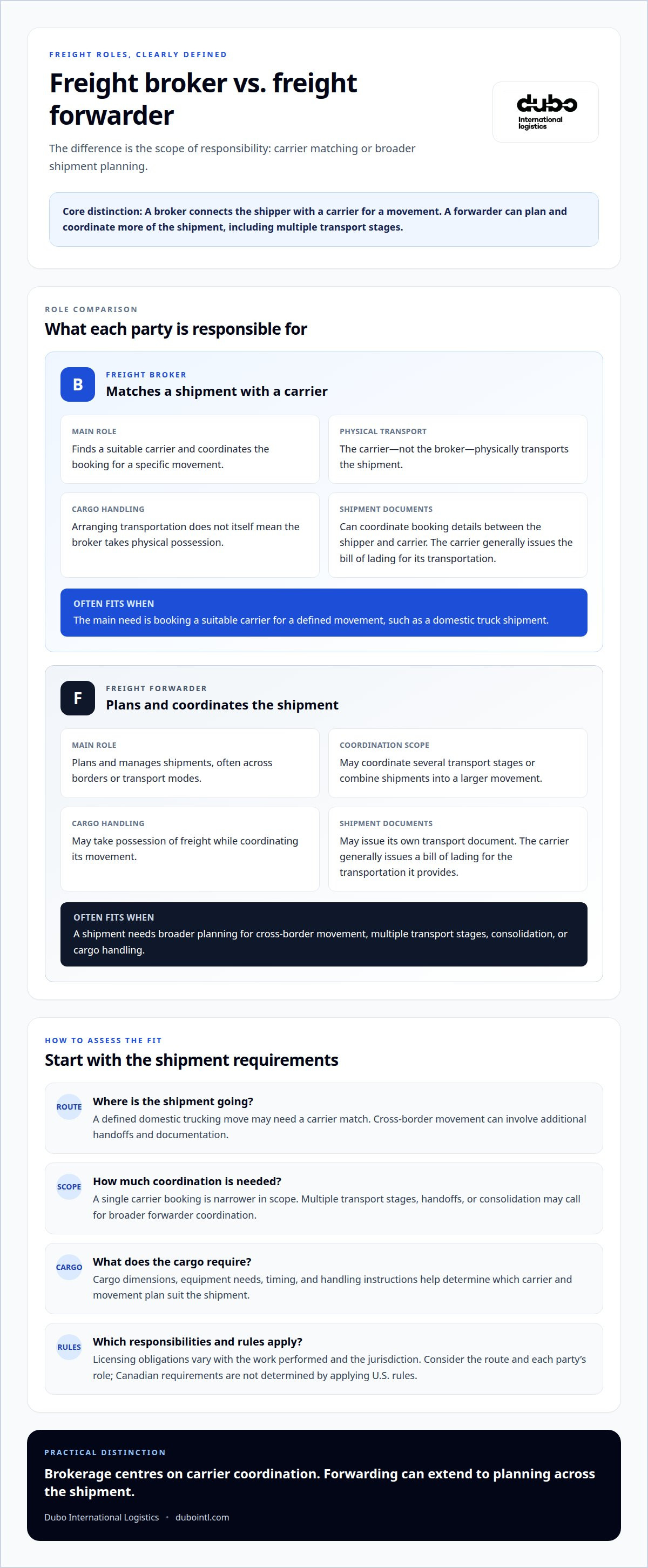
A freight broker arranges transportation by connecting a shipper with a carrier that can move the cargo. For example, a Canadian manufacturer arranging a domestic truck shipment provides the origin, destination, cargo details, and timing. The broker finds a suitable carrier and coordinates the booking. The carrier, not the broker, physically transports the shipment.
A broker generally arranges a carrier for a specific movement, while a forwarder can plan more of the shipment and may take possession of the freight. In practical terms, the broker matches a load with available transport capacity; the forwarder may coordinate several transport stages or combine shipments. The route and the coordination required help determine the best fit.
A bill of lading records key shipment details and accompanies the movement of goods. The carrier generally issues it for the transportation it provides. A broker can coordinate booking information between the shipper and carrier, but arranging transportation does not itself mean the broker takes physical responsibility for the cargo. Before pickup, align the cargo description, origin, destination, and handling requirements across the shipment details.
Consolidation is another distinction. A forwarder may combine freight from different shipments into a larger movement and coordinate its onward transport. A broker typically finds a carrier for the shipper’s load rather than physically combining freight. Separate shipments that need to travel together may call for forwarder coordination, while a single domestic truckload may simply need a carrier match.
| Option | Cargo booking | Bill of lading | Consolidation and handling |
|---|---|---|---|
| Freight broker | Connects shipper and carrier | Coordinates shipment details | Does not take physical possession |
| Freight forwarder | Plans and coordinates transport | May issue its own transport document | May take possession and consolidate freight |
Choose a broker when the main task is booking a suitable carrier for a defined movement. Consider a forwarder when international shipping, multiple transport stages, consolidation, or cargo handling calls for broader coordination. In either case, clear cargo details help align the booking with the transport documents.
Broker carrier sourcing and coordination
A broker starts by matching shipment requirements with a suitable carrier. The shipper provides the origin, destination, cargo dimensions, equipment needs, and delivery window. The broker then contacts carriers whose equipment and schedules suit the movement. For example, a shipment requiring a temperature-controlled trailer needs a carrier with equipment that meets that cargo requirement, not simply an available truck.
Carrier relationships help brokers coordinate bookings and confirm arrangements for a particular movement. Details can include pickup timing, equipment, handling instructions, and responsibilities recorded in shipment documents. The motor carrier performs the physical transport, while the broker communicates the agreed arrangements between carrier and shipper. Clear booking information helps keep the bill of lading consistent with the shipment.
Domestic and cross-border bookings call for different coordination. A shipment moving between Canadian cities may need one carrier for its road journey. A cross-border shipment may involve additional handoffs and documentation between parties on either side of the border. Brokers commonly arrange domestic shipments across Canada, the United States, and Mexico; international shipping may require broader coordination than a single trucking leg.
Tracking supports communication after dispatch. A broker can monitor a shipment and relay changes, such as a delay or revised pickup time, to the shipper and carrier. Carrier vetting also matters: the broker assesses whether a carrier’s capabilities and operating details suit the cargo and route. For fragile freight, that assessment should account for handling needs and the assigned equipment.
For shippers, the practical distinction remains the scope of coordination: brokers focus on arranging carriers, while forwarders may coordinate broader shipment plans.
In Canada, compare the work each role covers rather than assuming their services are identical. A broker’s arrangement centres on carrier coordination; a forwarder’s may include planning across multiple transport stages. For a shipment with several handoffs, coordinated freight planning can be a useful part of the discussion.
Broker and forwarder licensing
Licensing depends on the work performed and the jurisdiction governing a shipment. A broker arranging a carrier is not automatically subject to the same operating requirements as a carrier transporting freight. A forwarder coordinating a shipment may also have different obligations from the motor carrier. For Canadian businesses, the route and each party’s role matter when identifying applicable requirements.
Canada’s freight broker licensing requirements cannot be determined by applying U.S. rules. The Federal Motor Carrier Safety Administration (FMCSA) is a U.S. authority, and its framework does not establish a Canada-wide broker licence. Canadian obligations depend on the jurisdiction and activity involved, so distinguish domestic operations from movements that cross into the United States.
The same jurisdictional distinction applies to forwarders. Requirements for a forwarder handling Canadian shipments should not be confused with U.S. operating authority. Under the U.S. framework described by FMCSA, freight forwarders need operating authority for interstate or foreign commerce. That example is relevant when a Canadian company arranges a shipment entering U.S. commerce, but it does not replace Canadian requirements.
Responsibilities also depend on whether a forwarder acts as an agent or takes on a broader role. The Canada Revenue Agency describes a freight forwarder acting as a shipper’s agent as helping prepare and book freight transportation. Statistics Canada says forwarders handle documentation, taxes and fees, and communications with government authorities for international shipments. These functions show why a forwarder’s duties can extend beyond booking a carrier.
For a cross-border import, identify who books each transport leg and who handles the required shipment documentation. A party arranging transportation may have different responsibilities from the carrier moving the goods. A party coordinating international paperwork may also have duties distinct from a broker sourcing a domestic motor carrier. Separate these functions before assigning compliance tasks.
- Broker: Identify the jurisdiction and whether the work is carrier arrangement or transportation.
- Forwarder: Clarify the role, operating authority, and documentation responsibilities for each shipment.
- Carrier: Treat the motor carrier’s transportation and safety obligations as distinct from the broker’s role.
For example, a shipment moving from Ontario into the United States may involve a Canadian booking, a cross-border handoff, and U.S. interstate transportation. FMCSA requirements apply to the U.S. activity described above, not as Canadian licensing rules. Distinguishing each party’s role helps align operating authority with shipment responsibilities.
The U.S. FMCSA framework does not establish a Canada-wide broker licence. Applicable requirements depend on the jurisdiction, shipment route, and whether the business arranges transportation or operates as a carrier. Cross-border movements may also involve U.S. requirements.
Requirements depend on the jurisdiction, shipment route, and the forwarder’s role. A forwarder’s responsibilities may include arranging transportation and handling international shipment documentation, taxes, fees, and communications with government authorities. These duties are distinct from the motor carrier’s obligations.
What Is a Freight Forwarder?
A freight forwarder coordinates cargo movement from the shipper’s origin to its destination. The work can include selecting transport modes, booking carriers, planning routes, and organizing shipment documents. For an international shipment, the forwarder may coordinate several transport legs and communicate with government authorities. The exact scope depends on the services assigned to the forwarder.
The Canada Revenue Agency describes a freight forwarder acting as a shipper’s agent as helping prepare and book freight transportation. Statistics Canada notes that forwarders handle documentation, taxes and fees, and communications with government authorities for international shipments. These responsibilities matter when cargo crosses a border, where the shipper needs clear ownership of each logistics task.
Assess a provider against the shipment’s route and cargo requirements. Review relevant experience, applicable licensing, insurance, tracking, and claims support. For example, a forwarder handling fragile equipment should be able to coordinate suitable transport and careful handoffs. Licensing also depends on the jurisdictions involved: U.S. interstate activity can involve the Federal Motor Carrier Safety Administration, but its requirements are not Canadian rules.
A broker may suit a straightforward domestic trucking move when the main need is finding a carrier for one defined load. A forwarder may be a better fit when an international shipment needs route planning, coordination across transport modes, or documentation support. A Canadian business shipping machinery within one province may need a different level of coordination from an importer arranging cargo from overseas.
For a career choice, compare the day-to-day responsibilities. Freight brokerage centres on matching shipments with carriers and coordinating bookings. Freight forwarding can involve broader international logistics, documentation, and communication across shipment stages. Someone drawn to carrier relationships may prefer brokerage work; someone interested in cross-border planning may find forwarding a better fit.
- Experience: Match the provider’s shipment history to the cargo and route.
- Licensing: Consider the jurisdictions and activities involved.
- Insurance and claims: Understand the coverage and support relevant to the shipment.
- Coordination: Choose the role that fits the number of transport stages and documentation needs.
Use these criteria to define the work a shipment needs before choosing a broker or forwarder. Clear responsibilities help shippers coordinate logistics and keep documentation aligned with the cargo’s route.
Freight broker and freight forwarder roles
A freight broker connects a shipper with a carrier and coordinates a shipment without taking possession. A freight forwarder can plan broader transportation, take possession, and coordinate cross-border or multimodal movements.
For a domestic truck shipment, a broker typically matches the load with a motor carrier. For an international shipment, a forwarder can coordinate more of the movement from origin to destination.
Freight Broker Roles and Services
A freight broker arranges transportation by matching a shipper’s load with an available carrier. The broker can coordinate booking details, communicate shipment changes, and track the movement, while the carrier physically transports the cargo. For example, a Canadian shipper moving a full truckload between provinces may use a broker to source road capacity. The broker’s role centres on arranging that carrier movement, not taking possession or consolidating goods.
Freight Forwarder Roles and Services
A forwarder can coordinate a shipment across several stages, including different transport modes and border crossings. Forwarders may take possession, consolidate freight, and issue bills of lading under their own authority. For example, an importer receiving goods from overseas may need a plan that connects international transportation with domestic delivery. The forwarder’s remit can cover that broader movement, rather than only matching one load with a motor carrier.
The route helps clarify the distinction. A broker is commonly suited to domestic road freight, including full truckload and less-than-truckload shipments. A forwarder is suited to cargo crossing borders, moving by multiple modes, or requiring consolidation. A shipment from a Canadian supplier to a Canadian destination may need a carrier booking; an international shipment with several handoffs may need broader coordination.
Authority also depends on the activity and jurisdiction. The Federal Motor Carrier Safety Administration (FMCSA) operating authority described for forwarders applies to interstate or foreign commerce in the United States. It is not a general Canadian licence. For a Canada-to-U.S. movement, distinguish the forwarder’s coordinating role from the motor carrier’s transportation and safety responsibilities.
- Choose a broker when the shipment needs a carrier for a defined domestic road movement.
- Choose a forwarder when the route involves international transport, several stages, or consolidation.
- Define responsibilities for each party, from origin booking through delivery at destination.
For complex cargo moving across North America, specialized transportation planning can help align equipment and handoffs with shipment needs. Discuss freight coordination for your shipment.
Dubo International Logistics: Freight forwarding
Dubo International Logistics can help when a shipment needs coordinated planning beyond a single carrier booking. Its freight forwarding service supports cargo movement across North America, with coordination tailored to the route, shipment requirements, and transport stages. This can suit businesses managing complex project cargo or shipments with specialized handling needs.
Freight forwarding is useful when several parts of a shipment need to work together. Dubo International Logistics coordinates freight movement across Canada and the United States, including through complex corridors. For a shipment involving multiple transport stages, logistics consulting can help align route planning, carrier coordination, and cargo requirements before the shipment moves.
Specialized transportation services are designed for cargo that needs more than standard equipment or routine handling. Dubo International Logistics supports transportation for oversized machinery, delicate equipment, and temperature-sensitive products. A large machine or delicate component, for example, may need a transport plan that accounts for its dimensions, handling needs, and the equipment required along the route.
For specialized movements, Dubo International Logistics uses tracking systems and a carrier network to coordinate deliveries. This coordination matters when a shipment involves several handoffs or a complex corridor, where clear movement information supports planning throughout the journey. The cargo’s characteristics and route determine the coordination required.
Logistics consulting can help a business assess shipment requirements before arranging transportation. This may be useful for project cargo, sensitive equipment, or a route requiring careful coordination across Canada and the United States. The focus is on matching the logistics plan to the cargo and movement, rather than treating every shipment alike.
These services are most relevant when transportation involves complex project cargo, specialized equipment, or multiple coordinated stages. A straightforward domestic load that only needs a carrier booking may call for a narrower arrangement. For cargo requiring broader planning, freight forwarding and specialized transportation can bring the movement requirements into one coordinated plan.
Learn more about Dubo International Logistics and its freight forwarding services. Contact Dubo International Logistics to discuss your shipment’s logistics requirements.
Plan the Next Shipment with Confidence
Turn each completed shipment into a reference for future planning. Record what went as planned, where a handoff needed extra coordination, and which instructions helped protect the cargo. These observations can help your team prepare clearer shipment briefs and make decisions more consistently.
That practical review also puts the freight brokerage vs freight forwarding decision in context. Rather than treating it as fixed, revisit your approach when shipping needs change or a new type of cargo enters the supply chain.
For a considered discussion about future logistics planning, start a conversation with Dubo International Logistics. A thoughtful next step can help your team move forward with clarity.
Frequently Asked Questions
Can One Company Be Both?
Yes. A logistics company can act as a broker for one shipment and a forwarder for another, because the role depends on the work it undertakes. For example, it could arrange a domestic truck movement as a broker, then coordinate a separate cross-border shipment as a forwarder. The service agreement and transport documents should identify the company’s role and responsibilities for each shipment.
Can You Use Both?
Yes. A Canadian shipper can use a forwarder to coordinate an international shipment, then use a broker to arrange a domestic trucking leg. This division can suit goods arriving from another country that need onward road transport. The handoff plan should identify who coordinates each leg, communicates shipment updates, and ensures the relevant documents accompany the cargo at each transfer.
Who is responsible for cargo, claims, and liability in freight brokerage versus freight forwarding?
Responsibility depends on each party’s role, possession of the cargo, and the terms governing the shipment. A carrier handles the goods during its transport; a broker arranging that carrier does not take physical possession. A forwarder that takes possession assumes responsibility under its arrangement. If damage occurs, document the cargo’s condition at handoff and follow the applicable contract and claims process.
When should a Canadian shipper use a freight broker versus a freight forwarder?
Choose based on the shipment’s coordination needs. A broker can suit a defined domestic truck movement, such as shipping finished goods between Canadian distribution points. A forwarder can suit a shipment with an international origin, multiple transport stages, or coordinated handoffs. For machinery moving across a border, consider the route, cargo handling requirements, documentation, and how many parties need to coordinate the movement.
Can freight forwarders and freight brokers handle international and domestic shipments?
Both can be involved in domestic and cross-border movements, but their roles differ by shipment. Brokers commonly arrange domestic trucking and can participate in some international movements. Forwarders coordinate domestic or international cargo plans, including shipments with several transport stages. For example, a forwarder can coordinate an international movement while a broker arranges a separate domestic trucking leg within the overall route.
What risks should Canadian shippers consider when choosing a freight broker or freight forwarder?
Key risks include unclear responsibility at handoffs, inadequate cargo-specific planning, and discrepancies between documents and the actual shipment. A fragile shipment, for instance, needs handling requirements communicated consistently to each party. Shippers should also understand the relevant insurance and claims process, confirm who coordinates each movement, and ensure the agreed scope reflects the route, cargo, and delivery requirements.

