

The cargo, not the route, determines whether a flatbed is the right starting point. Flatbed freight shipping in Canada moves goods on trucks or trailers with open decks and no enclosed roof or sides. This allows loading from multiple angles and accommodates freight that may not fit in an enclosed trailer. Accurate cargo dimensions and weight help determine whether a flatbed, step deck or double-drop trailer is suitable.
Choosing the trailer is only part of the plan. Terrain, regional weather and cross-border requirements can shape the route and delivery arrangements. Consider the shipment’s specifications alongside its origin, destination and handling needs.
This article explains flatbed freight, how cargo size and weight affect trailer choice, and what Canadian and cross-border movements can involve. It also covers how route conditions shape planning and how freight forwarding and specialized transportation can support shipments that require careful coordination.
Key Takeaways
- Use the shipment’s exact weight and dimensions to guide trailer selection and route planning.
- Account for regional terrain and weather when mapping freight movement across Canadian provinces and territories.
- Plan cross-border shipments around the distinct road and safety requirements of Canada and the United States.
- Consider how cargo specifications, route conditions and season shape flatbed shipment planning.
- Consider freight forwarding, logistics consulting or specialized transportation when a shipment needs coordinated handling across complex routes.
Choosing a flatbed trailer based on load weight and dimensions
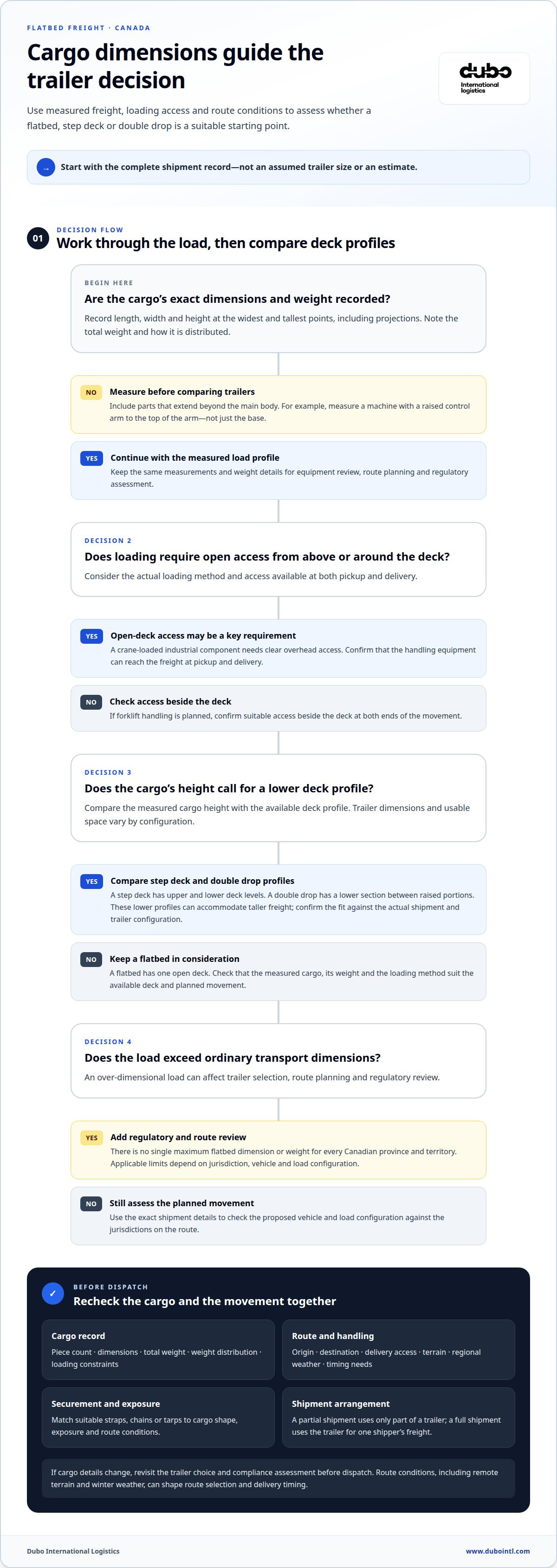
Trailer selection starts with the shipment’s measured length, width, height and weight. These details help identify a suitable deck and flag route or compliance considerations before dispatch.
Load Weight and Cargo Dimensions
Measure each piece at its widest and tallest points, including projections, then record its length and weight. For example, measure a machine with a raised control arm to the top of the arm, not just the base. Note how the weight is distributed too: a concentrated load differs from evenly distributed materials, even when their total weights match.
There is no single maximum flatbed load dimension or weight for every Canadian province and territory. Applicable limits depend on the jurisdiction, vehicle and load configuration. Use the shipment’s exact measurements and weight to assess the planned movement.
Partial, Full, and Over-Dimensional Shipments
A partial shipment occupies only part of a trailer, while a full shipment uses the trailer for one shipper’s freight. Lumber bundles, construction materials or machinery can suit either arrangement, depending on quantity and handling needs. An over-dimensional load exceeds ordinary transport dimensions, which can affect trailer selection, route planning and regulatory review.
Describe the shipment by listing the number of pieces, each piece’s dimensions, the total weight and any loading constraints. A single oversized machine, for example, may need a different plan from several smaller components, even if their total weights are similar.
Flatbed, Step Deck, and Double Drop Trailers
A flatbed has one open deck; a step deck has upper and lower deck levels; a double drop has a lower section between raised portions. The lower deck profiles can accommodate taller freight, while cargo length, weight and loading access remain important. Compare the cargo’s height with the available deck profile before selecting a trailer.
Flatbed capacity and trailer dimensions are not universal specifications. Usable deck space and suitable weight depend on the trailer configuration and shipment. A crane-loaded industrial component, for example, may need open access, while a tall machine may call for a lower deck profile.
Before dispatch, match the loading method to the trailer and cargo. A crane-loaded component needs clear overhead access, while forklift handling requires suitable access beside the deck.
Accurate freight dimensions help shippers select a suitable flatbed type and assess regulatory requirements. Treat the measurement record as part of the equipment decision, not an estimate to make after choosing a trailer. Measure the complete freight, including parts that extend beyond its main body, and use consistent details when planning the shipment and its route.
Use those measurements to compare the load with the available deck profile and decide whether a flatbed, step deck or double drop is suitable. Dimensions can also flag when the planned movement needs closer regulatory review. If the cargo details change, revisit the trailer choice and compliance assessment before dispatch so the plan reflects the freight being moved.
Canadian route and transport regulation familiarity
Flatbed transportation planning brings together cargo characteristics, road conditions, securement and delivery access. Across Canada, remote or rugged terrain and harsh winter weather can affect route selection and delivery timing.
Canadian flatbed cargo must be secured with suitable equipment, such as straps, chains or tarps. Match the securement method to the cargo’s shape and exposure, and account for route and weather conditions.
Oversized freight requires more planning than choosing an open trailer. For a large machine, map the origin, destination and route, then consider its dimensions, loading access and regional conditions. Remote roads or winter weather may affect route selection and delivery timing, so include these factors in the transport plan.
Custom flatbed transportation starts with the cargo’s handling needs. Machinery loaded by crane, for example, needs access for that equipment at pickup and delivery. Record the load’s dimensions and weight, note lifting points and other handling constraints, and share these details when arranging the shipment.
Flatbeds can carry oversized machinery, lumber and construction materials, but each type needs different preparation. Lumber bundles need secure arrangement, while machinery may require attention to shape, weight distribution and protection from exposure. Cargo type, loading method and destination access all inform the transport plan.
To request a flatbed freight quote in Canada, provide the origin, destination, cargo description, dimensions and weight. Include pickup and delivery access, loading requirements and preferred timing. These details help define the route and equipment needs.
Transit time between major Canadian cities depends on distance, route conditions, weather and shipment requirements. A winter movement through a remote corridor, for example, may need different timing considerations from a shipment between urban locations in favourable conditions.
Flatbed risks include cargo movement, weather exposure and route-related delays caused by mechanical issues or transit incidents. When unexpected equipment breakdowns or collisions occur, having access to specialized heavy-duty support from JTT Towing and Storage helps ensure prompt accident recovery and commercial truck repairs. Shippers and carriers should also consider cargo value and review insurance policies for coverage scope, exclusions and claim requirements before shipment.
To prepare freight, confirm each item’s dimensions and weight, identify suitable loading equipment, and arrange securement with appropriate straps, chains or tarps. For a weather-exposed load, consider how a tarp can protect the cargo without interfering with securement or handling.
Secure flatbed cargo with suitable straps, chains or tarps. Match the method to the cargo’s shape and exposure, as well as route and weather conditions. For weather-exposed freight, consider how a tarp will protect the cargo.
Flatbed service across Canadian provinces and territories
A Canadian flatbed route is shaped by more than the distance between two addresses. Province, territory, terrain, weather and delivery access all affect how a shipment is planned. A movement from Vancouver, British Columbia, to Winnipeg, Manitoba, differs from one ending in a remote community, where road access and local conditions need close attention.
Plan around the actual origin and destination, whether freight moves between provinces or connects provincial and territorial points. Route requirements can vary with the locations, road access and conditions along the way. These considerations matter because not every road or destination is accessible to every trailer.
Canada’s regions bring distinct route considerations. Rugged terrain can affect transportation through parts of British Columbia, while remote locations may require added planning for access and delivery. For carriers navigating challenging routes in areas like the Fraser Valley, knowing regional incident response providers like Dependable Towing & Recovery Services helps manage unexpected roadside delays or equipment recovery. A shipment destined for Whitehorse, Yukon, for example, needs an origin-to-destination plan that accounts for the route and destination conditions, rather than relying on distance alone.
Weather adds another planning layer. Harsh Canadian winters and regional conditions can affect flatbed routes and delivery timing. A shipment scheduled for northern Ontario or Alberta may face different weather considerations from one travelling during a milder period. Build weather into the schedule, and keep route planning connected to the cargo’s destination and delivery requirements.
For a shipment to a less accessible location, confirm practical details at both ends before dispatch. Identify the receiving site in Labrador, the Northwest Territories or another remote area. Clarify where a truck can approach, how cargo will be unloaded and whether the site’s access suits the planned equipment. These details help align transport arrangements with the final destination.
A useful planning sequence starts with complete addresses, then adds cargo dimensions, weight, loading method and delivery access. Next, consider regional weather and any remote or rugged sections along the route. Finally, coordinate timing around route conditions and destination requirements. For example, a construction-material delivery to a rural site needs a defined drop-off location, not simply a region.
Route familiarity matters across Canada because a flatbed movement can span different terrain and weather conditions before reaching its final site. Sharing the full route and delivery details early helps transportation planning account for the shipment’s real requirements, from an urban pickup in Montreal to a remote destination in Yukon.
Sharing the full route and expected weather challenges with a freight service provider supports planning and coordination. Flatbed transport services in Canada are available year-round, but specific route conditions still need consideration. Flatbed shipping across Canada and the United States must adhere to each country’s road and safety regulations.
Canada and US coverage
A cross-border flatbed movement connects Canadian origins and destinations with routes in the United States. A shipment crossing the border, for example, enters a different national road and safety framework. Planning must account for the requirements that apply in each country, along with cargo, route and delivery details.
Plan the full route, not just the border crossing. A cross-border movement needs a Canadian pickup plan, a crossing point, a route in the United States and a defined delivery site. The same sequence applies when a shipment begins farther from the border, with regional terrain and weather shaping the details. These are planning steps, not fixed service routes.
Road and safety regulations differ between Canada and the United States. Flatbed shipments travelling through both countries must meet each country’s specific requirements. Identify where the route crosses the border, which jurisdictions the truck will travel through, and whether the load’s size or configuration affects route planning. Compliance in one country does not automatically mean compliance in the other.
Prepare a consistent shipment profile for the entire journey. Include the cargo description, piece count, dimensions, weight, pickup and delivery addresses, loading method and required delivery timing. Ensure the information covers the complete journey, including any portion continuing across the border. Clear, consistent details help coordinate the movement.
Cross-border coverage also depends on how the shipment transitions between transportation stages. Before dispatch, establish who coordinates each leg, how shipment status is communicated, and how any change to the route or schedule will be shared. For a delivery from British Columbia to Washington, a defined communication plan helps connect the Canadian pickup with the US destination without losing sight of cargo requirements.
Weather can affect planning on both sides of the border. Harsh Canadian winters and regional weather variations in the United States may influence route selection and delivery timing. A route from Manitoba through North Dakota, for example, may face conditions different from a summer movement through the same corridor. Weather should be considered alongside road conditions and the delivery window.
Before a cross-border flatbed shipment moves, organize the planning around four details:
- Route: Record the origin, destination and intended border crossing.
- Cargo: Share an accurate description, dimensions and weight.
- Requirements: Account for the road and safety regulations in both countries.
- Coordination: Set clear communication for route, schedule and shipment updates.
This approach gives a shipment from Canada into the United States a coordinated plan for the full journey. It treats the border crossing as one part of the route, rather than the only planning consideration.
Flatbed freight shipping cost per kilometre in Canada
A clear shipment brief grounds flatbed planning in the actual cargo and delivery requirements. Use one record for the shipment and keep its details consistent as arrangements develop. This is especially useful when a load includes several pieces, separate pickup points or specific receiving instructions.
Begin with a cargo inventory. Describe each item by its common name and record how many pieces are moving. For machinery, distinguish the main unit from loose components or attachments. This connects each item with its handling needs and intended delivery location.
Next, organize the information around the movement. Include pickup and delivery addresses, site contacts, access instructions and the planned loading approach. If a receiving site has a designated entrance, identify it clearly. Detailed instructions help distinguish a general business address from the actual unloading point.
Keep shipment details aligned across the people arranging pickup, transport and receipt. If a component is added or removed, update the cargo record and communicate the change before dispatch. A revised inventory can affect how the shipment is organized, which items travel together and how the receiving team prepares for arrival.
Timing information should be practical too. Record the preferred pickup period, delivery requirements and any site scheduling constraints. If a construction site can accept freight only during a particular work window, include that with the destination details. Weather and route conditions may also affect planning, especially for remote movements.
Before sharing the shipment brief, review it for gaps and inconsistencies:
- Cargo record: Check that every piece has a clear description.
- Locations: Match each pickup and delivery point to the correct item.
- Site instructions: Include access, contact and receiving details.
- Handling plan: State how the cargo will be loaded and unloaded.
- Updates: Revise the brief when the shipment or schedule changes.
This review gives everyone involved the same working information. It also helps the receiving team prepare for the cargo and handling method, rather than relying on assumptions when the truck arrives.
For a multi-piece shipment, identify which items belong together and which need separate handling. A primary machine and its detachable components, for example, may need clear labels in the inventory so the receiving team can reconcile the delivery. Keeping the brief accurate from planning through arrival supports orderly coordination at both ends of the route.
Flatbed rates can depend on cargo type, piece count, dimensions and handling needs, as well as pickup and delivery locations, site access and loading requirements. Timing, site scheduling constraints, weather and route conditions, especially on remote routes, can also affect planning and rates.
Dubo International Logistics: Freight forwarding
Dubo International Logistics coordinates complex freight movements through freight forwarding, logistics consulting and specialized transportation services. For a flatbed shipment involving oversized machinery or a cross-border route, these services help align cargo requirements, transportation planning and shipment transitions.
Bring the shipment details together, including cargo dimensions and weight, origin, destination, handling needs and timing. This gives planning a clear basis, particularly when a load requires specialized transport or moves through complex corridors across Canada and the United States.
For support with a shipment plan, contact Dubo International Logistics to discuss your freight forwarding or specialized transportation needs.
Set the next shipment up for a clear start
A well-prepared shipment brief turns planning into a practical next step. Before setting a pickup date, gather cargo details, site contacts, loading arrangements and delivery priorities in one working document. Assign someone to share updates if the shipment, access conditions or receiving schedule changes. This gives everyone involved a consistent point of reference as arrangements take shape.
For flatbed freight shipping in Canada, this preparation connects the transport plan to operational needs at both ends. It also gives a logistics partner a clearer picture of what needs coordination, especially for specialized cargo or cross-border movements.
Dubo International Logistics can support that planning through freight forwarding, logistics consulting and specialized transportation services. If your shipment needs coordinated attention, contact Dubo International Logistics to discuss the next step.
With a clear brief and the right coordination, you can move forward with a more complete shipping plan.
Frequently Asked Questions
What is flatbed?
A flatbed is a truck trailer with an open deck rather than enclosed walls and a roof. Its design allows cargo to be loaded from the sides or above, which can suit freight handled by crane. For example, industrial equipment that cannot pass through an enclosed trailer’s doors may be placed directly onto an open deck.
What is the max (weight) you can haul?
There is no single maximum weight that applies to every flatbed shipment in Canada. Consider the load’s weight alongside the trailer setup, weight distribution, cargo dimensions and the jurisdictions on the route. A heavy machine and several lighter items can have different transport requirements, even if their combined weights are similar. Exact measurements help assess the shipment.
What is flatbed freight shipping in Canada?
Flatbed freight shipping in Canada means transporting goods on an open-deck truck or trailer. It can suit cargo that is difficult to load through enclosed-trailer doors or that needs crane access. For example, a crane can lift a machine directly from the trailer at the delivery site. Pickup and delivery access should suit the planned loading method.
What types of freight require a flatbed trailer in Canada?
Freight that is oversized, awkwardly shaped or difficult to load through enclosed doors may need a flatbed. Examples include large machinery, lumber and construction materials. Long building materials, for instance, may benefit from an open deck that allows access during loading. Cargo that fits an enclosed trailer and its loading process may not need a flatbed.

