

What if the best freight technology isn’t the platform with the longest feature list, but the one that helps your team make the right shipment decision at the right time? When updates arrive from different carriers and transport stages, it can be hard to tell what’s happening, who owns the next step, or whether shipment information will flow into your ERP. That’s why evaluating freight forwarder technology means looking at how it supports your operations, not just what appears on a screen.
A polished demonstration is only a starting point. Useful visibility depends on accurate milestone data, clear communication about exceptions, compatible systems, and people who can act when plans change. This guide offers a practical framework for comparing those elements before choosing a freight forwarding partner.
We’ll cover how to test shipment visibility, assess integration and data quality, and check whether stated service level agreements (SLAs) and processes match the technology being presented. We’ll also look at why human support matters for complex cargo, including oversized machinery and temperature-sensitive products. Dubo International Logistics provides freight forwarding and specialized transportation across North America. Learn more at www.dubointl.com.
Key Takeaways
- Start with your shipment requirements, then assess whether a provider’s technology supports the decisions your team needs to make.
- When evaluating freight forwarder technology, look for clear milestones, timestamps, responsible parties, and a defined approach to exceptions.
- Check how shipment information could connect with your ERP and what evidence the provider can show for reporting and data quality.
- Ask for a demonstration of a typical shipment and an exception, using clearly identified sample data to test real workflows.
- Choose a freight forwarding partner whose technology is supported by clear processes and capable people. Learn about Dubo International Logistics at www.dubointl.com.
Why evaluating freight forwarder technology starts with your shipment needs
Start with the work, not the software demonstration. Freight forwarder technology includes the systems and processes used to coordinate shipments and exchange information among a forwarder, carriers, customers, and other stakeholders. Tools may support shipment status, document exchange, reporting, or communication, but a long feature list doesn’t prove they fit your operations.
Digital visibility shows shipment information; accountable freight coordination clarifies who acts on it, communicates changes, and manages the next step. A location update may be useful, for example, but it doesn’t necessarily confirm a milestone, identify who is responsible for a delay, or explain how your team will be informed. For neutral background on the role of a freight forwarder, review this foundational overview before assessing providers.
Which shipment problems should the technology solve?
Identify the recurring friction your teams face. Do staff have to request status manually? Are updates delayed, milestones unclear, or responsibilities split across several parties? List the information your customer-facing and internal teams need. Then map it to the relevant shipment milestones and the exceptions that could affect plans.
Set requirements according to shipment volume, lanes, cargo, and stakeholders. A routine shipment may need clear pickup, transit, and delivery updates. Oversized machinery may require careful coordination across transport stages and handoffs, while temperature-sensitive products may call for a different monitoring approach. Don’t assume every shipment needs the same kind of visibility. Specify what matters for each cargo profile and ask how the provider will communicate when plans change.
What does technology-enabled freight forwarding include?
Depending on the provider, systems may support shipment-status updates, document exchange, reporting, and coordination between teams. Functions, data sources, update frequency, and exception processes vary. Ask providers to identify what they can demonstrate, what depends on carrier information, and which steps still rely on direct communication. This helps distinguish an available function from a claim that hasn’t been tested against your workflow.
As you’re evaluating freight forwarder technology, classify each requirement as essential or optional. Check whether shipment information can be exchanged with your ERP or other internal systems, and ask how teams respond to missing or conflicting updates. For broader service-level context, review a North American freight forwarding strategic guide alongside your requirements. Confirm any applicable service level agreements (SLAs) directly with the provider.
Technology should support a defined freight forwarding process, not replace one. Dubo International Logistics coordinates freight across North America and offers specialized transportation for unique cargo requirements. To discuss your operational needs, visit www.dubointl.com.
How to evaluate freight forwarder technology for visibility and control
A tracking screen is useful only if it helps your team understand what has happened, what may be changing, and who is responsible for the next action. Useful visibility combines timely shipment status with clear ownership of the next step. When evaluating freight forwarder technology, test this with representative shipment information and an exception, not just a polished product tour.
Which tracking details should a buyer request?
Ask the provider to show which milestones can be recorded, how users access current shipment status, and whether each update includes a timestamp. Clarify where updates come from, such as carrier systems or staff entries. This helps your team interpret the status and understand whether a gap means a delay, an unreported event, or unavailable information.
Use a representative shipment scenario. Ask the provider to walk through a planned pickup, a handoff between transport stages, and delivery. Then introduce a delayed, incomplete, or conflicting update. Can the team identify the discrepancy, explain what is known, and tell you what happens next? Ask which parties can see the information and how your team would receive it.
How should exceptions and escalations be assessed?
Visibility needs a defined response behind it. Ask who reviews an exception, who contacts the carrier, and how responsibility passes between the forwarder and carrier. Request a clear explanation of escalation steps, including how your team will be kept informed while the issue is assessed. Check whether applicable service level agreements (SLAs) document response or communication expectations, and confirm their scope for the shipment under consideration.
For specialized cargo, connect tracking to the agreed handling plan rather than assuming one monitoring approach fits every load. If a shipment involves delicate equipment or temperature-sensitive products, ask what relevant status or monitoring information can be provided, who reviews it, and what communication follows if it falls outside the agreed plan. Confirm each stated capability before relying on it.
Record the answers during the demonstration. Note the milestone shown, its source and timestamp, the party responsible for the next action, and how an exception is communicated. If the provider can’t demonstrate a step, record it as a follow-up question rather than a confirmed feature.
Technology works best as part of coordinated freight forwarding, with people and processes supporting the information it presents. For details about specialized transportation, visit Dubo’s expedited transportation information or www.dubointl.com.
Compare integrations, reporting, and cargo-specific technology fit
A platform may exchange data and produce polished reports, but the practical test is whether it supports your workflow and cargo requirements. While evaluating freight forwarder technology, compare providers against the same criteria: data exchange, shipment visibility, reporting, exception handling, and human support. Treat ERP, EDI, API, and sensor connections as unconfirmed until the provider explains and demonstrates the specific capability.
Can freight technology connect with your ERP and reporting workflows?
Ask what shipment data can be exchanged with your ERP, in what format, and who is responsible for setting up and maintaining the exchange. Clarify who owns the information, how corrections are handled, and what happens when a record is incomplete or inconsistent. Request a sample report showing available fields, shipment milestones, timestamps, and exception details. Check whether those fields answer the questions your operations team needs to resolve.
Use a comparison table to record evidence, not just claims. Mark a function as confirmed only when the provider can demonstrate it or supply relevant documentation.
| Area | Confirmed capability | Limitations | Evidence supplied | Follow-up question |
|---|---|---|---|---|
| Data exchange | Record demonstrated fields and format | Note unavailable or manual steps | Sample file or demonstration | Who resolves incomplete records? |
| Reporting and visibility | Record milestones and status shown | Note gaps in sources or timing | Sample report | How are exceptions identified? |
| Human support | Record named roles and process | Note unclear responsibilities | Workflow explanation | Who communicates changes? |
Does the technology suit specialized and LTL freight?
For oversized or delicate equipment, ask how cargo-specific instructions are recorded, shared with relevant parties, and checked during coordination. For temperature-sensitive products, confirm whether monitoring data or a sensor connection is available for the shipment, who reviews it, and how information is communicated. Don’t assume a tracking system records handling conditions simply because it shows shipment status.
With LTL freight shipping, clarify whether updates refer to your individual shipment or only to movement of the shared trailer. Ask how shipment-level milestones and exceptions are distinguished, especially at handoffs. A specialized transportation overview may offer useful cargo context. Confirm that any technology and reporting discussed with a provider apply to your specific requirements.
Use the same questions for every provider, then separate demonstrated functions from limitations and unresolved points. For freight forwarding and logistics support across North America, discuss your operational requirements at www.dubointl.com.
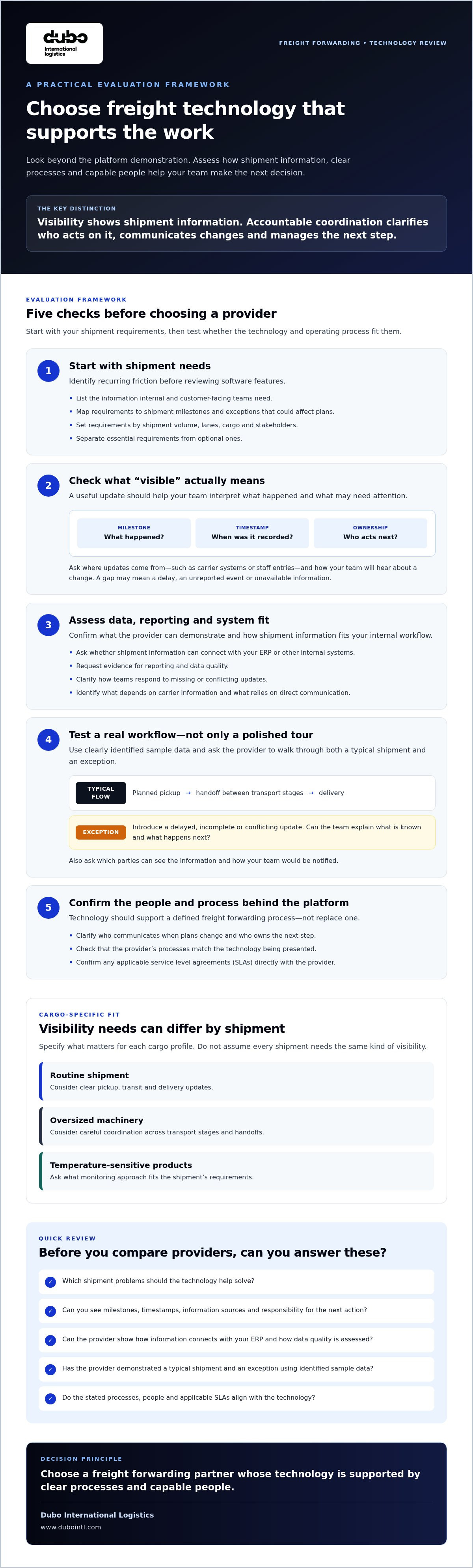
Use a practical due-diligence checklist before choosing a freight forwarder
A structured review turns a technology demonstration into evidence you can compare. As you’re evaluating freight forwarder technology, involve procurement and operations so the decision reflects both system requirements and the people responsible for coordinating shipments. Follow this sequence:
- 1. Define requirements. Record the shipment types, milestones, users, reporting needs, and communication responsibilities that matter to your operation.
- 2. Set the demonstration scenario. Ask the provider to show a typical shipment and an exception, using clearly identified sample data rather than implying sample records belong to a live customer.
- 3. Request evidence. Note what the provider demonstrates, documents, or confirms. Separate that evidence from capabilities that still need validation.
- 4. Test workflow fit. Check whether the system and staff processes fit your shipment requirements, internal handoffs, and communication channels.
- 5. Follow up in writing. Confirm open questions, responsibilities, applicable service level agreements (SLAs), and which capabilities require further setup.
What should a technology demonstration prove?
Choose a realistic scenario with relevant milestones, stakeholders, and cargo requirements. Ask the provider to show how the shipment progresses through the steps your team needs to see, then introduce a delay or missing update. Observe whether the issue becomes visible, who reviews it, and how the next action is communicated.
Record what the system can’t show and which steps depend on staff follow-up. A clear explanation of limitations is useful evidence; an unshown feature isn’t a confirmed capability.
Which questions should procurement and operations ask?
Ask who can access shipment data, what reports are available, who owns each workflow step, and how escalation works. Confirm which functions are available now, which require setup, and which aren’t offered. Also ask about the provider’s carrier vetting process, how carrier responsibilities are defined, and which communication channels are used when an exception affects the plan. Check that service commitments are documented and relevant to the shipment being assessed.
For broader coordination considerations, consult an end-to-end freight management guide alongside your technology review. Keep findings in one record, including evidence, limitations, and unresolved questions, so each provider is assessed on the same basis.
To discuss freight coordination requirements with Dubo International Logistics, visit Discuss your freight coordination requirements.
Choose technology-supported freight forwarding that fits the work
The right choice isn’t necessarily the provider with the most advanced-looking platform. It’s the partner whose processes fit your shipments, whose visibility claims can be verified, and whose people can explain responsibilities when plans change. Technology is most useful when it supports a clear freight forwarding process, with defined communication and accountability from one step to the next.
For this reason, evaluating freight forwarder technology should lead to a practical question: can the provider coordinate the work your shipments actually require? Consider operational fit, demonstrated status information, exception communication, and documented commitments together. A tool may present shipment data, but the service process determines how that information is interpreted and acted on.
How Dubo’s logistics role relates to technology evaluation
Dubo International Logistics provides freight forwarding, logistics consulting, and specialized transportation across North America. Its freight forwarding service coordinates carriers and documentation as part of end-to-end shipment handling. For cargo requiring a tailored solution, learn about specialized transportation services and discuss which processes fit your requirements.
What to prepare for a first conversation
A focused discussion helps both sides assess fit. Prepare a concise profile of the work rather than beginning with a list of software features. Include:
- Shipment types, cargo characteristics, and the lanes involved.
- Internal and external stakeholders who need shipment information.
- Reporting needs, key milestones, and the visibility your team considers essential.
- Known coordination challenges, such as unclear handoffs or delayed updates.
- Questions about data sources, exception communication, responsibilities, and any applicable service level agreements (SLAs).
Mark each requirement as essential, preferred, or still to be confirmed. This gives a prospective partner a clear basis for explaining what can be supported, what needs further review, and how responsibilities would be defined. It also helps your team compare the proposed process with evidence gathered during demonstrations and follow-up.
A sound decision brings people, process, and technology into alignment. If your shipments involve particular cargo requirements or multiple coordination points, discuss those details before proceeding. Start a conversation about freight forwarding needs.
Make your next freight technology decision with confidence
Effective freight technology should fit the shipment, make relevant status information clear, and support defined communication and responsibilities. When evaluating freight forwarder technology, look beyond feature lists. Ask for evidence that systems and people can support your actual workflows, including how exceptions are managed and what information can be shared with your team.
Dubo International Logistics provides freight forwarding, logistics consulting, and specialized transportation across North America. Its services include coordination of carriers and documentation to support cargo movement. Confirm the specific tracking, reporting, and coordination processes relevant to your shipment before proceeding.
Prepare your shipment types, lanes, stakeholders, visibility needs, and unresolved questions. A clear brief helps you assess whether the proposed freight forwarding process is a suitable fit and gives both parties a practical basis for discussing responsibilities and next steps.
Discuss your freight forwarding requirements with Dubo. With clear questions and verified answers, you can move forward with greater confidence in your logistics partner.
Frequently Asked Questions
What technology should a freight forwarder provide?
A freight forwarder’s technology should support the shipment information and coordination your operations require. Assess status updates, milestones, exception communication, reporting, and data exchange against your workflows and cargo needs. No single feature set suits every business. Ask the provider to distinguish current capabilities from planned or unavailable functions, then request a demonstration using a shipment scenario that reflects your stakeholders, milestones, and handling requirements.
How can I assess a freight forwarder’s tracking system?
Ask which milestones are recorded, where status information comes from, how often it is updated, and who acts if information is missing or delayed. Test the process with a realistic shipment example. Useful tracking should show more than location: it should help your team understand shipment status and who owns the next action. While evaluating freight forwarder technology, confirm what the system displays and what requires staff follow-up.
Can freight forwarder technology integrate with an ERP?
It may, but integration options depend on the provider and your requirements. Ask which data can be exchanged with your ERP, how it is transferred, who handles setup, and how incomplete or incorrect records are addressed. Don’t assume a connection exists simply because the provider uses digital tools. Request a relevant demonstration or sample report, then confirm the agreed workflow, responsibilities, and limitations in writing before deciding.
What is the difference between shipment visibility and tracking?
Tracking generally records or displays shipment location or milestones, while visibility helps stakeholders understand status, relevant changes, responsibilities, and next steps. A live map may show where a shipment is without explaining a delay or identifying who should respond. Ask how the forwarder communicates exceptions and supports decisions when plans change. Clear visibility connects shipment information with accountable coordination, rather than leaving your team to interpret updates alone.
How should technology support specialized cargo shipments?
Start with the cargo’s handling, monitoring, and communication requirements, then ask how the forwarder records and shares them. For oversized machinery, delicate equipment, or temperature-sensitive products, confirm what tracking information is available, who reviews it, and how exceptions are escalated. Request evidence for the process that applies to your shipment. Don’t assume every load uses the same equipment, monitoring approach, or information source.
Do I need a freight forwarder with a customer portal?
A portal is useful only if it provides information your team needs in a clear, dependable way. Assess whether users can view relevant milestones and records, identify exceptions, and reach someone who can clarify displayed information. A portal’s presence alone doesn’t establish service quality or prove that updates match your workflow. Ask how the provider’s shipment information and coordination processes would support your requirements, and learn about Dubo’s services at www.dubointl.com.
