

The direct option isn’t always the better fit. When comparing direct shipping vs consolidated freight, a shipment’s urgency matters, but so do its size, readiness, handling needs and tolerance for extra coordination. A choice that looks straightforward on paper can create challenges if it doesn’t suit the cargo or operating schedule.
It’s reasonable to want a clear comparison before choosing a transport plan. Direct shipping can reduce transfers, while consolidated freight combines shipments and may involve additional handling and coordination. Neither approach suits every load, and cargo-specific requirements can change the decision.
This guide compares the two options by shipment size and readiness, transit planning, handling, coordination and visibility. It also covers what to prepare before requesting a freight plan, including cargo dimensions, timing requirements and special handling needs. Dubo International Logistics coordinates freight forwarding and specialized transportation across North America, helping businesses assess options against their operational requirements. Learn more at www.dubointl.com.
Key Takeaways
- Choose between direct shipping and consolidation based on the shipment’s requirements, not the service label alone.
- Compare capacity, handling, coordination and readiness to understand how each freight plan may fit your operation.
- Assess urgency, cargo dimensions and destination requirements before selecting a transport approach.
- Prepare cargo details, operating restrictions and delivery priorities so a freight partner can assess your needs clearly.
- Explore freight forwarding and specialized transportation support from Dubo International Logistics at www.dubointl.com.
Direct Shipping vs. Consolidated Freight: What Each Option Means
The better option depends on the shipment’s requirements, not the service label alone. Direct shipping arranges movement for a shipment without combining it with unrelated freight. Consolidated freight groups compatible shipments in shared transport capacity. The right fit depends on the cargo, handling needs, readiness and service plan.
What does direct shipping mean for a business shipment?
A direct arrangement may assign dedicated capacity to a shipment or plan its movement with fewer freight-sharing steps. For example, a business shipping equipment for a scheduled production activity may prioritize control over how the load is coordinated and handled. Direct shipping can support that planning, but the term alone doesn’t confirm a particular route or delivery schedule.
Transfers may still occur, depending on the provider, carrier arrangements and route. Confirm whether the plan includes dedicated capacity, any planned transfers, the delivery window and how changes will be communicated. Direct doesn’t automatically mean nonstop or guarantee faster delivery. Service commitments depend on the actual arrangement.
How does consolidated freight work?
Consolidated freight combines compatible shipments from different shippers in shared transport capacity. LTL freight shipping is a common less-than-truckload model: a shipment uses part of a trailer rather than requiring the full capacity. Freight may move through a network where loads are grouped or sorted, though the specific routing and handling depend on the carrier and shipment plan. The Less-than-truckload (LTL) shipping model is often described through a hub-and-spoke network, but confirm the route for a specific shipment with its provider.
Consolidation requires coordination among shipments with compatible requirements. A shipment’s readiness, dimensions, packaging and handling instructions can affect whether it can travel in shared capacity. For example, palletized goods that are ready for collection may be considered for consolidation, while cargo with unusual handling needs may require a different plan. Assess suitability rather than assuming it.
The distinction is useful, but terminology can vary among providers. Ask what “direct” or “consolidated” means for the proposed route, how many transfers may be involved, what handling is planned and which delivery commitments apply. A freight-forwarding partner can help assess those details against the cargo and operating schedule. Dubo International Logistics coordinates freight forwarding and specialized transportation. Visit www.dubointl.com to learn more.
How Direct and Consolidated Freight Differ in Practice
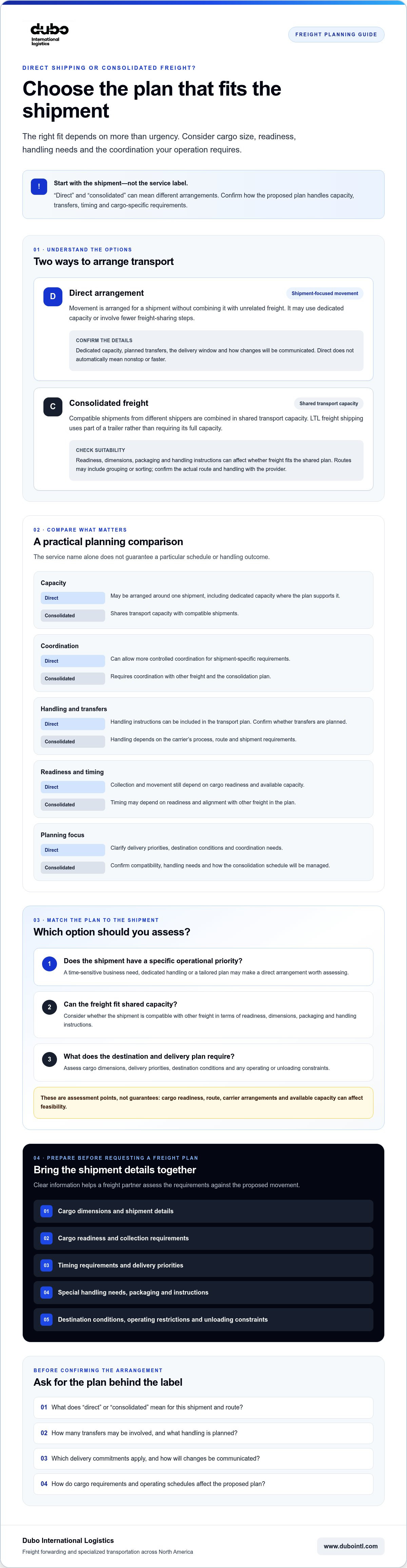
The practical difference is how capacity, handling and coordination are arranged. A direct plan can suit a shipment that needs dedicated capacity or a more controlled movement. Consolidation can suit compatible freight that can travel in a shared plan. Neither label guarantees a particular transit time or handling outcome, so confirm the details of the proposed service.
| Planning factor | Direct arrangement | Consolidated freight |
|---|---|---|
| Capacity | May be arranged around one shipment, including dedicated capacity where the plan supports it. | Shares transport capacity with compatible shipments. |
| Coordination | Can provide more controlled coordination for shipment-specific requirements. | Requires coordination with other freight and the consolidation plan. |
| Handling | Handling instructions can be considered as part of the shipment’s transport plan. Confirm any transfers. | Handling depends on the carrier’s process, route and shipment requirements. |
| Readiness | Collection and movement still depend on cargo being ready and the required capacity being available. | Timing may depend on readiness and alignment with other freight in the plan. |
| Planning focus | Clarify delivery priorities, destination conditions and coordination needs. | Confirm compatibility, handling needs and how the consolidation schedule will be managed. |
Direct shipping may be worth assessing when a shipment has a time-sensitive business requirement, needs dedicated handling or calls for a transport plan tailored to its dimensions or destination. For example, equipment needed for a planned operational activity may have specific delivery and unloading constraints. Those needs don’t automatically make direct movement feasible. Cargo readiness, route requirements and capacity must still be checked, and the delivery window should be confirmed rather than assumed.
Consolidation may be suitable when freight can share capacity and its handling requirements fit the proposed plan. A shipper should understand how its readiness aligns with the consolidation schedule and whether planned transfers or coordination steps affect delivery priorities. A freight consolidation strategy should account for shipment compatibility, not just available space.
When comparing direct shipping vs consolidated freight, assess the service plan against the cargo’s confirmed requirements before weighing preferences such as fewer transfers or greater schedule flexibility. A freight-forwarding partner can help assess those factors and coordinate the movement. For shipments that may need specialized transportation, explore specialized transportation options with Dubo.
Which Freight Option Fits Your Shipment? A Practical Comparison
Choosing between direct shipping and consolidated freight starts with what the cargo actually requires. Separate confirmed facts, such as dimensions, weight, readiness date and handling instructions, from preferences, such as fewer transfers or more schedule flexibility. A freight partner can assess how those preferences fit the available plan.
| Shipment consideration | Direct shipping may fit when… | Consolidated freight may fit when… | Verify before choosing |
|---|---|---|---|
| Urgency | A defined delivery priority calls for a tailored movement plan. | The shipment can align with the consolidation schedule. | Planned transit, collection timing and delivery commitments. |
| Dimensions and volume | The load needs dedicated capacity or specific equipment planning. | The freight can share capacity with compatible shipments. | Exact measurements, weight and loading requirements. |
| Handling | Specific handling needs call for closer coordination. | The cargo’s handling requirements suit the shared plan. | Packaging, transfer requirements and special instructions. |
| Readiness and destination | A tailored plan is needed to meet cargo or destination constraints. | Readiness can align with coordinated pickup and movement. | Ready date, receiving conditions and destination restrictions. |
How do shipment size and readiness affect the choice?
Volume and dimensions help determine whether a shipment can fit shared capacity or needs a plan centred on its own requirements. Readiness matters too: freight that isn’t prepared for the agreed collection can disrupt coordination, while a shipment able to follow the planned schedule may be easier to consider for consolidation. Share exact measurements and a realistic ready date. Don’t assume a minimum size, cut-off time or acceptance rule without confirmation.
How do handling and timing requirements affect the choice?
Identify whether the cargo is fragile, temperature-sensitive, oversized or otherwise specialized. State the delivery priority and explain any operating constraints at pickup or receipt. These details help the freight partner assess routing, suitable equipment, carrier coordination and whether shared handling fits the shipment. A preferred delivery date is useful, but it isn’t a confirmed service commitment until the plan is reviewed.
Unusual or sensitive cargo needs a specific handling review before you select a mode. Dubo coordinates specialized transportation across North America. Explore specialized transportation guidance for cargo-specific considerations. For freight forwarding and logistics consulting, visit www.dubointl.com.
How to Prepare a Freight Plan Before Choosing
A clear freight plan starts with accurate shipment facts. These details help a freight-forwarding partner compare direct and consolidated options against your actual requirements, rather than assumptions about what the cargo needs. Use this checklist to prepare:
- Describe the cargo: Record what it is, the quantity, dimensions and weight. Note whether it is fragile, temperature-sensitive, oversized or subject to other specific handling needs.
- Confirm readiness: State when the shipment will be ready and whether it can follow a coordinated schedule or needs a tailored plan.
- Document constraints: Identify required handling, delivery priorities, pickup and receiving conditions, operating restrictions, and the origin and destination. Confirm whether the shipment crosses an international border.
- Compare service plans: Review proposed capacity, routing, transfers, coordination and shipment visibility. Confirm which carrier capabilities can meet the cargo’s requirements.
What shipment details should you gather first?
Be precise about measurements and weight, and distinguish confirmed details from estimates. For example, if equipment dimensions are still being verified, flag that before a carrier plan is assessed. Don’t assume specialized requirements apply, but clearly identify them if the cargo is fragile, temperature-sensitive or out-of-gauge. Accurate origin, destination and border-crossing information also helps shape the proposed movement.
What should you ask a freight-forwarding partner?
Ask how the proposed service handles consolidation and transfers, what shipment visibility is available, and which handling requirements or carrier capabilities still need confirmation. Clarify delivery priorities and operating restrictions, then review applicable service level agreements (SLAs) for defined commitments. Ask how those commitments apply to the specific shipment instead of relying on a general service description.
Planning also extends beyond the transport leg. For a broader view of coordinating shipment stages, refer to the article on end-to-end freight management. The article on professional freight forwarding in North America can also help you assess a partner’s role in coordinating cargo movement. These considerations ground the choice between direct shipping and consolidated freight in shipment facts and operational needs.
Prepare your shipment details and discuss a freight plan with Dubo International Logistics. Visit www.dubointl.com to learn about its freight forwarding and logistics consulting services.
Plan the Right Freight Movement with Dubo International Logistics
There’s no universal winner in direct shipping vs consolidated freight. Select the approach that aligns with the cargo, timing priorities, readiness and handling requirements, then confirm the proposed route and service commitments. For shipments with unusual dimensions, sensitive handling needs or multiple coordination requirements, a freight-forwarding partner can help assess the plan before movement is arranged.
Dubo International Logistics coordinates freight forwarding across North America and provides logistics consulting and specialized transportation services. As a member of the Canadian International Freight Forwarders Association (CIFFA), Dubo has an industry affiliation that can inform a shipper’s partner assessment. Membership is not an endorsement of a particular shipment plan or a guarantee of service outcomes, so confirm the details that matter to your operation.
When does freight-forwarding support add value?
Coordination can be valuable when a shipment’s capacity, handling, timing and destination requirements need to be considered together. A freight-forwarding partner can assess carrier arrangements and compare a direct plan with consolidation against those needs. If standard shared-capacity handling may not suit the cargo, specialized transportation expertise can help identify questions that need a tailored review. An expedited option is relevant only when the shipment’s confirmed priorities call for it and the service arrangement is suitable.
What information should you share to start a conversation?
Prepare a clear shipment profile before discussing options. Include the cargo description, dimensions, weight and quantity, along with the origin, destination and expected ready date. Identify handling requirements, delivery priorities, operating restrictions and any border-crossing needs. Separate confirmed shipment facts from preferences, such as a preferred delivery window, so the team can assess what the plan can address and what needs further confirmation.
With those details in hand, the next step is a focused discussion of the shipment requirements, proposed service plan and any carrier capabilities or commitments that must be verified. This keeps the decision grounded in operational needs rather than assumptions about what “direct” or “consolidated” means.
Discuss your freight requirements with Dubo International Logistics to explore a freight plan suited to your cargo and operating priorities.
Choose a Freight Plan That Fits Your Operation
The right decision in direct shipping vs consolidated freight comes from matching the service plan to the shipment, not relying on the label. Confirm cargo dimensions, readiness, destination and handling needs, then compare how each option manages capacity, coordination and delivery priorities. Discuss a preference for fewer transfers or a particular schedule alongside the shipment’s confirmed requirements.
Dubo International Logistics coordinates freight forwarding and specialized transportation across North America, helping businesses assess shipment needs and carrier arrangements. Its membership in the Canadian International Freight Forwarders Association (CIFFA) is a professional affiliation, not an endorsement or guarantee of shipment outcomes.
Share your cargo details, origin and destination, ready date, handling requirements and timing priorities to start a practical discussion about suitable freight options. Discuss your freight requirements with Dubo at www.dubointl.com. With clear information and careful planning, you can move forward with greater confidence in the freight plan selected for your operation.
Frequently Asked Questions
What is the difference between direct shipping and consolidated freight?
Direct shipping arranges movement for a shipment without combining it with unrelated freight, while consolidated freight groups compatible shipments in shared transport capacity. Direct arrangements may involve dedicated capacity, but the term doesn’t necessarily mean a nonstop trip. Consolidated freight may involve additional coordination or transfers, depending on the carrier and route. When comparing direct shipping vs consolidated freight, assess the actual service plan, handling steps and commitments rather than relying on the label alone.
Is direct shipping always faster than consolidated freight?
No, direct shipping isn’t always faster. Transit depends on the route, carrier arrangements, shipment readiness and service commitments. A direct plan may reduce some coordination steps, but it doesn’t guarantee a specific delivery window or nonstop movement. Consolidated freight schedules may depend on grouping compatible shipments. Ask for the proposed routing, planned transfers and applicable delivery commitments, then assess them against your timing requirements before choosing an option.
Can oversized or sensitive cargo move as consolidated freight?
It may be possible, but suitability depends on the cargo and the specific consolidation plan. Oversized machinery, fragile equipment or temperature-sensitive products can have requirements that affect capacity, handling, equipment and carrier selection. Share exact dimensions, weight, packaging details and handling instructions before choosing a service. A freight partner should confirm whether the cargo’s requirements fit shared transport or call for specialized transportation and a tailored plan.
How do I choose between direct shipping and LTL freight shipping?
Compare the shipment’s urgency, dimensions, readiness, handling needs and destination requirements. LTL freight shipping can suit cargo that can share capacity with compatible shipments and follow a coordinated schedule. A direct arrangement may be worth assessing when dedicated capacity or more controlled coordination is required. Neither option is automatically suitable based on shipment size alone. Confirm routing, handling steps, carrier capabilities and service commitments for the actual load.
What information do I need to compare freight options?
Prepare a cargo description, quantity, dimensions, weight and expected ready date. Note confirmed requirements for fragile, temperature-sensitive or oversized freight, along with handling instructions and operating restrictions. Include the shipment’s origin and destination, whether it crosses an international border, and your delivery priorities. Distinguish firm requirements from preferences, such as a preferred delivery window. These details help a freight partner assess realistic options and identify what still needs confirmation.
Does consolidated freight involve more handling?
It can involve additional handling if freight is transferred, sorted or regrouped as part of the carrier’s network, but the process varies by route and service plan. Ask whether the proposed shipment will pass through terminals, how transfers are managed and which handling instructions apply at each stage. Don’t assume every consolidated shipment follows the same path. Review the planned handling against the cargo’s packaging, sensitivity and operational requirements.
Can a freight forwarder help decide which option is suitable?
Yes. A freight forwarder can assess shipment details, coordinate carrier arrangements and compare direct and consolidated plans against your requirements. Dubo International Logistics coordinates freight forwarding and specialized transportation across North America, and is a member of the Canadian International Freight Forwarders Association (CIFFA). Membership is a professional affiliation, not an endorsement or a guarantee of results. Prepare your cargo and timing details, then learn more at www.dubointl.com.
