

Paperwork errors can have different consequences: depending on the document and shipment, they may require corrections, delay border release or affect the duties and taxes assessed. A cross-border shipping documentation checklist helps you catch mismatched details before cargo is in transit. For Canada-U.S. freight, core documents may include a commercial invoice, bill of lading and packing list, plus a certificate of origin or permits when applicable.
Shipping paperwork is more than administration: each document helps identify the goods, the parties and the shipment terms. When descriptions, quantities, values or addresses don’t match, resolving the discrepancy can disrupt the handoff and clearance process.
This guide covers which records to prepare, how requirements vary by transport mode and cargo, and how accurate information supports duty and tax assessment and shipment release. It also offers practical checks for reviewing documents together and updating them when shipment details change, helping you plan each cross-border move with greater confidence.
Key Takeaways
- Match goods descriptions, quantities, values and party details across the invoice, packing list and transport documents to reduce discrepancies that can interrupt clearance.
- Prepare the documents that fit the shipment, including a certificate of origin or permits when applicable, and provide accurate cargo details before dispatch.
- Account for the mode and destination: ocean freight and shipments on Mexican roads can involve distinct filing or accompanying-document requirements.
- Identify regulated or dangerous cargo early so its classification, labels and supporting documents align with the requirements that apply in Canada.
- Use freight forwarding and logistics consulting to coordinate shipment details across complex movements, including specialized cargo needs.
Shipment release and payment of duties and taxes
Accurate paperwork supports customs assessment, but completing a checklist does not itself release a shipment. For Canada-bound freight, customs documentation typically includes a Canada Customs Invoice (CCI) or commercial invoice. Customs authorities assess the declared goods, value and quantity. Missing or inconsistent details may need correction before release. Use a cross-border shipping documentation checklist to review the file before dispatch.
For Canada-U.S. shipments, the exporter prepares the commercial invoice, and both parties should keep a copy. The invoice identifies the parties and describes the goods and their value. Be specific: “steel replacement gears” tells border personnel more than “parts.” Compare the invoice with the transport records before the shipment leaves.
- Match descriptions, quantities, weights and values across documents. Differences between invoices, packing lists and transport documents can prompt questions.
- Keep shipper and consignee names and addresses consistent. Compare the invoice, bill of lading and customs entry.
- Update paperwork when quantity, product or destination changes. Revised documents should reflect the freight actually moving.
Before preparing documents, collect the shipment’s origin and destination, commodity, value, dimensions, weight, dates, packaging and required equipment. These details help align commercial, transportation and customs information before freight reaches the border. Share draft documents for review before the cargo is ready to leave, not when the truck is already at the crossing.
Canada export declarations and CERS: Prepare the export record with the goods description, destination, quantity and value. Keep any CERS filing information with the shipment file, and follow the export declaration steps that apply to the shipment.
Records and retention: Keep invoices, declarations, transport documents and related correspondence together. Canadian importers must retain import documents for six years following importation. This period applies to import records, not automatically to every exporter’s file.
Declare contents and value accurately. Commercial shipments valued at C$2,500 or less arriving in Canada by mail or courier may be assessed for duties and taxes, then released by the CBSA or courier company. That threshold does not establish release for other freight or remove shipment-specific requirements.
Label packages with shipping and return addresses. Before departure, compare each label with the shipper and consignee details in the documents. Duty assessment can depend on the goods’ Harmonized System (HS) classification, while taxes depend on applicable import requirements. Keep the cross-border shipping documentation checklist current when shipment details change. An accurate file supports assessment but does not itself confirm release.
What documents are required for cross border freight shipments?
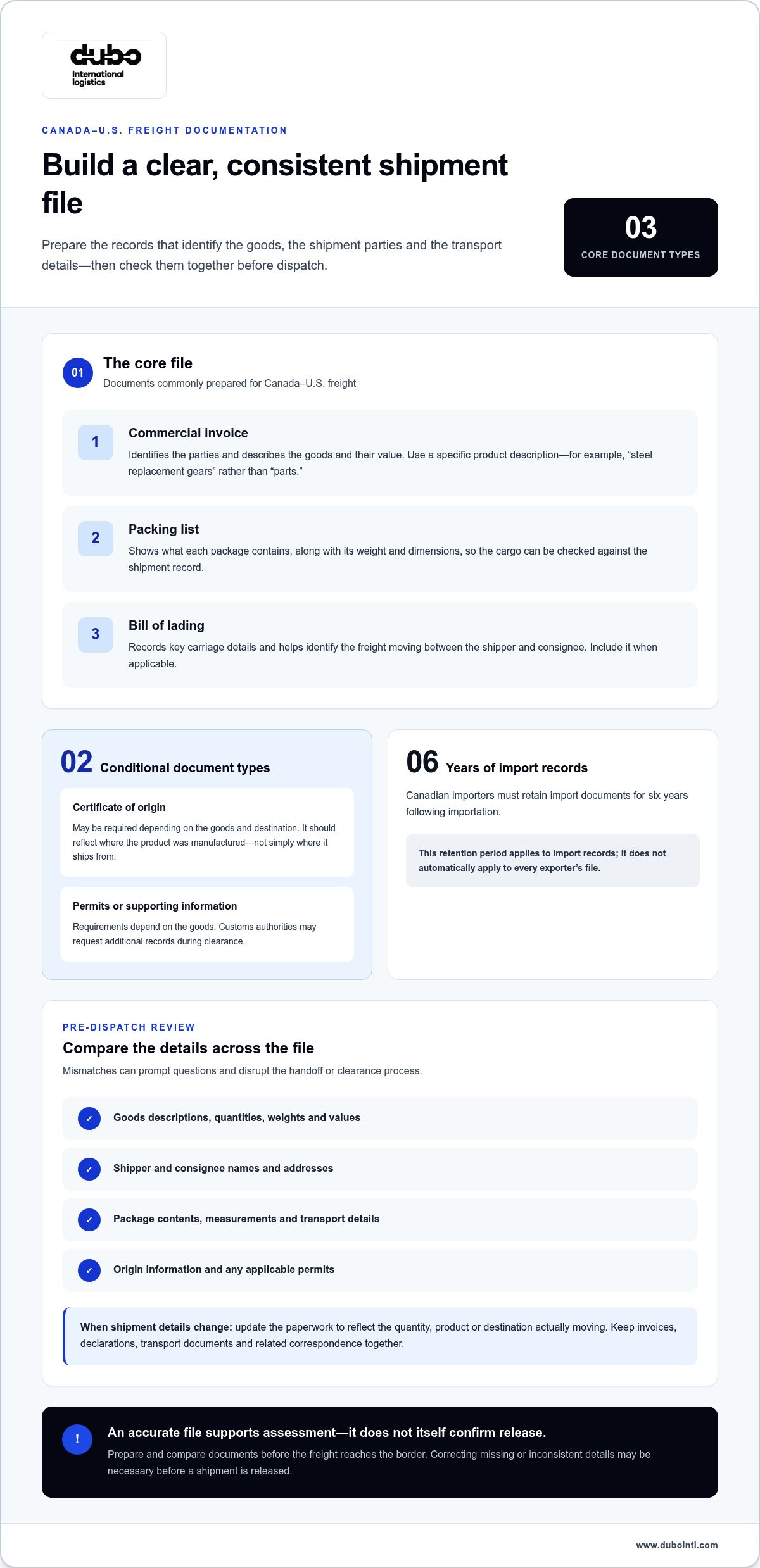
For Canada-U.S. freight, prepare documents that identify the goods, shipment parties and transport details. The core file may include a commercial invoice, packing list and bill of lading. A certificate of origin or permit may also apply, depending on the goods and destination. Customs may request additional information during clearance, so keep supporting records accessible.
Each document serves a distinct purpose in the shipment file:
- Prepare a commercial invoice. Describe the goods, state their value and identify the parties involved so customs personnel can assess the transaction.
- Complete a packing list. Show what each package contains, with its weight and dimensions, so the cargo can be checked against the shipment record.
- Include a bill of lading when applicable. This transport document records key details for the carriage and helps identify the freight moving between shipper and consignee.
- Add a certificate of origin when required. It provides manufacturing information about the country where the product was produced.
- Attach relevant permits or supporting information. Requirements depend on the goods, and customs authorities may request additional records during clearance.
Distinguish the country where goods were produced from the country they ship from. For example, a product manufactured in one country might be dispatched from a facility in another. The commercial invoice should describe the goods clearly, while origin documentation should reflect where they were manufactured. A vague product label such as “samples” may not provide enough detail for customs classification.
Certificates of origin can matter when a shipment is assessed under a preferential trade agreement. For Canada-U.S. shipments, whether one is required can depend on the materials being shipped. Don’t assume the dispatch location establishes origin. The certificate’s manufacturing information should match the product’s actual production history. If a shipment contains goods from different origins, keep supporting information distinct for each product line.
Review documents before the freight is ready to move. First, describe each product specifically, then confirm its declared value and quantity. Ensure the packing list accounts for the packages and measurements. Add origin documentation or permits where applicable, and keep completed records with the shipment file. If the product or destination changes, revise the documents to reflect the freight being moved. This process gives the parties a clear record if customs requests further details.
For complex shipments with multiple products or origin details, cross-border freight coordination can help organize the movement and its documentation requirements.
Core freight documents by mode and destination
A freight file depends on its route and transport mode. A border shipment travelling by road does not follow every filing step used for ocean freight. Start by recording the origin, destination, mode and planned loading date. Then identify the documents and filing deadlines for that route. The right paperwork helps the parties coordinate the shipment before it reaches a port or border crossing.
For ocean freight entering the United States, the importer must file an Importer Security Filing (ISF) no later than 24 hours before cargo is loaded onto the vessel at origin. This deadline occurs before the vessel departs, not after arrival. The U.S. entry summary is a separate import filing. It must be filed within 15 calendar days after arrival at the U.S. port of entry. Keep each filing reference with the shipment record.
Other ocean destinations have their own advance filings. For shipments to the European Union, the Entry Summary Declaration deadline is 24 hours before loading. For ocean cargo shipped to Great Britain, the S&S GB declaration is filed 24 hours before loading. These filings are distinct from the commercial and transport documents accompanying the freight. Put each destination’s deadline on the shipment schedule, using its planned loading date. When planning onward UK distribution, coordinating with dedicated road freight providers like Evolve Haulage helps ensure local transport records and delivery timing remain aligned.
Road freight into Mexico has a different document requirement. Cargo is generally accompanied by an electronic Complemento Carta Porte, a CFDI tax-document complement describing the goods, route and carrier. The carrier normally issues it using shipment information supplied by the shipper. Provide accurate cargo and route details early, then compare the issued document with the final shipment plan.
- Record the mode and destination. Distinguish road, air and ocean movements, and name the destination country and port or crossing.
- Identify advance filing deadlines. For ocean freight, calculate timing from vessel loading where the rule uses that milestone.
- Track filing references separately. Keep ISF or declaration details with the invoice and transport record.
- Update the file after a route change. A new destination, port or loading date can affect the applicable document process.
Tariff classification and customs filings serve different purposes. A tariff code helps identify goods for assessment, while an advance cargo filing supplies shipment information to the destination authority. Keep product descriptions and classification details aligned across relevant records. For example, “equipment” gives less useful detail than a clear identification of the item being shipped.
Review documents for the specific route before dispatch. Confirm the destination, mode, loading milestone and filing responsibility with the parties handling the shipment. A general checklist can help organize the file, but it cannot replace the deadlines and documents tied to a particular route. For those coordinating overseas relocations or personal freight, relocation specialists such as Execu-Move offer guidance on navigating route-specific customs paperwork and overseas transit planning.
Dangerous goods and regulated cargo documents
Regulated cargo needs a document review before dispatch, not at the border. In Canada, imported goods must meet applicable labelling requirements and safety standards. Importers should also determine whether the goods are controlled, regulated or prohibited by the Canada Border Services Agency (CBSA) or another government department or agency. A product’s everyday name alone may not reveal which requirements apply.
Start with the product and its intended use. Record the exact item, its composition where relevant, quantity, packaging and destination. For example, identify a chemical by its specific product name rather than writing only “liquid.” Share these details with the parties responsible for classification and transport, including the carrier and customs broker. Clear information helps them assess the shipment against its route and cargo requirements.
- Identify the cargo accurately. Use the product name and a specific description, not a broad label such as “supplies.”
- Record the quantity and packaging. Ensure the shipment documents reflect what is physically prepared for transport.
- Determine whether the goods are regulated. Consider the product, its use, destination and applicable Canadian requirements.
- Align documents before pickup. Provide consistent cargo details to the carrier and broker, then update them if the shipment changes.
Dangerous-goods classification should match the actual product, not a guess based on its appearance. A sealed container or familiar trade name does not establish how the cargo must be handled. Give the responsible parties accurate product information and supporting records needed to assess the shipment. If the quantity or packaging changes, revise the shipment details before the freight moves.
Some shipments may need additional documents or information during customs clearance. Keep relevant product and compliance records accessible, and make sure the shipment description matches the commercial invoice and packing list. For example, if the invoice says “cleaning solution” but the product record identifies a different chemical, that mismatch can prompt questions. Consistent wording helps explain what the cargo is.
Before release, verify that the labels and paperwork describe the same goods, quantity and destination. Confirm who supplies each document and communicates updates when details change. A Canadian import may involve requirements from the CBSA and another government department, so one document set may not cover every applicable control. Keep the final shipment file together, including correspondence about classification or requested information.
For each regulated shipment, identify the goods, determine applicable controls, provide accurate details, align labels and documents, then retain the final records. This process gives the carrier and broker a clear basis for handling the freight and responding to customs requests without relying on incomplete product descriptions.
Bills of lading and air waybills
A bill of lading is the contract of carriage between the shipper and carrier. It records the freight moved under that transport arrangement and gives the parties a shared shipment reference. An air waybill serves as a transport document for air freight. The transport mode determines which document belongs in the shipment file.
Review the document against the cargo being handed over. Check the shipper and consignee names, origin, destination, goods description and package count. Compare the recorded weight and dimensions with the details supplied for booking. For example, if a crate’s dimensions change, update the transport record before the carrier receives the freight.
Use the document to make transport instructions clear. A named consignee, precise delivery location and accurate cargo description help distinguish the intended shipment from other freight. Avoid internal shorthand that the carrier or customs broker may not recognize. If the goods comprise several pieces, record them in a way that can be reconciled with the packing list.
- Confirm the mode. Select a bill of lading for the relevant carriage or an air waybill for air freight.
- Check the parties. Verify the shipper and consignee names and addresses against the shipment record.
- Describe the freight precisely. Use an identifiable goods description rather than a broad label such as “equipment.”
- Compare cargo measurements. Ensure package count, weight and dimensions reflect the freight prepared for pickup.
- Review routing details. Check origin and destination, including any transfer point shown in the transport plan.
Keep the transport document aligned with the commercial record, but don’t treat them as interchangeable. The invoice describes the transaction and goods; the bill of lading or air waybill documents transport. If a customs broker receives shipment information, provide the same current details used for the carrier’s document. This helps prevent different parties from working from separate versions.
Before pickup, review the final document against the shipping instructions and package details. Ensure any change to the consignee, route, package count or dimensions reaches the carrier and relevant parties. After delivery, retain the completed transport record with proof of delivery and related shipment communications. That file can help resolve questions about what was tendered and where it was sent.
For freight with complex routing or cargo-handling needs, coordinate the shipment plan around accurate transport details and clear handoffs.
Dubo International Logistics: Freight forwarding
Dubo International Logistics provides freight forwarding for businesses coordinating cross-border shipments. When a route involves several parties, cargo requirements or document handoffs, freight forwarding can help organize shipment information and movement across the supply chain.
Logistics consulting can help clarify responsibilities, shipment details and planning decisions before dispatch. For oversized machinery, delicate equipment or temperature-sensitive products, specialized transportation services address cargo needs that standard freight planning may not cover. The right approach depends on the shipment’s characteristics, route and handling requirements.
For a complex Canadian or North American shipment, bring the cargo details, origin, destination and available documents into the planning discussion. Contact Dubo International Logistics or visit www.dubointl.com.
Build document planning into your next shipment
Make paperwork part of shipment planning from the outset, rather than leaving it to the final handoff. Assign a responsible contact to maintain the shipment record, communicate approved changes and keep the parties working from the same version. This discipline connects operational decisions with the documents that represent them.
Use a cross-border shipping documentation checklist as a working control, not a formality to complete once and forget. Revisit it whenever the route, cargo or shipment plan changes, and keep a clear record of decisions. This gives your team a practical way to manage exceptions and prepare for the next movement consistently.
For support coordinating a shipment’s freight requirements and planning, contact Dubo International Logistics. A deliberate start can help your next cross-border move proceed with clarity and confidence.
Frequently Asked Questions
How much does a missing or wrong document cost a freight forwarder?
There is no single standard amount; the impact depends on the error and shipment. A freight forwarder may need to spend additional time coordinating corrections, revised paperwork and changed shipment arrangements. Delays can also affect the importer, exporter or carrier through missed appointments or extra handling. For a particular shipment, identify which record is wrong, who must correct it and whether the change affects the route, release timing or agreed responsibilities.
What is the difference between a commercial invoice and packing list for freight?
A commercial invoice records transaction details customs needs, while a packing list describes the physical contents of packages. For example, an invoice might identify a sale of machine components, while the packing list shows which crates contain each component and their weights. Keep both tied to the same shipment reference. This makes it easier for the receiving team to compare the paperwork with the freight arriving at its facility.
What documents are required for cross-border shipping from Canada?
For a typical commercial shipment, prepare a commercial invoice, transport document and packing list, then add origin documentation or permits when applicable. The exact file depends on the goods, destination and mode. For example, ocean freight can involve advance filings that road freight does not. Before dispatch, assign responsibility for each document and keep one current shipment record so the exporter, importer and carrier use matching details.
Which customs forms are needed for exports from Canada to the US?
Canadian exports to the United States commonly need commercial shipment information and transport documents, with an export declaration through CERS when required. Applicable filings depend on the goods and shipment circumstances, so there is no single form set for every export. The importer also has responsibilities on the U.S. side. Agree who supplies each filing and reference before pickup, and retain submission details with the export record.
What documents are required to import goods into Canada?
A Canadian import file commonly includes a commercial invoice or Canada Customs Invoice, transport document and any applicable permits or supporting records. The importer also needs the information used to account for the goods, including tariff classification. For a mixed shipment, keep product lines distinct rather than grouping unlike items under a broad description. Retain import documents for six years following importation, including relevant correspondence.
How do I complete a commercial invoice for international shipping?
Identify the exporter and importer, describe each product specifically, and enter its quantity and value. Add the shipment’s origin and destination, then compare the invoice with the packing list and transport record. For instance, “replacement steel valve” is more informative than “parts.” Keep product descriptions consistent across lines and supporting documents, and revise the invoice if the goods, quantity or destination changes before dispatch.
When is a certificate of origin required for Canadian shipments?
A certificate of origin may be required for Canada-U.S. shipments depending on the materials being shipped and the trade treatment sought. It identifies where goods were manufactured, which can differ from where they ship from. For example, goods made elsewhere and dispatched from Canada have a separate manufacturing origin. Keep origin evidence aligned with the product description and shipment records.
What documents are needed for shipping restricted or regulated goods across borders?
Requirements depend on the product, destination and applicable controls. Start with an accurate product description, quantity and packaging details, then determine whether the goods are controlled, regulated or prohibited. Supporting information or permits may apply, and customs authorities can request additional records during clearance. For a Canadian import, consider whether the Canada Border Services Agency or another government department regulates the goods, and align cargo labels with the documents.

