

Most common cross-border shipping problems start before a truck reaches the border. A delay may appear to be a border issue, but incomplete paperwork, mismatched shipment details or an unclear handoff can disrupt plans well before arrival. When no one is sure who owns a shipment detail, even a small information gap can affect the delivery schedule.
Deliberate preparation can reduce many disruptions. This article explains why cross-border shipments are delayed or interrupted, and how a repeatable process can help protect cargo, schedules and business continuity.
You’ll learn how to assign documentation responsibilities, keep shipment details consistent across handoffs and match the transport plan to the cargo and its urgency. Dubo International Logistics coordinates North American freight through freight forwarding and specialized transportation, with cargo-specific planning and managed handoffs. Learn more at www.dubointl.com.
Key Takeaways
- Many common cross-border shipping problems begin with planning gaps. Clear ownership and preparation can reduce avoidable disruption.
- Keep shipment details accurate and consistent across records and handoffs to help prevent questions that interrupt planned movement.
- Match transport, packaging and loading plans to the cargo’s dimensions, fragility, environmental needs and urgency.
- Use a repeatable checklist: define the cargo, assign responsibilities, align records, plan transport and monitor movement.
- Freight forwarding coordinates shipment information, carrier communication and handoffs. A structured carrier vetting process helps align transport with cargo requirements.
Common cross-border shipping problems start before a shipment moves
Preparation and clear ownership can reduce many cross-border disruptions. Treat a shipment as a connected journey, not simply a truck movement. Planning, documentation, carrier handoffs, transit and delivery all depend on people having accurate information and understanding their responsibilities.
A delay noticed at the border may have started earlier. For example, if cargo details are incomplete or different parties are working from inconsistent records, questions can surface after the shipment is already moving. That can interrupt the plan even when the original information gap arose during preparation. Tracing the issue back to its source helps teams address the cause, not just the visible delay.
Which problems most often disrupt cross-border freight?
Common cross-border shipping problems tend to fall into four areas: incomplete information, unclear responsibilities, unsuitable transport and handling gaps. A missing cargo detail can leave a party unsure how to prepare. An unclear handoff can make it uncertain who should pass along an update. Either problem may affect later planning, depending on the shipment and the parties involved. Preparation is the first control point.
Transport and handling decisions also need to reflect the cargo. A plan for standard freight may not account for oversized machinery, delicate equipment or temperature-sensitive products. If dimensions, fragility or environmental needs aren’t identified early, equipment selection, loading arrangements or delivery coordination may need to be revisited. These decisions are connected: cargo information informs the transport plan, and the plan shapes each handoff.
Why Canada-United States shipments need joined-up planning
A Canada-United States shipment can involve the shipper, the receiving business and multiple transportation parties, with documents and information passing between them. A sound plan connects origin, destination, cargo characteristics and delivery expectations from the outset. This gives each party a shared reference and makes it easier to identify who owns each task as the shipment progresses.
This coordinated approach is central to freight forwarding, which organizes cargo movement across the parties and stages of a shipment. Rather than treating each leg separately, teams can consider how early decisions affect later transitions. Clear ownership and consistent shipment details won’t remove every uncertainty, but they can help prevent avoidable gaps from travelling with the cargo.
Documentation and responsibility gaps can stall cross-border shipments
Shipment information is useful only when the right people have it at the right time. Before a Canada-United States movement, the buyer, seller and logistics partners should agree on who supplies, reviews and shares each detail. If those roles are left implicit, a task can remain unfinished while each party assumes someone else has handled it.
A documentation gap is missing, inconsistent or late shipment information that leaves a responsible party unable to prepare for the next step. It may prompt questions or require details to be reconciled, interrupting planned movement. This is one reason common cross-border shipping problems can begin at a handoff between parties, not just in the records themselves.
What shipment details should teams align before dispatch?
Start with a shared description of the cargo and its planned movement. Align the cargo description, quantities, origin, destination and handling needs, then check that the shipment records present a consistent account. For example, if a quantity or cargo description differs between records, a party may need clarification before proceeding. The issue is not just whether information exists, but whether it is clear and consistent wherever it is used.
The U.S. International Trade Administration’s Common Export Documents resource provides an overview of export documentation. Use it as general background, not as a substitute for confirming which information applies to a specific shipment. Requirements depend on the shipment, so don’t assume one reference covers every movement.
How unclear responsibilities create preventable delays
Even accurate details can be held up if no one knows who must provide or check them. The seller may expect the buyer to supply a detail, while the buyer assumes the logistics partner is coordinating it. Until ownership is clear, an important task can be missed or completed too late for the planned dispatch.
Record three things in the shipment plan: who owns each information task, when it must be completed, and who should be contacted if details are missing or inconsistent. This gives the parties a practical way to resolve questions before they affect a handoff. Update the plan if cargo details or delivery expectations change.
For shipments with several moving parts, coordinated freight forwarding support can connect shipment information, partner communication and planned handoffs. Clear responsibilities make coordination more effective and give each party a common reference as the cargo moves.
Transport, cargo handling, and handoffs can create avoidable disruption
A transport plan should fit the shipment rather than rely on a one-size-fits-all mode or vehicle. Urgency matters, but so do dimensions, fragility, environmental sensitivity, loading needs and the number of transfers. A solution for standard freight may not address the requirements of oversized machinery or delicate equipment. Matching the plan to the cargo helps teams anticipate practical handling needs at each stage.
How cargo characteristics affect transport planning
Assess what the cargo needs to travel securely. Standard freight may follow routine handling arrangements, while fragile equipment could need additional protection and careful loading. Customized crating may be appropriate when the cargo’s protection requirements call for it. Temperature-sensitive products need a plan that accounts for their environmental sensitivity throughout transit.
Dimensions and weight also shape equipment planning. For tall or heavy cargo, a lowbed trailer may be one consideration, depending on the shipment and transport requirements. It isn’t a universal solution. The right approach depends on the cargo, its handling requirements, urgency and delivery plan. Common cross-border shipping problems can arise when transport and loading arrangements don’t reflect these details.
Before dispatch, document how the cargo should be loaded, secured and handled at transfer points. Share those expectations with everyone involved so each handoff follows the same plan. Clear instructions help prevent assumptions, such as handling delicate equipment like ordinary freight or overlooking a temperature requirement during a transfer.
Why carrier handoffs and shipment visibility matter
At every transfer, shipment information and handling expectations need to reach the next responsible party. If a receiving carrier doesn’t have current cargo dimensions or special handling instructions, the team may need to pause and clarify the plan. Agreeing on transfer points, responsibilities and status updates in advance makes it easier to understand what has happened and what needs attention if plans change.
Tracking updates show shipment progress and can help teams identify an exception early enough to coordinate a response. They don’t prevent every disruption, but they give the parties a shared view of movement instead of leaving them to rely on assumptions. A structured carrier vetting process also helps align carrier capabilities with cargo and handling requirements.
For complex or specialized movements, specialized freight coordination connects transport planning, carrier communication and shipment visibility. The focus is on fit: coordinating the transport approach around the cargo, its handling needs and the planned handoffs.
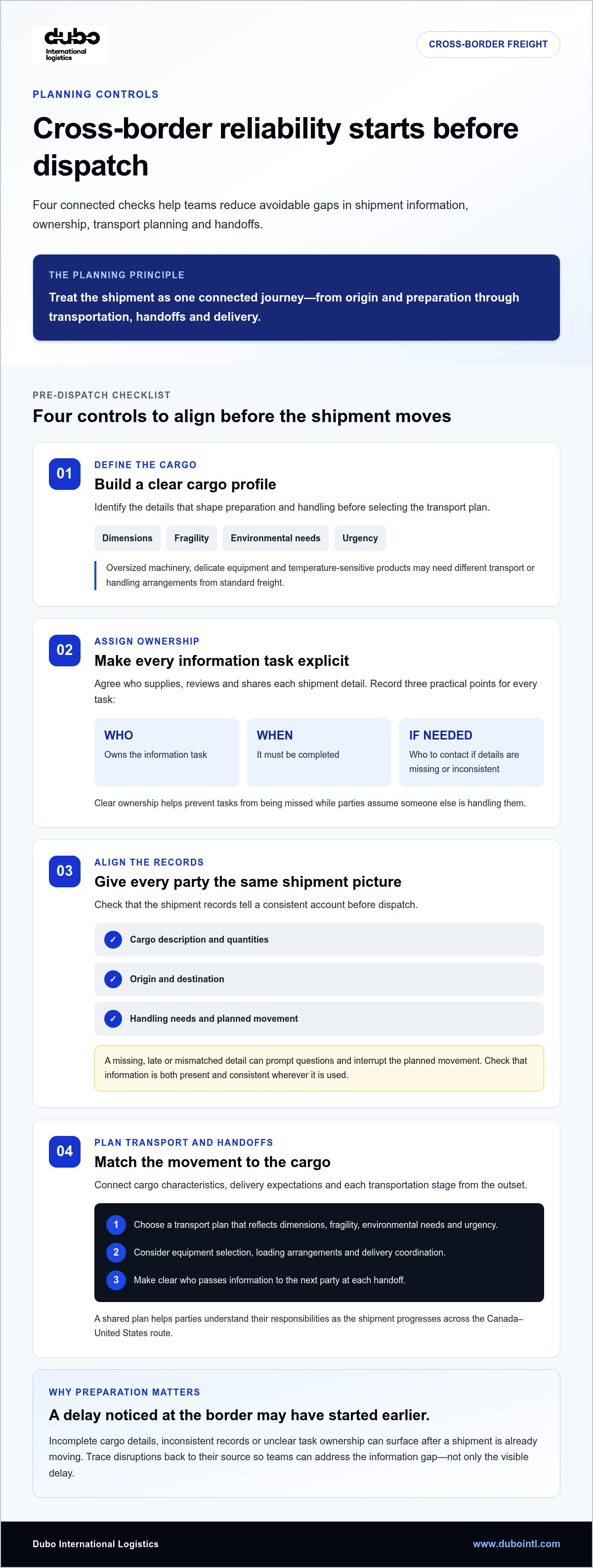
Prevent common cross-border shipping problems with a repeatable checklist
A consistent preparation process turns separate tasks into one coordinated shipment plan. For Canada-United States freight, use the same sequence for each movement, adapting the details to the cargo and delivery requirements.
- Define the cargo. Record its description, dimensions, quantity and handling needs, along with the origin, destination and delivery expectations. Note any special loading or environmental considerations.
- Assign responsibilities. Identify who supplies each shipment detail, who reviews it and who coordinates each handoff. Record when information is due and who is responsible for resolving missing details.
- Align the records. Compare the shipment information used by the parties involved. Resolve differences in descriptions, quantities or other details before dispatch so each handoff follows a consistent account.
- Plan the transport. Match the transport approach and handling arrangements to the cargo’s urgency, dimensions, fragility and environmental sensitivity. Specify how the cargo should be loaded and handled during transfers.
- Monitor movement. Decide how tracking updates will be shared, who reviews them and how the team will respond if an exception appears. Keep the plan current as the shipment progresses.
One accountable shipment plan gives every party a shared reference for responsibilities, timing and next actions.
A pre-dispatch checklist for shippers
Before the shipment moves, use this checklist to catch gaps early:
- Cargo description, dimensions, quantity and handling needs are recorded.
- Origin, destination and delivery expectations are documented.
- Owners for shipment details and each handoff are named.
- Records have been reviewed for consistency.
- Transport and loading plans reflect the cargo’s requirements.
- Tracking updates, exception contacts and escalation steps are agreed.
For recurring shipments, retain the sequence as a working template, then review each movement for changes in cargo, route or delivery expectations. A reusable process supports consistency without assuming every shipment has the same needs.
What to do when a shipment exception appears
First, identify the stage affected: planning, documentation, a carrier transfer, transit or delivery. Establish what is known, what information is still needed and who owns the next action. Share the updated status with the parties responsible for coordination, and record decisions so everyone works from the same information.
Cross-border freight forwarding covers the coordination of freight movement between Canada and the United States. Dubo International Logistics provides freight forwarding and specialized transportation for cargo-specific planning.
How freight forwarding helps manage cross-border shipment complexity
Freight forwarding is more than arranging a vehicle. It coordinates cargo movement, carrier communication and shipment information so the stages of a cross-border shipment work as a connected plan. This coordination can help address common cross-border shipping problems by keeping transport needs, handoffs and shipment updates visible to the people responsible for them.
What coordinated freight forwarding can address
The cargo and delivery requirements shape the movement plan. Standard freight may need a different transport arrangement from oversized machinery, delicate equipment or temperature-sensitive products. Considering cargo characteristics alongside timing and handoffs helps align carrier coordination and handling expectations with the shipment’s actual needs.
For specialized transportation, carrier networks and tracking systems help teams follow deliveries and coordinate planned transitions. Tracking updates show progress and can bring an exception to the team’s attention. They don’t remove every uncertainty, but they support timely communication and a clearer view of what needs attention next. A structured carrier vetting process also helps align carrier capabilities with cargo requirements.
In practice, coordination connects details that might otherwise sit in separate conversations: who supplies shipment information, which transport arrangements suit the cargo, what each handoff requires and how status updates will be shared. When a shipment changes, the parties can refer to the same plan and identify the next action.
When a tailored logistics plan is useful
A tailored plan is useful for recurring shipments, complex handoffs, unusual cargo or time-sensitive delivery expectations. These conditions can make small gaps harder to manage when parties are working from different assumptions. Defining responsibilities, communication points and transport considerations in advance gives the shipment a more orderly path from planning through delivery.
Similarly, for businesses managing global staff transitions alongside freight operations, specialized international moving partners can streamline end-to-end relocation logistics; to explore these services, check out Asiatic International Relocation.
Dubo International Logistics coordinates freight movement across North America, including specialized transportation for oversized, delicate and temperature-sensitive cargo. Its project-specific planning, carrier network and tracking systems support coordinated shipment movement. Dubo is a member of the Canadian International Freight Forwarders Association (CIFFA), a professional association for businesses seeking freight coordination. For additional context, read this guide to professional freight forwarding in North America.
Freight forwarding support from Dubo International Logistics brings shipment planning, coordination and cargo requirements together.
Build greater confidence into your next cross-border shipment
Common cross-border shipping problems often begin with preventable gaps in planning, shipment information or coordination. Clear responsibilities, consistent records and a transport plan suited to the cargo can help protect schedules and support continuity from dispatch through delivery.
A repeatable checklist gives each shipment a practical foundation: define the cargo, assign responsibilities, align records, plan transport and monitor movement. When an exception occurs, identifying the affected stage and agreeing on next steps helps keep the responsible parties aligned.
Dubo International Logistics coordinates freight across North America, including specialized transportation for oversized machinery, delicate equipment and temperature-sensitive products. Carrier networks and tracking systems support coordination for specialized transport deliveries. Dubo’s membership in the Canadian International Freight Forwarders Association (CIFFA) reflects its connection to the freight forwarding industry.
For a coordinated approach tailored to your cargo and delivery requirements, discuss your cross-border freight requirements with Dubo at www.dubointl.com.
Frequently Asked Questions
What are the most common cross-border shipping problems?
The most common cross-border shipping problems include incomplete or inconsistent shipment information, unclear responsibilities, unsuitable transport planning, inadequate cargo protection and poorly coordinated handoffs. The risks depend on the goods, route and parties involved. Review the shipment from planning through delivery, then assign an owner to each information and coordination task. This helps teams spot gaps early and gives everyone a clear point of responsibility.
Why do cross-border shipments get delayed?
Cross-border shipments may be delayed when information is incomplete, records conflict, responsibilities are unclear or a handling issue interrupts planned movement. Not every delay begins at the border. Some start during planning or a transfer between parties, when details need clarification or an expected update is missing. Clear shipment information, assigned task owners and regular status updates can help teams identify issues sooner and coordinate a response.
What documents are needed for shipping from Canada to the United States?
The documents needed depend on the goods, transaction, route and requirements that apply to the shipment. Prepare accurate cargo and transaction information, and establish which parties are responsible for supplying and reviewing it. A generic document list may not suit every movement. Before dispatch, verify current requirements through authoritative guidance, especially if the goods have specialized handling or classification needs. Keep shipment records consistent across the parties coordinating the movement.
How can a business prevent cross-border shipping problems?
Prevent cross-border shipping problems by starting with a clear description of the cargo, destination, delivery expectations and handling needs. Assign responsibility for supplying and reviewing shipment details, then align the transport plan with the cargo and route. Agree on how each handoff will be coordinated and how status updates will be shared. For recurring movements, use a consistent preparation checklist and review exceptions afterward to inform future planning.
How does incorrect shipment information affect cross-border freight?
Incomplete or inconsistent shipment information can prompt questions, require added coordination or interrupt movement while parties clarify what is being shipped and how it should be handled. Conflicting records can also complicate a transfer if different parties rely on different descriptions. Before dispatch, compare cargo details across shipment records and resolve discrepancies. Assigning one owner to check that information is consistent helps reduce confusion as the shipment moves between parties.
How should businesses plan transport for fragile or oversized cargo?
Plan transport around the cargo’s dimensions, weight, sensitivity and handling requirements. Fragile equipment may need purpose-built packaging, while oversized machinery may call for specialized transport equipment and coordinated transfers. The right arrangements depend on the shipment rather than a universal mode recommendation. Document loading and handling expectations, and share them with the parties involved. Keep tracking expectations clear so the team can follow progress and coordinate if an exception arises.
When should a business work with a freight forwarder for cross-border shipping?
Freight forwarding can help when shipments involve several carriers or stages, recurring cross-border movements, or specialized cargo requirements. A freight forwarder coordinates cargo movement, carrier communication and shipment information, connecting transport planning with handoffs and tracking. Dubo International Logistics coordinates freight across North America, including specialized transportation for oversized, delicate and temperature-sensitive cargo. Discuss your freight requirements at www.dubointl.com.
