

A shipment’s route is only one part of getting it across the border. The challenges of shipping to the USA include managing transport costs, coordinating carriers and delivery timing, meeting customs requirements, arranging appropriate cargo insurance, and preparing accurate documents. Missing or incomplete paperwork can delay a shipment or lead to return fees.
These complications are real: a shipment can be ready to move while a documentation gap or coordination issue holds up the next step. Planning the shipment as a connected process helps identify details that may affect its progress and keeps responsibilities clear across the border.
This article explains how cargo characteristics and route planning shape costs, why customs documents and compliance matter, and what insurance and logistics coordination contribute. It also outlines cross-border terms and documents Canadian shippers may encounter, helping you prepare before cargo leaves for the United States.
Key Takeaways
- Map out how exchange rates, tariffs, brokerage charges and shipment terms can affect the landed cost before dispatch.
- Prepare complete commercial invoices, HS codes and origin documents to help reduce avoidable border delays.
- Coordinate carriers, routes, handoffs and shipment updates as one process, especially when cargo has specialized handling needs.
- Match carrier arrangements, compliance paperwork and insurance considerations to the shipment’s commodity and risks.
- Understand where ACI, PARS, PAPS, IT Bonds and ATAs fit into cross-border movements, and when freight forwarding support can help coordinate the details.
1. Currency exchange, tariffs, and brokerage costs
Keep currency details consistent across invoices and internal shipment records. Record the currency shown on the commercial invoice and the conversion method used in your accounts. This gives finance and logistics teams a shared reference when reconciling a shipment. If an invoice uses one currency and company records use another, identify both clearly instead of relying on an unexplained converted figure.
How do US customs rules vary by product type, such as food, clothing, electronics, and cosmetics? Requirements vary by commodity, and these products may need different supporting documents, certifications, permits, or compliance steps. Identify the specific goods, materials, or ingredients before preparing shipment paperwork, then ensure the product description matches the item being sent.
How do HS codes, country of origin, and USMCA affect duties on Canadian exports to the USA? HS codes identify goods, while origin records help establish where they were produced. Goods that meet CUSMA requirements may qualify for preferential treatment. Keep classification and origin information together so the importer can assess the applicable tariff treatment using accurate shipment details.
Delivery teams need clear instructions before a shipment reaches its destination. Specify the delivery address, site access arrangements, receiving contact, unloading responsibilities, and appointment details. For example, a team delivering equipment to a manufacturing site needs to know where the vehicle should report and who will accept the cargo. Confirming these handoffs helps prevent avoidable coordination gaps.
Businesses can simplify internal administration by assigning one person to maintain the shipment record and communicate changes. Use a consistent reference across the invoice, transport documents, and customer correspondence. A shared record helps operations and finance teams reconcile information without repeatedly requesting the same details. It also gives staff a clear process for escalating shipment questions.
For a UPS return, retain the tracking reference, delivery record, return authorization, and correspondence explaining the return. If submitting a refund claim, organize the service record and supporting documents, then follow the carrier’s claim process. Keep the original shipment and return records connected so staff can trace the package’s movement and explain the circumstances clearly.
How should businesses handle US sales tax, returns, and liability when shipping to American customers? Track sales by destination and establish who manages customer returns and transportation arrangements. Document when responsibility for the goods transfers between seller, carrier, and recipient, and keep the relevant terms with the order record. Clear responsibilities help teams handle customer questions consistently.
2. Using a logistics partner to manage cross-border shipments
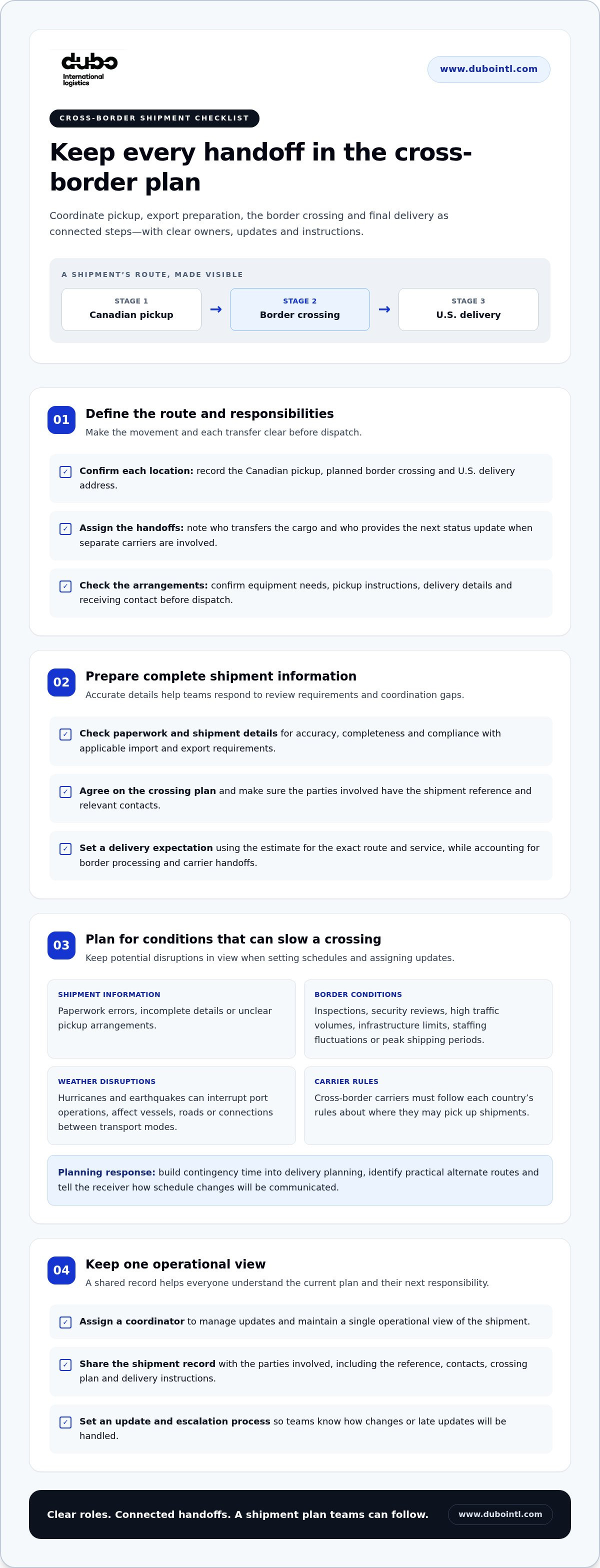
A cross-border logistics plan connects pickup, export preparation, border crossing, and final delivery. A logistics partner can coordinate these handoffs, align carrier schedules, and track ownership of each next step. For example, a shipment from Canada to a US customer needs clear pickup instructions, an agreed crossing plan, and a receiving contact. A missed handoff can delay the wider supply chain, even while the cargo is moving.
Common delays begin with paperwork errors, incomplete shipment information, or unclear pickup arrangements. Customs authorities review whether cross-border shipment information is accurate, complete, and compliant with applicable import and export requirements. Inspections, security reviews, high traffic volumes, infrastructure limits, staffing fluctuations, and peak shipping periods can also slow a crossing. Assign a coordinator to manage updates and maintain a single operational view of each shipment.
Weather can disrupt several stages of transportation. Hurricanes and earthquakes can interrupt port operations, damage vessels, or disrupt schedules. Severe conditions may also affect roads and connections between transport modes. Build contingency time into delivery planning, identify practical alternate routes, and tell the receiver how schedule changes will be communicated. These steps help teams respond when an interruption affects a planned handoff.
Cross-border carriers must follow each country’s rules about where they may pick up shipments. A route plan should distinguish the Canadian pickup, border crossing, and US delivery rather than assume one driver can perform every movement. Confirm pickup and delivery locations, equipment needs, and handoff responsibilities before dispatch. When separate carriers are involved, record who transfers the cargo and who provides the next status update.
How long does shipping from Canada to the USA take with Canada Post, UPS, FedEx, and DHL? Each carrier offers different service options, and transit time depends on the selected service, origin and destination, customs processing, border congestion, and weather. Compare the delivery estimate for the exact route and service, then account for border processing and handoffs when scheduling the receiving team.
Experienced coordination is especially useful when a shipment involves multiple carriers, unusual handling needs, or a time-sensitive delivery window. Logistics consulting can help map responsibilities, identify likely delays, and establish how teams will respond to late updates. Before dispatch, share a shipment record with the parties involved, including its reference, contacts, crossing plan, and delivery instructions. This gives each participant a defined role and supports timely decisions when conditions change.
3. Shipment visibility and logistics coordination
Tracking is most useful when every shipment update prompts a clear next action. A Canadian exporter sending freight to a US customer can map pickup, departure, border crossing, and delivery as distinct milestones. Assign an owner to each handoff, then share shipment references and contact details with the relevant parties. A missed scan or delayed arrival is easier to investigate than a broad “in transit” status.
Visibility also depends on accurate, consistent logistics data. Record the shipment identifier, origin, destination, carrier, service, delivery contact, and planned milestone dates in one shared record. If a carrier update uses a different reference from the sales order, staff may not connect the status to the customer’s order. Matching key identifiers across records reduces manual searching and helps teams communicate accurate updates.
Technology integration can reduce duplicate entry between order management software, an ERP, and carrier systems. For example, a shipment created from a sales order can carry the same reference into dispatch records and customer notifications. Before connecting systems, decide which platform owns each field, such as the delivery address or requested arrival date. Clear data ownership prevents conflicting records from disrupting freight coordination.
In 2026, 70% of survey respondents said they were very or extremely likely to use technology to improve shipping performance. For Canadian businesses, the practical value lies in using tracking and visibility tools to identify developing delays and provide customers with current information. A dashboard should make exceptions visible, such as a missed pickup scan or a border crossing that has not updated. Staff can then investigate the specific event rather than search every shipment.
Set a simple exception process before dispatch. Define which status triggers action, who contacts the carrier, and who updates the receiving team. If a delivery appointment changes, for instance, the coordinator can notify the receiver and revise internal arrival plans. Record the reason, time, and agreed next step. This creates a useful history for managing recurring issues across routes and carriers.
Integrate shipment data with customer communications carefully. A tracking update should distinguish confirmed events from estimated milestones, so a projected arrival is not mistaken for completed delivery. Share the shipment reference and latest status in each update. If several loads are moving to the same US site, include the relevant order or cargo identifier to prevent teams from applying one shipment’s information to another.
Visibility supports coordination, but it does not replace decision-making. Teams still need to review exceptions, resolve mismatched records, and coordinate handoffs when conditions change. For complex freight movements, freight forwarding connects carrier coordination with shipment milestones and documentation processes. A consistent record, clear ownership, and defined responses give Canadian shippers a practical way to manage shipments and communicate delays while keeping sight of the next step.
4. Carrier licensing, compliance, and cargo insurance
Carrier credentials, shipment compliance, and insurance address different operational risks. Before arranging international freight, record the carrier’s identity, the service it will perform, and the parties responsible at each handoff. For a shipment travelling from a Canadian manufacturer to a US recipient, document the pickup carrier, crossing plan, and delivery arrangement. This makes it easier to identify who handles each stage if clearance or delivery is delayed.
What restrictions apply to shipping hazardous, regulated, or prohibited goods from Canada to the USA? Requirements depend on the commodity, and cross-border shipments may need additional documents, certifications, permits, or compliance procedures. Identify the product’s classification and intended US destination before tendering it. Prohibited goods cannot be treated as ordinary freight.
Commodity details shape compliance requirements. A shipment containing regulated materials may need documents or handling arrangements beyond those used for ordinary goods. Ensure the description matches the actual product, and provide relevant safety or product information to the parties coordinating transportation. Inaccurate descriptions can raise questions during border review and delay clearance. Keep the invoice, shipment record, and carrier instructions consistent.
Cargo insurance deserves a separate review from carrier liability. Read the applicable policy wording and transport agreement to understand what property, route, and events are covered. Compare the insured value with the shipment’s documented value, and note any exclusions, limits, or claim deadlines stated in the documents. For a delicate electronic unit, retain its condition report, packaging details, and proof of handoff. These records can support a claim if damage occurs.
Set a clear process for reporting loss or damage. Record the time, location, and visible condition when the issue is discovered. Photograph the packaging and cargo before altering either. Notify the responsible parties through the channels named in the policy or agreement, and preserve delivery records, invoices, and correspondence. Complete documentation helps distinguish transit damage from pre-existing condition or handling issues.
These checks support continuity across operations and infrastructure handoffs. A practical pre-dispatch file can include carrier credentials, commodity documents, insurance terms, shipment instructions, and named contacts. Assign one coordinator to review the file before pickup and communicate changes to the carrier and receiving team. This organized process helps businesses address compliance gaps before cargo reaches the border.
5. ACI, PARS, PAPS, IT Bonds and ATAs
Cross-border paperwork can include several distinct terms and records. ACI, PARS, PAPS, IT Bonds, and ATAs may appear in shipment instructions, depending on the goods and movement. They are not interchangeable labels. Treat each reference as a cue to confirm which shipment details, documents, and parties apply to the planned route.
What customs forms and documentation are required for shipments from Canada to the USA? Prepare a complete commercial invoice, the goods’ HS codes, and origin information before shipping. Commodity-specific shipments may also need certifications, permits, or other compliance documents, so match the paperwork to the product and its movement.
Start with one shipment file. Include the commercial invoice, product description, HS code, origin details, carrier information, and delivery destination. Add any relevant certificates or permits for the commodity. The paperwork should describe the same goods consistently across the invoice, transport instructions, and shipment records. For example, a precise description of an item is more useful than a vague label such as “parts.”
Then map each document or reference to the movement it supports. Note whether the shipment is travelling directly to its US destination, passing through another point, or moving temporarily for a defined purpose. The route and shipment purpose affect which records need attention. Keep the document owner, completion status, and carrier handoff visible in the same file instead of relying on separate email threads.
Timing matters. Share shipment information with the parties coordinating the crossing before dispatch, and ensure identifiers match across records. A mismatch between a shipment reference and its supporting paperwork can make it harder to connect documents with the freight. If a route, product description, or destination changes, update the relevant parties and records together. Consistent paperwork helps prevent avoidable questions during border processing.
For a recurring supply route, create a reusable checklist, but leave room for shipment-specific requirements. A clothing shipment and a piece of machinery may need different supporting details. The checklist can prompt staff to review the commodity, origin, destination, route, and any named document references. It should also identify who gathers each record and who confirms the file is complete before pickup.
Keep a final copy of the shipment file with the dispatch record. This gives operations staff a consistent reference if a carrier requests information or a crossing is delayed. Clear document control supports global trade processes and helps businesses respond to questions without rebuilding the shipment history. Organizing paperwork around the actual goods and route helps Canadian exporters manage cross-border regulations with fewer disconnected steps.
Dubo International Logistics: Freight forwarding
Dubo International Logistics coordinates freight forwarding for businesses managing cross-border shipments with multiple carriers, complex routes, or specialized cargo. Its logistics consulting can help organize shipment requirements, responsibilities, and handoffs before freight moves.
For oversized machinery, delicate equipment, or temperature-sensitive products, Dubo International Logistics provides specialized transportation services tailored to cargo-specific handling needs. This support is especially relevant when a shipment requires careful coordination across North American routes rather than a straightforward, standard movement.
Share the cargo type, origin, destination, timing requirements, and known documentation needs to identify the shipment’s key logistics considerations. Contact Dubo International Logistics to discuss your cross-border shipment.
Build a clearer plan for your next shipment
The challenges of shipping to the USA are best addressed before a shipment enters the transportation network. Use your next dispatch to turn lessons from previous shipments into a working plan: assign document ownership, set update responsibilities, and define who makes decisions if a route or delivery arrangement changes. These steps connect cross-border logistics with your operational needs.
Dubo International Logistics supports this planning through freight forwarding, logistics consulting, and specialized transportation services. Bring the shipment’s origin, destination, cargo requirements, and known constraints to the discussion. This creates a practical starting point, whether you’re coordinating a routine movement or planning transport for specialized cargo.
Choose a next step that fits your shipment. Contact Dubo International Logistics to discuss how your freight movement can be coordinated. With clear priorities and a defined plan, your team can approach the next cross-border shipment with greater direction.
Frequently Asked Questions
What Are the Reasons Behind These New Challenges and Opportunities?
Changing product requirements, delivery expectations, and cross-border processes create new demands as well as commercial opportunities. A business adding US customers, for example, may need to adapt product information, customer communications, and transport plans for different destinations. The opportunity is broader market access; the operational challenge is coordinating each order correctly. Treat each product and route as a separate planning case instead of assuming one process suits every shipment.
What are the main challenges of shipping goods from Canada to the USA?
The challenges of shipping to the USA include coordinating transport and handoffs, preparing accurate shipment information, understanding duties and taxes, and meeting commodity-specific requirements. Electronics, for example, may need different supporting details from clothing. Delivery planning must also account for border processing and the receiving location’s requirements. Map responsibilities across the shipment, including who supplies product details, receives status updates, and resolves delivery issues.
What are the US import duties and taxes on goods shipped from Canada?
Import duties depend on the product’s classification, origin, and eligibility for preferential treatment under CUSMA. The applicable duty treatment is separate from sales tax, which can depend on the US destination and the seller’s tax obligations. A Canadian-made product does not qualify for preferential treatment solely because it ships from Canada. Keep records that support the product’s origin and classification, and assess tax obligations separately from the customs entry.
What are the de minimis and duty-free thresholds for shipments entering the USA from Canada?
Don’t assume a shipment qualifies for duty-free or de minimis treatment based on its value alone. Eligibility can depend on the goods, origin, shipment purpose, and rules that apply when the goods enter the United States. A low-value parcel and a commercial shipment of the same product may need different assessments. Before dispatch, identify the goods accurately and determine which entry treatment applies.
How much does it cost to ship a package from Canada to the USA, including brokerage and customs fees?
The total depends on package dimensions and weight, origin and destination, selected service, product classification, and any applicable duties, taxes, or brokerage charges. The carrier’s transportation charge is only one part of the shipment’s total. Compare estimates using the same package details and service requirements, and clarify which party pays import charges. For a tailored service quote, the amount depends on the shipment and is provided after a quote request.
What are the common causes of customs delays or returned shipments at the US-Canada border?
Incomplete paperwork, inconsistent product descriptions, missing supporting documents, and incorrect recipient details can delay or return a shipment. These are common challenges of shipping to the USA. For example, an invoice that identifies goods only as “equipment” may not describe the item clearly enough for review. Check that shipment records use consistent descriptions and contact details, and include documents required for the specific commodity. Keep dispatch and delivery records to help resolve questions promptly.

