

What if a carrier’s strong national score is hiding repeated delays on the routes your business depends on? Carrier performance management is most useful when it looks beyond isolated reports and connects shipment data to clear expectations and follow-up. For Canadian shippers, service needs can vary by lane, delivery window and cargo requirements, so a single overall rating may not tell the full story.
When carriers report results differently and shipment visibility is limited, recurring problems can be difficult to identify or assign to an owner. Choose measures that reflect your actual shipment requirements, then use a consistent process to review service issues and agree on next steps. This gives your team a clearer basis for working with carriers and deciding when coordination or carrier selection needs attention.
This guide explains how to choose practical performance measures, compare results at the route and service level, and respond to recurring issues with evidence. You’ll also learn how to set expectations, strengthen accountability across carrier relationships and build a more dependable transportation network, including when specialized cargo or cross-border coordination calls for closer attention.
Key Takeaways
- Set shipment-specific expectations so carrier results reflect the service your operation actually needs.
- Use a repeatable carrier performance management cycle, from gathering reliable data to agreeing on follow-up actions.
- Compare carriers using clearly defined measures, such as on-time delivery, damage or loss, communication and exception resolution.
- Check scorecard data, look for recurring patterns and investigate causes before assigning corrective actions.
- Choose a review cadence that fits your shipment volume, and consider logistics consulting or freight forwarding when coordination needs grow more complex.
What carrier performance management means for Canadian shippers
Carrier performance management is the ongoing process of agreeing on service expectations, measuring performance against them and acting on evidence to address gaps. It gives shippers a structured way to oversee carrier relationships after selection, rather than treating a carrier choice as a one-time decision. Expectations might cover pickup and delivery windows, cargo handling, status updates and how service exceptions are communicated.
Useful measures should reflect the shipment and the commitment it supports. Key performance indicators (KPIs) are measures selected to assess progress towards defined objectives; a Key Performance Indicators (KPIs) overview offers a general starting point. For carrier reviews, agree with the carrier on what each measure means, which records count and who will review the result. Consistent definitions make performance evidence more useful for planning and discussions about customer commitments.
Dependable transportation can support continuity by helping teams recognize service patterns and consider their operational implications. It cannot guarantee that every shipment will meet its planned schedule. The value of a structured process is that teams can make informed decisions, clarify responsibilities and follow up when service falls short.
How carrier performance management differs from shipment tracking
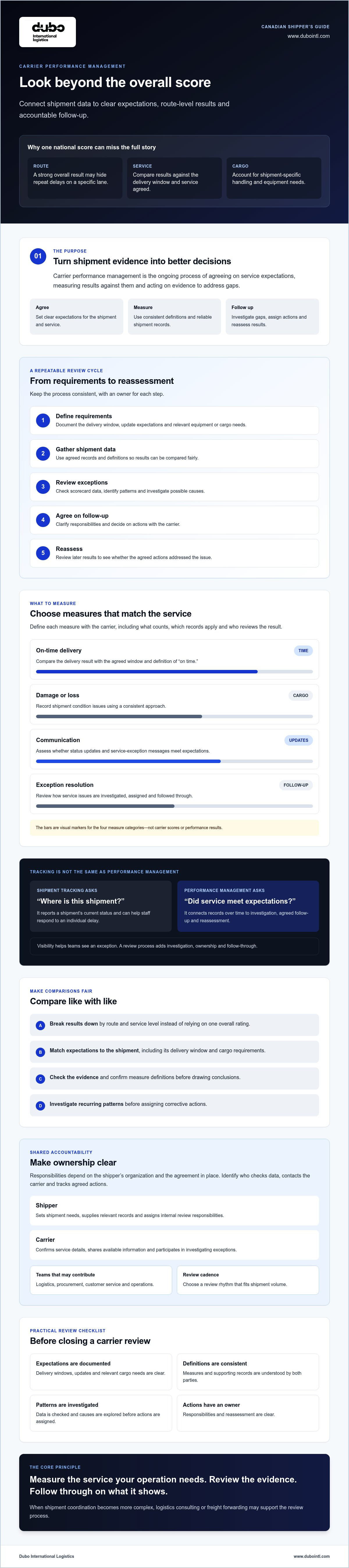
Tracking answers, “Where is this shipment, and what is its current status?” Performance management asks, “Did the service meet the agreed expectation, and what should happen if it didn’t?” A tracking update can help staff respond to an individual delay. Reviewing shipment records over time may reveal a recurring issue, such as missed appointments on a particular lane, that a single status update cannot establish.
Visibility supports decisions, but it doesn’t assign ownership by itself. A review process connects shipment records to investigation, agreed follow-up and reassessment. Without that step, teams may see an exception without establishing its cause or confirming who will address it.
Which teams benefit from a structured carrier review
Carrier reviews can help logistics teams assess service, procurement teams evaluate ongoing relationships, customer service teams prepare accurate updates, and operations teams plan around inbound or outbound movements. Responsibility depends on the shipper’s organization and the agreements in place. Make clear who checks the data, contacts the carrier and tracks agreed actions.
For example, a manufacturer coordinating shipments of production components between Canada and the United States may involve logistics in monitoring movement, operations in assessing schedule implications and customer service in communicating relevant changes. The review brings these perspectives together without assuming that one team owns every part of the process. Shippers seeking coordination or logistics consulting can learn about Dubo International Logistics at www.dubointl.com.
How a carrier performance management cycle works
A useful review follows a closed loop: define requirements, gather data, review exceptions, agree on actions and reassess. Each step needs an owner. The shipper sets shipment needs and supplies relevant records; the carrier confirms service details, shares available information and participates in investigating exceptions. The exact responsibilities depend on their agreement and operating relationship.
Set expectations before shipments move
Start with the shipment, not a generic scorecard. Document the relevant delivery window, status-update expectations and equipment requirements, where applicable. For specialized cargo, include handling considerations that may affect carrier selection and coordination.
Service level agreements (SLAs) can clarify contractual commitments and how performance will be measured. Define terms such as “on time,” the records used to assess them and how exceptions are reported. These are points to establish with the carrier, not universal terms that apply to every shipment. For cross-border or corridor-based movements, the Government of Canada’s overview of Canadian logistics performance offers broader context for transportation planning.
Review results and close the improvement loop
Once shipments move, compare the available records with the agreed definitions. Flag exceptions for investigation rather than assuming that every missed target has the same cause. Document what happened, who owns the next step, the action agreed to and a follow-up date. This gives both parties a shared reference and makes it easier to check progress.
Reassess the issue after the action has had a fair opportunity to address its cause. If the evidence points to a process gap, clarify instructions or communication. If shipment requirements or operating conditions have changed, revisit the plan together. Avoid changing carrier assignments based on a single exception before understanding the circumstances.
A closed-loop review turns performance data into action by linking each exception to an owner, an agreed response and a check on whether the response worked.
- Define requirements: The shipper records shipment needs; the carrier confirms what service is agreed.
- Gather data: Both parties provide the records available under their process.
- Review exceptions: The shipper and carrier examine results against shared definitions.
- Agree actions: Assign an owner and follow-up date to each response.
- Reassess: Check whether the action addressed the issue, then adjust the plan if needed.
This is the working discipline behind carrier performance management: measurement matters when it leads to accountable follow-through. If your team needs support coordinating freight movement or planning around complex shipment requirements, explore Dubo’s logistics consulting.
Which carrier performance metrics provide a fair comparison?
A scorecard is useful only when its measures reflect the service a shipment requires and each carrier is assessed on the same basis. The measures below are examples, not universal benchmarks. Before using them, confirm their definitions, reporting period and data availability with the carriers involved.
| Example measure | Possible definition | Check before comparing |
|---|---|---|
| On-time delivery | Shipments delivered within the agreed delivery window, compared with eligible shipments. | Confirm the delivery timestamp, denominator and how rescheduled appointments are treated. |
| Damage or loss | Shipments with a confirmed damage or loss issue, compared with shipments reviewed. | Agree on how issues are verified and recorded, and whether the measure suits the cargo type. |
| Communication | Required status updates provided within the agreed communication window. | Define which updates count, the expected timing and the record used to verify them. |
| Exception resolution | Exceptions addressed within an agreed process or timeframe. | Set the start and end points, and clarify which party owns each response. |
Choose KPIs that reflect the service commitment
In carrier performance management, select each key performance indicator (KPI) because it relates to a documented shipping requirement or business priority. A delivery-window measure may matter for a time-sensitive movement; equipment availability may matter more when a shipment needs specific handling. Before comparing results, define the numerator, denominator, event timestamp and exclusions for each measure. An EPA SmartWay shipper resource offers U.S.-focused carrier assessment tools that may provide useful context for shippers coordinating cross-border transportation.
Compare like with like. Group shipments by relevant factors such as cargo type, service commitment, route context and reporting period. A carrier’s results on one service or lane may not represent its performance on another. A single overall score can hide those differences or give exceptions disproportionate influence without showing what happened.
Account for exceptions and data quality
Separate verified service issues from records that are incomplete, late or inconsistent. Use a common data source and reporting period where possible, and mark unavailable information clearly rather than treating it as a successful result or a failure. Record exception causes consistently, distinguishing issues within a party’s control from external factors when the evidence supports that distinction.
These checks make comparisons more credible and help teams identify what needs investigation. No single KPI tells the full story; a balanced view should retain the detail needed to understand service, cargo requirements and exceptions.
How to turn carrier scorecards into practical improvements
A scorecard should guide a decision, not become another report to maintain. Use it to validate the underlying data, identify patterns, investigate likely causes and assign actions. Keep the record concise: note the relevant shipment or service, what the evidence shows, the next step, who owns it and when the team will review progress.
Set a review cadence that fits shipment volume, operational needs and the pace at which issues arise. A shipper with frequent movements may need to review exceptions more often than one with occasional shipments. There’s no universal schedule. The aim is to address meaningful patterns in time to inform planning, without creating unnecessary reporting work.
Run a focused carrier performance review
Bring the agreed KPIs, shipment exceptions and unresolved actions to each review. Ask the carrier to explain observed patterns and provide relevant supporting information, such as shipment records or communication history where available. Keep the discussion specific: identify the service requirement, the shipment or period in question and the evidence that needs clarification.
Separate confirmed issues from data gaps or assumptions. For example, if a scorecard flags a missed delivery window, first confirm that the appointment and delivery timestamps use the agreed definitions. Then discuss the circumstances with the carrier before deciding on a response. A factual review helps both parties focus on service requirements rather than broad impressions.
Agree on corrective actions and escalation
Each action should have an owner, a clear next step and a review date. Record only what the team needs to follow through, such as updating a communication process, confirming shipment requirements or investigating a recurring exception. Use the escalation path agreed with the carrier if an issue continues or needs a decision beyond the day-to-day contacts.
At follow-up, check whether the action addressed the cause, not just whether the record was closed. If service needs or cargo requirements have materially changed, reassess whether the carrier remains a suitable fit for that work. A decision to change assignments should follow a review of the evidence and requirements, rather than a reaction to one isolated event.
For broader coordination context, see End-to-End Freight Management: A Strategic Guide for Canadian Businesses. Effective carrier performance management connects scorecard findings to accountable follow-through, while keeping the review proportionate to the operation. If your team needs support with freight forwarding or logistics consulting, explore Dubo’s logistics support or visit www.dubointl.com.
When a logistics partner can support carrier performance management
External coordination may help when shipments involve several carriers, complex requirements or more oversight than an internal team can consistently provide. The need depends on the operation, not simply the number of shipments. Consider how much time teams spend aligning carrier updates, addressing exceptions and preparing performance information, alongside the complexity of the cargo and reporting needs.
Assess the support your operation actually needs
Map responsibilities before engaging a logistics partner. The shipper should retain oversight of business priorities, shipment requirements and decisions about carrier relationships. A partner may support freight forwarding, logistics consulting and coordination of freight movement, with the precise scope agreed in advance. Clarifying who gathers shipment data, communicates with carriers, reviews exceptions and approves changes helps prevent gaps or duplicated work.
For example, a shipper coordinating several movements across North America may need help aligning carrier information and planning around different shipment requirements, while keeping internal ownership of service expectations and customer commitments. For more context on coordinated freight movement, see Professional Freight Forwarding in North America: A Strategic Guide for 2026.
Connect carrier coordination with specialized freight needs
Out-of-gauge machinery, fragile equipment and temperature-sensitive products can require cargo-specific planning. The shipper and logistics partner need to clarify handling requirements, equipment needs and communication expectations before selecting and coordinating transportation. A general carrier scorecard may not show whether a carrier is suitable for every cargo type, so assess performance against the requirements of the shipment in question.
Dubo International Logistics coordinates freight movement across North America and offers specialized transportation for unique cargo requirements, including project cargo and sensitive or oversized equipment. This is coordination support, not a promise of a particular delivery outcome. Learn more about specialized transportation services, or explore the “Specialized Freight North America” buyer’s guide where it is available.
The right level of support should strengthen, not replace, shipper oversight. Clear expectations, defined roles and useful reporting allow the shipper to remain accountable while a logistics partner helps coordinate carriers and freight requirements. If you’re reviewing a shipment or coordination requirement, visit www.dubointl.com to discuss how freight forwarding, logistics consulting or specialized transportation may fit your needs.
Make carrier reviews part of dependable planning
Dependable service starts with clear expectations and continues through consistent review. Effective carrier performance management connects shipment-specific measures to evidence, then assigns owners and follow-up actions when service falls short. Comparing like with like and checking recurring patterns helps teams make informed decisions instead of relying on a single score or tracking update.
For operations managing multiple carriers or specialized cargo, added coordination may help bring requirements, carrier information and shipment records into a clearer process. Dubo International Logistics coordinates freight movement across North America and offers freight forwarding, logistics consulting and specialized transportation. The company is a member of the Canadian International Freight Forwarders Association (CIFFA).
Keep shipper oversight at the centre of the process, with responsibilities agreed between your team, carriers and any logistics partner. Clear roles support more focused reviews and practical next steps.
To discuss a shipment or coordination requirement, contact Dubo International Logistics about your freight coordination needs. A measured, evidence-led approach can help your team build stronger carrier relationships and plan with greater confidence.
Frequently Asked Questions
What is carrier performance management?
Carrier performance management is the ongoing process of setting service expectations, measuring carrier performance against them and following up on issues using evidence. It helps shippers assess whether service meets shipment requirements and address recurring gaps with clear ownership. Shipment tracking, by contrast, shows the status or location of an individual load. Tracking can inform a review, but it doesn’t by itself assess performance over time or ensure that anyone investigates an exception.
Which KPIs should a shipper use to measure carrier performance?
Choose measures that reflect documented shipment requirements, such as on-time delivery, damage or loss, communication and exception resolution. These are examples, not universal standards. Before comparing carriers, agree on what counts for each measure, including the data source, time period, event timestamp, numerator, denominator and exclusions. For instance, define the delivery window and which timestamp establishes delivery. Use only measures with sufficiently consistent, available records to support a fair review.
How often should carrier performance be reviewed?
Set a review cadence based on shipment volume, service needs and operational risk rather than a universal schedule. Frequent, time-sensitive or complex movements may call for closer review of exceptions, while lower-volume operations may be able to assess results at wider intervals. Review promptly when a material service issue arises, and schedule broader reviews often enough to identify patterns and follow up on actions. Adjust the cadence as shipment needs or carrier arrangements change.
What should a carrier scorecard include?
A useful carrier scorecard includes relevant, agreed KPIs, the reporting period and the data source, along with exceptions and enough context to interpret results. Record unresolved issues, their causes where known, assigned owners and follow-up actions. Make unavailable or incomplete data visible rather than treating it as a confirmed success or failure. Keep the scorecard focused on measures tied to shipment requirements, so the review supports decisions instead of adding reporting that teams won’t use.
How can a shipper compare carrier performance fairly?
Compare shipments with similar service commitments, cargo needs, route context and reporting periods. Apply the same metric definitions and use consistent data sources wherever possible. Check that each carrier’s records cover the same events, such as the agreed delivery window, and identify incomplete information before drawing conclusions. A single overall score can hide differences between lanes or shipment types, so review relevant groups separately and interpret exceptions in context.
Can a freight forwarder help manage carrier performance?
Yes. A freight forwarder can help coordinate freight movement and carrier information, while the shipper retains oversight of its requirements, service priorities and decisions. Agree on who gathers records, follows up on exceptions and approves changes. Dubo International Logistics offers freight forwarding and logistics consulting, and coordinates freight movement across North America. To learn more about its services, visit www.dubointl.com and discuss how coordination could fit your operation.
What should a business do when a carrier repeatedly misses agreed service expectations?
Review the shipment records against the agreed definitions, then investigate the pattern with the carrier before deciding on a response. Confirm the circumstances and distinguish verified service issues from missing or inconsistent data. Document the cause where known, the corrective action, its owner and a follow-up date. Reassess whether the action addressed the issue. If service needs or cargo requirements have changed, review carrier fit using the evidence and the current requirements.
