

Missing a single document can bring your entire cross-border shipment to a complete standstill. If you've ever watched a freight load sit at the border while duties, paperwork, and compliance questions pile up, you already know how costly that uncertainty can be. It's a frustration that many Canadian shippers face, and it's almost always preventable.
The reality is that shipping freight from Canada to the United States doesn't have to feel like navigating a maze. Most delays trace back to the same root cause: incomplete preparation. Having a reliable Canada to US freight shipping checklist in hand before your cargo ever leaves the dock changes everything. It transforms a process that feels unpredictable into one that's methodical, compliant, and far less stressful.
This guide walks you through every essential step, from the documentation your shipment requires to the regulatory considerations that keep cargo moving without interruption. Whether you're shipping commercially for the first time or looking to tighten up an existing process, what follows gives you a clear, practical framework for getting your freight across the border smoothly and on schedule. For additional logistics support and cross-border expertise, visit www.dubointl.com.
Key Takeaways
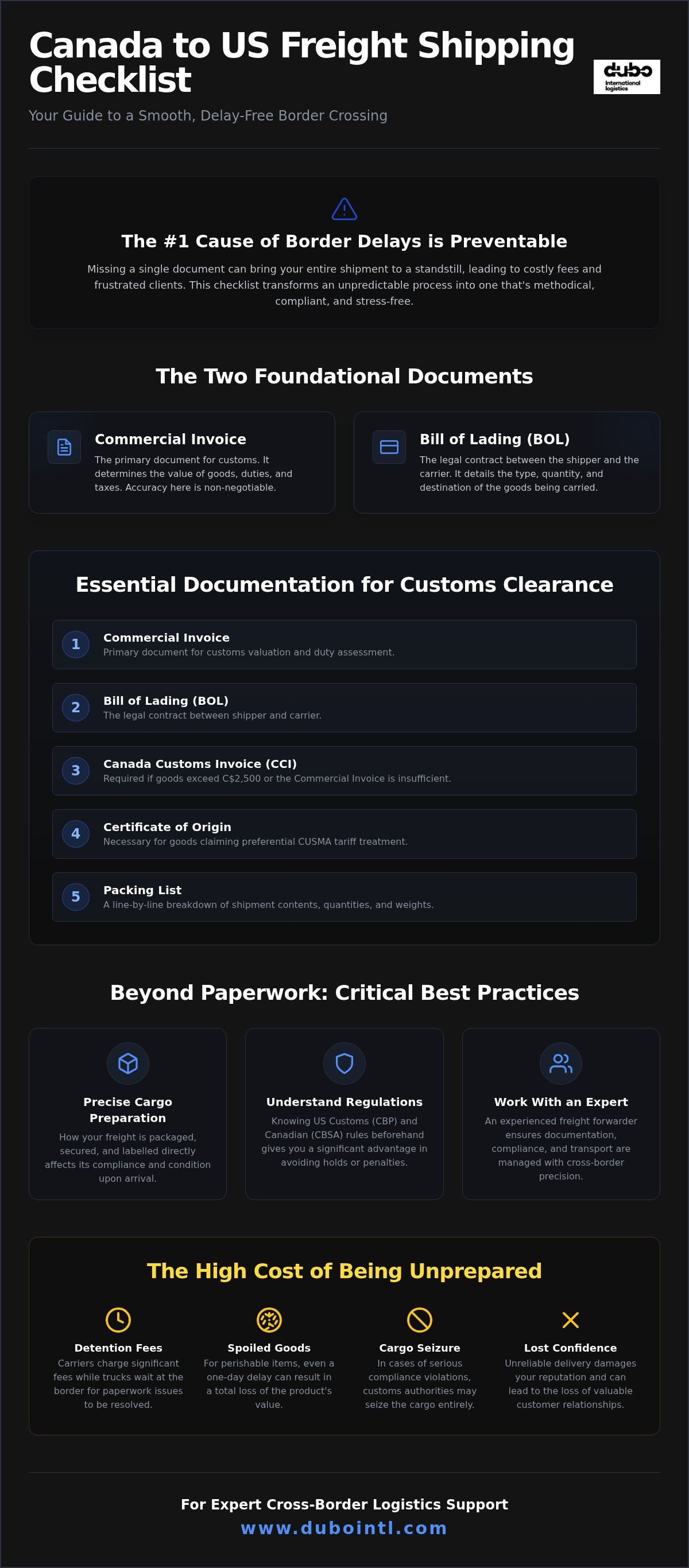
- A complete Canada to US freight shipping checklist is your most reliable defence against border delays - missing even a single document can halt your shipment and trigger costly compliance issues.
- The Commercial Invoice and Bill of Lading are the two foundational documents every cross-border shipment requires, and accuracy in both is non-negotiable for smooth customs clearance.
- Proper packaging and precise cargo preparation are just as critical as paperwork - how your freight is secured directly affects its compliance and condition upon arrival.
- Understanding US customs regulations and inspection protocols before your shipment departs gives you a significant advantage in avoiding unexpected holds or penalties at the border.
- Working with an experienced freight forwarding partner ensures your documentation, compliance requirements, and transport logistics are all managed with the precision that cross-border shipping demands.
Understanding the Importance of Documentation in Cross-Border Freight Shipping
Cross-border freight movement between Canada and the United States is one of the most active trade corridors in the world, and yet it remains one of the most documentation-sensitive. Two sovereign nations, two sets of customs authorities, and two distinct regulatory frameworks all intersect at the border. A single missing field on a commercial invoice or an incorrect Harmonized System code on a customs declaration isn't a minor oversight; it's grounds for a hold, a fine, or a full refusal of entry.
The consequences of incomplete or inaccurate documentation are immediate and measurable. Shipments can be detained at the port of entry for days while corrections are processed. Carriers incur detention fees. Perishable goods deteriorate. Customers lose confidence. And in some cases, customs authorities may seize cargo entirely if compliance violations are serious enough. These aren't edge-case scenarios; they're routine outcomes when documentation isn't treated as a priority from the outset.
Any practical Canada to US freight shipping checklist starts with a clear-eyed understanding of what both governments require. Canada Border Services Agency (CBSA) governs what leaves Canadian soil, while US Customs and Border Protection (CBP) controls what enters American territory. Both agencies have distinct filing requirements, timelines, and compliance standards. Knowing both sides of that equation before your freight departs is what separates a smooth crossing from a costly one.
Key Regulations Affecting Cross-Border Shipping
The Canada-United States-Mexico Agreement (CUSMA) plays a significant role in determining how goods are classified, what duties apply, and whether a shipment qualifies for preferential tariff treatment. To benefit from CUSMA provisions, goods must meet specific rules of origin criteria and be supported by the appropriate certification documentation. Tariffs and duties vary considerably by product category, and misclassification can result in unexpected charges that erode your margins. Understanding these regulatory layers before shipment isn't optional; it's foundational to cost-effective cross-border logistics.
The Role of Freight Forwarders
A qualified freight forwarder brings more than carrier relationships to the table. They bring regulatory fluency. Coordinating documentation, ensuring compliance with both Canadian and US customs requirements, and managing the logistical sequencing of a cross-border shipment requires a level of expertise that most shippers don't maintain in-house. When evaluating a freight forwarding partner, look for demonstrated experience in Canada-US trade lanes, a clear process for documentation review, and the capacity to anticipate compliance issues before they become border problems. For cross-border freight forwarding expertise, visit www.dubointl.com.
The right partner doesn't just move your freight. They protect it at every regulatory checkpoint along the way.
Essential Documents Required for Shipping from Canada to the US
Documentation is where most cross-border shipments succeed or fail. Before a single pallet leaves your facility, five core documents need to be accurate, complete, and ready for scrutiny from both CBSA and CBP. Every item on any credible Canada to US freight shipping checklist traces back to these foundational records.
- Commercial Invoice - the primary document for customs valuation and duty assessment
- Bill of Lading (BOL) - the legal contract between shipper and carrier
- Canada Customs Invoice (CCI) - required when goods exceed C$2,500 in value or when a commercial invoice doesn't meet CBSA's format requirements
- Certificate of Origin - necessary for goods claiming preferential CUSMA tariff treatment
- Packing List - a line-by-line breakdown of shipment contents, quantities, and weights
Understanding Each Document's Purpose
The Commercial Invoice does more work than most shippers realise. It must include the seller's and buyer's full contact details, a precise description of the goods, the Harmonized System (HS) tariff classification code, country of origin, declared value in the transaction currency, and the terms of sale (Incoterms). CBP uses this document to determine applicable duties, so vague product descriptions like "machine parts" or "general merchandise" create immediate red flags.
The Bill of Lading functions as both a receipt of goods and a title document. It confirms what was loaded, under what conditions, and where it's headed. Any discrepancy between the BOL and the physical cargo can trigger an inspection. The Canada Customs Invoice mirrors much of the commercial invoice's content but follows a specific CBSA-prescribed format, making it the authoritative record for Canadian export clearance. When both documents are required, they must be consistent with each other in every detail.
Certificates of Origin and packing lists are often treated as secondary, but they're not. A missing Certificate of Origin means your shipment won't qualify for CUSMA preferential duty rates, and your buyer absorbs the difference. An incomplete packing list slows physical inspections and gives customs officers reason to look harder at everything else.
Common Mistakes to Avoid
Incomplete documentation is the most predictable source of border delays, and it's entirely avoidable. Shippers frequently undervalue goods to reduce duty exposure, misclassify products under incorrect HS codes, or submit invoices with missing fields because internal templates haven't been updated to reflect current regulatory requirements. Each of these errors carries real consequences: amended entries, penalty assessments, or cargo holds that cost far more than the original duty would have.
Regulatory requirements also change. Tariff classifications get updated, CUSMA certification formats evolve, and CBP periodically adjusts its admissibility criteria for specific product categories. Document templates that worked two years ago may not meet today's standards. Building a regular review cycle into your shipping process keeps your paperwork current and your cargo moving.
If you're unsure whether your documentation package is complete, working with an experienced freight forwarding partner is the most reliable way to close those gaps before they become border problems. Learn more about cross-border freight forwarding support at www.dubointl.com.
Best Practices for Preparing Your Freight Shipment
Getting your documents right is only half the equation. How you prepare your physical freight, select your transport mode, and sequence your pre-departure timeline determines whether a technically compliant shipment actually arrives on time and in the condition your buyer expects. Every solid Canada to US freight shipping checklist treats cargo preparation and document accuracy as equally weighted priorities.
Start with packaging. Freight that's improperly secured creates two distinct problems: damage in transit and complications at the border. Customs inspectors who open a container and find poorly organised cargo are more likely to conduct a thorough examination, which adds time. Pallets should be stable, stretch-wrapped, and within the weight tolerances specified by your carrier. Fragile goods need internal cushioning, not just outer bracing. Labels must be legible, correctly oriented, and consistent with what's declared on your packing list. If your shipment includes hazardous materials, WHMIS and DOT classification requirements apply to packaging and labelling independently of your customs documentation.
Choosing the right shipping method matters more than many shippers initially assume. Less-than-truckload (LTL) freight works well for smaller loads where consolidation is cost-effective, but it introduces additional handling and potentially longer transit times. Full truckload (FTL) offers more control over timing and reduces the risk of damage from multiple load cycles. For time-sensitive cargo, expedited ground transport may be worth the premium. Match your mode to your cargo type, your delivery window, and the sensitivity of the goods, not simply to the lowest available rate.
Timeline planning is where preparation either holds together or unravels. Build your shipping schedule backwards from your required delivery date, accounting for carrier booking windows, CBSA export reporting requirements, and CBP's Automated Manifest System (AMS) filing deadlines. Leaving documentation preparation to the day before departure is a reliable way to introduce errors under pressure.
Digital Document Management
Managing shipping documents digitally reduces the risk of version errors, lost paperwork, and last-minute scrambles. Cloud-based platforms that centralise your commercial invoices, bills of lading, certificates of origin, and packing lists give your team and your freight forwarding partner access to the same current versions at all times. When customs authorities request documentation, you can respond in minutes rather than hours. Going paperless also creates an audit trail that's invaluable if a compliance question arises weeks after a shipment clears the border.
Working with Customs Brokers
A licensed customs broker adds a layer of regulatory precision that's difficult to replicate in-house. Involve one early, ideally before your shipment is booked, so they can review your HS classifications, confirm your valuation methodology, and flag any admissibility issues specific to your product category. When evaluating brokers, look for demonstrated experience in Canada-US trade lanes, familiarity with CBP's Automated Commercial Environment (ACE) system, and clear communication about their review process. For freight forwarding expertise that supports seamless cross-border compliance, visit www.dubointl.com.
Navigating Compliance and Customs Regulations
Compliance isn't a checkbox you tick once and forget. It's an ongoing discipline that requires active attention to shifting regulations, updated tariff schedules, and evolving CBP admissibility criteria. Any comprehensive Canada to US freight shipping checklist must treat customs compliance as a living process, not a static document review.
When CBP selects a shipment for inspection, preparation determines how quickly your freight moves on. Inspections can be documentary, where officers review your paperwork, or physical, where the cargo itself is examined. The best defence against extended holds is consistency: every figure, description, and classification on your documentation should match the physical contents of your shipment exactly. Discrepancies, even minor ones, give inspectors reason to look harder and hold longer.
Common customs violations that Canadian shippers encounter include:
- Misclassification of goods under incorrect Harmonized System codes, which triggers incorrect duty assessment and potential penalty notices
- Undervaluation of shipments, whether intentional or the result of outdated pricing on invoice templates
- Missing or expired CUSMA certification, which strips preferential duty treatment and leaves your buyer absorbing the difference
- Inaccurate country of origin declarations, particularly for goods with components sourced from multiple jurisdictions
- Failure to file advance electronic data within CBP's required timelines through the Automated Commercial Environment (ACE) system
Each of these violations carries real consequences: amended entry filings, liquidated damages, or cargo holds that cost more in detention fees than the original duty would have.
The Role of Tariffs and Duties
Tariff rates vary considerably by product category, and accurate HS classification is what determines which rate applies to your shipment. Goods that qualify under CUSMA may attract a preferential rate of zero, but that benefit disappears without proper certification. Misclassifying a product, even by a single digit in the HS code, can shift your duty rate significantly and expose your business to back-duty assessments. The investment in getting classification right before your freight departs is always smaller than the cost of correcting it at the border.
Resources for Compliance
Several authoritative resources help Canadian shippers stay current on regulatory requirements. CBP's official website publishes binding rulings, tariff schedules, and admissibility updates. The Canada Border Services Agency maintains detailed export compliance guides and CUSMA certification resources. Industry associations such as the Canadian International Freight Forwarders Association (CIFFA) and the Canadian Association of Importers and Exporters (I.E. Canada) provide member resources, regulatory updates, and professional development that keep compliance teams current. Building a habit of checking these sources quarterly, rather than reactively, is what separates proactive shippers from those who discover regulatory changes at the border.
Staying compliant across a busy shipping programme is significantly easier with an experienced logistics partner managing the regulatory detail on your behalf. Connect with the cross-border freight forwarding team at www.dubointl.com to ensure your shipments meet every compliance requirement before they reach the border.
Final Checklist for Successful Cross-Border Freight Shipping
Everything covered in this guide converges here. Documentation accuracy, cargo preparation, transport mode selection, and compliance verification all need to come together before your shipment moves. A well-constructed Canada to US freight shipping checklist doesn't replace expertise, but it does give you a structured framework that makes it far harder to miss something critical under the time pressure of a live shipment.
Before your freight departs, run through each of these verification points:
- Documentation package complete: Commercial Invoice, Bill of Lading, Canada Customs Invoice (where required), Certificate of Origin, and Packing List are all present, accurate, and consistent with each other
- HS codes confirmed: All product classifications have been verified against the current tariff schedule, not carried forward from a previous shipment
- CUSMA certification in order: If claiming preferential duty treatment, the certification format is current and the goods genuinely meet rules of origin requirements
- Cargo secured correctly: Pallets are stable, within carrier weight tolerances, stretch-wrapped, and labelled consistently with your packing list
- Hazardous materials declarations filed: If applicable, WHMIS and DOT requirements are met independently of your customs paperwork
- Advance electronic data submitted: CBP's Automated Commercial Environment (ACE) filing has been completed within the required timeline
- Carrier booking confirmed: Mode of transport, pickup window, and border crossing point are all locked in
Creating Your Own Shipping Checklist
A generic checklist gets you most of the way there. A customised one gets you all the way. Start with the core document and cargo requirements outlined above, then layer in the specifics of your product category, your regular trade lanes, and any commodity-specific requirements that apply to your goods. Digital tools like shared cloud documents, project management platforms, or dedicated freight management software let your team and your logistics partner work from the same current version at all times. Review and update your checklist whenever regulations change or a new product category enters your shipping programme.
What to Do If Problems Arise
Even well-prepared shipments occasionally encounter issues. If a documentation problem surfaces after your freight has departed, contact your carrier and customs broker immediately; delays compound quickly when corrections aren't initiated within hours. For customs holds, your broker can file amended entries or provide supplementary documentation directly to CBP, which is almost always faster than attempting to resolve the issue through the carrier alone. If the problem is systemic rather than isolated, that's the right moment to engage a freight forwarding partner who can review your entire documentation process and identify the root cause before it affects your next shipment.
When complexity outpaces your internal capacity, working with an experienced freight forwarding team removes the uncertainty. Connect with the cross-border logistics professionals at www.dubointl.com to ensure your shipments are prepared, compliant, and positioned to cross without interruption.
Your Next Cross-Border Shipment Starts Here
Cross-border freight doesn't have to be complicated. When your documentation is accurate, your cargo is properly prepared, and your compliance obligations are met before departure, the Canada-US border becomes a checkpoint rather than a barrier. That's the real value of a thorough Canada to US freight shipping checklist: it converts uncertainty into a repeatable, manageable process.
The shippers who consistently move freight without delays aren't lucky. They're prepared. They've built reliable systems, they work with experienced logistics partners, and they treat compliance as an ongoing discipline rather than a last-minute task.
You don't have to navigate that complexity alone. Dubo International Logistics brings deep expertise in cross-border freight forwarding and a genuine commitment to compliance and timely delivery, so your shipments arrive on schedule and without surprises.
Get expert assistance for your cross-border shipping needs at Dubo International Logistics and move your freight with the confidence that comes from having the right team in your corner.
Frequently Asked Questions
What documents are needed for shipping from Canada to the US?
Core documents include the Commercial Invoice, Bill of Lading, and the Canada Customs Invoice for shipments valued over C$2,500. You also need a CUSMA Certificate of Origin if you're claiming preferential tariff treatment under North American trade agreements. Using a comprehensive Canada to US freight shipping checklist ensures that these forms are consistent and complete. This level of preparation prevents the administrative errors that frequently cause shipments to be turned back at the border.
How can I avoid customs delays during shipping?
Precision in your documentation and the early submission of electronic data are the most effective ways to prevent border delays. You should verify that your Harmonised System (HS) codes are accurate and that all declared values match your commercial records exactly. Submitting your manifest through the Automated Commercial Environment (ACE) system well before the truck reaches the border allows US Customs to pre-screen your cargo for faster clearance.
What is a Commercial Invoice and why is it important?
The Commercial Invoice is the primary document used by customs authorities to determine the value, classification, and admissibility of your goods. It serves as the legal foundation for duty and tax assessment in the United States. Without a clear description of the items, their country of origin, and their transaction value, customs officers cannot process the entry. This document must be precise to avoid any ambiguity regarding the nature of the cargo.
Do I need a customs broker for my shipment?
While not legally mandatory for every shipper, a licensed customs broker is highly recommended to manage the complex entry process and electronic filings required by CBP. They act as your professional representative, ensuring that all regulatory requirements are met and duties are paid correctly. This partnership reduces your internal administrative burden and provides a layer of protection against compliance errors. For expert logistics support and consulting, visit Dubo International Logistics.
What are the penalties for missing documentation?
Missing or incorrect documentation can result in significant administrative monetary penalties (AMPs), liquidated damages, or the seizure of your goods. Beyond government fines, you may face mounting carrier detention fees and storage costs while the shipment is held. These secondary costs often exceed the original duty amount. Repeated compliance failures can also lead to a loss of shipping privileges or increased inspection rates on all future loads.
How can I manage my shipping documents digitally?
You can manage your shipping documents digitally by using cloud-based platforms to centralise and share your records with carriers and brokers. This approach reduces version control errors and allows for the rapid transmission of data to customs authorities when requested. Integrating a digital Canada to US freight shipping checklist into your workflow ensures that no required field is left blank. It also creates a reliable audit trail for your long-term compliance records.
What should I do if my shipment is delayed at customs?
You should contact your customs broker and carrier immediately to identify the specific reason for the hold. If the delay is caused by missing or incorrect information, you must provide the corrected documents as a priority to the port of entry. Resolving border issues requires direct and professional communication with customs officers. Your broker is typically best positioned to facilitate this interaction and minimise the total duration of the delay.

